CBSE Blueprint Explained (With Example for All Subjects)
Published Date: 2026-01-01
CBSE Blueprint Explained (With Example for All Subjects)
Learn what a CBSE blueprint is, its format, importance, and how to create structured question papers with examples for all subjects.
Introduction
In today’s competitive academic environment, preparing question papers randomly is no longer effective. Schools and teachers must follow a structured approach to ensure fairness, consistency, and alignment with learning objectives.
This is where the CBSE blueprint plays a crucial role. It acts as a roadmap for designing question papers by defining marks distribution, question types, difficulty levels, and syllabus coverage.
What is CBSE Blueprint?
A CBSE blueprint is a structured plan that outlines how a question paper should be designed.
Number of questions
Types of questions (MCQ, short, long)
Marks distribution
Unit-wise weightage
Difficulty levels
Why is CBSE Blueprint Important?
Ensures standardization across exams
Creates balanced question papers
Reduces teacher effort
Improves student performance
Aligns with CBSE exam pattern
Key Components of a CBSE Blueprint
1. Unit-wise Weightage
Each chapter or unit is assigned specific marks.
2. Question Types
MCQs
Very short answers
Short answers
Long answers
3. Marks Distribution
1 mark questions
2 mark questions
5 mark questions
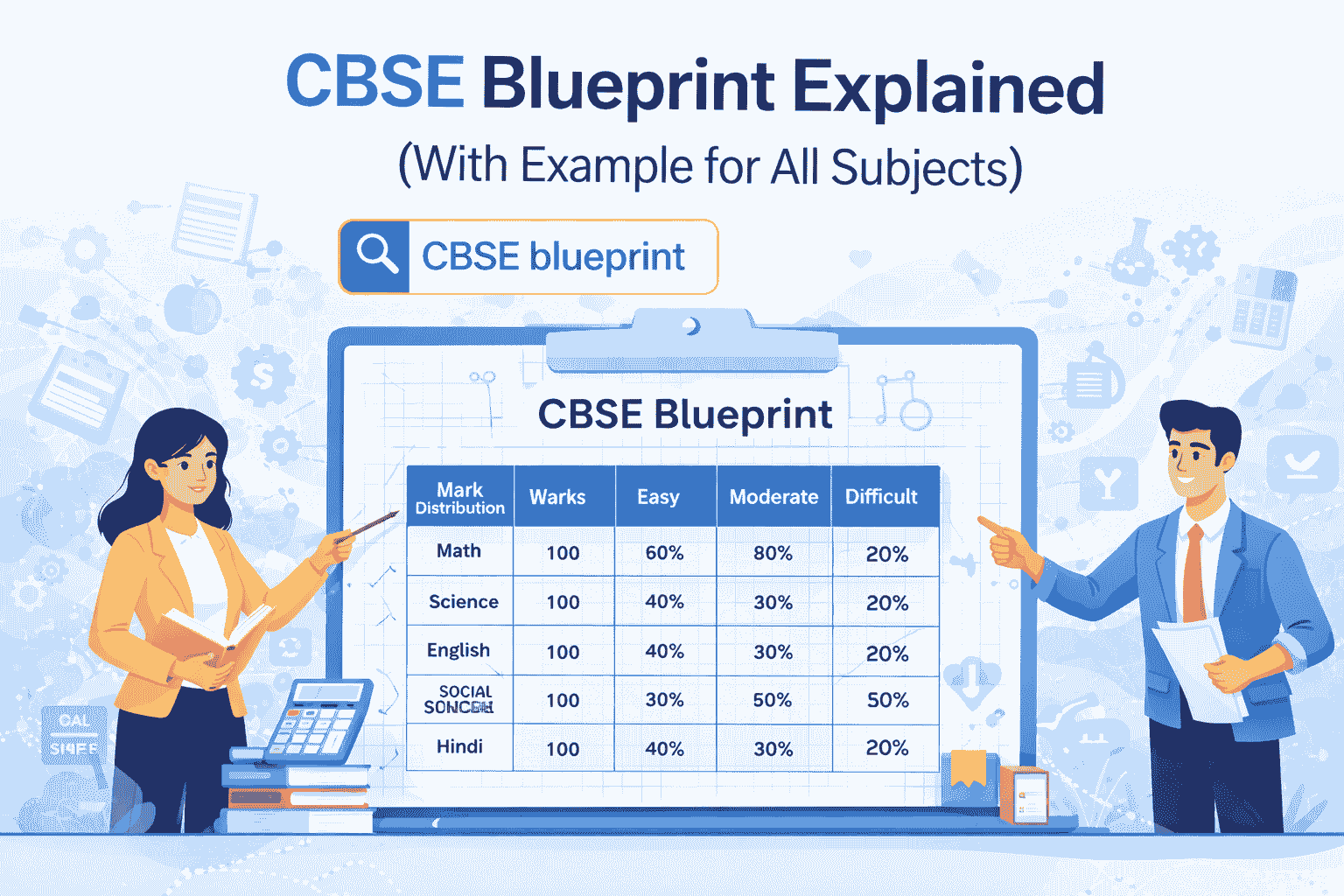
4. Difficulty Level
Easy (30%)
Moderate (50%)
Difficult (20%)
5. Sections & Total Marks
Defines number of sections (A, B, C, D) and total marks.
CBSE Blueprint Format (Sample)
Section
Question Type
No. of Questions
Marks
A
MCQ
20
20
B
Short Answer
6
12
C
Short Answer
8
24
D
Long Answer
4
24
Subject-wise Examples
Mathematics
Algebra – 20 marks
Geometry – 15 marks
Trigonometry – 15 marks
Statistics – 10 marks
Science
Physics – 25 marks
Chemistry – 25 marks
Biology – 30 marks
English
Reading – 20 marks
Writing – 20 marks
Literature – 40 marks
Social Science
History – 20 marks
Geography – 20 marks
Civics – 20 marks
Economics – 20 marks
How to Create a CBSE Blueprint
Identify syllabus units
Assign weightage
Define question types
Set difficulty levels
Create sections
Finalize total marks
Common Mistakes to Avoid
Ignoring unit balance
Too many difficult questions
Lack of structure
Repeating same question types
Not following CBSE pattern
How QB365 Helps
Ready-made CBSE blueprint templates
Automatic paper generation
Balanced question distribution
Instant answer keys
Tips for Effective Usage
Follow previous year trends
Maintain consistent format
Use mixed question types
Review before finalizing
Conclusion
The CBSE blueprint is essential for creating structured and fair question papers. It improves academic quality, ensures consistency, and reduces teacher workload.
 Blog
Blog