Published Date: 2026-01-01
Why District-Level Franchise Models Are the Future of EdTech Expansion | QB365
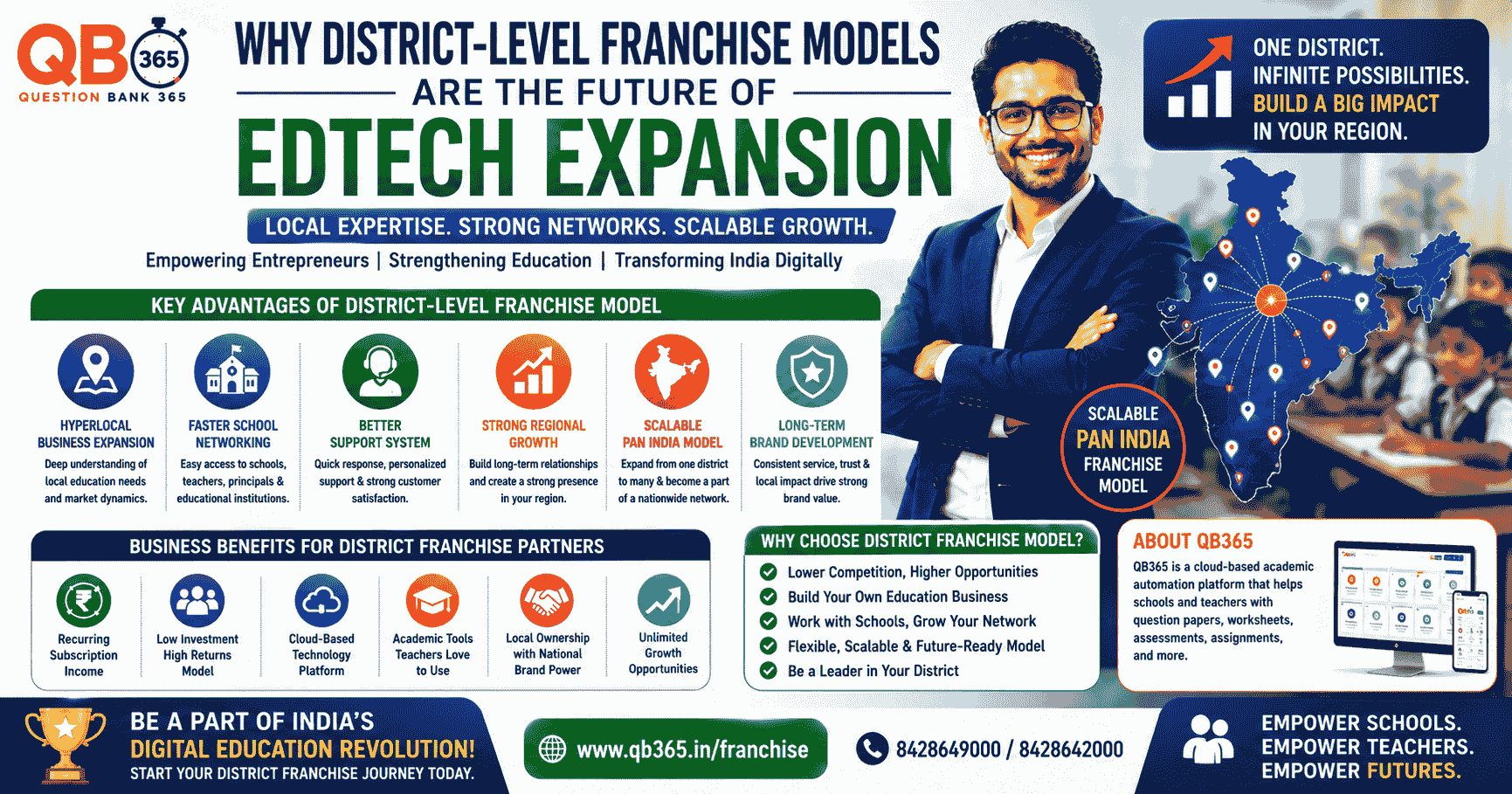
India’s EdTech industry is rapidly expanding through district-level franchise models that combine local networking, cloud-based educational platforms, and scalable business growth. This blog explores how regional educational partnerships help entrepreneurs build sustainable education businesses with recurring revenue, school onboarding opportunities, and PAN India expansion through QB365.
India’s education technology industry is expanding rapidly as schools, teachers, and educational institutions increasingly adopt digital learning systems, cloud-based academic platforms, and educational automation tools.
As the demand for scalable educational technology solutions grows across the country, EdTech companies are searching for effective expansion strategies that allow them to build strong local educational networks while scaling nationally.
One of the most successful business models emerging in India’s education sector is the district franchise expansion model.
Unlike centralized expansion systems, district-level franchise models combine:
This model allows educational technology companies to expand efficiently while maintaining strong local support systems and customer engagement.
QB365 is helping entrepreneurs establish district-level educational businesses through its cloud-based academic automation platform designed for schools and teachers across India.
India is a highly diverse market where educational preferences, school structures, and regional networking patterns vary significantly across districts and states.
A hyperlocal expansion strategy allows franchise partners to understand:
Local franchise partners can often build stronger educational relationships compared to centralized sales systems.
Education is a relationship-driven industry.
Schools and educators often prefer working with local representatives who understand regional educational systems and can provide personalized support.
District franchise models help build:
Local presence significantly improves customer confidence and onboarding success.
School networking is one of the most important factors in educational business expansion.
District-level franchise partners often already have access to:
These relationships help accelerate:
Educational institutions often require ongoing support during implementation and daily usage.
District franchise partners can provide:
This localized support improves customer satisfaction and long-term subscription renewals.
District-level business models allow educational companies to scale region by region in a structured and sustainable way.
Instead of expanding randomly, district franchise systems create:
One of the biggest advantages of the franchise expansion India model is scalability.
District-level franchise systems allow companies to expand across:
Cloud-based educational platforms make nationwide expansion even more efficient because franchise partners can manage operations digitally.
Cloud-based systems simplify educational business expansion because they provide:
Centralized business expansion often creates operational challenges such as:
District franchise systems solve these problems through decentralized local management.
Strong educational brands are often built through long-term local trust and consistent service delivery.
District franchise models help EdTech companies establish:
Smaller cities and emerging educational markets are rapidly adopting digital academic systems.
Several factors are accelerating EdTech adoption in regional markets:
Several factors make district-level educational businesses highly attractive:
QB365 is a cloud-based educational technology platform designed to simplify academic assessment preparation for schools and teachers.
The platform provides:
Several major trends are accelerating educational technology growth across India:
At the same time, entrepreneurs increasingly seek scalable digital businesses, recurring income opportunities, and future-ready franchise models.
District-level franchise systems are becoming one of the most effective expansion strategies in India’s growing EdTech industry.
Compared to centralized business expansion, district franchise models provide:
QB365 helps entrepreneurs build scalable district-level educational businesses through cloud-based academic automation solutions designed for schools and teachers across India.
A district franchise model allows entrepreneurs to operate and expand business services within a specific district or regional territory.
District-level systems help build local trust, improve school networking, provide better support, and accelerate regional educational expansion.
Local networking helps entrepreneurs connect with schools, teachers, principals, coaching centers, and educational institutions more effectively.
Regional support improves customer satisfaction, onboarding efficiency, subscription renewals, and long-term relationship building.
Cloud-based systems allow remote access, centralized management, digital onboarding, and scalable educational operations across multiple regions.
Smaller cities are rapidly adopting digital education systems and often offer lower competition with strong regional growth opportunities.
Subscription models provide recurring revenue, predictable cash flow, customer retention, and scalable long-term business growth.
QB365 provides question paper generation, worksheets, assignments, assessments, practice tests, and academic automation solutions.
No. QB365 provides onboarding support, training, and easy-to-use cloud-based educational tools.
You can apply by visiting the official QB365 franchise page or contacting QB365 directly.
Visit: https://www.qb365.in/franchise
Call: 8428649000 / 8428642000
 Blog
Blog