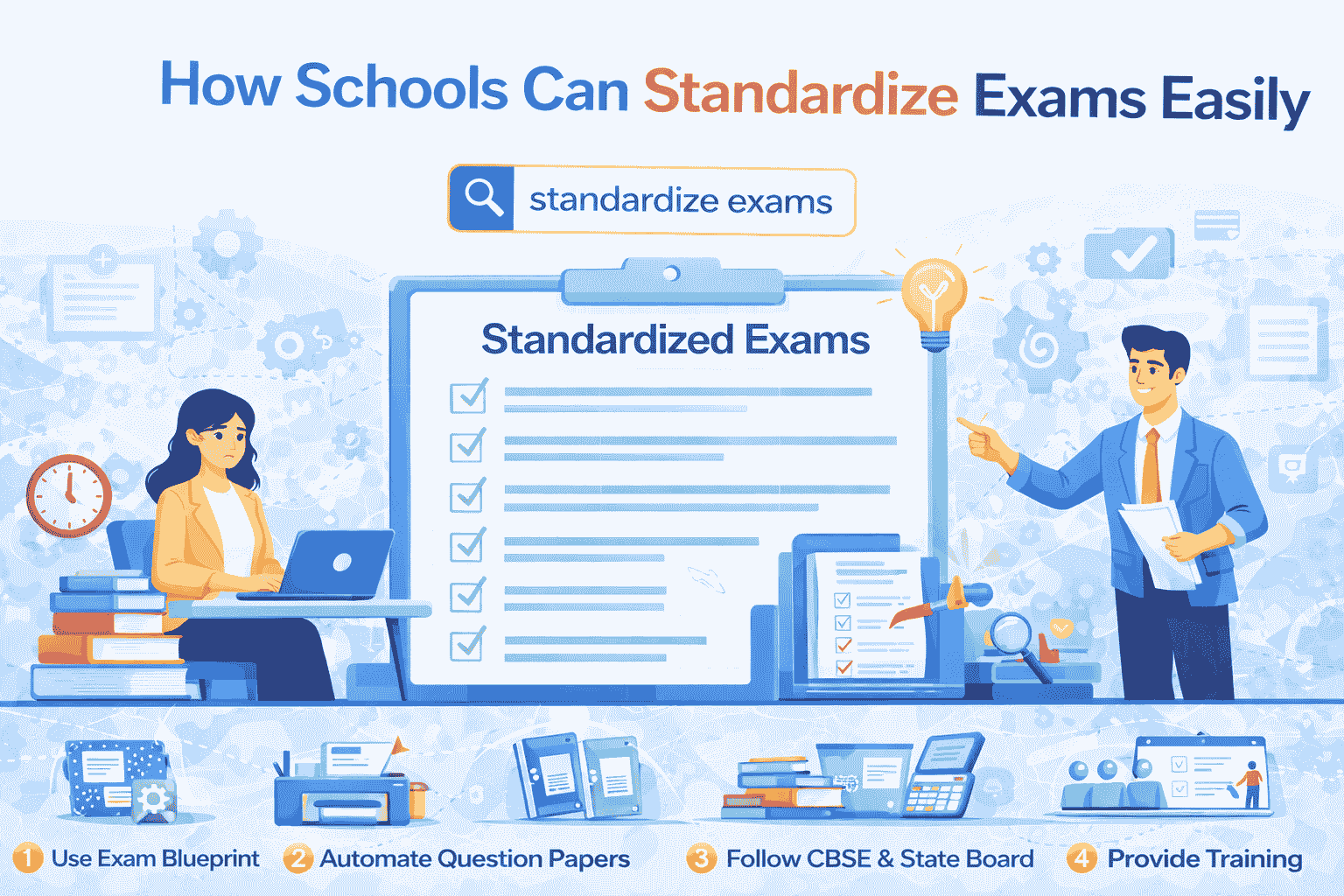
Learn how schools can standardize exams using structured methods like blueprints, question banks, and exam software.
Introduction
Maintaining consistency and fairness in examinations is a major challenge for schools. Different teachers, varying formats, and inconsistent difficulty levels often lead to confusion and unequal evaluation.
This is why schools are focusing on how to standardize exams effectively using structured methods and modern tools.
What Does It Mean to Standardize Exams?
Uniform exam pattern
Balanced question distribution
Consistent difficulty levels
Standardized marking schemes
Problems Without Standardization
Inconsistent question papers
Unfair evaluation
Poor performance analysis
Increased teacher workload
Benefits of Standardizing Exams
Fair assessment
Consistent exam patterns
Improved academic quality
Reduced teacher effort
Better performance analysis
Key Steps to Standardize Exams
1. Create a Blueprint
Define marks distribution, question types, and unit-wise weightage.
2. Use a Question Bank
Ensures balanced syllabus coverage and avoids repetition.
3. Maintain Difficulty Balance
Easy: 30%
Moderate: 50%
Difficult: 20%
4. Standardize Paper Format
Consistent sections
Clear instructions
Uniform layout
5. Enable Teacher Collaboration
Teachers contribute questions while HOD reviews for quality.
6. Use Exam Software
Automates paper creation and ensures consistency.
Manual vs Standardized System
Aspect
Manual Method
Standardized System
Consistency
Low
High
Time Required
High
Low
Error Rate
High
Low
Fairness
Uncertain
Consistent
Scalability
Limited
High
How QB365 Helps
Blueprint-based paper generation
Centralized question bank
Consistent exam formats
Multi-teacher collaboration
Automated paper creation
Best Practices
Use predefined templates
Review papers before exams
Train teachers on blueprint usage
Maintain shared question bank
Use technology for automation
Future of Standardized Exams
AI-driven exam generation
Adaptive testing
Data-based evaluation
Personalized insights
Conclusion
Standardizing exams ensures fairness, consistency, and improved academic performance. Schools can achieve this easily by adopting structured methods and digital tools.
 Blog
Blog