
 100% FREE ACCESS
10th Standard CBSE Syllabus & Materials
10th Standard CBSE
CBSE 10th Social Science ECO - Globalisation and the Indian Economy - New Model Questions Papers Study Material - QB365 Set A
NEW10th Standard CBSE
CBSE 10th Social Science ECO - Money and Credit - New Model Questions Papers Study Material - QB365 Set A
NEW10th Standard CBSE
CBSE 10th Social Science ECO - Sectors of the Indian Economy - New Model Questions Papers Study Material - QB365 Set A
NEW10th Standard CBSE
CBSE 10th Social Science ECO - Development - New Model Questions Papers Study Material - QB365 Set A
NEW10th Standard CBSE
CBSE 10th Social Science PS - Outcomes of Democracy - New Model Questions Papers Study Material - QB365 Set A
NEW10th Standard CBSE
CBSE 10th Social Science PS - Gender, Religion and Caste - New Model Questions Papers Study Material - QB365 Set A

Published on: 26/10/2025
Download CBSE Class 10th Standard CBSE Maths question papers, sample papers, important questions, and previous year solved papers in PDF format. Get free study materials, NCERT solutions, and exam preparation resources for Class 10th Standard CBSE Maths
Questions + Answers key
Take MCQ Maths Test
1.
Prove that (cosec \(\theta\) - sin \(\theta\)) (sec \(\theta\) - cos \(\theta\)) (tan \(\theta\) + cot \(\theta\)) = 1
2.
Prove that \(\frac{\sin A+\cos A}{\sin A-\cos A}+\frac{\sin A-\cos A}{\sin A+\cos A}=\frac{2}{2 \sin ^2 A-1}\)
3.
If \(\cos A=\frac{5}{13}\), then verify that \(\frac{\cos A}{1-\tan A}+\frac{\sin A}{1-\cot A}=\cos A+\sin A\)
4.
Prove that sec A (1 – sin A) (sec A + tan A) = 1.
5.
Evaluate the following \(\frac{\sin 30^{\circ}+\tan 45^{\circ}-\operatorname{cosec} 60^{\circ}}{\sec 30^{\circ}+\cos 60^{\circ}+\cot 45^{\circ}}\)
6.
Evaluate the following : 2 tan2 45° + cos2 30° – sin2 60°
7.
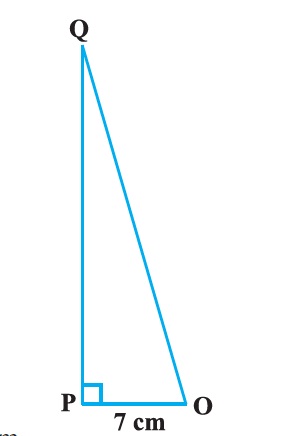
In \(\triangle\) OPQ, right-angled at P, OP = 7 cm and OQ – PQ = 1 cm . Determine the values of sin Q and cos Q.
8.
Express ; sin A, tan A and cosec A in terms of sec A.
9.
If \(\sec { \theta } =x+\frac { 1 }{ 4x } \), prove that \(\sec { \theta } +\tan { \theta } =2x\) or \(\frac{1}{2x}\)
10.
Prove that : \(\frac { 1 }{ cosecA-\cot { A } } -\frac { 1 }{ \sin { A } } =\frac { 1 }{ \sin { A } } -\frac { 1 }{ cosecA-\cot { A } } \)
11.
Prove that : \(\frac { { cosec }^{ 2 }\theta }{ { cosec }\theta -1 } -\frac { { cosec }^{ 2 }\theta }{ { cosec }\theta +1 } =2\sec ^{ 2 }{ \theta } \)
12.
If \(b\cos { \theta } =a\), then prove that \(cosec\theta +\cot { \theta } =\sqrt { \frac { b+a }{ b-a } } \)
13.
Prove that : \(\frac { \cos { A } }{ 1-\tan { A } } +\frac { \sin { A } }{ 1-\cot { A } } =\sin { A } +\cos { A } \)
14.
If \(\cos { \theta } +\sin { \theta } =\sqrt { 2 } \cos { \theta } \), show that \(\cos { \theta } -\sin { \theta } =\sqrt { 2 } \sin { \theta } \).
15.
Verify : \(\sqrt { \frac { 1-\cos { \theta } }{ 1+\cos { \theta } } } =\frac { \sin { \theta } }{ 1+\cos { \theta } } ,\quad for\quad \theta ={ 60 }^{ ° }\)
16.
Prove that \(\frac { cosec\theta +cot\theta }{ cosec\theta -cot\theta } =1+2{ cot }^{ 2 }\theta +2{ cosec }^{ 2 }\theta cos\theta \)
17.
Prove that \(\cos { \theta } \sin { \theta } -\frac { \sin { \theta } \cos { ({ 90 }^{ 0 }-\theta ) } \cos { \theta } }{ cosec({ 90 }^{ 0 }-\theta ) } -\frac { \cos { \theta } \sin { ({ 90 }^{ 0 }-\theta ) } \sin { \theta } }{ \sec { ({ 90 }^{ 0 }-\theta ) } } +cosec({ 90 }^{ 0 }-\theta )=\frac { 1 }{ \cos { \theta } } .\)
18.
If \(\tan { \theta } +\sin { \theta } =m\) and \(\tan { \theta } -\sin { \theta } =n\) ,then show that (m2-n2)2 = 16 mn or (m2-n2) = \(4 \sqrt { mn } \).
19.
If \(a\cos { \theta } -b\sin { \theta } =x\) and \(a \sin \theta+b \cos \theta=y\), prove that \({ \quad a }^{ 2 }+{ b }^{ 2 }={ x }^{ 2 }+{ y }^{ 2 }.\)
20.
Prove that \(\frac { \sin { \theta } -\cos { \theta } +1 }{ \sin { \theta } +\cos { \theta } -1 } =\frac { 1 }{ \sec { \theta } -\tan { \theta } } \) using the identity \(\sec ^{ 2 }{ \theta } =1+\tan ^{ 2 }{ \theta } .\)
21.
Prove that \(\frac { \sin { A } +\cos { A } }{ \sin { A } -\cos { A } } +\frac { \sin { A } -\cos { A } }{ \sin { A } +\cos { A } } =\frac { 2 }{ \sin ^{ 2 }{ A } -\cos ^{ 2 }{ A } } .\)
22.
Prove the trigonometric identity \(\sqrt { \frac { cosecA-1 }{ cosecA+1 } } +\sqrt { \frac { cosecA+1 }{ cosecA-1 } } =2\ sec { A } \)
23.
If sec 5 A = cosec (A + 300), find A. where 5 A is an acute angle, then find the value of A.
24.
If sin 3A = cos (A - 26°), where 3A is an acute angle, find the value of A.
25.
In a \(\triangle ABC\), right angle at B, \(\angle A=\angle C,\) find the value of sin A cos C + cos A sin C.
26.
Find acute angles A and B, if sin (A + 2B)=\(\frac { \sqrt { 3 } }{ 2 } \) and cos (A + 4B) = 00 , A > B.
27.
If sin (A – B) = \(\frac{1}{2}\) cos (A + B) = \(\frac{1}{2}\) 0° < A + B \(\leq\) 90°, A > B, find A and B.
28.
If \(\angle A=\angle B={ 45 }^{ 0 }\), verify that sin(A + B) = sin A cos B + cos A sin B.
29.
Evaluate \(8\sqrt { 3 } { cosec }^{ 2 }{ 30 }^{ 0 }\sin { { 60 }^{ 0 } } \cos { { 60 }^{ 0 } } { cos }^{ 2 }{ 45 }^{ 0 }\sin { { 45 }^{ 0 } } \tan { { 30 }^{ 0 } } { cosec }^{ 3 }{ 45 }^{ 0 }\)
30.
If \(m\cot { A } =n,\) find the value of \(\frac { m\sin { A } -n\cos { A } }{ n\cos { A } +m\sin { A } } \)
1.
To prove (cosec \(\theta\) - sin \(\theta\))(sec \(\theta\) - cos \(\theta\)) (tan \(\theta\) + cot \(\theta\)) = 1
Proof LHS = (cosec \(\theta\) - sin \(\theta\)) (sec \(\theta\) - cos \(\theta\)) (tan \(\theta\) + cot \(\theta\))
\(=\left(\frac{1}{\sin \theta}-\sin \theta\right)\left(\frac{1}{\cos \theta}-\cos \theta\right)\left(\frac{\sin \theta}{\cos \theta}+\frac{\cos \theta}{\sin \theta}\right)\)
\(\left[\begin{array}{l}
\because \operatorname{cosec} A=\frac{1}{\sin A}, \sec A=\frac{1}{\cos A} \\
\tan A=\frac{\sin A}{\cos A}, \cot A=\frac{\cos A}{\sin A}
\end{array}\right]\)
\(=\frac{1-\sin ^2 \theta}{\sin \theta} \times \frac{1-\cos ^2 \theta}{\cos \theta} \times \frac{\sin ^2 \theta+\cos ^2 \theta}{\cos \theta \sin \theta}\)
[ \(\because\) sin2 A + cos2 A = 1 \(\Rightarrow\) 1 - cos2 A = sin2 A and 1 - sin2 A = cos2 A]
\(=\frac{\cos ^2 \theta}{\sin \theta} \times \frac{\sin ^2 \theta}{\cos \theta} \times \frac{1}{\cos \theta \sin \theta}=1=\text { RHS }\)
Hence proved.
2.
\(\begin{aligned}
\mathrm{LHS} & =\frac{\sin A+\cos A}{\sin A-\cos A}+\frac{\sin A-\cos A}{\sin A+\cos A} \\
\end{aligned}\)
\(\begin{aligned}
=\frac{(\sin A+\cos A)^2+(\sin A-\cos A)^2}{(\sin A-\cos A)(\sin A+\cos A)}
\end{aligned}\)
\(=\frac{\left[\begin{array}{c}
\sin ^2 A+2 \sin A \cos A+\cos ^2 A+\sin ^2 A \\
-2 \sin A \cos A+\cos ^2 A
\end{array}\right]}{\sin ^2 A-\cos ^2 A}\)
\(\left[\because(a \pm b)^2=a^2+b^2 \pm 2 a b\right]\)
\(\begin{aligned}
& =\frac{2 \sin ^2 A+2 \cos ^2 A}{\sin ^2 A-\cos ^2 A}=\frac{2\left(\sin ^2 A+\cos ^2 A\right)}{\sin ^2 A-\cos ^2 A}
\end{aligned}\)
\(\begin{aligned}
=\frac{2}{\sin ^2 A-\cos ^2 A}
\end{aligned}\)
\(\begin{aligned}
=\frac{2}{\sin ^2 A-\left(1-\sin ^2 A\right)}
\end{aligned}\)
\(\begin{aligned}
=\frac{2}{\sin ^2 A-1+\sin ^2 A}
\end{aligned}\)
\(\begin{aligned}
=\frac{2}{2 \sin ^2 A-1}
\end{aligned}\)
= RHS Hence proved.
3.
Given, cos A = \(\frac{5}{13}=\frac{\operatorname{Base}(B)}{\text { Hypotenuse }(H)}\)
By Pythagoras theorem, we get
H2 = P2 + B2
\(\Rightarrow\) (13)2 = P2 + (5)2
\(\Rightarrow\) 169 = P2 + 25
\(\Rightarrow\) 169 - 25 = P2
\(\Rightarrow\) 144 = P2
\(\Rightarrow\) P = 12
Now, we have to verify that
\(\frac{\cos A}{1-\tan A}+\frac{\sin A}{1-\cot A}=\cos A+\sin A\)
\(\begin{aligned} \text { LHS } & =\frac{\cos A}{1-\tan A}+\frac{\sin A}{1-\cot A} \end{aligned}\)
\(\begin{aligned} =\frac{\frac{5}{13}}{1-\frac{12}{5}}+\frac{\frac{12}{13}}{1-\frac{5}{12}} \end{aligned}\)
\(=\frac{\frac{5}{13}}{\frac{5-12}{5}}+\frac{\frac{12}{13}}{\frac{12-5}{12}}=\frac{5}{13} \times\left(-\frac{5}{7}\right)+\frac{12}{13} \times \frac{12}{7}\)
\(=-\frac{25}{91}+\frac{144}{91}=\frac{119}{91}=\frac{17}{13}\)
RHS = cosA + sinA
\(=\frac{5}{13}+\frac{12}{13}=\frac{17}{13}\)
LHS = RHS Hence proved.
4.
LHS = sec A (1 – sin A)(sec A + tan A) \(=\left(\frac{1}{\cos A}\right)(1-\sin A)\left(\frac{1}{\cos A}+\frac{\sin A}{\cos A}\right)\)
\(=\frac{(1-\sin \mathrm{A})(1+\sin \mathrm{A})}{\cos ^{2} \mathrm{~A}}=\frac{1-\sin ^{2} \mathrm{~A}}{\cos ^{2} \mathrm{~A}}\)
\(=\frac{\cos ^{2} \mathrm{~A}}{\cos ^{2} \mathrm{~A}}=1=\mathrm{RHS}\)
5.
\(\frac{\sin 30^{\circ}+\tan 45^{\circ}-\operatorname{cosec} 60^{\circ}}{\sec 30^{\circ}+\cos 60^{\circ}+\cot 45^{\circ}}\)
\(=\frac{\frac{1}{2}+\frac{1}{1}-\frac{2}{\sqrt{3}}}{\frac{2}{\sqrt{3}}+\frac{1}{2}+\frac{1}{1}}=\frac{\frac{\sqrt{3}+2 \sqrt{3}-4}{2 \sqrt{3}}}{\frac{4+\sqrt{3}+2 \sqrt{3}}{2 \sqrt{3}}}\)
\(\begin{aligned} & {\left[\begin{array}{c} \because \sin 30^{\circ}=\cos 60^{\circ}=\frac{1}{2}, \operatorname{cosec} 60^{\circ}=\sec 30^{\circ}=\frac{2}{\sqrt{3}}, \\ \cot 45^{\circ}=\tan 45^{\circ}=1 \end{array}\right]} \\ \end{aligned}\)
\(=\frac{3 \sqrt{3}-4}{4+3 \sqrt{3}}=\frac{3 \sqrt{3}-4}{4+3 \sqrt{3}} \times \frac{4-3 \sqrt{3}}{4-3 \sqrt{3}}\)
[multiplying numerator and denominator by the conjugate of 4 + 3\(\sqrt3\), i.e. 4 - 3\(\sqrt3\)]
\(\begin{aligned} & =\frac{12 \sqrt{3}-27-16+12 \sqrt{3}}{(4)^2-(3 \sqrt{3})^2}\left[\because(a+b)(a-b)=a^2-b^2\right] \\ \end{aligned}\)
\(\begin{aligned} =\frac{24 \sqrt{3}-43}{16-27}=\frac{-(43-24 \sqrt{3})}{-11}=\frac{43-24 \sqrt{3}}{11} \end{aligned}\)
6.
2tan245° + cos230° − sin260°
\(=2(1)^{2}+\left(\frac{\sqrt{3}}{2}\right)^{2}-\left(\frac{\sqrt{3}}{2}\right)^{2}\)
\(=2(1)^{2}+\left(\frac{\sqrt{3}}{2}\right)^{2}-\left(\frac{\sqrt{3}}{2}\right)^{2}\)
\(=2+\frac{3}{4}-\frac{3}{4}=2\)
7.
In \(\triangle\) OPQ, we have
OQ2 = OP2 + PQ2
i.e., (1 + PQ)2 = OP2 + PQ2
i.e., 1 + PQ2 + 2PQ = OP2 + PQ2
i.e., 1 + 2PQ = 72
i.e., PQ = 24 cm and OQ = 1 + PQ = 25 cm
So, \(\sin \mathrm{Q}=\frac{7}{25} \text { and } \cos \mathrm{Q}=\frac{24}{25}\)
8.
sin2 A + cos2 A = 1
(i) \(\sin { A } =\sqrt { 1-\cos ^{ 2 }{ A } } \)
\(=\sqrt { 1-\frac { 1 }{ \sec ^{ 2 }{ A } } } \)
\(=\sqrt { \frac { \sec ^{ 2 }{ A } -1 }{ \sec ^{ 2 }{ A } } } =\sqrt { \frac { \sec ^{ 2 }{ A } -1 }{ \sec { A } } } \)
(ii) \(\tan { A } =\frac { \sin { A } }{ \cos { A } } =\sin { A } \sec { A } \)
\(=\sqrt { \frac { \sec ^{ 2 }{ A } -1 }{ \sec ^{ 2 }{ A } } } \times \sec { A } =\sqrt { \sec ^{ 2 }{ A } -1 } \)
(iii) \(cosecA=\frac { 1 }{ \sin { A } } =\frac { \sec { A } }{ \sqrt { \sec ^{ 2 }{ A } -1 } } \)
9.
Let \(\sec { \theta } +\tan { \theta } =\lambda \) ....(i)
We know that \(\sec ^{ 2 }{ \theta } -\tan ^{ 2 }{ \theta } =1\)
\(\Rightarrow \quad \left( \sec { \theta } +\tan { \theta } \right) \left( \sec { \theta } -\tan { \theta } \right) =1\)
\(\Rightarrow \quad \lambda \left( \sec { \theta } -\tan { \theta } \right) =1\)
\(\Rightarrow \quad \sec { \theta } -\tan { \theta } =\frac { 1 }{ \lambda } \) .... (ii)
Adding eqns.(i) and (ii),
\(2\sec { \theta } =\lambda +\frac { 1 }{ \lambda } \)
\(\Rightarrow \quad 2\left( x+\frac { 1 }{ 4x } \right) =\lambda +\frac { 1 }{ \lambda } \)
\(\Rightarrow \quad 2x+\frac { 1 }{ 2x } =\lambda +\frac { 1 }{ \lambda } \)
Comparing both sides,
\(\lambda =2x\quad or\quad \lambda =\frac { 1 }{ 2x } \)
\(\Rightarrow \quad \sec { \theta } +\tan { \theta } =2x\quad or\quad \frac { 1 }{ 2x } \)
10.
\(LHS=\frac { 1 }{ cosecA-\cot { A } } -\frac { 1 }{ \sin { A } } \)
\(=\frac { 1 }{ cosecA-\cot { A } } \times \left( \frac { cosecA+\cot { A } }{ cosecA+\cot { A } } \right) -cosecA\)
\(\left( \because \quad \sin { A } =\frac { 1 }{ cosecA } \right) \)
\(=\frac { cosecA+\cot { A } }{ { cosec }^{ 2 }A-\cot ^{ 2 }{ A } } -cosecA\)
\(=\frac { cosecA+\cot { A } }{ 1 } -cosecA=\cot { A } \)
Now RHS = \(\frac { 1 }{ \sin { A } } -\frac { 1 }{ cosecA+\cot { A } } \)
\(=cosecA-\frac { 1 }{ cosecA+\cot { A } } \times \left( \frac { cosecA-\cot { A } }{ cosecA-\cot { A } } \right) \)
\(=cosecA-\frac { \left( cosecA-\cot { A } \right) }{ { cosec }^{ 2 }A-\cot ^{ 2 }{ A } } \)
\(=cosecA-\frac { \left( cosecA-\cot { A } \right) }{ 1 } \)
= cot A
\(\therefore \quad LHS=RHS\)
11.
\(\frac { { cosec }^{ 2 }\theta }{ { cosec }\theta -1 } -\frac { { cosec }^{ 2 }\theta }{ { cosec }\theta +1 } \)
\(={ cosec }^{ 2 }\theta \left[ \frac { 1 }{ \frac { 1 }{ \sin { \theta } } -1 } -\frac { 1 }{ \frac { 1 }{ \sin { \theta } } +1 } \right] \)
\(={ cosec }^{ 2 }\theta \left[ \frac { \sin { \theta } }{ 1-\sin { \theta } } -\frac { \sin { \theta } }{ 1+\sin { \theta } } \right] \)
\(=\frac { 1\times \sin { \theta } }{ \sin ^{ 2 }{ \theta } } \left[ \frac { \left( 1+\sin { \theta } \right) -\left( 1-\sin { \theta } \right) }{ \left( 1-\sin { \theta } \right) \left( 1+\sin { \theta } \right) } \right] \)
\(=\frac { 1 }{ \sin { \theta } } \left[ \frac { 2\sin { \theta } }{ 1-\sin ^{ 2 }{ \theta } } \right] \)
\(=\frac { 2 }{ \cos ^{ 2 }{ \theta } } =2\sec ^{ 2 }{ \theta } \)
= RHS
12.
\(b\cos { \theta } =a\)
\(\Rightarrow \quad \cos { \theta } =\frac { a }{ b } \)
\(cosec\theta =\frac { b }{ \sqrt { { b }^{ 2 }-{ a }^{ 2 } } } ,\cot { \theta } =\frac { a }{ \sqrt { { b }^{ 2 }-{ a }^{ 2 } } } \)
\(cosec\theta +\cot { \theta } =\frac { b+a }{ \sqrt { { b }^{ 2 }-{ a }^{ 2 } } } =\sqrt { \frac { b+a }{ b-a } } \)
13.
\(LHS=\frac { \cos { A } }{ 1-\tan { A } } +\frac { \sin { A } }{ 1-\cot { A } } \)
\(=\frac { \cos { A } }{ 1-\left( \frac { \sin { A } }{ \cos { A } } \right) } +\frac { \sin { A } }{ 1-\left( \frac { \cos { A } }{ \sin { A } } \right) } \)
\(=\frac { \cos ^{ 2 }{ A } }{ \cos { A } .\sin { A } } +\frac { \sin ^{ 2 }{ A } }{ \sin { A } .\cos { A } } \)
\(=\frac { \cos ^{ 2 }{ A } }{ \cos { A } -\sin { A } } .\frac { \sin ^{ 2 }{ A } }{ \cos { A } -\sin { A } } \)
\(=\frac { \cos ^{ 2 }{ A.\sin ^{ 2 }{ A } } }{ \cos { A } .\sin { A } } \)
\(=\frac { \left( \cos { A } -\sin { A } \right) \left( \cos { A } +\sin { A } \right) }{ \left( \cos { A } -\sin { A } \right) } \)
\(=\cos { A } +\sin { A } \)
= RHS
14.
\(\cos { \theta } +\sin { \theta } =\sqrt { 2 } \cos { \theta } \)
\(\Rightarrow \quad \sin { \theta } =\cos { \theta } \left( \sqrt { 2 } -1 \right) \)
\(\Rightarrow \quad \sin { \theta } =\frac { \cos { \theta } \left( \sqrt { 2 } -1 \right) \left( \sqrt { 2 } +1 \right) }{ \left( \sqrt { 2 } +1 \right) } \)
\(\Rightarrow \quad \sin { \theta } =\frac { \cos { \theta } \left( 2-1 \right) }{ \sqrt { 2 } +1 } \)
\(\Rightarrow \quad \left( \sqrt { 2 } +1 \right) \sin { \theta } =\cos { \theta } \)
\(\Rightarrow \quad \sqrt { 2 } \sin { \theta } +\sin { \theta } =\cos { \theta } \)
\(\Rightarrow \quad \cos { \theta } -\sin { \theta } =\sqrt { 2 } \sin { \theta } \)
15.
LHS = \(\sqrt { \frac { 1-\cos { \theta } }{ 1+\cos { \theta } } } =\sqrt { \frac { 1-\frac { 1 }{ 2 } }{ 1+\frac { 1 }{ 2 } } } \left( \because \quad \cos { { 60 }^{ ° } } =\frac { 1 }{ 2 } \right) \)
\(=\sqrt { \frac { \frac { 1 }{ 2 } }{ \frac { 3 }{ 2 } } } =\frac { 1 }{ \sqrt { 3 } } \)
RHS \(=\frac { \sin { \theta } }{ 1+\cos { \theta } } =\frac { \sin { { 60 }^{ ° } } }{ 1+\cos { { 60 }^{ ° } } } \)
\(=\frac { \frac { \sqrt { 3 } }{ 2 } }{ 1+\frac { 1 }{ 2 } } =\frac { \frac { \sqrt { 3 } }{ 2 } }{ \frac { 3 }{ 2 } } \)
\(=\frac { 1 }{ \sqrt { 3 } } =LHS\)
Hence relation is verified for \(\theta ={ 60 }^{ ° }\)
16.
\(LHS=\frac { cosec\theta +cot\theta }{ cosec\theta -cot\theta } =\frac { \frac { 1 }{ sin\theta } +\frac { cos\theta }{ sin\theta } }{ \frac { 1 }{ sin\theta } -\frac { cos\theta }{ sin\theta } } \)
\(=\frac { (1+cos\theta )/sin\theta }{ (1-cos\theta )/sin\theta } =\frac { 1+cos\theta }{ 1-cos\theta } \)
\(=\frac { 1+cos\theta }{ 1-cos\theta } \times \frac { 1+cos\theta }{ 1+cos\theta } \)
\(=\frac { { \left( 1+cos\theta \right) }^{ 2 } }{ (1-cos\theta )(1+cos\theta ) } =\frac { { \left( 1+cos\theta \right) }^{ 2 } }{ 1-{ cos }^{ 2 }\theta } \)
\(=\frac { 1+{ cos }^{ 2 }\theta +2cos\theta }{ { sin }^{ 2 }\theta } \)
\(=\frac { 1 }{ { sin }^{ 2 }\theta } +\frac { { cos }^{ 2 }\theta }{ { sin }^{ 2 }\theta } +\frac { 2cos\theta }{ { sin }^{ 2 }\theta } \)
\(={ cosec }^{ 2 }\theta +{ cot }^{ 2 }\theta +2{ cosec }^{ 2 }\theta cos\theta \)
\(=1+{ cot }^{ 2 }\theta +{ cot }^{ 2 }\theta +2{ cosec }^{ 2 }\theta cos\theta \)
\(=1+2{ cot }^{ 2 }\theta +2{ cosec }^{ 2 }\theta cos\theta =RHS\)
17.
LHS = \(\cos { \theta } \sin { \theta } -\frac { \sin { \theta } \sin { \theta } \cos { \theta } }{ cosec\theta } -\frac { \cos { \theta } \cos { \theta } \sin { \theta } }{ \sec { \theta } } +\sec { \theta } \)
\(=\cos { \theta } \sin { \theta } -\sin ^{ 3 }{ \theta } \cos { \theta } -\cos ^{ 3 }{ \theta } \sin { \theta } +\sec { \theta } \)
\(\\ =\cos { \theta } \sin { \theta } -\sin { \theta } \cos { \theta } (\sin ^{ 2 }{ \theta } +\cos ^{ 2 }{ \theta } )+\sec { \theta } \)
18.
Given, \(\tan { \theta } +\sin { \theta } =m\quad \quad \quad ...(i)\)
and \(\tan { \theta } -\sin { \theta } =n\quad \quad ...(ii)\)
On adding Eqs. (i) and (ii), we get
\(2\tan { \theta } =m+n\quad \Rightarrow \tan { \theta } =\frac { m+n }{ 2 } \)
\(\therefore \quad \cot { \theta } =\frac { 1 }{ \tan { \theta } } =\frac { 2 }{ m+n } \quad \quad ...(iii)\)
On subtracting Eq. (ii) from Eq. (i), we get, \(2\sin { \theta } =m-n\)
\(\Rightarrow \sin { \theta } =\frac { m-n }{ 2 } \quad \quad \quad \quad .....(iv)\)
\(\therefore \quad cosec\theta =\frac { 1 }{ \sin { \theta } } =\frac { 2 }{ m-n } \)
We know that, \({ cosec }^{ 2 }\theta -\cot ^{ 2 }{ \theta } =1\)
\({ \left( \frac { 2 }{ m-n } \right) }^{ 2 }-{ \left( \frac { 2 }{ m+n } \right) }^{ 2 }=1\) [from Eqs. (ii) and (iv)]
\(\Rightarrow \frac { 4 }{ { \left( m-n \right) }^{ 2 } } -\frac { 4 }{ { \left( m+n \right) }^{ 2 } } =1\)
\(\Rightarrow 4\left[ \frac { 1 }{ { \left( m-n \right) }^{ 2 } } -\frac { 1 }{ { \left( m+n \right) }^{ 2 } } \right] =1\)
\(\Rightarrow 4\left[ \frac { { \left( m+n \right) }^{ 2 }-{ \left( m-n \right) }^{ 2 } }{ { \left( m-n \right) }^{ 2 }{ \left( m+n \right) }^{ 2 } } \right] =1\)
\(\Rightarrow 4\left[ \frac { ({ m }^{ 2 }+{ n }^{ 2 }+2mn)-({ m }^{ 2 }+{ n }^{ 2 }-2mn) }{ { \left( m-n \right) }^{ 2 }{ \left( m+n \right) }^{ 2 } } \right] =1\)
\(\Rightarrow 4\left[ \frac { 2mn+2mn) }{ { \left( m-n \right) }^{ 2 }{ \left( m+n \right) }^{ 2 } } \right] =1\)
\(\Rightarrow \frac { 16mn }{ { \left( m-n \right) }^{ 2 }{ \left( m+n \right) }^{ 2 } } =1\)
\(\Rightarrow \frac { 16mn }{ { \left( { m }^{ 2 }-{ n }^{ 2 } \right) }^{ 2 } } =1\)
\(\Rightarrow { \left( { m }^{ 2 }-{ n }^{ 2 } \right) }^{ 2 }=16mn\)
\(\therefore \quad { \left( { m }^{ 2 }-{ n }^{ 2 } \right) }=4\sqrt { mn } \) [taking positive square roor]
Hence proved.
19.
Given, \(a\cos { \theta } -b\sin { \theta } =x\quad ...(i)\)
and \(a\cos { \theta } +b\sin { \theta } =y\quad ....(ii)\)
On squaring Eqs. (i) and (ii) and then adding, we get
\({ x }^{ 2 }+{ y }^{ 2 }={ \left( a\cos { \theta } -b\sin { \theta } \right) }^{ 2 }+{ \left( a\cos { \theta } +b\sin { \theta } \right) }^{ 2 }\)
\(\Rightarrow { x }^{ 2 }+{ y }^{ 2 }={ a }^{ 2 }\cos ^{ 2 }{ \theta } +{ b }^{ 2 }\sin ^{ 2 }{ \theta } -2ab\cos { \theta } \sin { \theta } +{ a }^{ 2 }\cos ^{ 2 }{ \theta } +{ b }^{ 2 }\sin ^{ 2 }{ \theta } +2ab\cos { \theta } \sin { \theta } \)\(\left[ \because { (a+b) }^{ 2 }={ a }^{ 2 }+{ b }^{ 2 }+2ab\quad and\quad { (a-b) }^{ 2 }={ a }^{ 2 }+{ b }^{ 2 }-2ab\quad \right] \)
\(\Rightarrow { x }^{ 2 }+{ y }^{ 2 }={ a }^{ 2 }\cos ^{ 2 }{ \theta } +{ b }^{ 2 }\sin ^{ 2 }{ \theta } +{ a }^{ 2 }\cos ^{ 2 }{ \theta } +{ b }^{ 2 }\sin ^{ 2 }{ \theta } \)
\(\Rightarrow { x }^{ 2 }+{ y }^{ 2 }={ a }^{ 2 }(\cos ^{ 2 }{ \theta } +\sin ^{ 2 }{ \theta } )+{ b }^{ 2 }(\cos ^{ 2 }{ \theta } +\sin ^{ 2 }{ \theta } )\)
\(\Rightarrow { x }^{ 2 }+{ y }^{ 2 }={ a }^{ 2 }+{ b }^{ 2 }\quad \quad \left[ \because \cos ^{ 2 }{ \theta } +\sin ^{ 2 }{ \theta } =1 \right] \)
Hence proved.
20.
Since we will apply the identity involving sec \(\theta\) and tan \(\theta\), let us first convert the LHS (of the identity we need to prove) in terms of sec \(\theta\) and tan \(\theta\) by dividing numerator and denominator by cos \(\theta\).
\(\begin{aligned} \text { LHS } & =\frac{\sin \theta-\cos \theta+1}{\sin \theta+\cos \theta-1}=\frac{\tan \theta-1+\sec \theta}{\tan \theta+1-\sec \theta} \\ \end{aligned}\)
\(\begin{aligned} & =\frac{(\tan \theta+\sec \theta)-1}{(\tan \theta-\sec \theta)+1}=\frac{\{(\tan \theta+\sec \theta)-1\}(\tan \theta-\sec \theta)}{\{(\tan \theta-\sec \theta)+1\}(\tan \theta-\sec \theta)} \\ \end{aligned}\)
\(\begin{aligned} & =\frac{\left(\tan ^2 \theta-\sec ^2 \theta\right)-(\tan \theta-\sec \theta)}{\{\tan \theta-\sec \theta+1\}(\tan \theta-\sec \theta)} \\ \end{aligned}\)
\(\begin{aligned} & =\frac{-1-\tan \theta+\sec \theta}{(\tan \theta-\sec \theta+1)(\tan \theta-\sec \theta)} \end{aligned}\)
\(=\frac{-1}{\tan \theta-\sec \theta}=\frac{1}{\sec \theta-\tan \theta}\)
which is the RHS of the identity, we are required to prove.
21.
LHS = \(\frac { \sin { A } +\cos { A } }{ \sin { A } -\cos { A } } +\frac { \sin { A } -\cos { A } }{ \sin { A } +\cos { A } } \)
\(=\frac { { \left( \sin { A } +\cos { A } \right) }^{ 2 }+{ \left( \sin { A } -\cos { A } \right) }^{ 2 } }{ \left( \sin { A } -\cos { A } \right) \left( \sin { A } +\cos { A } \right) } \)
\(=\frac { \left[ \sin ^{ 2 }{ A } +2\cos { A } \sin { A } +\cos ^{ 2 }{ A } +\sin ^{ 2 }{ A } -2\cos { A } \sin { A } +\cos ^{ 2 }{ A } \right] }{ \sin ^{ 2 }{ A } -\cos ^{ 2 }{ A } } \)
\(=\frac { 2\sin ^{ 2 }{ A } +2\cos ^{ 2 }{ A } }{ \sin ^{ 2 }{ A } -\cos ^{ 2 }{ A } } =\frac { 2(\sin ^{ 2 }{ A } +\cos ^{ 2 }{ A } ) }{ \sin ^{ 2 }{ A } -\cos ^{ 2 }{ A } } \)
\(=\frac { 2 }{ \sin ^{ 2 }{ A } -\cos ^{ 2 }{ A } } \left[ \because \sin ^{ 2 }{ A } +\cos ^{ 2 }{ A } =1 \right] \)
= RHS
Hence proved.
22.
LHS = \(\sqrt { \frac { cosecA-1 }{ cosecA+1 } } +\sqrt { \frac { cosecA+1 }{ cosecA-1 } } =2\sec { A } \)
\(=\frac { \left[ \sqrt { (cosecA-1) } \sqrt { (cosecA-1) } +\sqrt { (cosecA+1) } \sqrt { (cosecA+1) } \right] }{ \sqrt { (cosecA+1) } \sqrt { (cosecA-1) } } \)
\(=\frac { { \left( \sqrt { cosecA-1 } \right) }^{ 2 }+{ \left( \sqrt { cosecA+1 } \right) }^{ 2 } }{ \sqrt { cosecA+1 } \sqrt { (cosecA-1) } } \)
\(=\frac { \left( cosecA-1 \right) +\left( cosecA-1 \right) }{ \sqrt { { cosec }^{ 2 }A-1 } } \) \(\left[ \because { \left( \sqrt { a } \right) }^{ 2 }=a\quad and\quad \sqrt { a+b } \times \sqrt { a-b } =\sqrt { { a }^{ 2 }-{ b }^{ 2 } } \right] \)
\(=\frac { 2cosec\quad A }{ \sqrt { \cot ^{ 2 }{ A } -1 } } \left[ \because { cosec }^{ 2 }A=1+\cot ^{ 2 }{ A } \right] \)
\(=\frac { 2cosec\quad A }{ \cot { A } } =\frac { 2 }{ \sin { A } } \times \frac { \sin { A } }{ \cos { A } } \left[ \because cosecA=\frac { 1 }{ \sin { A } } \quad and\cot { A } =\frac { \cos { A } }{ \sin { A } } \right] \)
\(=\frac { 2 }{ \cos { A } } =2\sec { A } \left[ \because \frac { 1 }{ \cos { A } } =\sec { A } \right] \)
= RHS
Hence proved.
23.
We have, sec 5A = cosec (A + 300)
\(\Rightarrow\) sec 5A = sec[900- (A + 300)] \([\because sec({ 90 }^{ 0 }-\theta )=cosec\theta ]\)
\(\Rightarrow\) sec 5A = sec(600 - A)
\(\Rightarrow\) 5A = 600 - A [\(\therefore\) 5A and (600- A) are acute angles]
\(\Rightarrow\) 6A = 600
\(\therefore\) A = 100
24.
Given, sin 3A = cos (A - 260) ...(i)
where, 3A is an acute angle.
We know that, \(\sin { \theta } =\cos { ({ 90 }^{ 0 }-\theta ) } \)
From Eq. (i), \(\cos { ({ 90 }^{ 0 }-3A) } =\cos { ({ A-26 }^{ 0 }) } \)
Since, (900 - 3A) and (A - 260) both are acute angles.
900 - 3A = A - 260
\(\Rightarrow\) 4A = 1160 \(\Rightarrow A=\frac { { 116 }^{ 0 } }{ 4 } ={ 29 }^{ 0 }\)
25.
Given, \(\angle A=\angle C\therefore \angle A+\angle B+\angle C={ 180 }^{ 0 }\) [since, sum of three angles of a triangle is equal to 1800]
\(\Rightarrow \quad { 90 }^{ 0 }+\angle A+\angle C={ 180 }^{ 0 }\quad \quad [\because \angle B={ 90 }^{ 0 }]\)
\(\Rightarrow \quad \angle A+\angle C={ 90 }^{ 0 }\quad \)
\(\Rightarrow \quad 2\angle A={ 90 }^{ 0 }\)and \(\Rightarrow 2\angle C={ 90 }^{ 0 }\) \([\therefore \angle A=\angle C]\)
\(\Rightarrow \angle A={ 45 }^{ 0 }\) and \(\Rightarrow \angle C={ 45 }^{ 0 }\)
sin A cos C+cos A sin C
= sin 450 cos 450+cos 450 sin 450
\(=\frac { 1 }{ \sqrt { 2 } } \times \frac { 1 }{ \sqrt { 2 } } +\frac { 1 }{ \sqrt { 2 } } \times \frac { 1 }{ \sqrt { 2 } } \quad \left[ \because \sin { { 45 }^{ 0 } } =\cos { { 45 }^{ 0 } } =\frac { 1 }{ \sqrt { 2 } } \right] \)
\(=\frac { 1 }{ 2 } +\frac { 1 }{ 2 } =1\)
26.
We have, sin (A + 2B) = \(\frac { \sqrt { 3 } }{ 2 } \)=600 \(\left[ \because \sin { { 60 }^{ 0 } } =\frac { \sqrt { 3 } }{ 2 } \right] \)
\( \Rightarrow\) A + 2B = 600 ....(i)
Again, cos (A + 4B) =00 = cos 900 [cos 900 = 0]
\( \Rightarrow\) A + 4B = 900 ....(ii)
On subtracting Eq. (i) from Eq. (ii), we get
A + 4B = 900
A+2B = 600
2B = 300
\(\Rightarrow \ B=\frac { { 30 }^{ 0 } }{ 2 } ={ 15 }^{ 0 }\)
On substituting B = 150 in Eq. (i), we get
A + 2 x 150=600 \(\Rightarrow\) A+300 = 600
\( \Rightarrow\) A = 60 0- 300 = 300
Hence, A = 300 and B = 150
27.
since, sin (A - B) = \(\frac{1}{2}\), therefore, A - B = 30° (1)
Also, since cos (A + B) = \(\frac{1}{2}\), therefore, A + B = 60° (2)
Solving (1) and (2), we get : A = 45° and B = 15°.
28.
Given,\(\angle A=\angle B={ 45 }^{ 0 }\)
LHS= sin (A + B)
= sin (450 + 450) = sin 900 = 1
and RHS = sin A cos B+cos A sin B
=sin 450 cos 450 + cos 450 sin 450
\(=\frac { 1 }{ \sqrt { 2 } } .\frac { 1 }{ \sqrt { 2 } } +\frac { 1 }{ \sqrt { 2 } } .\frac { 1 }{ \sqrt { 2 } } \)
\(=\frac { 1 }{ 2 } +\frac { 1 }{ 2 } =1\)=LHS
\(\therefore\) sin(A + B) = sin A cos B + cos A sin B
Hence verified.
29.
\(8\sqrt { 3 } { cosec }^{ 2 }{ 30 }^{ 0 }\sin { { 60 }^{ 0 } } \cos { { 60 }^{ 0 } } { cos }^{ 2 }{ 45 }^{ 0 }\sin { { 45 }^{ 0 } } \tan { { 30 }^{ 0 } } { cosec }^{ 3 }{ 45 }^{ 0 }\)
\(=8\sqrt { 3 } .\frac { 1 }{ \sin ^{ 2 }{ { 30 }^{ 0 } } } .\sin { { 60 }^{ 0 } } .\cos { { 60 }^{ 0 } } .{ cos }^{ 2 }{ 45 }^{ 0 }.\sin { { 45 }^{ 0 } } .\frac { \sin { { 30 }^{ 0 } } }{ \cos { { 30 }^{ 0 } } } .\frac { 1 }{ \sin ^{ 3 }{ { 45 }^{ 0 } } } \)
\(=8\sqrt { 3 } .\frac { 1 }{ \sin ^{ 2 }{ { 30 }^{ 0 } } } .\sin { { 60 }^{ 0 } } .\cos { { 60 }^{ 0 } } .{ cos }^{ 2 }{ 45 }^{ 0 }.\sin { { 45 }^{ 0 } } .\frac { 1 }{ \cos { { 30 }^{ 0 } } } .\frac { 1 }{ \sin ^{ 2 }{ { 45 }^{ 0 } } } \)
\(=8\sqrt { 3 } .\frac { 1 }{ 1/2 } \frac { \sqrt { 3 } }{ 2 } .\frac { 1 }{ 2 } { \left( \frac { 1 }{ \sqrt { 2 } } \right) }^{ 2 }.\frac { 1 }{ \sqrt { 3 } /2 } .\frac { 1 }{ { (1/\sqrt { 2 } ) }^{ 2 } } \)
\(=8\sqrt { 3 } .\frac { 1 }{ 4 } .\frac { 2 }{ \sqrt { 3 } } .2=\frac { 24 }{ \sqrt { 3 } } =\frac { 24\times \sqrt { 3 } }{ \sqrt { 3 } \times \sqrt { 3 } } \) [on multiplying numerator and denominator by \(\sqrt { 3 } \)]
\(=\frac { 24\times \sqrt { 3 } }{ 3 } =8\sqrt { 3 } \) .
30.
Given, \(m\cot { A } =n\)
\(\Rightarrow m.\frac { 1 }{ \tan { A } } =n\quad \left[ \therefore \cot { A } =\frac { 1 }{ \tan { A } } \right] \)
\(\Rightarrow \quad \tan { A } =\frac { m }{ n } \) ....(i)
Now, \(\frac { m\sin { A } -n\cos { A } }{ n\cos { A } +m\sin { A } } =\frac { m.\frac { \sin { A } }{ \cos { A } } -n }{ n+m.\frac { \sin { A } }{ \cos { A } } } \) [dividing numerator and denominator by cosA]
\(\frac { m\tan { A } -n }{ n+m\tan { A } } =\frac { \frac { { m }^{ 2 } }{ n } -n }{ n+\frac { { m }^{ 2 } }{ n } } \) [from Eq. (i)]
\(=\frac { \frac { { m }^{ 2 }-{ n }^{ 2 } }{ n } }{ \frac { { m }^{ 2 }+{ n }^{ 2 } }{ n } } =\frac { { m }^{ 2 }-{ n }^{ 2 } }{ { m }^{ 2 }+{ n }^{ 2 } } \)

10th Standard CBSE Syllabus & Materials
10th Standard CBSE
CBSE 10th Social Science PS - Federalism - New Model Questions Papers Study Material - QB365 Set A
NEW10th Standard CBSE
CBSE 10th Social Science PS - Power Sharing - New Model Questions Papers Study Material - QB365 Set A
NEW10th Standard CBSE
CBSE 10th Social Science GEO - Manufacturing Industries - New Model Questions Papers Study Material - QB365 Set A
NEW10th Standard CBSE
CBSE 10th Social Science GEO - Minerals and Energy Resources - New Model Questions Papers Study Material - QB365 Set A



NCERT Books

Syllabus

Exam Pattern

Sample Question Papers

Previous year Question Papers

Important Notes

MCQ Practice test

NCERT Exemplers

Case study Questions

Image Based Questions

Passage based Questions

HOT Questions

Value Based Questions

Model Questions Papers
NCERT ( Book Back ) Questions

Assertion and Reason
Important Questions And Answers

CBSE 10th Standard CBSE Subjects
CBSE Standards