 100% FREE ACCESS
10th Standard CBSE Syllabus & Materials
10th Standard CBSE
CBSE 10th Social Science ECO - Globalisation and the Indian Economy - New Model Questions Papers Study Material - QB365 Set A
NEW10th Standard CBSE
CBSE 10th Social Science ECO - Money and Credit - New Model Questions Papers Study Material - QB365 Set A
NEW10th Standard CBSE
CBSE 10th Social Science ECO - Sectors of the Indian Economy - New Model Questions Papers Study Material - QB365 Set A
NEW10th Standard CBSE
CBSE 10th Social Science ECO - Development - New Model Questions Papers Study Material - QB365 Set A
NEW10th Standard CBSE
CBSE 10th Social Science PS - Outcomes of Democracy - New Model Questions Papers Study Material - QB365 Set A
NEW10th Standard CBSE
CBSE 10th Social Science PS - Gender, Religion and Caste - New Model Questions Papers Study Material - QB365 Set A

Published on: 20/10/2025
Download CBSE Class 10th Standard CBSE Maths question papers, sample papers, important questions, and previous year solved papers in PDF format. Get free study materials, NCERT solutions, and exam preparation resources for Class 10th Standard CBSE Maths
Questions + Answers key
Take MCQ Maths Test
1.
Prove that \(\frac{\cot A-\cos A}{\cot A+\cos A}=\frac{\operatorname{cosec} A-1}{\operatorname{cosec} A+1}\)
2.
Find a relation between x and y such that the point (x , y) is equidistant from the points A (7, 1) and B (3, 5).
3.
From a point 100m above lake, the angle of elevation of stationary helicopter is 300 and angle of depression of the helicopter in the lake is 600.Find the height of the helicopter.
4.
The height of the lighthouse is h m. The angles of depression of two ships on opposite sides of this lighthouse are observed to be \({ 30 }^{ \circ }\ and \ \ { 45 }^{ \circ }\). Then, find the distance between the two ships.
5.
An aeroplane when flying at a height of 3125 m from the ground passes vertically below another plane at an instant when the angles of elevation of the two planes from the same point on the ground are 30o and 60o respectively. Find the distance between the two planes at that instant.
6.
Show that the points A(a,a), B(-a,a) and C(\(-a\sqrt3,a\sqrt3\)) form an equilateral triangle.
7.
Prove that sec A (1 – sin A) (sec A + tan A) = 1.
8.
Prove that \(\frac { \sin { A } +\cos { A } }{ \sin { A } -\cos { A } } +\frac { \sin { A } -\cos { A } }{ \sin { A } +\cos { A } } =\frac { 2 }{ \sin ^{ 2 }{ A } -\cos ^{ 2 }{ A } } .\)
9.
Show that the points (a, a). (-a, - a) and \(\left( -\sqrt { 3 } a,\sqrt { 3 } a \right) \) are the vertices of an equilateral triangle. Also, find its area.
10.
The angle of elevation of a jet fighter from a point A on the ground is \({ 60 }^{ ° }\). After a flight of 10 s, the angle of elevation charge to \({ 30 }^{ ° }\) .
If the jet is flying at a speed of 432 Km/h, then find the constant height at which the jet is flying.
11.
For what value of \(\lambda \), the three points (a,a), \((\lambda ,\sqrt { 3 } a)\) and (-a,-a) are the vertices of an equilateral triangle?
12.
Point P divides the line segment joining the points A(2,1) and B(5,-8) such that \({AP\over AB}={1\over 3}\). If P lies on the 2x-y+k=0, find the value of k.
13.
Two boats approach a lighthouse in mid - sea from opposite directions. The angles of elevations of the top of the lighthouse from two boats are 30o and 45o respectively. If the distance between two boats is 100 m, find the height of the lighthouse.
14.
Consider a ship with a right triangular mast. If the base of the mast is 10 m long, and the angle that the mast makes with the base is 60°, then what area of cloth is used to make the mast?
50 (√3 + 1) m2
50 √3 m2
50 m2
100 m2
15.
A kite is flying at a height of 75 metres from the ground level, attached to a string inclined at 60° to the horizontal. The length of the string to the nearest metre is
55 m
87 m
100 m
60 m
16.
The ——– is the line drawn from the eye of an observer to the point in the object viewed by the observer
Line of sight
Line of sight propagation
Line of symmetry
Line of incidence
17.
A man on a top of a tower observes a truck at an angle of depression α where tanα = 1/ √5 and sees that it is moving towards the base of the tower. Ten minutes later, the angle of depression of the truck is found to be β where tan β = √5 . If the truck is moving at a uniform speed, then how much more time it will take to reach the base of the tower.
150√5 sec
1500 sec
150 sec
150/ √5 sec
18.
The angle of elevation from a point 30 feet from the base of a pole, of height h, as level ground to the top of the pole is 45° degree. Which equation can be used to find the height of the pole.
tan 45° = 30/h
tan 45° = h/30
sin 45° = h/30
cos 45° = h/30
19.
A man has to clean a window at a height of 5 m on a building. He needs to reach a point 1.3m below the window to clean it. What should be the length of the ladder that he should use which, when inclined at an angle of 60° to the horizontal, would enable him to reach the required position?
2.46
2√3
2.46/ √3
2.46√3
20.
A tree is broken by wind and its upper part touches the ground at a point 10 metres from the foot of the tree and makes an angle of 45° with the ground. The entire length of the tree is
20 m
10 (1 + √2) m
10√2 m
10 m
21.
Consider a ladder which makes an angle of 60° with a wall of height 10 m and its top just touches the top of the wall. If the ladder is now rotated in such a way that its top now touches the top of the opposite wall which has a height of 10/√3 m. What is the angle by which the ladder is rotated.
45°
60°
90°
30°
22.
A 20 m long ladder touches the wall at a height of 10 m. The angle which the ladder makes with the horizontal is
30°
45°
60°
90°
23.
The angle of depression of a car, standing on the ground, from the top of a 75 m high tower, is 30°. The distance of the car from the base of the tower (in m.) is:
75√3
25√3
150
50√3
24.
The shadow of a tower standing on a level ground is found to be 40 m longer when the Sun’s altitude is 30° than when it is 60°. Find the height of the tower.
20
40√3
20√3
40
25.
A tower stands vertically on the ground from a point on the ground which is 15 m away from the foot of tower. If the height of tower is 15√3 meters find the angle of elevation
30°
60°
90°
120°
26.
A tower stands vertically on the ground from a point on the ground which is 25 m away from the foot of tower if the height of tower is 25√3 metres find the angle of elevation.
120°
90°
60°
30°
27.
A tree is broken by the wind. The top struck the ground at an angle of 30° and at a distance of 30 metres from the foot of the tree. The height of the tree in metres is
35√3
40√3
25√3
30√3
28.
Consider a constellation of 3 stars A, B and C forming a right triangle with angle ABC = 90° and angle BAC = 30° . If the distance between star A and B is 3√3 x 10¹³ km, then how much time does light take to travel from star C to B with a speed of 3 x 10⁸ m/s?
√3 x 10⁵ sec
104 sec
√3 x 10⁴ sec
105 sec
29.
The horizontal distance between two towers is 140 m. The angle of elevation of the top of the first tower when seen from the top of the second tower is 30°. If the height of the second tower is 60 m then, the height of the first tower is
139.5 m
142 m
135 m
140.83 m
30.
A vertical tower is 20 m high. A man at some distance from the tower knows that the cosine of the angle of the elevation of the top of tower is 0.5. He is standing from the foot of the tower at a distance of:
30√3 m
20√3 m
20/√3 m
10/√3 m
31.
The length of shadow of a tower on the plane ground is √3 times the height of the tower. The angle of elevation of sun is :
90o
60o
30o
45o
32.
The angles of elevation of the top of a cliff from two points x and y metres from the base and in the same straight line with it are complementary. The height of the cliff is
\(x\sqrt { _{ ym } } m\)
\(\sqrt { x } y\quad m\)
\(\sqrt { XY } m\)
xy m
33.
If altitude of the sun is 60°, the height of a tower which casts a shadow of length 30 m is:
30√3 cm
30/√3 m
15 m
15√2 m
1.
\(L H S=\frac{\cot A-\cos A}{\cot A+\cos A}=\frac{\frac{\cos A}{\sin A}-\cos A}{\frac{\cos A}{\sin A}+\cos A}\)
\(=\frac{\cos A\left(\frac{1}{\sin A}-1\right)}{\cos A\left(\frac{1}{\sin A}+1\right)}=\frac{\left(\frac{1}{\sin A}-1\right)}{\left(\frac{1}{\sin A}+1\right)}=\frac{\operatorname{cosec} A-1}{\operatorname{cosec} A+1}=\operatorname{RHS}\)
2.
Given point P(x, y) is equidistant from the points A(7, 1) and B(3, 5).
So, AP = BP
\(\Rightarrow\) AP2 = BP2
\(\Rightarrow\) (x - 7)2 + (y - 1)2 = (x - 3)2 + (y - 5)2
\(\left[\because \text { distance }=\sqrt{\left(x_2-x_1\right)^2+\left(y_2-y_1\right)^2}\right]\)
\(\Rightarrow\) x2 + 49 - 14x + y2 + 1 - 2y
= x2 + 9 - 6x + y2 + 25 - 10y
\(\Rightarrow\) -14x - 2y + 50 = -6x - 10y + 34
\(\Rightarrow\) -6x - 10y + 14x + 2y = 50 - 34
\(\Rightarrow\) 8x - 8y = 16
\(\Rightarrow\) x - y = 2
[dividing by 8 on both sides]
Hence, the relation between x and y is x - y = 2.
3.
200m
4.
\(h\left( 1+\sqrt { 3 } \right) m\)
5.
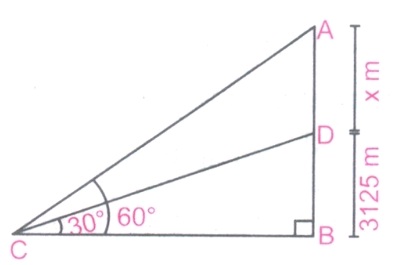
Let A and D are two aeroplanes such that BD = 3125 m
ㄥACB = 60o, ㄥDCB = 30o
ㄥACB = 60o.ㄥDCB = 30o
In rt. ΔABC, \(\frac { AB }{ BC } \) = tan 60o
⇒ \(\frac { x+3125 }{ BC } =\sqrt { 3 } \)
⇒ BC=\(\frac { x+3125 }{ \sqrt { 3 } } \)
⇒ BC=\(\frac { x+3125 }{ \sqrt { 3 } } \)m
In rt. ΔDBC, \(\frac { DB }{ BC } \) = tan 30o
⇒ \(\frac { BD }{ BC } =\frac { 1 }{ \sqrt { 3 } } \)
⇒ BD=\(\frac { BC }{ \sqrt { 3 } } \)
⇒ BD = \(\frac { 1 }{ \sqrt { 3 } } \times \frac { 3125+x }{ \sqrt { 3 } } \)
⇒ BD = 3125 = \(\frac { 3125+x }{ 3 } \)
Now, x = 6250 m
⇒ AD = 6250 m
6.
\(AB=\sqrt { ({ -a-a) }^{ 2 }+({ -a-a) }^{ 2 } } =\sqrt { ({ -2a) }^{ 2 }+({ -2a) }^{ 2 } } =\sqrt { (4a^{ 2 }+4a^{ 2 } } =\sqrt { 8a^{ 2 } } =2\sqrt { 2a } \)
\(BC=\sqrt { ({ -a\sqrt { 3 } +a) }^{ 2 }+({ a\sqrt { 3 } +a) }^{ 2 } } =\sqrt { 3a^{ 2 }+a^{ 2 }-2\sqrt { 3 } a^{ 2 }+3a^{ 2 }+a^{ 2 }+2\sqrt { 3 } a^{ 2 } } =\sqrt { 8a^{ 2 } } =2\sqrt { 2a } \)
\(AC=\sqrt { ({ -a\sqrt { 3 } -a) }^{ 2 }+({ a\sqrt { 3 } -a) }^{ 2 } } =\sqrt { 3a^{ 2 }+a^{ 2 }+2\sqrt { 3 } a^{ 2 }+3a^{ 2 }+a^{ 2 }-2\sqrt { 3 } a^{ 2 } } =\sqrt { 8a^{ 2 } } =2\sqrt { 2a } \)
Since AB=BC=AC ∴△ABC is equilateral.
7.
LHS = sec A (1 – sin A)(sec A + tan A) \(=\left(\frac{1}{\cos A}\right)(1-\sin A)\left(\frac{1}{\cos A}+\frac{\sin A}{\cos A}\right)\)
\(=\frac{(1-\sin \mathrm{A})(1+\sin \mathrm{A})}{\cos ^{2} \mathrm{~A}}=\frac{1-\sin ^{2} \mathrm{~A}}{\cos ^{2} \mathrm{~A}}\)
\(=\frac{\cos ^{2} \mathrm{~A}}{\cos ^{2} \mathrm{~A}}=1=\mathrm{RHS}\)
8.
LHS = \(\frac { \sin { A } +\cos { A } }{ \sin { A } -\cos { A } } +\frac { \sin { A } -\cos { A } }{ \sin { A } +\cos { A } } \)
\(=\frac { { \left( \sin { A } +\cos { A } \right) }^{ 2 }+{ \left( \sin { A } -\cos { A } \right) }^{ 2 } }{ \left( \sin { A } -\cos { A } \right) \left( \sin { A } +\cos { A } \right) } \)
\(=\frac { \left[ \sin ^{ 2 }{ A } +2\cos { A } \sin { A } +\cos ^{ 2 }{ A } +\sin ^{ 2 }{ A } -2\cos { A } \sin { A } +\cos ^{ 2 }{ A } \right] }{ \sin ^{ 2 }{ A } -\cos ^{ 2 }{ A } } \)
\(=\frac { 2\sin ^{ 2 }{ A } +2\cos ^{ 2 }{ A } }{ \sin ^{ 2 }{ A } -\cos ^{ 2 }{ A } } =\frac { 2(\sin ^{ 2 }{ A } +\cos ^{ 2 }{ A } ) }{ \sin ^{ 2 }{ A } -\cos ^{ 2 }{ A } } \)
\(=\frac { 2 }{ \sin ^{ 2 }{ A } -\cos ^{ 2 }{ A } } \left[ \because \sin ^{ 2 }{ A } +\cos ^{ 2 }{ A } =1 \right] \)
= RHS
Hence proved.
9.
Let A(a,a), B(-a,-a) and C\(\left( -\sqrt { 3 } a,\sqrt { 3 } a \right) \) be the given points.
Then, AB = \(\sqrt { { \left( -a-a \right) }^{ 2 }+{ \left( -a-a \right) }^{ 2 } } \) [\(\because \) distance=\(\sqrt { { \left( { x }_{ 2 }-{ x }_{ 1 } \right) }^{ 2 }-{ \left( { y }_{ 2 }-{ y }_{ 1 } \right) }^{ 2 } } \)]
\(\sqrt { 4{ a }^{ 2 }+4{ a }^{ 2 } } =\quad 2\sqrt { 2 } \)a units
BC = \(\sqrt { { \left( -\sqrt { 3 } a+a \right) }^{ 2 }+{ \left( \sqrt { 3 } a+a \right) }^{ 2 } } \)
\(=\sqrt { { a }^{ 2 }{ \left( 1-\sqrt { 3 } \right) }^{ 2 }+{ a }^{ 2 }{ \left( \sqrt { 3 } +1 \right) }^{ 2 } } \\ =a\sqrt { 1+3-2\sqrt { 3 } +1+3+2\sqrt { 3 } } \\ =a\sqrt { 8 } =2\sqrt { 2 } a\) units
Clearly, we have AB = BC = AC
So, the \(\Delta \)ABC formed by the given points is an equilateral triangle.
Now, area of \(\Delta \)ABC = \(\frac { \sqrt { 3 } }{ 4 } \)(Side)2 = \(\frac { \sqrt { 3 } }{ 4 } \) \(\times \) AB2
=\(\frac { \sqrt { 3 } }{ 4 } \)\(\times \) (\(2\sqrt { 2 } \)a)2
=\(2\sqrt { 3} \) a2 sq units
Hence, area of an equilateral triangle is \(2\sqrt { 3} \) a2 sq units.
10.
1039.2 m
11.
Let A(a,a), B(λ, \(\sqrt{3}a\) ), C(-a,-a)
AB = \(\sqrt { { (\lambda -a) }^{ 2 }+({ \sqrt { 3 } a-a) }^{ 2 } } \)
BC \(=\sqrt { { (-a-\lambda ) }^{ 2 }+({ -a-\sqrt { 3 } a) }^{ 2 } } \)
As △ABC is equilateral triangle ⇒ AB = BC
\(\Rightarrow \ { (\lambda -a) }^{ 2 }+({ \sqrt { 3 } a-a) }^{ 2 }\ ={ (\lambda +a) }^{ 2 }+({ \sqrt { 3 } a+a) }^{ 2 }\)
\(\Rightarrow \ 0=4a\lambda +4\sqrt { 3 } { a }^{ 2 }\)
\(\Rightarrow \ \lambda \ = -\sqrt { 3 } a\)
12.
P is the point of intersection of line segment AB and line 2x-y+k=0.
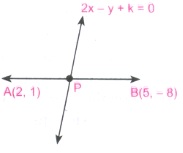
Such that \(\frac {AP}{AB}=\frac{1}{3} \Rightarrow 3AP =AB\)
\(\Rightarrow \) 3AP = AP+PB ⇒ 2AP = PB
\(\Rightarrow \frac{AP}{AB} = \frac{1}{2} \Rightarrow\) AP : PB = 1:2
⇒ P divides the join of A(2,1) and B(5,-8) in the ratio 1:2.
∴ Coordinates of point P are \((\frac {5+4}{1+2}, \frac {2-8}{1+2})\) i.e, P(3,-2)
As points P lies on the 2x-y+k=0
∴ 6+2+k=0 ⇒ k=-8
13.
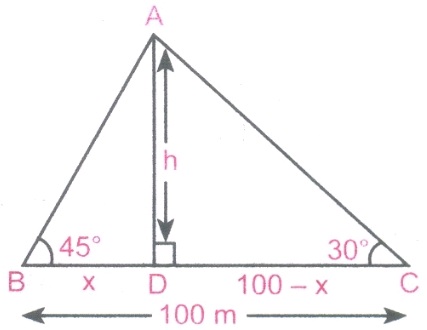
AD is the lighthouse, Find AD=?
In right ΔABD,
h=x
\(\frac { h }{ x } \)=tan45o
\(\frac { h }{ 100-x } \)=tan30o ......(ii)
Solve for h and x.
⇒ \(\frac { h }{ 100-x } =\frac { 1 }{ \sqrt { 3 } } \Rightarrow \sqrt { 3 } h\)=100-x
⇒ \(\sqrt { 3 } \)x=100-x [Using eq (i)]
⇒ (\(\sqrt { 3 } \)+1)x=100 ⇒ x=\(\frac { 100 }{ \sqrt { 3 } +1 } \)
⇒ x=\(\frac { 100(\sqrt { 3 } -1) }{ (\sqrt { 3 } +1)(\sqrt { 3 } -1) } \)
⇒ x=\(\frac { 100(\sqrt { 3 } -1) }{ 2 } =50(\sqrt { 3 } -1)\)m
∴ h=height of lighthouse=\(50(\sqrt { 3 } -1)\)m
14.
(b)
50 √3 m2
15.
(b)
87 m
16.
(a)
Line of sight
17.
(c)
150 sec
18.
19.
20.
(b)
10 (1 + √2) m
21.
(c)
90°
22.
(a)
30°
23.
(a)
75√3
24.
(c)
20√3
25.
(b)
60°
26.
(c)
60°
27.
(d)
30√3
28.
(b)
104 sec
29.
(d)
140.83 m
30.
(c)
20/√3 m
31.
(c)
30o
32.
(c)
\(\sqrt { XY } m\)
33.
(a)
30√3 cm

10th Standard CBSE Syllabus & Materials
10th Standard CBSE
CBSE 10th Social Science PS - Federalism - New Model Questions Papers Study Material - QB365 Set A
NEW10th Standard CBSE
CBSE 10th Social Science PS - Power Sharing - New Model Questions Papers Study Material - QB365 Set A
NEW10th Standard CBSE
CBSE 10th Social Science GEO - Manufacturing Industries - New Model Questions Papers Study Material - QB365 Set A
NEW10th Standard CBSE
CBSE 10th Social Science GEO - Minerals and Energy Resources - New Model Questions Papers Study Material - QB365 Set A



NCERT Books

Syllabus

Exam Pattern

Sample Question Papers

Previous year Question Papers

Important Notes

MCQ Practice test

NCERT Exemplers

Case study Questions

Image Based Questions

Passage based Questions

HOT Questions

Value Based Questions

Model Questions Papers
NCERT ( Book Back ) Questions

Assertion and Reason
Important Questions And Answers

CBSE 10th Standard CBSE Subjects
CBSE Standards