
 100% FREE ACCESS
10th Standard CBSE Syllabus & Materials
10th Standard CBSE
CBSE 10th Social Science ECO - Globalisation and the Indian Economy - New Model Questions Papers Study Material - QB365 Set A
NEW10th Standard CBSE
CBSE 10th Social Science ECO - Money and Credit - New Model Questions Papers Study Material - QB365 Set A
NEW10th Standard CBSE
CBSE 10th Social Science ECO - Sectors of the Indian Economy - New Model Questions Papers Study Material - QB365 Set A
NEW10th Standard CBSE
CBSE 10th Social Science ECO - Development - New Model Questions Papers Study Material - QB365 Set A
NEW10th Standard CBSE
CBSE 10th Social Science PS - Outcomes of Democracy - New Model Questions Papers Study Material - QB365 Set A
NEW10th Standard CBSE
CBSE 10th Social Science PS - Gender, Religion and Caste - New Model Questions Papers Study Material - QB365 Set A

Published on: 20/10/2025
Download CBSE Class 10th Standard CBSE Maths question papers, sample papers, important questions, and previous year solved papers in PDF format. Get free study materials, NCERT solutions, and exam preparation resources for Class 10th Standard CBSE Maths
Questions + Answers key
Take MCQ Maths Test
1.
On comparing the ratios \(\frac{a_{1}}{a_{2}}, \frac{b_{1}}{b_{2}} and \frac{c_{1}}{c_{2}}\) find out whether the following pair of linear equations are consistent, or inconsistent.
\(\frac{3}{2} x+\frac{5}{3} y=7 ; 9 x-10 y=14\)
2.
On comparing the ratios \(\frac{a_{1}}{a_{2}}, \frac{b_{1}}{b_{2}} and \frac{c_{1}}{c_{2}}\) find out whether the following pairs of linear equations are consistent, or inconsistent.
2x – 3y = 8 ; 4x – 6y = 9
3.
Draw the graph of the equation y-x = 2.
4.
On comparing the ratios \(\frac { { a }_{ 1 } }{ { a }_{ 2 } } ,\frac { { b }_{ 1 } }{ { b }_{ 2 } } and\frac { { c }_{ 1 } }{ { c }_{ 2 } } \), find out whether the following pairs of linear equations are consistent or inconsistent:
3x + 2y = 5; 2x - 3y = 7
5.
If a motorboat can travel 30 km upstream and 28km down stream in 7 h, it can travel 21 km upstream and return in 5 h. Find the speed of the boat in still water and the speed of the stream.
6.
Solve the following pair of equations of reducing them into a pair of linear equation.
\(\frac{57}{x+y}+\frac{6}{x-y}=5, \frac{38}{x+y}+\frac{21}{x-y}=9\)
7.
On comparing the ratios \(\frac{a_{1}}{a_{2}}, \frac{b_{1}}{b _{2}}\) and \(\frac{c_{1}}{c_{2}}\) and c1/c2 and without drawing them, find out whether the lines representing the following pairs of linear equations intersect at a point or are parallel or coincide.
\(4x + 3y -7 = 0, 12x + 9y = 21\)
8.
Solve the following question - Aftab tells his daughter, “Seven years ago, I was seven times as old as you were then. Also, three years from now, I shall be three times as old as you will be.” (Isn’t this interesting?) Represent this situation algebraically and graphically by the method of substitution.
9.
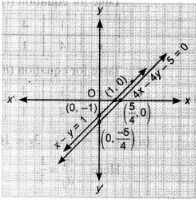
Which of the following pairs of linear equations are consistent/inconsistent? If consistent, obtain the solution graphically:
2x – 2y – 2 = 0, 4x – 4y – 5 = 0
10.
Form the pair of linear equations for the following problems and find their solution by substitution method:
The larger of two supplementary angles exceeds the smaller by 18 degree. Find the angles.
11.
Determine algebraically, the vertices of the triangle formed by the lines
3x-y=3, 2x-3y=2 and x+2y=8.
12.
Solve the following pair of equations by using elimination method.
3x-5y=4,9x-2y-7=0
13.
Solve the pair of equations :
\(\frac{2}{x}+\frac{3}{y}=13\)
\(\frac{5}{x}-\frac{4}{y}=-2\)
14.
Form the pair of linear equations for the following problems and find their solution by substitution method.
The taxi charges in a city consist of a fixed charge together with the charge for the distance covered. For a distance of 10 km, the charge paid is Rs 105 and for a journey of 15 km the charge paid is Rs 155. What are the fixed charges and the charge per km? How much does a person have to pay for travelling a distance of 25 km?
15.
Solve the following pair of linear equations by the substitution method
0.2x+ 0.3y = 1.3
0.4x + 0.5y = 2.3
16.
The value of thor which the pair of linear equations 3 x+5 y=8 and k x+15 y=24 has infinltely many solutions, is
3
9
5
15
17.
The lines represented by linear equations x = a and y= b\((a \neq b)\)are
intersecting at (a,b)
intersecting at (b, a)
parallel
coincident
18.
The value of a for which the lines x = 1.y = 2 and a2 x +2y - 20 = 0 are concurrent, is
1
8
-4
-2
19.
Vijay had some bananas and he divided them into two lots A and B. He sold the first lot at the rate of Rs 2 for 3 bananas and the second lot at the rate of Rs 1 per banana and got a total of Rs 400. If he had sold the first lot at the rate of Rs 1per banana and the second lot at the rate of Rs 4 for 5 bananas, his total collection would have been Rs 460. Total number of bananas, he had is
200
300
400
500
20.
After covering a distance of 30 km with a uniform speed, there is some defect in a train engine and therefore, its speed is reduced to 4/5 of its original speed. Consequently, the train reaches its destination late by 45 min. Had it happened after covering 18 km more, the trains would have seached 9 min earlier. The speed of train and the distance of journey is
20 km/h and 100 km
18 km/h and 120 km
30 km/h and 120 km
None of these
21.
If 3 |x| + 5 |y|= 8 and 7|x|- 3 |y| = 48, then the value of x+ y is
5
-4
4
The value does not exist
22.
Find the point on Cartesian plane where the line 3x – 2y = 6 intersects the y axis
(3, 2)
(-1, -2)
(0, -3)
(1, 2)
23.
The value of x in mx + ny = c; nx – ny = c + 1 is
x = (m + n) / (c + 1)
x = m + n
x = 2c + 1
x = (2c + 1) / (m + n)
24.
Which of the following equation is not a linear equation
2a-b =1
a + b =1
√a+b =1
2a+b =1
25.
The value of x, y in the following
2x+2 – 3y+1 = 5 ………(1)
2x + 3y = 17 ………(2)
3,2
2,-3
-2,3
2,3
26.
What is the solution of the equations \(\sqrt { 2 } x-\sqrt { 3 } y\ =\ 0\ and\ \sqrt { 5 } x+\sqrt { 2 } y=0\)
0, 2
2, 0
0, 0
None
27.
The values of ‘a’ and ‘b’ for which (2a – 1)x – 3y = 5, 3x + (b – 2)y = 3, has infinitely many solution are
a=3, b= \(\frac { 1 }{ 5 } \)
a=3, b =\(\frac { 2 }{ 7 } \)
\(a=\frac { 7 }{ 2 } ,b=\frac { 1 }{ 5 } \)
\(a=\frac { 1 }{ 5 } \),b= 3
28.
The pair of linear equations 8x – 5y = 7 and 5x – 8y = -7 have
One solution
Two solutions
Many solutions
No solution
29.
The following pairs of linear equations 2x + 5y = 3 and 6x + 15y = 12 represent
Intersecting
Parallel lines
Coincident lines
None from a, b, c
30.
In elimination method_______is an important condition
Equating only the x co-efficient
Equating only the y coefficient
Equating either of the coefficients
Equating both the coefficients
31.
The number of solutions of the pair of linear equations x + 2y – 8 = 0 and 2x + 4y = 16 are
Infinitely many
1
0
None
32.
If x=a, y=b is the solution of the pair of equation x-y=2 and x+y=4 then what will be value of a and b
2,1
3,1
4,6
1,2
33.
What will be the solution of these equations ax+by=a-b, bx-ay=a+b
x=1, y=2
x=2,y=-1
x=-2, y=-2
x=1, y=-1
34.
A fraction becomes when subtracted from the numerator and it becomes . when 8 is added to its denominator. Find the fraction
4/12
3/13
5/12
11/7
35.
The sum of two digits and the number formed by interchanging its digit is 110. If ten is subtracted from the first number, the new number is 4 more than 5 times of the sum of the digits in the first number. Find the first number
46
48
64
84
36.
A coaching institute conducts at Mathematics classes in two batches I and Il and fee for rich and poor children are different. In batch I there are 20 poor and 5 rich children, whereas in batch II, there are 5 poor and 25 rich children. The total monthly collection of fees from batch I is Rs 9000 and from batch Il is Rs 26000.
Assume that each poor child pays Rs x per month and each rich child pays Rs y per month.
Based on the above information, answer the following questions.
(i) Represents the information given above in terms of x and y.
(ii) Find the monthly fee paid by a poor child.
Or
Find the difference in the monthly fee paid by a poor child and a rich child.
(iii) If there are 10 poor and 20 rich children in batch II, what is the total monthly collection of fees from batch II?
37.
A boat in the river Ganga near Rishikesh covers 24 km upstream and 36 km downstream in 6 hours while it covers 36 km upstream and 24 km downstream in \(6 \frac{1}{2}\) hours. Consider speed of the boat in still water be x km/hr and speed of the stream be y km/hr and answer the following questions.
(i) Represent the 1st situation algebraically.
| \((a) \frac{24}{x-y}+\frac{36}{x+y}=6\) | \((b) \frac{24}{x+y}+\frac{36}{x-y}=6\) | \((c) 24 x+36 y=6\) | \((d) 24 x-36 y=6\) |
(ii) Represent the 2nd situation algebraically.
| \((a) \frac{36}{x+y}+\frac{24}{x-y}=\frac{13}{2}\) | \((b) \frac{36}{x-y}+\frac{24}{x+y}=\frac{13}{2}\) | \((c) 36 x-24 y=\frac{13}{2}\) | \((d) 36 x+24 y=\frac{13}{2}\) |
(iii) If u \(=\frac{1}{x-y} \text { and } v=\frac{1}{x+y}, \text { then } u=\)
| \((a) \frac{1}{4}\) | \((b) \frac{1}{12}\) | \((c) \frac{1}{8}\) | \((d) \frac{1}{6}\) |
(iv) Speed of boat in still water is
| (a) 4 km/hr | (b) 6 km/hr | (c) 8 km/hr | (d) 10 krn/hr |
(v) Speed of stream is
| (a) 3 km/hr | (b) 4 km/hr | (c) 2 km/hr | (d) 5 km/hr |
38.
Mr Manoj Jindal arranged a lunch party for some of his friends. The expense of the lunch are partly constant and partly proportional to the number of guests. The expenses amount to Rs 650 for 7 guests and Rs 970 for 11 guests .

Denote the constant expense by Rs x and proportional expense per person by Rs y and answer the following questions.
(i) Represent both the situations algebraically.
| (a) x + 7y = 650, x + 11y = 970 | (b) x - 7y = 650, x - 11y = 970 |
| (c) x+ 11y=650,x+7y=970 | (d) 11x + 7y = 650, 11x - 7y = 970 |
(ii) Proportional expense for each person is
| (a) Rs 50 | (b) Rs 80 | (c) Rs 90 | (d) Rs 100 |
(iii) The fixed (or constant) expense for the party is
| (a) Rs 50 | (b) Rs 80 | (c) Rs 90 | (d) Rs 100 |
(iv) If there would be 15 guests at the lunch party, then what amount Mr Jindal has to pay?
| (a) Rs 1500 | (b) Rs 1300 | (c) Rs 1200 | (d) Rs 1290 |
(v) The system of linear equations representing both the situations will have
| (a) unique solution | (b) no solution |
| (c) infinitely many solutions | (d) none of these |
1.
\(\frac{3}{2} x+\frac{5}{3} y=7,9 x-10 y=14\)
Here,\(\frac{a_{1}}{a_{2}}=\frac{3}{2 \times 9}=\frac{1}{6}, \frac{b_{1}}{b_{2}}=-\frac{5}{3 \times 10}=\frac{-1}{6}, \frac{c_{1}}{c_{2}}=\frac{-7}{-14}=\frac{1}{2}\)
\(\because \quad \frac{a_{1}}{a_{2}} \neq \frac{b_{1}}{b_{2}}\)
\(\therefore\) Pair of equations is consistent with unique solution
2.
The given equations can be rewritten as
2x - 3y - 8 = 0 and 4x - 6y - 9 = 0
On comparing with standard form of pair of linear equations, we get
a1 = 2, b1 = -3, c1 = -8
and a2 = 4, b2 = -6, c2 = -9
Now, \(\frac{a_{1}}{a_{2}}=\frac{2}{4}=\frac{1}{2},\frac{b_{1}}{b_{2}}=\frac{-3}{-6}=\frac{1}{2} and \frac{c_{1}}{c_{2}}=\frac{-8}{-9}=\frac{8}{9}\)
Thus, \(\frac{1}{2}=\frac{1}{2}\neq \frac{8}{9}\) i.e.,\(\frac{a_{1}}{a_{2}}=\frac{b_{1}}{b_{2}} \neq \frac{c_{1}}{c_{2}}\)
Hence, the pair of linear equations is inconsistent.
3.
Given linear equation can be written as y = 2 + x ...(i)
When x = - 2, then from Eq. (i), we get y = 2 - 2 = 0
When x = 0, then from Eq. (i), we get y = 2
When x = 1, then from Eq. (i), we get y = 2 + 1 = 3
Thus, we get the table
| x | 0 | -2 | 1 |
| y | 2 | 0 | 3 |
Draw the coordinate axes XOX' and YOY', and plot the points A( -2,0), B (0, 2) and C( 1, 3 ) by taking a suitable scale.
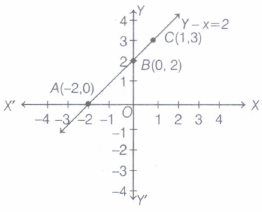
On joining the points A, Band C, we get a straight line AC. Thus, the line AC represents the required graph of given linear equation in two variables.
4.
The given equations can be rewritten as
3x + 2y - 5 = 0 and 2x - 3y - 7 = 0
On comparing with standard form of pair of linear equations, we get a1 = 3, b1 = 2, c1 = -5
and a2 = 2, b2 = -3, c2 = -7
Now, \(\frac{a_{1}}{a_{2}}=\frac{3}{2}, \frac{b_{1}}{b_{2}}=-\frac{2}{3}\) and \(\frac{c_{1}}{c_{2}}=\frac{5}{7}\)
Thus, \(\frac{3}{2}\neq -\frac{2}{3},i.e.\frac{a_{1}}{a_{2}}\neq \frac{b_{1}}{b_{2}}\)
Hence, the pair of linear equations is consistent.
5.
Let the speed of steam be x km/h, then speed of person going upstream=(x+5) km/h and speed of person going downstream=(5-x)h
According to question
\(\frac { 4 }{ 5-x } =3\left( \frac { 4 }{ 5-x } \right) \)
2.4 km/h
Lete the speed of boat in still water be x km/h and that of stream be y km/h, then according to question
\(\frac { 30 }{ x-y } +\frac { 28 }{ x+y } =7\quad \quad ...(i)\)
and \(\frac { 21 }{ x+y } +\frac { 21 }{ x-y } =5\quad \quad ...(ii)\)
Solve Eq. (i) and Eq. (ii) to get the speed of boat and speed of stream.
Speed of motorboat in still water=10 km/h
Speed of stream=4 km/h
6.
x = 11, y = 8
7.
The given pair oflinear equations is
4x+3y-7=0 ...(i)
and 12x+9y-21=0 ...(ii)
On comparing the above equations with standard form of pair of linear equations, we get
a1 = 4, b1 = 3,c1 = - 7
and a2 =12,b2 =9, c2 =- 21
Now, \( \frac{a_{1}}{a_{2}}=\frac{4}{12}=\frac{1}{3},\frac{b_{1}}{b _{2}}=\frac{3}{9}=\frac{1}{3} \)
and \(\frac{c_{1}}{c _{2}}=\frac{-7}{-21}=\frac{1}{3}\)
\(\therefore\) \(\frac{a _{1}}{a _{2}}=\frac{b_{1}}{b _{2}}=\frac{c_{1}}{c _{2}}\)
\(\therefore\) The lines representing the given pair of linear equations will coincide.
8.
Let s and t be the ages (in years) of Aftab and his daughter, respectively.
Then, the pair of linear equations that represent the situation is
s – 7 = 7 (t – 7), i.e., s – 7t + 42 = 0 ...(1)
and s + 3 = 3 (t + 3), i.e., s – 3t = 6 ...(2)
Using Equation (2), we get s = 3t + 6.
Putting this value of s in Equation (1), we get
(3t + 6) – 7t + 42 = 0,
i.e., 4t = 48, which gives t = 12.
Putting this value of t in Equation (2), we get
s = 3 (12) + 6 = 42
So, Aftab and his daughter are 42 and 12 years old, respectively.
Verify this answer by checking if it satisfies the conditions of the given problems.
9.
2x − 2y − 2 = 0
4x − 4y − 5 = 0
\(\frac{a_{1}}{a_{2}}=\frac{2}{4}=\frac{1}{2}, \frac{b_{1}}{b_{2}}=\frac{-2}{-4}=\frac{1}{2}, \frac{c_{1}}{c_{2}}=\frac{2}{5}\)
Since \(\frac{a_{1}}{a_{2}}=\frac{b_{1}}{b_{2}} \neq \frac{c_{1}}{c_{2}}\)
Therefore, these linear equations are parallel to each other and thus have no possible solution. Hence, the pair of linear equations is inconsistent
10.
Let the supplementary angles be x and y(x > y).
Then, x + y = 180 ...(i)
Now, according to the question,
x - y = 18 ...(ii)
From Eq. (ii), we have
y = x - 18 ...(iii)
On substituting the value of y from Eq. (iii) in Eq. (i),
we get
x + x - 18 = 180
\(\Rightarrow\) 2x = 198
\(\Rightarrow\) x = 99
On substituting x = 99 in Eq. (iii) we get
y = 99 - 18
\(\Rightarrow\) y = 81
Hence, the required angles are 99° and 81°.
11.
Given equation of lines are
3x - y = 3 ...(i)
2x-3y=2 ...(ii)
and x + 2y = 8 ....(iii)
Let lines (i), (ii) and (iii) represent the sides of \(\triangle\)ABC,
say AB, BC and CA, respectively.
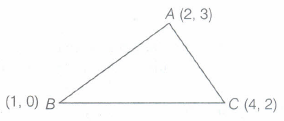
On multiplying Eq. (i) by 3 and then subtracting Eq. (ii) from Eq. (i), we get
7x=7 \(\Rightarrow\) x=1
On putting the value of x in Eq. (i), we get
3 x 1-y=3
\(\Rightarrow\) y=0
So, the coordinate of point or vertex B is (1, 6). Similarly, on solving Eq. (ii) and Eq. (iii), we get the coordinate of point or vertex Cis (4, 2).
And on solving Eq. (i) and Eq. (iii), we get the coordinate of point or vertex A is (2, 3).
Hence, the vertices of \(\triangle\)ABC formed by the given lines are A (2,3), B (1, 0) and C( 4, 2).
12.
\(x=\frac{9}{13}, y=\frac{-5}{13}\)
13.
Let us write the given pair of equations as
\(2\left(\frac{1}{x}\right)+3\left(\frac{1}{y}\right)=13\) ...(1)
\(5\left(\frac{1}{x}\right)-4\left(\frac{1}{y}\right)=-2\) ...(2)
These equations are not in the form ax + by + c = 0. However, if we substitute
\(\frac{1}{x}=p\) and \(\frac{1}{y}=q\) in Equations (1) and (2), we get
2p + 3q = 13 ...(3)
5p – 4q = – 2 ...(4)
So, we have expressed the equations as a pair of linear equations. Now, you can use any method to solve these equations, and get p = 2, q = 3.
You know that \(p=\frac{1}{x}\) and \(q=\frac{1}{y}\)
Substitute the values of p and q to get
\(\frac{1}{x}=2, \text { i.e., } x=\frac{1}{2}\) and \(\frac{1}{y}=3, \text { i.e., } y=\frac{1}{3}\)
Verification : By substituting \(x=\frac{1}{2}\) and \(y=\frac{1}{3}\) in the given equations, we find that both the equations are satisfied.
14.
Let fixed charge be Rs x and charge per km be Rs y.
We are given that,
x + 10y = 105 .....(i)
x + 15y = 155 ......(ii)
From eqn. (i), x = 105 - 10y ... (iii)
On substituting x from eqn. (iii) in eqn. (ii),
105 - 10y + 15y = 155
\(\Rightarrow\) 5y = 155 - 105 = 50
\(\therefore\) y = 10
On substituting y = 10 in eqn. (iii),
x = 105 - 10 \(\times\) 10
= 105 - 100 = 5
\(\therefore\) x = 5
Hence, fixed charges = Rs 5
Rate per km = Rs 10
Amount to be paid for travelling 25 km
= Rs 5 + Rs 10 \(\times\) 25
= Rs 5 + Rs 250
= Rs 255
15.
Given, a pair of linear equations is :
0.2x + 0.3y = 1.3 .....(i)
and 0.4 x + 0.5y= 2.3 ....(ii)
Multiply both sides of Eq. (i) and Eq. (ii) by 10, we get
2x + 3y = 13 ....(iii)
and 4x + 5y = 23 ....(iv)
On substituting y from eqn. (iii) in eqn. (ii),
\(\frac { 4 }{ 10 } x+\frac { 5 }{ 10 } \times \frac { (13-2x) }{ 3 } =\frac { 23 }{ 10 } \)
\(\Rightarrow \quad 4x+\frac { 5 }{ 3 } (13-2x)=23\)
\(\Rightarrow\) 12x + 5 (13 - 2x) = 3 \(\times\) 23
\(\Rightarrow\) 12x + 65 - 10x = 69
\(\Rightarrow\) 2x = 69 - 65 = 4
\(\therefore\) x = 2
On substituting x = 2 in eqn. (iii), we get
\(\\ y=\frac { 13-2\times 2 }{ 3 } =\frac { 9 }{ 3 } \)
i.e., y = 3
Hence, x = 2,y = 3
16.
(d)
15
17.
(a)
intersecting at (a,b)
18.
(c)
-4
19.
(d)
500
20.
(c)
30 km/h and 120 km
21.
(a)
5
22.
(c)
(0, -3)
23.
(d)
x = (2c + 1) / (m + n)
24.
(c)
√a+b =1
25.
(a)
3,2
26.
(c)
0, 0
27.
(a)
a=3, b= \(\frac { 1 }{ 5 } \)
28.
(a)
One solution
29.
(b)
Parallel lines
30.
(c)
Equating either of the coefficients
31.
(a)
Infinitely many
32.
(b)
3,1
33.
(d)
x=1, y=-1
34.
(c)
5/12
35.
(c)
64
36.
(i) For batch I,
20x + 5y = 9000
For batch II,
5x + 25y = 26000
(ii) We have,
20x + 5y = 9000
\(\Rightarrow\) 4x + y = 1800 ...(i)
and 5x + 25y = 26000
\(\Rightarrow\) x + 5y = 5200 ...(ii)
Multiplying Eq. (i) by 5 and subtracting Eq. (ii) from it.
5(4x + y) - (x + 5y) = 5 \(\times\) 1800 - 5200
\(\Rightarrow\) 19x = 3800
\(\Rightarrow\) x = 200
Or
On substituting x = 200 in Eq. (i), we get
4(200) + y = 1800
\(\Rightarrow\) 800 + y = 1800
\(\Rightarrow\) y = 1000
\(\therefore\) Difference in the monthly fee paid by a poor child and a rich child = y - x = Rs (1000 - 200) = Rs 800
(iii) Total monthly collection of fees, if there are 10 poor and 20 rich children = 10x + 20 y
= 10 \(\times\) 200 + 20 \(\times\)1000
= 2000 + 20000
= Rs 22000
37.
Speed of boat in upstream = (x - y)km/hr and speed of boat in downstream = (x + y)km/hr.
(i) (a): 1st situation can be represented algebraically as \(\frac{24}{x-y}+\frac{36}{x+y}=6\)
(ii) (b): 2nd situation can be represented algebraically as \(\frac{36}{x-y}+\frac{24}{x+y}=\frac{13}{2}\)
(iii) (c) : Putting \(\frac{1}{x-y}=u \text { and } \frac{1}{x+y}=v\)
we get,
24u + 36v = 6 and 36u + 24v = 13/2
Solving the above equations, we get u \(=\frac{1}{8}, v=\frac{1}{12}\)
(iv) (d): \(\because u=\frac{1}{8}=\frac{1}{x-y} \Rightarrow x-y=8\) ........(i)
\(\text { and } v=\frac{1}{12}=\frac{1}{x+y} \Rightarrow x+y=12\) .........(ii)
Adding equations (i) from (ii), we get 2x = 20 \(\Rightarrow\) x = 10
\(\therefore\) Speed of boat in still water = 10 km/hr -.
(v) (c): From equation (i), 10 - y = 8 \(\Rightarrow\) y = 2
\(\therefore\) Speed of stream = 2 km/hr.
38.
(i) (a): 1st situation can be represented as x + 7y = 650 ...(i) and
2nd situation can be represented as x + 11y = 970 ...(ii)
(ii) (b): Subtracting equations (i) from (ii), we get
\(4 y=320 \Rightarrow y=80\)
\(\therefore\) Proportional expense for each person is Rs 80.
(iii) (c): Puttingy = 80 in equation (i), we get
x + 7 x 80 = 650 \(\Rightarrow\) x = 650 - 560 = 90
\(\therefore\) Fixed expense for the party is Rs 90
(iv) (d): If there will be 15 guests, then amount that Mr Jindal has to pay = Rs (90 + 15 x 80) = Rs 1290
(v) (a): We have a1 = 1, b1 = 7, c1 = -650 and
\(a_{2}=1, b_{2}=11, c_{2}=-970 \)
\(\therefore \frac{a_{1}}{a_{2}}=1, \frac{b_{1}}{b_{2}}=\frac{7}{11}, \frac{c_{1}}{c_{2}}=\frac{-650}{-970}=\frac{65}{97}\)
\(\text { Here, } \frac{a_{1}}{a_{2}} \neq \frac{b_{1}}{b_{2}} \neq \frac{c_{1}}{c_{2}}\)
Thus, system of linear equations has unique solution.

10th Standard CBSE Syllabus & Materials
10th Standard CBSE
CBSE 10th Social Science PS - Federalism - New Model Questions Papers Study Material - QB365 Set A
NEW10th Standard CBSE
CBSE 10th Social Science PS - Power Sharing - New Model Questions Papers Study Material - QB365 Set A
NEW10th Standard CBSE
CBSE 10th Social Science GEO - Manufacturing Industries - New Model Questions Papers Study Material - QB365 Set A
NEW10th Standard CBSE
CBSE 10th Social Science GEO - Minerals and Energy Resources - New Model Questions Papers Study Material - QB365 Set A



NCERT Books

Syllabus

Exam Pattern

Sample Question Papers

Previous year Question Papers

Important Notes

MCQ Practice test

NCERT Exemplers

Case study Questions

Image Based Questions

Passage based Questions

HOT Questions

Value Based Questions

Model Questions Papers
NCERT ( Book Back ) Questions

Assertion and Reason
Important Questions And Answers

CBSE 10th Standard CBSE Subjects
CBSE Standards