
 100% FREE ACCESS
10th Standard CBSE Syllabus & Materials
10th Standard CBSE
CBSE 10th Social Science ECO - Globalisation and the Indian Economy - New Model Questions Papers Study Material - QB365 Set A
NEW10th Standard CBSE
CBSE 10th Social Science ECO - Money and Credit - New Model Questions Papers Study Material - QB365 Set A
NEW10th Standard CBSE
CBSE 10th Social Science ECO - Sectors of the Indian Economy - New Model Questions Papers Study Material - QB365 Set A
NEW10th Standard CBSE
CBSE 10th Social Science ECO - Development - New Model Questions Papers Study Material - QB365 Set A
NEW10th Standard CBSE
CBSE 10th Social Science PS - Outcomes of Democracy - New Model Questions Papers Study Material - QB365 Set A
NEW10th Standard CBSE
CBSE 10th Social Science PS - Gender, Religion and Caste - New Model Questions Papers Study Material - QB365 Set A

Published on: 26/10/2025
Download CBSE Class 10th Standard CBSE Maths question papers, sample papers, important questions, and previous year solved papers in PDF format. Get free study materials, NCERT solutions, and exam preparation resources for Class 10th Standard CBSE Maths
Questions + Answers key
Take MCQ Maths Test
1.
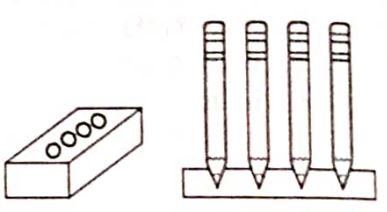
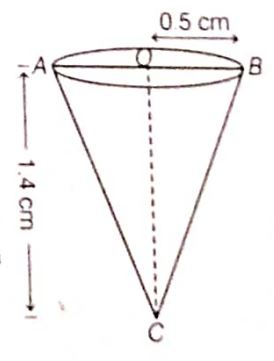
A pen stand made of wood is in the shape of a cuboid with four conical depressions to hold pens.The dimensions of the cuboid are 15 cm \(\times\) 10 cm \(\times\) 3.5 cm. The radius of each of the depressions is 0.5 cm and the depth is 1.4cm. Find the volume of wood in the entire stand (see figure).
2.
A solid is in the shape of a cone standing on a hemisphere with both their radii being equal to 1cm and the height of the cone is equal to its radius.Find the volume of the solid in terms of \(\pi\)
3.
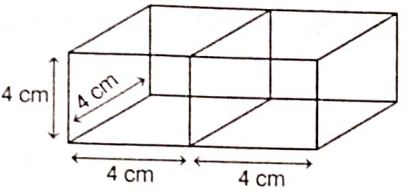
2 cubes each of volume 64 cm3 are joined end to end. Find the surface area of the resulting cuboid.
4.
A chord of a circle of radius 10 cm subtends a right angle at the centre. Find area of the corresponding
(i) minor segment
(ii) major sector \(( Take, \quad \pi = 3.14)\)
5.
Find the area of a sector of a circle with radius 6 cm, if angle of the sector is \(60^o\)
6.
A hemispherical depression is cut out from one face of a cubical wooden block such that the diameter l of the hemisphere is equal to the edge of the cube. Determine the surface area of the remaining solid.
7.
A cubical block of side 7 cm is surmounted by a hemisphere. What is the greatest diameter the hemisphere can have? Find the surface area of the solid.
8.
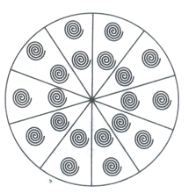
A brooch is made with silver wire in the form of a circle with diameter 35 mm. The wire is also used in making 5 diameters which divide the circle into 10 equal sectors as shown in figure.
Find:
(i) the total length of the silver wire required.
(ii) the area of each sector of the brooch.
9.
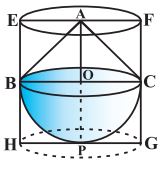
A solid toy is in the form of a hemisphere surmounted by a right circular cone. The height of the cone is 2 cm and the diameter of the base is 4 cm. Determine the volume of the toy. If a right circular cylinder circumscribes the toy, find the difference of the volumes of the cylinder and the toy. (Take \(\pi\)= 3.14)
10.
The following frequency distribution gives the monthly consumption of electricity of 68 consumers of a locality. Find (i) median, (ii) mean and (iii) mode of the data and compare them. (iv) How electricity consumption can be reduced?
| Monthly consumption (in units) | Number of consumers |
| 65-85 | 4 |
| 85-105 | 5 |
| 105-125 | 13 |
| 125-145 | 20 |
| 145-165 | 14 |
| 165-185 | 8 |
| 185-205 | 4 |
11.
The marks obtained by 30 students of Class X of a certain school in a Mathematics paper consisting of 100 marks are presented in table below. Find the mean of the marks obtained by the students
| Marks obtained (xi) | 10 | 20 | 36 | 40 | 50 | 56 | 60 | 70 | 72 | 80 | 88 | 92 | 95 |
| Number of students (fi) | 1 | 1 | 3 | 4 | 3 | 2 | 4 | 4 | 1 | 1 | 2 | 3 | 1 |
12.
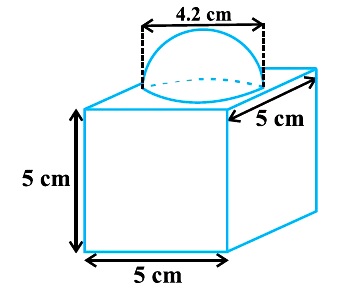
The decorative block shown in figure is made of two solids — a cube and a hemisphere. The base of the block is a cube with edge 5 cm, and the hemisphere fixed on the top has a diameter of 4.2 cm. Find the total surface area of the block. \(\text { (Take } \pi=\frac{22}{7} \text { ) }\)
13.
The following table gives the distribution of the life time of 400 neon lamps :
| Lifetime (in hours) | Number of lamps |
|---|---|
| 1500-2000 | 14 |
| 2000-2500 | 56 |
| 2500-3000 | 60 |
| 3000-3500 | 86 |
| 3500-4000 | 74 |
| 4000-4500 | 62 |
| 4500-5000 | 48 |
Find the median lifetime of a lamp.
14.
The table below shows the daily expenditure on food of 25 households in a locality.
| Daily expenditure (in RS) | 100-150 | 150-200 | 200-250 | 250-300 | 300-350 |
|---|---|---|---|---|---|
| Number of households | 4 | 5 | 12 | 2 | 2 |
Find the mean daily expenditure on food by a suitable method.
15.
Find the area of a quadrant of a circle whose circumference is 22 cm.
16.
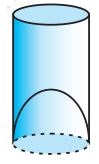
A juice seller was serving his customers using glasses as shown in Figure. The inner diameter of the cylindrical glass was 5 cm, but the bottom of the glass had a hemispherical raised portion which reduced the capacity of the glass. If the height of a glass was 10 cm, find the apparent capacity of the glass and its actual capacity. \(\left[ Use\quad \pi =3.14 \right] \)
17.
Tick the correct answer in the following:
Area of a sector of angle P (in degrees) of a circle with radius R is
\({P \over 180^o}\times 2\pi R\)
\({P \over 180^o}\times \pi R^2\)
\({P \over 360^o}\times 2\pi R\)
\({P \over 720^o}\times 2\pi R^2\)
1.
Given, length of cuboid (l) = 15 cm, breadth of cuboid (b) = 10 cm and height of cuboid (h) = 3.5 cm
\(\therefore\) Volume of cuboid = l \(\times\) b \(\times\) h
= 15 \(\times\) 10 \(\times\)3.5 = 525 cm3
Also, radius of conical depression,r = 0.5 cm
and height of conical depression, h = 1.4 cm
\(\therefore\) Volume of one conical depression \(=\frac{1}{3} \pi \times r^2 \times h\)
\(\begin{aligned} & =\frac{1}{3} \times \frac{22}{7} \times 0.5 \times 0.5 \times 1.4 \\ \end{aligned}\)
\(\begin{aligned} & =\frac{22}{3} \times \frac{1}{2} \times \frac{1}{2} \times \frac{2}{10}=\frac{11}{30} \mathrm{~cm}^3 \end{aligned}\)
Now, volume of 4 conical depressions = 4 \(\times\)Volume of one conical depression
\(=4 \times \frac{11}{30}=\frac{22}{15} \mathrm{~cm}^3\)
Hence, the volume of wood in the entire stand = Volume of cuboid - Volume of 4 conical depressions
\(=525-\frac{22}{15}=525-1.47=523.53 \mathrm{~cm}^3\)
2.
Given, solid is a combination of a cone and a hemisphere.
Also, radius of the cone, r = radius of the hemisphere
= 1 cm
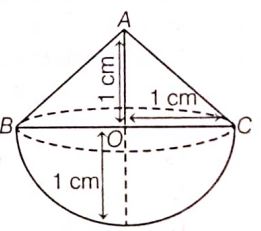
Height of the cone, h = 1 cm
\(\therefore\) Required volume of the solid = Volume of the cone + Volume of the hemisphere
\(\begin{aligned} & =\frac{1}{3} \pi r^2 h+\frac{2}{3} \pi r^3=\frac{1}{3} \pi(1)^2(1)+\frac{2}{3} \pi(1)^3 \\ \end{aligned}\)
\(\begin{aligned} & =\frac{\pi}{3}+\frac{2}{3} \pi=\frac{(\pi+2 \pi)}{3}=\frac{3 \pi}{3}=\pi \mathrm{cm}^3 \end{aligned}\)
3.
Given, the volume of each cube is 64 cm3.
Let each side of the cube be a cm.
\(\because\) Volume of cube = (Side)3
\(\therefore\) 64 = a3 [given]
\(\Rightarrow\) a = 4 cm
When two cubes are joined end-to-end, then we get a cuboid whose length, l = (4 + 4) = 8 cm, breadth, b = 4 cm and height, h = 4 cm.
Now, surface area of the resulting cuboid
= 2(lb + bh + hl) = 2(8 \(\times\) 4 + 4 \(\times\)4 + 4 \(\times\) 8)
= 2(32 + 16 + 32) = 2(80) = 160 cm2
4.
Given, radius of a circle, AO = 10 cm and \(\angle\)AOC = 90°
Area of \(\triangle A O C=\frac{1}{2} \times O A \times O C=\frac{1}{2} \times 10 \times 10=50 \mathrm{~cm}^2\)
\(\begin{aligned} \text { Area of sector } O A E C O & =\frac{\theta}{360^{\circ}} \times \pi r^2 \\ \end{aligned}\)
\(\begin{aligned} =\frac{90^{\circ}}{360^{\circ}} \times 3.14 \times(10)^2 \\ \end{aligned}\)
\(\begin{aligned} =\frac{314}{4}=78.5 \mathrm{~cm}^2 \end{aligned}\)
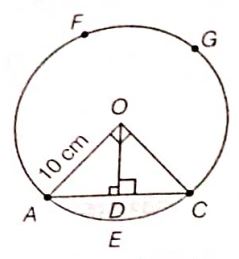
(i) Area of minor segment AECDA
= Area of sector OAECO - Area of \(\Delta\)AOC
= 78.5 - 50 = 28.5 cm2
(ii) Area of major sector OAFGCO
= Area of circle - Area of sector OAECO
= 3.14 \(\times\)(10)2 - 78.5
= 314 - 78.5 = 235.5 cm2
5.
We know that area of sector of a circle =\(\frac{\theta}{360^{\circ}} \times \pi r^2\)
Given, radius of circle, r = 6 cm
and angle of sector, \(\theta\)= 60°
\(\therefore\) Area of sector of a circle \(=\frac{60^{\circ}}{360^{\circ}} \times \frac{22}{7} \times(6)^2=\frac{132}{7} \mathrm{~cm}^2\)
6.
Given, side of the cube = Diameter of the hemisphere = l units
\(\therefore\) Radius of the hemisphere, \(r=\frac{l}{2}\) units
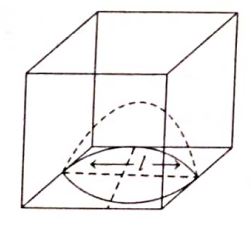
Now, required surface area of the remaining solid = TSA of the cube + CSA of hemisphere - Area of circular base of hemisphere
\(\begin{aligned} & =6 \times(\text { Edgc })^2+2 \pi r^2-\pi r^2 \\ \end{aligned}\)
\(\begin{aligned} & =6 \times l^2+2 \pi \times\left(\frac{l}{2}\right)^2-\pi\left(\frac{l}{2}\right)^2 \\ \end{aligned}\)
\(\begin{aligned} & =6 l^2+2 \pi \times \frac{l^2}{4}-\pi \frac{l^2}{4}=6 l^2+\pi \frac{l^2}{4} \\ \end{aligned}\)
\(\begin{aligned} & =\frac{l^2}{4}(\pi+24) \text { sq units } \end{aligned}\)
7.
Given, a cubical block is surmounted by a hemisphere. Therefore, diameter of hemisphere must be equal to the side of cubical block and it is the greatest diameter of hemisphere.
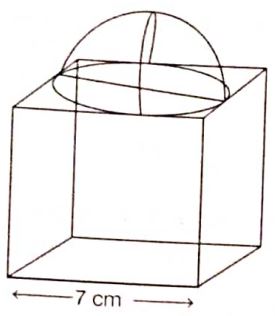
For cubical portion,
Edge = 7 cm
For hemispherical portion,
Diameter = 7 cm
\(\therefore\) Radius, r = \(\frac{7}{2}\)cm
Now, required surface area of solid = TSA of the cube + CSA of hemisphere - Area of circular base of hemisphere.
\(\begin{aligned} & =6 \times(\text { Edge })^2+2 \pi r^2-\pi r^2 \\ \end{aligned}\)
\(\begin{aligned} & =6 \times(7)^2+2 \times \frac{22}{7} \times \frac{7}{2} \times \frac{7}{2}-\frac{22}{7} \times \frac{7}{2} \times \frac{7}{2} \\ \end{aligned}\)
\(\begin{aligned} & =294+11 \times 7-\frac{11 \times 7}{2} \\ \end{aligned}\)
\(\begin{aligned} & =294+77-\frac{77}{2} \end{aligned}\)
= 371 - 38.5 = 332.5 cm2
8.
Given, diameter of circle, d = 35 mm
\(\therefore\) Circumference of circle = \(\pi\)d [\(\because\) d = 2r]
\(=\frac{22}{7} \times 35=110 \mathrm{~mm}^2\)
Now, length of 5 diameters = 5 \(\times\) 35 = 175 mm
(i) Total length of the silver wire = \(\pi\)d + 5d
= 110 + 175 = 285 mm2
(ii) Here, we see that total circle is divided into 10 sectors.
\(\therefore\) Angle of each sector = \(\frac{360^{\circ}}{10}=36^{\circ}\)
Then, area of each sector ofthe brooch = \(=\frac{\theta}{360^{\circ}} \times \pi r^2\)
\(\begin{aligned} & =\frac{36^{\circ}}{360^{\circ}} \times \frac{22}{7}\left(\frac{35}{2}\right)^2 \quad\left[\because r=\frac{d}{2}=\frac{35}{2} \mathrm{~mm}\right] \\ \end{aligned}\)
\(\begin{aligned} & =\frac{1}{10} \times \frac{22}{1} \times \frac{5}{2} \times \frac{35}{2}=\frac{11 \times 35}{2 \times 2}=\frac{385}{4} \mathrm{~mm}^2 \end{aligned}\)
9.
Let BPC be the hemisphere and ABC be the cone standing on the base of the hemisphere (see Figure). The radius BO of the hemisphere (as well as of the cone) \(=\frac{1}{2} \times 4 \mathrm{~cm}=2 \mathrm{~cm} .\)
So, volume of the toy = \(\begin{aligned} & =\frac{2}{3} \pi r^3+\frac{1}{3} \pi r^2 h \end{aligned}\)
\(\begin{aligned} & =\left[\frac{2}{3} \times 3.14 \times(2)^3+\frac{1}{3} \times 3.14 \times(2)^2 \times 2\right] \mathrm{cm}^3=25.12 \mathrm{~cm}^3 \end{aligned}\)
Now, let the right circular cylinder EFGH circumscribe the given solid. The radius of the base of the right circular cylinder = HP = BO = 2 cm, and its height is EH = AO + OP = (2 + 2) cm = 4 cm
So, the colume required = volume of the right circular cylinder - volume of the toy
= 3.14 \(\times\)22 \(\times\)4 - 25.12) cm3
= 25.12 cm3
hence, the required difference of the two volumes = 25.12 cm3.
10.
(i) The cumulative frequency table of given frequency distribution is
| Monthly consumption (in units) | Number of consumers (fi) | Cumulative frequency (cf) |
| 65-85 | 4 | 4 |
| 85-105 | 5 | 9 |
| 105-125 | 13 | 22 = cf |
| 125-145 | 20 = f | 42 |
| 145-165 | 14 | 56 |
| 165-185 | 8 | 64 |
| 185-205 | 4 | 68 |
| Total | n = 68 |
Here, n = 68
\(\therefore \quad \frac{n}{2}=34\)
Since, the cumulative frequency just greater than 34 is 42 and the corresponding class is 125- 145. So, the median class is 125-145.
Now, l = 125, f = 20, cf = 22 and h = 20
\(\begin{aligned} & \therefore \text { Median }=l+\left\{\frac{\frac{n}{2}-c f}{f}\right\} \times h \\ \end{aligned}\)
\(\begin{aligned} \quad=125+\left\{\frac{34-22}{20}\right\} \times 20=125+12=137 \text { units } \end{aligned}\)
(ii) Let the assumed mean, a = 135
and width of the class, h = 20
Table for the given data is
| Monthly consumption (in units) | Number of consumers (fi) | Class marks (xi) | \(u_1=\frac{x_i-135}{20}\) | fiui |
| 65-85 | 4 | 75 | -3 | -12 |
| 85-105 | 5 | 95 | -2 | -10 |
| 105-125 | 13 | 115 | -1 | -13 |
| 125-145 | 20 | a = 135 | 0 | 0 |
| 145-165 | 14 | 155 | 1 | 14 |
| 165-185 | 8 | 175 | 2 | 16 |
| 185-205 | 4 | 195 | 3 | 12 |
| Total | N = 68 | \(\sum\)fiui = 7 |
We have, N = 68, and \(\sum\)fiui = 7
By step deviation method,
Mean = \(\begin{aligned} \text { Mean } & =a+b \times \frac{1}{N} \times \Sigma f_i u_i=135+20 \times \frac{1}{68} \times 7 \\ \end{aligned}\)
\(\begin{aligned} & =135+\frac{35}{17}=135+2.05=137.05 \text { units } \end{aligned}\)
(iii) Here, the modal class is 125-145 having maximum frequency, f1 = 20.
Now, f0 = 13, f2 = 14, l = 125 and h = 20
\(\begin{aligned} \therefore \text { Mode } & =l+\left\{\frac{f_1-f_0}{2 f_1-f_0-f_2}\right\} \times h \\ \end{aligned}\)
\(\begin{aligned} & =125+\left\{\frac{20-13}{40-13-14}\right\} \times 20 \\ \end{aligned}\)
\(\begin{aligned} & =125+\frac{7 \times 20}{13}=125+\frac{140}{13} \end{aligned}\)
= 125 + 10.77 = 135.77 units
Hence, median = 137 units, mean = 137.05 units and mode = 135.77 units
So, we conclude that three measures are approximately the same.
(iv) Electricity consumption can be reduced by
(a) switching off electric appliances when not in use.
(b) using star rated AC's, refrigerators.
11.
Recall that to find the mean marks, we require the product of each xi with the corresponding frequency fi. So, let us put them in a column as shown in Table 1.
Table - 1
| Marks obtained (xi) | Number of students (fi) | fixi |
| 10 | 1 | 10 |
| 20 | 1 | 20 |
| 36 | 3 | 108 |
| 40 | 4 | 160 |
| 50 | 3 | 150 |
| 56 | 2 | 112 |
| 60 | 4 | 240 |
| 70 | 4 | 280 |
| 72 | 1 | 72 |
| 80 | 1 | 80 |
| 88 | 2 | 176 |
| 92 | 3 | 276 |
| 95 | 1 | 95 |
| Total | \(\Sigma {f}_{i}=30\) | \(\Sigma {f}_{i}{x}_{i}=1779\) |
Now, \(\bar{x}=\frac{\sum f_{i} x_{i}}{\Sigma f_{i}}=\frac{1779}{30}=59.3\)
Therefore, the mean marks obtained is 59.3.
In most of our real life situations, data is usually so large that to make a meaningful study it needs to be condensed as grouped data. So, we need to convert given ungrouped data into grouped data and devise some method to find its mean.
Let us convert the ungrouped data example into grouped data by forming class-intervals of width, say 15. Remember that, while allocating frequencies to each class-interval, students falling in any upper class-limit would be considered in the next class, e.g., 4 students who have obtained 40 marks would be considered in the classinterval 40-55 and not in 25-40. With this convention in our mind, let us form a grouped frequency distribution table. (see Table - 2)
Table - 2
| Class interval | 10-25 | 25-40 | 40-55 | 55-70 | 70-85 | 85-100 |
| Number of students | 2 | 3 | 7 | 6 | 6 | 6 |
Now, for each class-interval, we require a point which would serve as the representative of the whole class. It is assumed that the frequency of each classinterval is centred around its mid-point. So the mid-point (or class mark) of each class can be chosen to represent the observations falling in the class. Recall that we find the mid-point of a class (or its class mark) by finding the average of its upper and lower limits. That is,
\(\text { Class mark }=\frac{\text { Upper class limit }+\text { Lower class limit }}{2}\)
With reference to Table - 2, for the class 10-25, the class mark is \(\frac{10+25}{2}\) i.e.,
17.5. Similarly, we can find the class marks of the remaining class intervals. We put them in Table - 3. These class marks serve as our xi’s. Now, in general, for the ith class interval, we have the frequency fi corresponding to the class mark xi. We can now proceed to compute the mean in the same manner as in Example.
Table - 3
| Class interval | Number of students (fi) | Class mark (xi) | fixi |
| 10-25 | 2 | 17.5 | 35.0 |
| 25-40 | 3 | 32.5 | 97.5 |
| 40-55 | 7 | 47.5 | 332.5 |
| 55-70 | 6 | 62.5 | 375.0 |
| 70-85 | 6 | 77.5 | 465.0 |
| 85-100 | 6 | 92.5 | 555.0 |
| Total | \(\Sigma {f}_{i}=30\) | \(\Sigma {f}_{i}{x}_{i}=1860.0\) |
The sum of the values in the last column gives us \(\Sigma \)fi xi. So, the mean \(\bar {x}\) of the given data is given by
\(\bar{x}=\frac{\Sigma f_{i} x_{i}}{\Sigma f_{i}}=\frac{1860.0}{30}=62\)
This new method of finding the mean is known as the Direct Method.
We observe that Table -1 and Table - 3 are using the same data and employing the same formula for the calculation of the mean but the results obtained are different. Can you think why this is so, and which one is more accurate? The difference in the two values is because of the mid-point assumption in Table - 3, 59.3 being the exact mean, while 62 an approximate mean.
Sometimes when the numerical values of xi and fi are large, finding the product of xi and fi becomes tedious and time consuming. So, for such situations, let us think of a method of reducing these calculations.
We can do nothing with the fi’s, but we can change each xi to a smaller number so that our calculations become easy. How do we do this? What about subtracting a fixed number from each of these xi’s? Let us try this method. The first step is to choose one among the xi’s as the assumed mean, and denote it by ‘a’. Also, to further reduce our calculation work, we may take ‘a’ to be that xi which lies in the centre of x1, x2, . . ., xn. So, we can choose a = 47.5 or a = 62.5. Let us choose a = 47.5
The next step is to find the difference di between a and each of the xi’s, that is,the deviation of ‘a’ from each of the xi’s.
\(\text { i.e., } \quad d_{i}=x_{i}-a=x_{i}-47.5\)
The third step is to find the product of di with the corresponding fi, and take the sum of all the fi di’s. The calculations are shown in Table - 4.
Table - 4
| Class interval | Number of students | Class marks | di = xi- 47.5 | fidi |
| 10-25 | 2 | 17.5 | -30 | -60 |
| 25-40 | 3 | 32.5 | -15 | -45 |
| 40-55 | 7 | 47.5 | 0 | 0 |
| 55-70 | 6 | 62.5 | 15 | 90 |
| 70-85 | 6 | 77.5 | 30 | 180 |
| 85-100 | 6 | 92.5 | 45 | 270 |
| Total | \(\Sigma {f}_{i}=30\) | \(\Sigma {f}_{i}{d}_{i}=435\) |
So, from Table - 4, the mean of the deviations \(\bar{d}=\frac{\Sigma f_{i} d_{i}}{\Sigma f_{i}}\)
Now, let us find the relation between \(\bar {d}\) and \(\bar {x}\) .
Since in obtaining di, we subtracted ‘a’ from each xi, so, in order to get the mean \(\bar {x}\) , we need to add ‘a’ to \(\bar {d}\) . This can be explained mathematically as:
Mean of deviations \(\bar{d}=\frac{\Sigma f_{i} d_{i}}{\Sigma f_{i}}\)
So, \(\bar{d}=\frac{\Sigma f_{i} d_{i}}{\Sigma f_{i}} \)
\(\bar{d}=\frac{\Sigma f_{i}\left(x_{i}-a\right)}{\Sigma f_{i}}\)
\(=\frac{\Sigma f_{i} x_{i}}{\Sigma f_{i}}-\frac{\sum f_{i} a}{\Sigma f_{i}}\)
\(=\bar{x}-a \frac{\Sigma f_{i}}{\Sigma f_{i}} \)
\(=\bar{x}-a \)
So,
\(\bar{x} =a+\bar{d} \)
i.,e
\(\bar{x} =a+\frac{\Sigma f_{i} d_{i}}{\Sigma f_{i}}\)
Substituting the values of a, \(\Sigma\)fidi and \(\Sigma\)fi from Table - 4, we get
\(\bar{x}=47.5+\frac{435}{30}=47.5+14.5=62\)
Therefore, the mean of the marks obtained by the students is 62.
The method discussed above is called the Assumed Mean Method.
Activity 1 : From the Table - 3 find the mean by taking each of xi (i.e., 17.5, 32.5, and so on) as ‘a’. What do you observe? You will find that the mean determined in each case is the same, i.e., 62. (Why ?)
So, we can say that the value of the mean obtained does not depend on the choice of ‘a’.
Observe that in Table - 4, the values in Column 4 are all multiples of 15. So, if we divide the values in the entire Column 4 by 15, we would get smaller numbers to multiply with fi. (Here, 15 is the class size of each class interval.)
So, let \(u_{i}=\frac{x_{i}-a}{h}\) where a is the assumed mean and h is the class size.
Now, we calculate ui in this way and continue as before (i.e., find fiui and then \(\Sigma\)fi ui). Taking h = 15, let us form Table - 5.
Table - 5
| Class interval | fi | xi | di = xi- a | \(u_{i}=\frac{x_{i}-a}{h}\) | fiui |
| 10-25 | 2 | 17.5 | -30 | -2 | -4 |
| 25-40 | 3 | 32.5 | -15 | -1 | -3 |
| 40-55 | 7 | 47.5 | 0 | 0 | 0 |
| 55-70 | 6 | 62.5 | 15 | 1 | 6 |
| 70-85 | 6 | 77.5 | 30 | 2 | 12 |
| 85-100 | 6 | 92.5 | 45 | 3 | 18 |
| Total | \(\Sigma {f}_{i}=30\) | \(\Sigma {f}_{i}{u}_{i}=29\) |
Let \(\bar{u}=\frac{\Sigma f_{i} u_{i}}{\Sigma f_{i}}\)
Here, again let us find the relation between \(\bar {u}\) and \(\bar {x}\).
We have, \(u_{i} =\frac{x_{i}-a}{h} \)
Therefore, \(\bar{u} =\frac{\sum f_{i} \frac{\left(x_{i}-a\right)}{h}}{\Sigma f_{i}}=\frac{1}{h}\left[\frac{\Sigma f_{i} x_{i}-a \Sigma f_{i}}{\Sigma f_{i}}\right] \)
\(=\frac{1}{h}\left[\frac{\Sigma f_{i} x_{i}}{\Sigma f_{i}}-a \frac{\Sigma f_{i}}{\Sigma f_{i}}\right]\)
\(=\frac{1}{h}[\bar{x}-a] \)
So, \(h \bar{u} =\bar{x}-a \)
i.e., \(\bar{x} =a+h \bar{u} \)
So, \(\bar{x} =a+h\left(\frac{\sum f_{i} u_{i}}{\Sigma f_{i}}\right)\)
Now, substituting the values of a, h, \(\Sigma\)fiui and \(\Sigma\)fi from Table - 5, we get
\(\bar{x} =47.5+15 \times\left(\frac{29}{30}\right) \)
\(=47.5+14.5=62\)
So, the mean marks obtained by a student is 62.
The method discussed above is called the Step-deviation method.
12.
The total surface area of the cube = 6 × (edge)2 = 6 × 5 × 5 cm2 = 150 cm2.
Note that the part of the cube where the hemisphere is attached is not included in the surface area.
So, the surface area of the block = TSA of cube – base area of hemisphere + CSA of hemisphere
\(=150-\pi r^{2}+2 \pi r^{2}=\left(150+\pi r^{2}\right) \mathrm{cm}^{2} \)
\(=150 \mathrm{~cm}^{2}+\left(\frac{22}{7} \times \frac{4.2}{2} \times \frac{4.2}{2}\right) \mathrm{cm}^{2} \)
\(=(150+13.86) \mathrm{cm}^{2}=163.86 \mathrm{~cm}^{2}\)
13.
The cumulative frequencies with their respective class intervals are as follows.
| Life time | Number of lamps (fi) | Cumulative frequency |
| 1500 − 2000 | 14 | 14 |
| 2000 − 2500 | 56 | 14 + 56 = 70 |
| 2500 − 3000 | 60 | 70 + 60 = 130 |
| 3000 − 3500 | 86 | 130 + 86 = 216 |
| 3500 − 4000 | 74 | 216 + 74 = 290 |
| 4000 − 4500 | 62 | 290 + 62 = 352 |
| 4500 − 5000 | 48 | 352 + 48 = 400 |
| Total (n) | 400 |
It can be observed that the cumulative frequency just greater than n/2 (i.e 400/2 = 200) is 216
belonging to class interval 3000 − 3500.
Median class = 3000 − 3500
Lower limit (l) of median class = 3000
Frequency (f) of median class = 86
Cumulative frequency (cf) of class preceding median class = 130
Class size (h) = 500
\(\text { Median }=l+\left(\frac{\frac{n}{2}-c f}{f}\right) \times h \)
\(=3000+\left(\frac{200-130}{86}\right) \times 500 \)
\(=3000+\frac{70 \times 500}{86}\)
= 3406.976
Therefore, median life time of lamps is 3406.98 hours.
14.
To find the class mark (xi) for each interval, the following relation is used.
Class size = 50
Taking 225 as assumed mean (a), di, ui, fiui are calculated as follows.
| Daily expenditure (in Rs) | fi | xi | di = xi − 225 | ui= di/50 | fiui |
| 100-150 | 4 | 125 | -100 | -2 | -8 |
| 150-200 | 5 | 175 | -50 | -1 | -5 |
| 200-250 | 12 | 225 | 0 | 0 | 0 |
| 250-300 | 2 | 275 | 50 | 1 | 2 |
| 300-350 | 2 | 325 | 100 | 2 | 4 |
| Total | 25 | -7 |
From the table, we obtain
\(\sum f_{i}=25 \)
\(\sum f_{i} u_{i}=-7 \)
\(\text { Mean } \bar{x}=a+\left(\frac{\sum f_{1} u_{i}}{\sum f_{i}}\right) x h \)
\(=225+\left(\frac{-7}{25}\right) \times(50)\)
= 225 - 14
= 211
Therefore, mean daily expenditure on food is Rs 211.
15.
Given, circumference of a circle = 22 cm
\(\begin{array}{lll} \Rightarrow & 2 \pi r=22 \quad \Rightarrow \quad 2 \times \frac{22}{7} \times r=22 \\ \end{array}\)
\(\begin{array}{lll} \Rightarrow & \quad r=\frac{22 \times 7}{2 \times 22}=\frac{7}{2} \mathrm{~cm} \end{array}\)
Now, area of a quadrant of a circle \(=\frac{\pi r^2}{4}\)
\(\begin{aligned} & =\frac{22}{7} \times \frac{\left(\frac{7}{2}\right)^2}{4} \\ \end{aligned}\)
\(\begin{aligned} & =\frac{11}{14} \times \frac{49}{4}=\frac{77}{8} \mathrm{~cm}^2 \end{aligned}\)
16.
Since the inner diameter of the glass = 5 cm and height = 10 cm,
the apparent capacity of the glass \(=\pi r^{2} h\)
\(=3.14 \times 2.5 \times 2.5 \times 10 \mathrm{~cm}^{3}=196.25 \mathrm{~cm}^{3}\)
But the actual capacity of the glass is less by the volume of the hemisphere at the base of the glass.
i.e., it is less by \(\frac{2}{3} \pi r^{3}=\frac{2}{3} \times 3.14 \times 2.5 \times 2.5 \times 2.5 \mathrm{~cm}^{3}=32.71 \mathrm{~cm}^{3}\)
So, the actual capacity of the glass = apparent capacity of glass – volume of the hemisphere
= (196.25 – 32.71) cm3
=163.54 cm3
17.
(d)
\({P \over 720^o}\times 2\pi R^2\)

10th Standard CBSE Syllabus & Materials
10th Standard CBSE
CBSE 10th Social Science PS - Federalism - New Model Questions Papers Study Material - QB365 Set A
NEW10th Standard CBSE
CBSE 10th Social Science PS - Power Sharing - New Model Questions Papers Study Material - QB365 Set A
NEW10th Standard CBSE
CBSE 10th Social Science GEO - Manufacturing Industries - New Model Questions Papers Study Material - QB365 Set A
NEW10th Standard CBSE
CBSE 10th Social Science GEO - Minerals and Energy Resources - New Model Questions Papers Study Material - QB365 Set A



NCERT Books

Syllabus

Exam Pattern

Sample Question Papers

Previous year Question Papers

Important Notes

MCQ Practice test

NCERT Exemplers

Case study Questions

Image Based Questions

Passage based Questions

HOT Questions

Value Based Questions

Model Questions Papers
NCERT ( Book Back ) Questions

Assertion and Reason
Important Questions And Answers

CBSE 10th Standard CBSE Subjects
CBSE Standards