
 100% FREE ACCESS
10th Standard CBSE Syllabus & Materials
10th Standard CBSE
CBSE 10th Social Science ECO - Globalisation and the Indian Economy - New Model Questions Papers Study Material - QB365 Set A
NEW10th Standard CBSE
CBSE 10th Social Science ECO - Money and Credit - New Model Questions Papers Study Material - QB365 Set A
NEW10th Standard CBSE
CBSE 10th Social Science ECO - Sectors of the Indian Economy - New Model Questions Papers Study Material - QB365 Set A
NEW10th Standard CBSE
CBSE 10th Social Science ECO - Development - New Model Questions Papers Study Material - QB365 Set A
NEW10th Standard CBSE
CBSE 10th Social Science PS - Outcomes of Democracy - New Model Questions Papers Study Material - QB365 Set A
NEW10th Standard CBSE
CBSE 10th Social Science PS - Gender, Religion and Caste - New Model Questions Papers Study Material - QB365 Set A

Published on: 26/10/2025
Download CBSE Class 10th Standard CBSE Maths question papers, sample papers, important questions, and previous year solved papers in PDF format. Get free study materials, NCERT solutions, and exam preparation resources for Class 10th Standard CBSE Maths
Questions + Answers key
Take MCQ Maths Test
1.
Find the mean and mode of the following frequency distribution
| Classes | 0-10 | 10-20 | 20-30 | 30-40 | 40-50 | 50-60 | 60-70 |
| Frequency | 3 | 8 | 10 | 15 | 7 | 4 | 3 |
2.
An incomplete distribution is given as follows:
| Class interval | Frequency |
| 0-10 | 10 |
| 10-20 | 20 |
| 20-30 | ? |
| 30-40 | 40 |
| 40-50 | ? |
| 50-60 | 25 |
| 60-70 | 15 |
The median value is 35 and the sum of all the frequencies is 170. Using the median formula, fill up the missing frequencies.
3.
The following data is the distribution of student's height of a certain class in a certain city:
| Height (in cm) | 160-162 | 163-165 | 166-168 | 169-171 | 172-174 |
|---|---|---|---|---|---|
| Number of students | 15 | 118 | 142 | 127 | 18 |
Find the median height.
4.
If median=137 units and mean=137.05 units, then find the mode.
5.
Find the median of the first ten prime numbers.
6.
If the mode of the following series is 54, then find the value of f.
| Class | 0-15 | 15-30 | 30-45 | 45-60 | 60-75 | 75-90 |
|---|---|---|---|---|---|---|
| Frequency | 3 | 5 | f | 16 | 12 | 7 |
7.
In a class test, marks obtained by 120 students are given in the following frequency distribution. If it is given that mean is 59, then find the missing frequencies x and y.
| Marks | Number of students |
|---|---|
| 0-10 | 1 |
| 10-20 | 3 |
| 20-30 | 7 |
| 30-40 | 10 |
| 40-50 | 15 |
| 50-60 | x |
| 60-70 | 9 |
| 70-80 | 27 |
| 80-90 | 18 |
| 90-100 | y |
8.
Find the mean of the following data, by using step deviation method.
| Class | 10-20 | 20-30 | 30-40 | 40-50 | 50-60 | 60-70 |
|---|---|---|---|---|---|---|
| Frequency | 4 | 28 | 15 | 20 | 17 | 16 |
9.
The distribution of monthly wages of 200 workers of a certain factory is as given below
| Monthly wages | 80-100 | 100-120 | 120-140 | 140-160 | 160-180 |
| Number of workers | 20 | 30 | 20 | 40 | 90 |
Change the above distribution to a 'more than type' distribution and draw its ogive
10.
The following distribution gives the distribution of life times of washing machines of a certain company
| Life time (in hours) | 1000-1200 | 1200-1400 | 1400-1600 | 1600-1800 | 1800-2000 | 2000-2200 | 2200-2400 |
| Number of washing machines | 15 | 60 | 68 | 86 | 75 | 61 | 45 |
Convert the above distribution into 'less than type' and draw its ogive
11.
Calculate the average daily income (in Rs of the following data about men working in a company:
| Daily income(Rs) | <100 | <200 | <300 | <400 | <500 |
| Number ofmen | 12 | 28 | 34 | 41 | 50 |
12.
During the medical check-up 35 students of a class, their weights were recorded as follows:
| Weight (in kg) | Number of students |
|---|---|
| Less than 38 | 0 |
| Less than 40 | 3 |
| Less than 42 | 5 |
| Less than 44 | 9 |
| Less than 46 | 14 |
| Less than 48 | 28 |
| Less than 50 | 32 |
| Less than 52 | 35 |
Draw a 'less than type' ogive for the given data. Hence, obtain the median weight from the graph and verify the result by using the formula. What are benefits of regular medical check-up?
13.
A boy scored the following marks in various tests during a term, each test being marked out of 20 15, 17, 16, 7, 10, 12, 14, 16, 19, 12, 16. The median marks are
15
16
13
18
14.
For the following distribution the differences in the upper limit of median and modal class is
| C1 | 0-10 | 10-20 | 20-30 | 30-40 | 40-50 |
| F | 2 | 5 | 7 | 5 | 2 |
40
10
0
20
15.
| Expendicture | 0-10 | 10-20 | 20-30 | 30-40 | 40-50 |
| No. of families | 14 | 23 | 27 | 21 | 15 |
What is the mode of the given data?
25
27
22
21
16.
A batsman in his 12th innings makes a score of 63 runs and thereby increases his average score by 2. His average score after 12th
41
60
51
45
17.
If the median of the following data is 166.79, then the mean and mode are
| Class Interval | Frequency |
| 130-140 | 5 |
| 140-150 | 9 |
| 150-160 | 17 |
| 160-170 | 28 |
| 170-180 | 24 |
| 180-190 | 10 |
| 190-200 | 7 |
Mode = 161.9 Mean = 168
Mode = 152.9 Mean = 166.73
Mode = 160.9 Mean = 167
Mode = 167.3, Mean = 168.03
18.
1.
| Class Interval | Xi | fi | fixi |
| 010 | 5 | 3 | 15 |
| 10-20 | 15 | 8 | 120 |
| 20-30 | 25 | 10 | 250 |
| 30-40 | 35 | 15 | 525 |
| 40-50 | 45 | 7 | 315 |
| 50-60 | 55 | 4 | 220 |
| 60-70 | 65 | 3 | 1954 |
| \(\Sigma f_{ i }=50\) | \(\Sigma f_{ i }x_{ i }=1640\) |
Mean = \(\frac { \Sigma f_{ i }x_{ i } }{ \Sigma f_{ i } } =\frac { 1640 }{ 50 } \times 32.8\)
Modal class = 30-40
l=30, f1=15 , f2=7, f0=10 , h=10
Mode = \(l+\frac { f_{ 1 }-f_{ 0 } }{ 2f_{ 1 }f_{ 0 }-f_{ 2 } } \times h\)
\(30+\frac { 15+10 }{ 30-10-7 } \times 10\)
30+3.85
=33.85
2.
Let frequency of class 20-30 be f1 and that of class 40-50 be f2.
Since, the sum of all frequency is 170.
The cumulative frequency table for given distribution is
| Class interval | Frequency | Cumulative frequency |
|---|---|---|
| 0-10 | 10 | 10 |
| 10-20 | 20 | 30 |
| 20-30 | f1 | 30+f1 |
| 30-40 | 40 | 70+f1 |
| 40-50 | f2 | 70+f1+f2 |
| 50-60 | 25 | 95+f1+f2 |
| 60-70 | 15 | 110+f1+f2 |
Here, median=35
So, the median is 30-40. Also, n=170\(\Rightarrow \quad \frac { n }{ 2 } =85\)
∴ l=30, f=40, c.f=30+f1 and h=10
Now median \(=l+\left\{ \frac { \frac { n }{ 2 } -cf }{ f } \right\} \times h\)
\(\Rightarrow \quad 35=30+\left\{ \frac { 85-(30+f_{ 1 }) }{ 40 } \right\} \times 10\\ \Rightarrow \quad 35\times 4=120+(55-f_{ 1 })\\ \Rightarrow \quad 140=175-f_{ 1 }\Rightarrow f_{ 1 }=35\)
Also, 110+f1+f2=170 [∵ sum of all frequencies=170, given]
\(\Rightarrow \quad f_{ 1 }+f_{ 2 }=60\\ \Rightarrow \quad 35+f_{ 2 }=60\\ \therefore \quad f_{ 2 }=60-35=25\)
Hence, the missing frequency of the class 20-30 is 35 and the class 40-50 is 25.
3.
167.13
4.
Given, median=137 units and mean=137.05 units
We know that,
Mode=3(Median-2(Mean)
=3(137)-2(137.05)
=411-274.10=136.90
Hence, the value of mode is 136.90 units.
5.
First ten prime numbers in ascending order are 2, 3, 5, 7, 11, 13, 17, 19, 23 and 29.
Here, n=10 [even]
∴ Median
\(=\frac { 1 }{ 2 } \times Value\quad of\quad \left[ \left( \frac { n }{ 2 } \right) th+\left( \frac { n }{ 2 } +1 \right) th \right] observation\\ =\frac { 1 }{ 2 } \times Value\quad of\quad \left[ \left( \frac { 10 }{ 2 } \right) th+\left( \frac { 10 }{ 2 } +1 \right) th \right] observation\)
\(\)\(=\frac { 1 }{ 2 } \) [Value of 5th observation+Value of 6th ob
servation]
\(=\frac { 1 }{ 2 } [11+13]\)
\(=\frac { 24 }{ 2 }=2\)
\(\)
6.
Here, given mode, is 54, which lies between 45-60. Therefore, the modal class is 45-60.
l=45, f1=16, f0=f, f2=12 and h=15
Mode \(=l+\left( \frac { f_{ 1 }-f_{ 0 } }{ 2f_{ 1 }-f_{ 0 }-f_{ 2 } } \right) \times h\)
\(54-45+\frac { 16-f }{ 32-f-12 } \times 15\Rightarrow 9=\frac { 16-f }{ 20-f } \times 15\\ \Rightarrow \quad 9(20-f)=15(16-f)\\ \Rightarrow \quad 180-9f=240-15f\\ \Rightarrow \quad 6f=240-180=60\Rightarrow f=10\)
Hence, required value of f is 10.
7.
Let the assumed mean, a=55 and width of class interval, h=10.Table for given data is
| Marks | Class marks (xi) | Number of students (fi) | \(u_{ i }=\frac { x_{ i }-a }{ h } \) | fiui |
|---|---|---|---|---|
| 0-10 | 5 | 1 | -5 | -5 |
| 10-20 | 15 | 3 | -4 | -12 |
| 20-30 | 25 | 7 | -3 | -21 |
| 30-40 | 35 | 10 | -2 | -20 |
| 40-50 | 45 | 15 | -1 | -15 |
| 50-60 | 55=a | x | 0 | 0 |
| 60-70 | 65 | 9 | 1 | 9 |
| 70-80 | 75 | 27 | 2 | 54 |
| 80-90 | 85 | 18 | 3 | 54 |
| 90-100 | 95 | y | 4 | 4y |
| Total | \(N=\sum { f_{ i } } =90+x+y\) | \(\sum { f_{ i }u_{ i } } =44+4y\) |
Now, we have, N=90+x+y
\(\Rightarrow \quad 120=90+x+y\)
\(\Rightarrow \quad x+y=30\)
\(\because \quad Mean=59\)
\(\Rightarrow \quad a+\left( \frac { \sum { f_{ i }u_{ i } } }{ N } \right) \times h=59\)
\(\Rightarrow \quad 55+\left( \frac { 44+4y }{ 120 } \right) \times 10=59\)
\(\Rightarrow \quad \frac { 11+y }{ 3 } =4\)
\(\Rightarrow \quad 11+y=12\)
\(\Rightarrow \quad y=1\)
On putting the value of y in Eq.(i), we get
x + 1 = 30⇒ x = 29
Hence, x = 29 and y = 1.
8.
Here, class width, h = 20 - 10- = 10. Nw, let the assumed
Mean, a = 35.
Then, table for the given data is
| Class | xi | fi | \(u_{ i }=\frac { x_{ i }-a }{ h } \) | fiui |
|---|---|---|---|---|
| 10-20 | \(\frac { 10+20 }{ 2 } =15\) | 4 | \(\frac { 15-35 }{ 10 } =\frac { -20 }{ 10 } =-2\) | -8 |
| 20-30 | \(\frac { 20+30 }{ 2 } =25\) | 28 | \(\frac { 25-35 }{ 10 } =\frac { -10 }{ 10 } =-1\) | -28 |
| 30-40 | \(\frac { 30+40 }{ 2 } =35=a\) | 15 | \(\frac { 35-35 }{ 10 } =\frac { 0 }{ 10 } =0\) | 0 |
| 40-50 | \(\frac { 40+50 }{ 2 } =45\) | 20 | \(\frac { 45-35 }{ 10 } =\frac { 10 }{ 10 } =1\) | 20 |
| 50-60 | \(\frac { 50+60 }{ 2 } =55\) | 17 | \(\frac { 55-35 }{ 10 } =\frac { 20 }{ 10 } =2\) | 34 |
| 60-70 | \(\frac { 60+70 }{ 2 } =65\) | 16 | \(\frac { 65-35 }{ 10 } =\frac { 30 }{ 10 } =3\) | 48 |
| Total | \(\sum { f_{ i } } =100\) | \(\sum { f_{ i }u_{ i } } =66\) |
Now, we have,
\(\sum { f_{ i }u_{ i } } =66\), \(\sum { f_{ i } } =100\), a=35 and h=10
Mean \((\overline { x } )=a+\left( \frac { \sum { f_{ i }u_{ i } } }{ \sum { f_{ i } } } \right) \times h\)
\(=35+\frac { 66 }{ 100 } \times 10\)
\(=35+\frac { 66 }{ 100 } \)
\(=35+6.6=41.6\)
9.
| Wages | c.f |
| More than 80 | 200 |
| More than 100 | 180 |
| More than 120 | 150 |
| More than 140 | 130 |
| More than 160 | 90 |
10.
| Life time | c.f. |
| Less than 1200 | 15 |
| Less than 1400 | 75 |
| Less than 1600 | 143 |
| Less than 1800 | 229 |
| Less than 2000 | 304 |
| Less than 2200 | 365 |
| Less than 2400 | 410 |
11.
| Class | xi(class mark) | fi | fixi |
| 0-100 | 50 | 12 | 600 |
| 100-200 | 150 | 16 | 2400 |
| 200-300 | 250 | 6 | 1500 |
| 300-400 | 350 | 7 | 2450 |
| 400-500 | 450 | 9 | 4050 |
| Total | \(\Sigma f_{ i }=50\) | \(\Sigma x_{ i }f=11,000\) |
Mean = \(\frac { \Sigma x_{ i }f_{ i } }{ \Sigma f_{ i } } =\frac { 11000 }{ 50 } \)
= 220
Average daily Income = Rs 220
12.
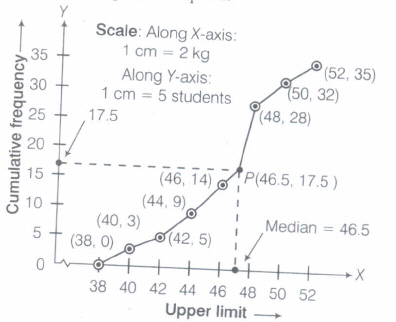
Benefits of regular medical check-up are
(t) It enables us to take pre-medical action on time.
(it) It reduces the chances of getting sick.
13.
(a)
15
14.
(c)
0
15.
(b)
27
16.
(a)
41
17.
(a)
Mode = 161.9 Mean = 168
18.
(d)

10th Standard CBSE Syllabus & Materials
10th Standard CBSE
CBSE 10th Social Science PS - Federalism - New Model Questions Papers Study Material - QB365 Set A
NEW10th Standard CBSE
CBSE 10th Social Science PS - Power Sharing - New Model Questions Papers Study Material - QB365 Set A
NEW10th Standard CBSE
CBSE 10th Social Science GEO - Manufacturing Industries - New Model Questions Papers Study Material - QB365 Set A
NEW10th Standard CBSE
CBSE 10th Social Science GEO - Minerals and Energy Resources - New Model Questions Papers Study Material - QB365 Set A



NCERT Books

Syllabus

Exam Pattern

Sample Question Papers

Previous year Question Papers

Important Notes

MCQ Practice test

NCERT Exemplers

Case study Questions

Image Based Questions

Passage based Questions

HOT Questions

Value Based Questions

Model Questions Papers
NCERT ( Book Back ) Questions

Assertion and Reason
Important Questions And Answers

CBSE 10th Standard CBSE Subjects
CBSE Standards