 100% FREE ACCESS
10th Standard CBSE Syllabus & Materials
10th Standard CBSE
CBSE 10th Social Science ECO - Globalisation and the Indian Economy - New Model Questions Papers Study Material - QB365 Set A
NEW10th Standard CBSE
CBSE 10th Social Science ECO - Money and Credit - New Model Questions Papers Study Material - QB365 Set A
NEW10th Standard CBSE
CBSE 10th Social Science ECO - Sectors of the Indian Economy - New Model Questions Papers Study Material - QB365 Set A
NEW10th Standard CBSE
CBSE 10th Social Science ECO - Development - New Model Questions Papers Study Material - QB365 Set A
NEW10th Standard CBSE
CBSE 10th Social Science PS - Outcomes of Democracy - New Model Questions Papers Study Material - QB365 Set A
NEW10th Standard CBSE
CBSE 10th Social Science PS - Gender, Religion and Caste - New Model Questions Papers Study Material - QB365 Set A

Published on: 26/10/2025
Download CBSE Class 10th Standard CBSE Maths question papers, sample papers, important questions, and previous year solved papers in PDF format. Get free study materials, NCERT solutions, and exam preparation resources for Class 10th Standard CBSE Maths
Questions + Answers key
Take MCQ Maths Test
1.
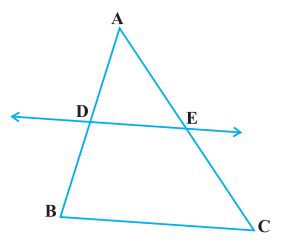
If a line divides any two sides of a triangle in the same ratio, then the line is parallel to the third side.
2.
In the given figure, if DE II AC and DF II AE. Prove that \(\frac { BF }{ FE } =\frac { BE }{ EC } .\)
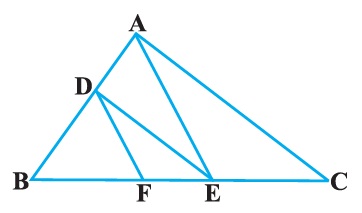
3.
If a line intersects sides AB and AC of a \(\triangle\) ABC at D and E respectively and is parallel to BC, prove that \(\frac { AD }{ AB } =\frac { AE }{ AC } .\)
4.
In the given figure, if LM II CB and LN II CD. Prove that \(\frac { AM }{ AB } =\frac { AN }{ AD } .\)
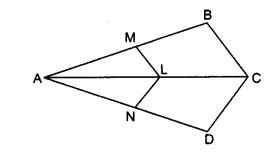
Use the basic proportionality theorem in both \(\Delta\)ABC and \(\Delta\)ACD
5.
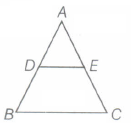
Using theorem (converse of basic proportionality theorem), prove that the line joining the mid-points of any two sides of a triangle, is parallel to the third side. (Recall that you have done it in Class IX.)
6.
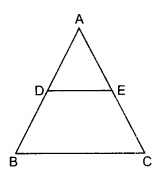
Using theorem (Thales theorem), prove that a line drawn through the mid-point of one side of a triangle parallel to another side, bisects the third side. (Recall that you have proved it in Class IX.)
7.
In \(\triangle ABC\) , D and E are points on the sides AB and AC respectively, such that \(DE\parallel BC\) . If AD = 4x - 3, AE = 8x - 7, BD = 3x - 1 and CE = 5x - 3, find the value of x.
8.
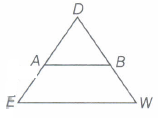
In \(\triangle DEW, AB\parallel EW\). If AD = 4 cm, DE = 12 cm and DW = 24 cm, find the value of DB.
9.
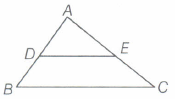
In the given figure, \(DE\parallel BC\) . If AD = 3 cm, DB = 4 cm and AE = 6 cm, find EC.
10.
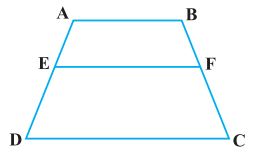
ABCD is a trapezium with AB || DC. E and F are points on non-parallel sides AD and BC respectively such that EF is parallel to AB. Show that \(\frac{AE}{ED}=\frac{BF}{FC}\).
11.
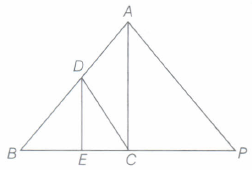
In the given figure of \(\triangle ABC\), \(DE\parallel AC\). If \(DC\parallel AP\), where point P lies on BC produced, then prove that \(\frac { BE }{ EC } =\frac { BC }{ CP } \).
12.
If D and E are points on the respective sides AB and AC of \(\triangle ABC\) such that AD = 6 cm. BD = 9 cm, AE = 8 cm, EC = 12 cm. Prove that \(DE\parallel BC\).
13.
In \(\triangle ABC\), points P and Q are on CA and CB, respectively such that CA = 16 cm, CP = 10 cm, CB = 30 cm and CQ = 25 cm. Is \(PQ\parallel AB\) ?
14.
Give two examples of pair of similar and non-similar figures.
15.
E and F are points on the sides PQ and PR respectively of a ΔPQR. For the following case, state whether EF || QR. PQ = 1.28 cm, PR = 2.56 cm, PE = 0.18 cm and PF = 0.36 cm
16.
E and F are points on the sides PQ and PR respectively of a ΔPQR. For the following case, state whether EF || QR
PE = 4 cm, QE = 4.5 cm, PF = 8 cm and RF = 9 cm
17.
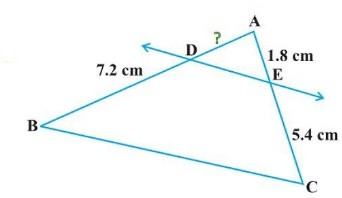
See the given Figure. DE || BC. Find AD
18.
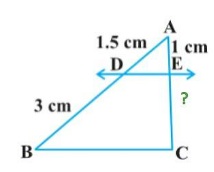
See the given Figure. DE || BC. Find EC
19.
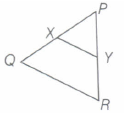
In the given figure, \(XY\parallel QR\), PQ / XQ = 7 /3 and PR = 6.3 cm. Find the value of YR.
20.
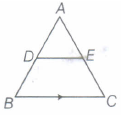
In \(\triangle ABC,DE\parallel BC\), so that AD = (7x - 4) cm, AE = (5x - 2) cm, DB = (3x + 4) cm and EC = 3x cm. Then, find the value of x.
21.
E and F are points on the sides PQ and PR respectively of a ΔPQR. For the following case, state whether EF || QR. PE = 3.9 cm, EQ = 3 cm, PF = 3.6 cm and FR = 2.4 cm
22.
Give two different examples of pair of
(i) similar figures
(ii) non-similar figures
23.
Fill in the blanks using the correct word given in brackets.
(i) All circles are --------------- (congruent, similar)
(ii) All squares are -------------- (similar, congruent)
(iii) All ------------- triangles are similar. (isosceles, equilateral)
(iv) Two polygons of the same number of sides are similar, if (a) their corresponding angles are ------------- and (b) their corresponding sides are ------------- (equal, proportional)
1.
This theorem can be proved by taking a line DE such that \(\frac{\mathrm{AD}}{\mathrm{DB}}=\frac{\mathrm{AE}}{\mathrm{EC}}\) and assuming that DE is not parallel to BC.
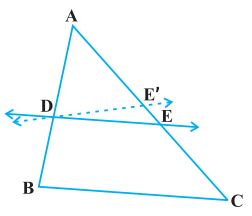
If DE is not parallel to BC, draw a line DE' parallel to BC.
So, \(\frac{\mathrm{AD}}{\mathrm{DB}}=\frac{\mathrm{AE}^{\prime}}{\mathrm{E}^{\prime} \mathrm{C}}\)
Therefore, \(\frac{\mathrm{AE}}{\mathrm{EC}}=\frac{\mathrm{AE}^{\prime}}{\mathrm{E}^{\prime} \mathrm{C}}\)
Adding 1 to both sides of above, you can see that E and E' must coincide.
Let us take some examples to illustrate the use of the above theorems.
2.
In \(\triangle\)ABC DE || AC, (Given)
\(\frac { BD }{ DA } =\frac { BE }{ EC } \quad \quad \quad (BPT)\quad ...(i)\)
In \(\triangle\)ABE, DF || AE, (Given)
\(\frac { BD }{ DA } =\frac { BF }{ FE } \quad \quad \quad (BPT)\quad ...(ii)\)
From (i) and (ii), we have
\(\frac { BF }{ FE } =\frac { BE }{ EC } \)
Hence proved.
3.
DE || BC (Given)
So, \(\begin{aligned} {\frac{\mathrm{AD}}{\mathrm{DB}}}=\frac{\mathrm{AE}}{\mathrm{EC}} \end{aligned}\)
or, \(\begin{aligned} \frac{\mathrm{DB}}{\mathrm{AD}}=\frac{\mathrm{EC}}{\mathrm{AE}} \\ \end{aligned}\)
or, \(\begin{aligned} \frac{\mathrm{DB}}{\mathrm{AD}}+1=\frac{\mathrm{EC}}{\mathrm{AE}}+1 \\ \end{aligned}\)
or, \(\begin{aligned} \frac{\mathrm{AB}}{\mathrm{AD}}=\frac{\mathrm{AC}}{\mathrm{AE}} \end{aligned}\)
So, \(\begin{aligned} \frac{\mathrm{AD}}{\mathrm{AB}}=\frac{\mathrm{AE}}{\mathrm{AC}} \end{aligned}\)
4.
In \(\Delta\)ACB, LM || CB [given]
\(\Rightarrow \quad \frac{A M}{M B}=\frac{A L}{L C}\) ....(i)
[ by basic proportionality theorem]
In \(\Delta\)ACD, LN ||CD [given]
\(\Rightarrow \quad \frac{A N}{N D}=\frac{A L}{L C}\) ....(ii)
[by basic proportionality theorem]
From Eqs. (i) and (ii), we get
\(\frac{A M}{M B}=\frac{A N}{N D} \Rightarrow \frac{M B}{A M}=\frac{N D}{A N}\)
[on taking reciprocal of the terms]
\(\Rightarrow \quad \frac{M B}{A M}+1=\frac{N D}{A N}\) + 1 [adding 1 on both sides]
\(\begin{aligned} & \Rightarrow \quad \frac{M B+A M}{A M}=\frac{N D+A N}{A N} \\ \end{aligned}\)
\(\begin{aligned} \Rightarrow \quad \frac{A M}{A M+M B}=\frac{A N}{A N+N D} \end{aligned}\)
[on taking reciprocal of the terms]
\(\therefore \quad \frac{A M}{A B}=\frac{A N}{A D} \quad\left[\begin{array}{c} \because A D=A N+N D \\ \text { and } A B=A M+M B \end{array}\right]\)
Hence proved.
5.
Consider \(\triangle ABC\), in which D and E are the mid-points of sides AB and AC, respectively.
\(\because \frac { AD }{ DB } =1\quad and\quad \frac { AE }{ EC } =1\Rightarrow \quad \frac { AD }{ DB } =\frac { AE }{ EC } \)
\(\therefore DE\parallel BC\)
[by converse of basic proportionality theorem]
Hence, the line joining the mid-points of any two sides of a triangle, is parallel to the third side.
Hence proved.
6.
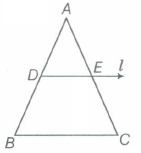
Consider \(\triangle ABC\), in which D is the mid-point of AB.
Then, \(\frac { AD }{ DB } =1\) ... (i)
Line l is drawn through D such that \(l\parallel BC\) and it meets AC at E.
By basic proportionality theorem,
\(\frac { AD }{ DB } =\frac { AE }{ EC } \)
\(\Rightarrow \frac { AE }{ EC } =1\) [from Eq. (i)]
\(\Rightarrow AE=EC\)
So, E is the mid-point of AC.
Hence, a line drawn through the mid-point of one side of a triangle parallel to another side, bisects the third side.
Hence proved.
7.
Given, in \(\triangle ABC\), \(DE\parallel BC\)
By Thales theorem, we get
\(\frac { AD }{ DB } =\frac { AE }{ EC } \)
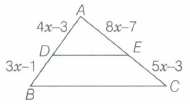
\(\Rightarrow \frac { 4x-3 }{ 3x-1 } =\frac { 8x-7 }{ 5x-3 } \)
[\(\because \) AD = 4x - 3, DB = 3x - 1, AE = 8x - 7, EC = 5x - 3]
\(\Rightarrow \) (4x - 3)(5x - 3) = (8x - 7)(3x - 1)
\(\Rightarrow \) 20x2 - 12x + 9 - 15x = 24x2 - 21x - 8x + 7
\(\Rightarrow \) 4x2 - 2x - 2 = 0
\(\Rightarrow \) 2x2 - x - 1 = 0 [dividing both sides by 2]
\(\Rightarrow \) 2x2 - 2x + x - 1 = 0 [by splitting the middle term]
\(\Rightarrow \) 2x(x - 1) + 1 (x - 1) = 0
\(\Rightarrow \) (2x + 1) (x - 1) = 0 \(\therefore x=-\frac { 1 }{ 2 } \) or x = 1
If \(x=-\frac { 1 }{ 2 } \), then AD = \(4\times -\frac { 1 }{ 2 } -3=-5<0\) [not possible]
Hence, x = 1 is the required value.
8.
\(\because AB\parallel EW\) [given]
\(\therefore \frac { DA }{ AE } =\frac { DB }{ BW } \) [by basic proportionality theorem]
\(\Rightarrow \frac { DA }{ DE-DA } =\frac { DB }{ DW-DB } \)
\(\Rightarrow \frac { 4 }{ 12-4 } =\frac { DB }{ 24-DB } \Rightarrow \frac { 4 }{ 8 } =\frac { DB }{ 24-DB } \)
\(\Rightarrow 24-DB=2DB\Rightarrow 24=3DB\Rightarrow DB=\frac { 24 }{ 3 } =\) 8 cm
9.
In \(\triangle ABC, DE\parallel BC\)
Let EC = x cm
\(\Rightarrow \frac { AD }{ DB } =\frac { AE }{ EC } \)
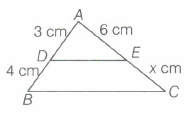
[by basic proportionality theorem]
\(\Rightarrow \frac { 3 }{ 4 } =\frac { 6 }{ x } \Rightarrow \) x = 8 cm
\(\therefore \) EC = 8 cm
10.
Let us join AC to intersect EF at G
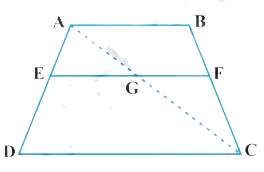
AB || DC and EF || AB (Given)
So, EF || DC (Lines parallel to the same line are parallel to each other)
Now, in \(\Delta\) ADC,
EG || DC (As EF || DC)
So, \(\frac{AE}{ED}=\frac{AG}{GC}\)
Similarly, from \(\Delta\)CAB,
\(\begin{aligned} & \frac{C G}{A G}=\frac{C F}{B F} \\ \end{aligned}\)
\(\begin{aligned} & \frac{A G}{G C}=\frac{B F}{F C} \end{aligned}\)
Therefore, from (1) and (2),
\(\frac{\mathrm{AE}}{\mathrm{ED}}=\frac{\mathrm{BF}}{\mathrm{FC}}\)
11.
Given, in \(\triangle ABC\), \(DE\parallel AC\) [given]
So, \(\frac { BE }{ EC } =\frac { BD }{ DA } \) ... (i)
[ by basic proportionality theorem]
Also, \(DC\parallel AP\) [given]
So, \(\frac { BC }{ CP } =\frac { BD }{ DA } \) ... (ii)
[ by basic proportionality theorem]
From Eqs. (i) and (ii), we get
\(\frac { BE }{ EC } =\frac { BC }{ CP } \)
12.
In \(\triangle ABC\), \(\frac { AD }{ DB } =\frac { 6 }{ 9 } =\frac { 2 }{ 3 } \)
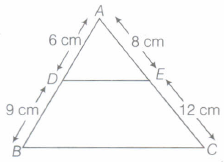
and \(\frac { AE }{ EC } =\frac { 8 }{ 12 } =\frac { 2 }{ 3 } \)
So, \(\frac { AD }{ DB } =\frac { AE }{ EC } \)
Hence, \(DE\parallel BC\)
[ by converse of basic proportionallity theorem]
13.
Given, CQ = 25 cm, CB = 30 cm, CP = 10 cm and CA = 16 cm
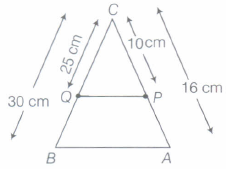
Here, \(\frac{C Q}{C B}=\frac{25}{30}=\frac{5}{6}\)
and \(\frac{C P}{C A}=\frac{10}{16}=\frac{5}{8} \Rightarrow \frac{C Q}{C B} \neq \frac{C P}{C A}\)
\(\Rightarrow \frac{C B}{C Q} \neq \frac{C A}{C P} \Rightarrow \frac{C B}{C Q}-1 \neq \frac{C A}{C P}-1\)
\(\Rightarrow \frac{C B-C Q}{C Q} \neq \frac{C A-C P}{C P}\)
\(\Rightarrow \frac{Q B}{C Q} \neq \frac{P A}{C P} \text { or } \frac{C Q}{Q B} \neq \frac{C P}{P A}\)
Then, by converse of basic proportionality theorem, PQ is not parallel to AB.
14.
(i) Examples of similar figures:
(a) All squared
(b) All regular hexagons
(ii) Examples of non-similar figures:
(a) Two isosceles triangles of different angle measures
(b) Two rhombus of different angle measures.
15.
PQ = 1.28 cm, PR = 2.56 cm, PE = 0.18 cm, PF = 0.36 cm
\( \frac{P E}{P Q}=\frac{0.18}{1.28}=\frac{18}{128}=\frac{9}{64} \)
\(\frac{P F}{P R}=\frac{0.36}{2.56}=\frac{9}{64} \)
Hence \(\frac{P E}{P Q}=\frac{P F}{P R}\)
Therefore EF is parallel to QR
16.
PE = 4 cm, QE = 4.5 cm, PF = 8 cm, RF = 9 cm
\( \frac{P E}{E Q}=\frac{4}{4.5}=\frac{8}{9} \)
\(\frac{P F}{F R}=\frac{8}{9} \)
\(\frac{P F}{F R}=\frac{P E}{E Q} \)
Therefore, EF is parallel to QR
17.
Let AD = x cm
It is given that DE || BC.
By using basic proportionality theorem, we obtain
\( \frac{A D}{D B}=\frac{A E}{E C} \)
\(\frac{x}{7.2}=\frac{1.8}{5.4} \)
\(x=\frac{1.8 \times 7.2}{5.4}\)
x = 2.4
∴ AD = 2.4 cm
18.
Let EC = x cm
It is given that DE || BC.
By using basic proportionality theorem, we obtain
\(\frac{A D}{D B}=\frac{A E}{E C}\)
\(\frac{1.5}{3}=\frac{1}{x}\)
\(x=\frac{3 \times 1}{1.5}\)
x = 2
∴ EC = 2 cm
19.
2.7 cm
20.
x = 4
21.
Given that, PE = 3.9 cm, EQ = 3 cm, PF = 3.6 cm, FR = 2.4 cm
\( \frac{P E}{E Q}=\frac{3.9}{3}=1.3 \)
\(\frac{P F}{F R}=\frac{3.6}{2.4}=1.5\)
Hence, \(\frac{P E}{E Q} \neq \frac{P F}{F R}\)
Therefore, EF is not parallel to QR
22.
(i) (a) Pair of the equilateral triangles are similar figures.
(b) Pair of the squares are similar figures.
(ii) (a) A triangle and a quadrilateral form a pair of non-similar figures.
(b) A square and a circle form a pair of non-similar figures.
23.
(i) AIl circles are similar because all circles have same shape but size can vary.
(ii) All squares are similar because all squares have same shape but size can vary.
(iii) All equilateral triangles are similar because all equilateral triangle have same shape but size can vary.
(iv) Two polygons of the same number of sides are similar, if
(a) their corresponding angles are cqual and
(b) their corresponding sides are proportional.

10th Standard CBSE Syllabus & Materials
10th Standard CBSE
CBSE 10th Social Science PS - Federalism - New Model Questions Papers Study Material - QB365 Set A
NEW10th Standard CBSE
CBSE 10th Social Science PS - Power Sharing - New Model Questions Papers Study Material - QB365 Set A
NEW10th Standard CBSE
CBSE 10th Social Science GEO - Manufacturing Industries - New Model Questions Papers Study Material - QB365 Set A
NEW10th Standard CBSE
CBSE 10th Social Science GEO - Minerals and Energy Resources - New Model Questions Papers Study Material - QB365 Set A



NCERT Books

Syllabus

Exam Pattern

Sample Question Papers

Previous year Question Papers

Important Notes

MCQ Practice test

NCERT Exemplers

Case study Questions

Image Based Questions

Passage based Questions

HOT Questions

Value Based Questions

Model Questions Papers
NCERT ( Book Back ) Questions

Assertion and Reason
Important Questions And Answers

CBSE 10th Standard CBSE Subjects
CBSE Standards