
 100% FREE ACCESS
10th Standard CBSE Syllabus & Materials
10th Standard CBSE
CBSE 10th Social Science ECO - Globalisation and the Indian Economy - New Model Questions Papers Study Material - QB365 Set A
NEW10th Standard CBSE
CBSE 10th Social Science ECO - Money and Credit - New Model Questions Papers Study Material - QB365 Set A
NEW10th Standard CBSE
CBSE 10th Social Science ECO - Sectors of the Indian Economy - New Model Questions Papers Study Material - QB365 Set A
NEW10th Standard CBSE
CBSE 10th Social Science ECO - Development - New Model Questions Papers Study Material - QB365 Set A
NEW10th Standard CBSE
CBSE 10th Social Science PS - Outcomes of Democracy - New Model Questions Papers Study Material - QB365 Set A
NEW10th Standard CBSE
CBSE 10th Social Science PS - Gender, Religion and Caste - New Model Questions Papers Study Material - QB365 Set A

Published on: 20/10/2025
Download CBSE Class 10th Standard CBSE Maths question papers, sample papers, important questions, and previous year solved papers in PDF format. Get free study materials, NCERT solutions, and exam preparation resources for Class 10th Standard CBSE Maths
Questions + Answers key
Take MCQ Maths Test
1.
ABCD is a trapezium, in which \(AB\parallel DC\) and its diagonals intersect each other at the point O. Show that \(\frac { AO }{ BO } =\frac { CO }{ DO } \) .
2.
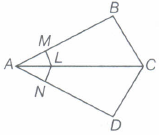
In the given figure, if \(LM\parallel CB\) and \(LN\parallel CD\), prove that \(\frac { AM }{ AB } =\frac { AN }{ AD } \).
3.
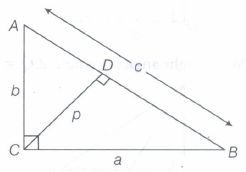
\(\triangle ABC\) is a right triangle in which \(\angle C=\) 90° and \(CD\bot AB\). If BC = a, CA = b, AB = C and CD = p, then prove that
(i) cp = ab
(ii) \(\frac { 1 }{ { p }^{ 2 } } =\frac { 1 }{ { a }^{ 2 } } +\frac { 1 }{ { b }^{ 2 } } \)
4.
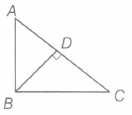
In the adjoining figure, ABC is a triangle right angled at B and \(BD\bot AC\) . If AD = 4 cm and CD = 5 cm. find BD and AB.
5.
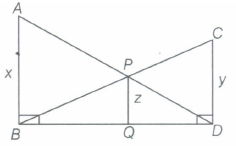
In the given figure, \(AB\parallel PQ\parallel CD\), AB = x units, CD = y units and PQ = z units. Prove that \(\frac { 1 }{ x } +\frac { 1 }{ y } =\frac { 1 }{ z } \)
6.
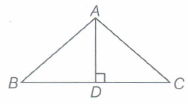
In the given figure, if \(\angle BAC\) = 90° and \(AD\bot BC\) . prove thart AD2 = BD.CD
7.
State whether the given pairs of triangles are similar or not. In case of similarity, mention the criterion.
-q.png)
-q.png)
8.
Shweta prepared two posters on National Integration for decoration on Independence day on triangular sheets (say ABC and DEF). The sides AB and AC and the perimeter P1 of \(\triangle ABC\) are respectively four times the corresponding sides DE and DF and the perimeter P2 of \(\triangle DEF\). Are the two triangular sheets similar? If yes, find \(\frac { ar\left( \triangle ABC \right) }{ ar\left( \triangle DEF \right) } \). What values can be indicated through celebration of national festivals?
9.
Let \(\triangle ABC\sim \triangle DEF\) and their areas be respectively 64 cm2 and 121 cm2 If EF = 15.4 cm2 then find BC.
10.
A 15 m high tower casts a shadow 24 m long at a certain time and at the same time, telephone pole caste a shadow 16 m long. Find the height of the telephone pole.
1.
Given ABCD is a trapezium in which \(AB\parallel CD\) . Diagonals AC and BD intersect each other at O.
To prove \(\frac { AO }{ BO } =\frac { CO }{ DO } \)
Construction Draw \(EOF\parallel AB\) , also parallel to CD.
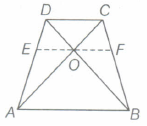
Proof In \(\triangle ACD,OE\parallel CD\) [by construction]
\(\Rightarrow \quad \frac { AE }{ ED } =\frac { AO }{ OC } \) ... (i)
[by basic proportionality theorem]
In \(\triangle ABD,OE\parallel BA\) [by construction]
\(\Rightarrow \quad \frac { ED }{ AE } =\frac { OD }{ OB } \) [by basic proportionalitytheorem]
\(\Rightarrow \quad \frac { AE }{ ED } =\frac { OB }{ OD } \) [on taking reciprocal of the terms] .... (ii)
From Eqs. (i) and (ii), we get
\(\frac { AO }{ OC } =\frac { OB }{ OD } \)
\(\therefore \quad \frac { AO }{ BO } =\frac { CO }{ DO } \)
Hence proved.
2.
In \(\triangle ACB\), \(LM\parallel CB\) [given]
\(\Rightarrow \quad \frac { AM }{ AB } =\frac { AL }{ LC } \) ... (i)
[by basic proportionality theorem]
In \(\triangle ACD\), \(LN\parallel CD\) [given]
\(\Rightarrow \quad \frac { AN }{ ND} =\frac { AL }{ LC } \) ... (ii)
[by basic proportionality theorem]
From Eqs. (i) and (ii), we get
\(\frac { AM }{ MB } =\frac { AN }{ ND } \quad \Rightarrow \frac { MB }{ AM } =\frac { ND }{ AN } \) [reciprocal the terms]
\(\Rightarrow \quad \frac { MB }{ AM } +1=\frac { ND }{ AN } +1\) [adding 1 on both sides]
\(\Rightarrow \quad \frac { MB+AM }{ AM } =\frac { ND+AN }{ AN } \)
\(\Rightarrow \quad \frac { AM }{ AM+MB } =\frac { AN }{ AN+ND } \)
reciprocal the terms]
\(\therefore \quad \frac { AM }{ AB } =\frac { AN }{ AD } \) [\(\because \) AD = AN + ND and AB = AM + MB]
3.
(i) \(ar\left( \triangle ABC \right) =\frac { 1 }{ 2 } CP\) [taking AB as base]
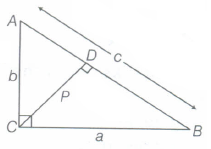
\(ar\left( \triangle ABC \right) =\frac { 1 }{ 2 } ab\) [taking BC as base]
\(\frac { 1 }{ 2 } cp=\frac { 1 }{ 2 } ab\)
\(\Rightarrow cp=ab\)
(ii) \(cp=ab \Rightarrow \frac { 1 }{ p } =\frac { c }{ ab } \)
\(\frac { 1 }{ { p }^{ 2 } } =\frac { { c }^{ 2 } }{ { a }^{ 2 }{ b }^{ 2 } } \Rightarrow \frac { 1 }{ { p }^{ 2 } } =\frac { { a }^{ 2 }{ +b }^{ 2 } }{ { a }^{ 2 }{ b }^{ 2 } } =\frac { 1 }{ { b }^{ 2 } } +\frac { 1 }{ { a }^{ 2 } } \)
4.
Prove \(\triangle DBA\) and \(\triangle DCB\) are similar.
\(\frac { DB }{ DA } =\frac { DC }{ DB } \)
\(\Rightarrow { DB }^{ 2 }=DA\times DC=4\times 5\)
\(\Rightarrow { DB }=2\sqrt { 5 } \) cm
In right \(\triangle BDC\) ,
BC2 = BD2 + CD2 = \({ \left( 2\sqrt { 5 } \right) }^{ 2 }+{ \left( 5 \right) }^{ 2 }\)
BC = \(3\sqrt { 5 } \)
As, \(\triangle DBA\sim \triangle DCB\)
\(\Rightarrow \frac { DB }{ DC } =\frac { BA }{ BC } \)
\(\Rightarrow \frac { 2\sqrt { 5 } }{ 5 } =\frac { BA }{ 3\sqrt { 5 } } \)
BA = 6 cm
BA = 6 cm, BD = \(2\sqrt { 5 } \) cm
5.
Prove \(\triangle DQP\) and \(\triangle DBA\) are similar.
\(\frac { QP }{ BA } =\frac { DQ }{ DB } \Rightarrow \frac { z }{ x } =\frac { DQ }{ BD } \) ... (i)
Similar, \(\frac { z }{ y } =\frac { BQ }{ BD } \) .... (ii)
On adding Eqs. (i) and (ii), we get
\(\frac { z }{ x } +\frac { z }{ y } =\frac { DQ }{ BD } +\frac { BQ }{ BD } =1\)
\(\Rightarrow \frac { z }{ x } +\frac { z }{ y } =1\)
\(\Rightarrow \frac { 1 }{ x } +\frac { 1 }{ y } =\frac { 1 }{ z } \)
6.
Prove \(\triangle ADB\sim \triangle ADC\), then \(\frac { BD }{ AD } =\frac { AD }{ CD } \)
\(\Rightarrow \) AD2 = BD.CD
7.
In Figure (i), corresponding sides are not in proportion.
In Figure (ii), In \(\triangle LMN\)
\(\angle LMN+\angle MNL+\angle MLN\) = 180°
[by angle sum property of a triangle]
45° + \(\angle MNL\) + 57° = 180°
\(\angle MNL\) = 78°
\(\angle QPR=\angle LMN\) = 45°
\(\angle PQR = \angle MNL\) = 78°
So, \(\angle PQR\sim \angle MNL\) [by AA similarity criterion]
8.
Yes, 16 : 1 ; unity of nation, fraternity and patriotism.
9.
Given, \(\triangle ABC\sim \triangle DEF\)
\(\therefore \frac { ar\left( \triangle ABC \right) }{ ar\left( \triangle DEF \right) } =\frac { { BC }^{ 2 } }{ { EF }^{ 2 } } \)
[ using property of area of similar triangles]
\(\Rightarrow \frac { 64 }{ 121 } =\frac { { BC }^{ 2 } }{ { EF }^{ 2 } } \Rightarrow \left( \frac { BC }{ EF } \right) ^{ 2 }=\left( \frac { 8 }{ 11 } \right) ^{ 2 }\)
\(\Rightarrow \frac { BC }{ EF } =\frac { 8 }{ 11 } \) [taking positive square root on both sides]
\(\Rightarrow BC=\frac { 8 }{ 11 } \times EF\)
\(\therefore BC=\frac { 8 }{ 11 } \times 15.4=11.2cm\quad \left[ \because EF=15.4cm,given \right] \)
10.
Draw the figure according to given condition, then show that both triangles are similar by AAA similarity criterion and then use ratio of sides of both triangles to get the requried length.
10 m

10th Standard CBSE Syllabus & Materials
10th Standard CBSE
CBSE 10th Social Science PS - Federalism - New Model Questions Papers Study Material - QB365 Set A
NEW10th Standard CBSE
CBSE 10th Social Science PS - Power Sharing - New Model Questions Papers Study Material - QB365 Set A
NEW10th Standard CBSE
CBSE 10th Social Science GEO - Manufacturing Industries - New Model Questions Papers Study Material - QB365 Set A
NEW10th Standard CBSE
CBSE 10th Social Science GEO - Minerals and Energy Resources - New Model Questions Papers Study Material - QB365 Set A



NCERT Books

Syllabus

Exam Pattern

Sample Question Papers

Previous year Question Papers

Important Notes

MCQ Practice test

NCERT Exemplers

Case study Questions

Image Based Questions

Passage based Questions

HOT Questions

Value Based Questions

Model Questions Papers
NCERT ( Book Back ) Questions

Assertion and Reason
Important Questions And Answers

CBSE 10th Standard CBSE Subjects
CBSE Standards