
 100% FREE ACCESS
10th Standard CBSE Syllabus & Materials
10th Standard CBSE
CBSE 10th Social Science ECO - Globalisation and the Indian Economy - New Model Questions Papers Study Material - QB365 Set A
NEW10th Standard CBSE
CBSE 10th Social Science ECO - Money and Credit - New Model Questions Papers Study Material - QB365 Set A
NEW10th Standard CBSE
CBSE 10th Social Science ECO - Sectors of the Indian Economy - New Model Questions Papers Study Material - QB365 Set A
NEW10th Standard CBSE
CBSE 10th Social Science ECO - Development - New Model Questions Papers Study Material - QB365 Set A
NEW10th Standard CBSE
CBSE 10th Social Science PS - Outcomes of Democracy - New Model Questions Papers Study Material - QB365 Set A
NEW10th Standard CBSE
CBSE 10th Social Science PS - Gender, Religion and Caste - New Model Questions Papers Study Material - QB365 Set A

Published on: 20/10/2025
Download CBSE Class 10th Standard CBSE Maths question papers, sample papers, important questions, and previous year solved papers in PDF format. Get free study materials, NCERT solutions, and exam preparation resources for Class 10th Standard CBSE Maths
Questions + Answers key
Take MCQ Maths Test
1.
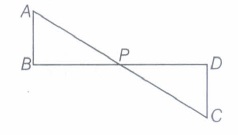
In the given figure, if \(\angle A=\angle C, A B=6\) cm BP = 15 cm, AP = 12 cm and CP = 4 cm, find the lengths of PD and CD.
2.
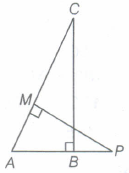
In the given figure, ABC and AMP are two right angled triangles, right angled at B and M, respectively. Prove that
\(\frac{CA}{PA}=\frac{BC}{MP}\)
3.
In the following figure, altitudes AD and CE of ΔABC intersect each other at the point P. Show that:
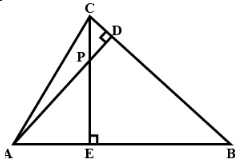
ΔABD ∼ ΔCBE
4.
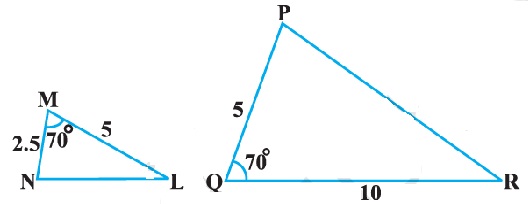
State which pair of triangles in the following figure are similar? Write the similarity criterion used by you for answering the question and also write the pairs of similar triangles in the symbolic form:
5.
A boy goes 24 m due East and 7 m due South. How far is he from the starting point?
6.
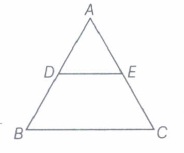
In figure, \(D E \| B C\) AD = 1cm and BD = 2 cm. What is the ratio of the ar (MBC) to the \(\text { ar }(\Delta A D E) ?\)
7.
If in two triangles, sides of one triangle are proportional to (i.e., in the same ratio of ) the sides of the other triangle, then their corresponding angles are equal and hence the two triangles are similiar.
8.
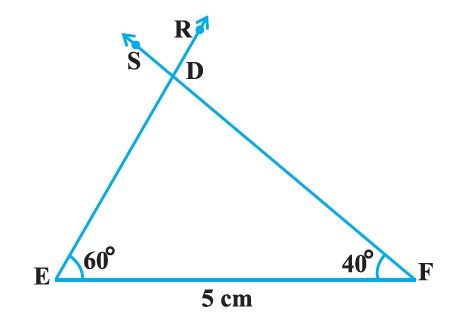
Draw two line segments BC and EF of two different lengths, say 3 cm and 5 cm respectively. Then, at the points B and C respectively, construct angles PBC and QCB of some measures, say, 60° and 40°. Also, at the points E and F, construct angles REF and SFE of 60° and 40° respectively.
9.
In the given figure, if LM II CB and LN II CD. Prove that \(\frac { AM }{ AB } =\frac { AN }{ AD } .\)
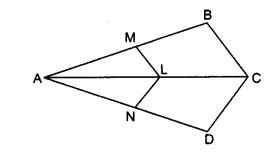
Use the basic proportionality theorem in both \(\Delta\)ABC and \(\Delta\)ACD
10.
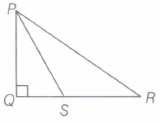
In the given figure, \(\triangle PQR\) is a right angled triangle in which \(\angle Q\) = 90°. If QS = SR, show that PR2 = 4 PS2 - 3PQ2.
11.
In \(\triangle ABC\) , D and E are points on the sides AB and AC respectively, such that \(DE\parallel BC\) . If AD = 4x - 3, AE = 8x - 7, BD = 3x - 1 and CE = 5x - 3, find the value of x.
12.
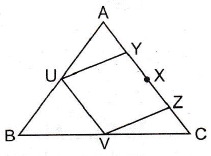
ln ΔABC, X is any point on AC. If Y, Z, U and V are the middle points on AX, XC, AB and BC respectively, then, prove that UY || VZ and UV || YZ.
13.
Prove that the sum of the squares of the sides of a rhombus is equal to the sum of the squares of its diagonals.
14.
Diagonals AC and BD of a trapezium ABCD with \(AB\parallel DC\) intersect each other at the point O. Using a similarity criterion for two triangles, show that \(\frac { OA }{ OC } =\frac { OB }{ OD } \) .
15.
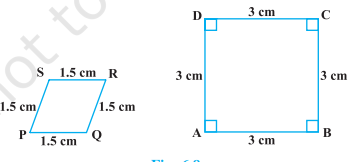
State whether the following quadrilaterals are similar or not.
16.
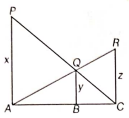
In the given figure, PA QB and RC are each perpendicular to AC. If x = 8 cm and z = 6 cm, then y is equal to
56/7 cm
7/56 cm
25/7 cm
24/7 cm
17.
In two \(\triangle P Q R\) and \(\triangle A B C\), it is given that \(\frac{A B}{B C}=\frac{P Q}{P R}\). For these two triangles to be similar, which of the following should be true?
∠A = ∠P
∠B = ∠Q
∠B = ∠E
∠A = ∠F
18.
In ΔABC and ΔDEF, \(\frac{AB}{DE} =\frac{BC}{EF}\) Which of the following makes the two triangles similar?
∠A = ∠D
∠B = ∠D
∠B = ∠P
∠A = ∠F
19.
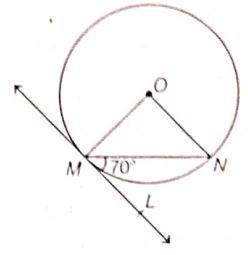
In the given figure, O is the centre of the circle, MN is the chord and the tangent ML at point M makes an angle of 70° with MN The measure of \(\angle\)MON is
120°
140°
70°
90°
20.
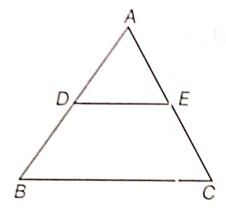
In \(\Delta\)ABC, DE || BC (as shown in the figure). If AD = 2 cm, BD = 3 cm and BC = 7.5 cm, then the length of DE (in cm) is
2.5
3
5
6
21.
A 5 m long ladder is placed leaning towards a vertical wall such that it reaches the wall at a point 4 m high. If the foot of the ladder is moved 1.6 m towards the wall, then the distance by which the top of the ladder would slide upwards on the wall is
0.6 cm
0.2 cm
0.4 cm
0.8 cm
22.
If the lengths of the diagonals of rhombus are 16 cm and 12 cm. Then, the length of the sides of the rhombus is
9 cm
10 cm
8 cm
20 cm
23.
If in ΔABC and ΔDEF, \(\frac { AB }{ DF } =\frac { AC }{ DE } \)then they will be similar , when
ㄥB =ㄥE
ㄥA = ㄥD
ㄥB = ㄥD
ㄥA = ㄥF
24.
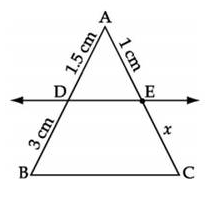
In figure, DE || BC, then x equals to :
1.4 cm
2 cm
4 cm
2.5 cm
25.
Two congruent triangles are actually similar triangles with the ratio of corresponding sides as.
1:2
1:1
1:3
2:1
26.
In triangle ABC, D and E are points on AB and AC such that DE || BC. If AD = 4x-3, AE = 8x-7, BD = 3x-1 and CE = 5x-3, find the value of x
1
1/2
1/2, -1
1, -1/2
27.
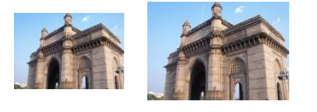
The above two pictures of Gateway of India are:
neither similar nor congruent
similar
dissimilar
congruent
28.
In right triangle ABC, right angled at A, A perpendicular is dropped from A to BC, meeting BC at D. Then which of the following is true?
ΔADC ~ ΔABD
ΔDCA ~ ΔDABD
ΔDAC ~ ΔDABD
ΔDAC ~ ΔDABA
29.
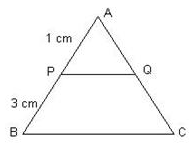
In the adjoining figure, PQ||BC , the what could be the values of AQ & QC respectively
3 cm and 6 cm
2 cm and 6 cm
3 cm and 4 cm
1 cm and 6 cm
30.
Given two triangles ABC and PQR such that, AB = 2 cm , PQ = 3cm, ∠B = ∠Q BC = 5 cm, QR = 7.5 cm. AG and PS are medians .Find \(\frac { AG }{ PS } \) =?
2/5
1/5
4/5
2/3
31.
Triangles ABC, DEF are similar , ∠A = 75° , ∠B = 85° so ∠F =?
20°
30°
10°
35°
32.
In figure, ΔABC ~ ΔPQR
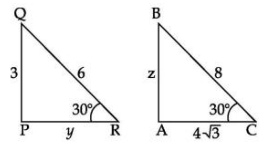
2 + √3
4 + √3
3 + 4√3
4 + 3√3
33.
The length of an altitude of an equilateral triangle of side a is
\(\frac { a }{ 2\sqrt { 3 } } \)
\(\frac { 2a }{ \sqrt { 3 } } \)
\(\frac { \sqrt { 3 } a }{ 2 } \)
\(\frac { \sqrt { 3 } }{ 2a } \)
34.
What is the diagonal length of a TV screen whose dimensions are 80 x 60 cm?
10
100
20
100
35.
Which of the following cannot be the sides a right triangle?
400mm, 300 mm, 500mm
9 cm, 15 cm, 12 cm
2 cm, 1 cm, √5 cm
9 cm, 5 cm, 7cm
36.
Three villages X, Y and Z are situated at the three ends of a triangular region bounded by three roads. The lengths of the roads connecting X to Y, Y to Z and Z to X are in the ratio 5 : 3 : 4. The total lengths of the three roads are 180 km.
A new road is to be constructed parallel to the longest road. A team of three researchers Mayank, Biju and Shanti work on the technical specifications of the new road construction. Each of them makes a scale drawing of the region using different scale factors. Based on the above information, answer the following questions.
(i) Which types of triangles are included in their scale drawings, similar or congruent? Why?
(ii) The proposed road will meet the road between Y and Z in the middle. How far is the Village Y (in km) from the meeting point of the roads?
(iii) In all the three scale drawings, the actual length of the new road is provided. Would the road length be the same in their maps? Justify your answer.
37.
In the figure given below, a folding table is shown. The legs of the table are represented by line segments AB and CD intersecting at O. Join AC and BD. Considering table top is a parallel to the ground and OB = x, OD = x + 3, OC = 3x + 19 and OA = 3x + 4, answer the following questions.
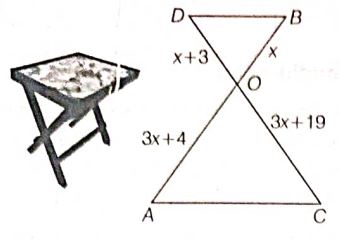
(i) Prove that \(\Delta\) OAC is similar to \(\Delta\) OBD
(ii) Prove that \(\frac{O A}{A C}=\frac{O B}{B D}\)
(iii) (a) Observe the figure and find the value of x. Hence, find the length of OC.
Or
(b) Observe the figure and find \(\frac{B D}{A C} .\)
38.
An aeroplane leaves an airport and flies due north at a speed of 1200km /hr. At the same time, another aeroplane leaves the same station and flies due west at the speed of 1500 km/hr as shown below. After \(1 \frac{1}{2}\) hr both the aeroplanes reaches at point P and Q respectively.
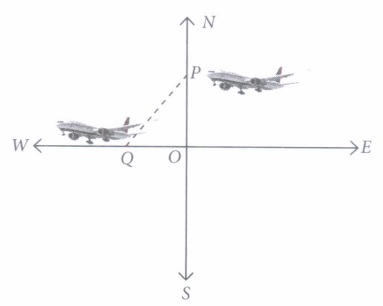
(i) Distance travelled by aeroplane towards north after \(1 \frac{1}{2}\) hr is
| (a) 1800 km | (b) 1500 km | (c) 1400km | (d) 1350 km |
(ii) Distance travelled by aeroplane towards west after \(1 \frac{1}{2}\) hr is
| (a) 1600 km | (b) 1800 km | (c) 2250km | (d) 2400 km |
(iii) In the given figure,\(\angle\)POQ is
| (a) 70° | (b) 90° | (c) 80° | (d) 100° |
(iv) Distance between aeroplanes after \(1 \frac{1}{2}\) hr is
| \((a) 450 \sqrt{41} \mathrm{~km}\) | \((b) 350 \sqrt{31} \mathrm{~km}\) | \((c) 125 \sqrt{12} \mathrm{~km}\) | \((d) 472 \sqrt{41} \mathrm{~km}\) |
(v) Area of \(\Delta\)POQ is
| (a) 185000km2 | (b) 179000km2 |
| (c) 186000km2 | (d) 2025000 km2 |
1.
Prove that \(\Delta A P B \sim \Delta C P D\) [byAA similarity criterion]
PD = 5 cm, CD = 2 cm
2.
As, \(\triangle ABC\sim \triangle AMP\) [proved in part(i)]
\(\therefore d\frac{AC}{AP}=\frac{BC}{MP}\)
[since ratio of the corresponding sides of similar triangles are equal]
\(\Rightarrow \frac{CA}{PA}=\frac{BC}{MP}\)
3.
Given, AD and CE are altitudes which intersect each other at the point P.
In ΔABD and ΔCBE,
∠ADB = ∠CEB [each 90°]
and ∠ABD = ∠CBE [Common angle]
\(\therefore\) ΔABD ∼ ΔCBE [by AA similarity criterion]
4.
Yes, the pair of triangles is similar.
In \(\triangle \mathrm{MNL} \text { and } \triangle \mathrm{QPR}\),
\(\begin{aligned} \angle N M L & =\angle P Q R=70^{\circ} \\ \end{aligned}\)
\(\begin{aligned} \frac{M N}{P Q} & =\frac{2.5}{5}=\frac{1}{2} \\ \end{aligned}\)
and \(\begin{aligned} \frac{M L}{Q R} & =\frac{5}{10}=\frac{1}{2} \\ \end{aligned}\)
Then, \(\begin{aligned} \frac{M N}{P Q} & =\frac{M L}{Q R} \end{aligned}\)
\(\therefore\) \(\Delta\)MNL \(\sim\) \(\Delta\)QPR [by SAS similarity criterion]
5.
25 m
6.
It is given that AD = 1cm, BD = 2 cm and DE II BC.
\(\text { In } \Delta A D E \text { and } \Delta A B C\)
\(\angle A D E=\angle A B C\) [corresponding angles]
\(\angle A=\angle A\) [common]
Therefore, by AA similar condition
\(\Delta A D E-\Delta A B C\)
Ratio of areas of similar triangles is equal to the square of the ratio of the corresponding sides.
\( \therefore \frac{\operatorname{ar}(\Delta A B C)}{\operatorname{ar}(\Delta A D E)}=\frac{A B^{2}}{A D^{2}} \Rightarrow \frac{\operatorname{ar}(\Delta A B C)}{\operatorname{ar}(\Delta A D E)}=\left(\frac{3}{1}\right)^{2} \)
\(\Rightarrow \frac{\operatorname{ar}(\Delta A B C)}{\operatorname{ar}(\Delta A D E)}=\frac{9}{1} \)
Therefore, the ratio of the area of MBC to the area of ΔADE is 9: 1.
7.
This criterion is referred to as the SSS (Side - Side - Side) similarity criterion for two triangles.
This theorem can be proved by taking two triangles ABC and DEF such that
\(\frac{\mathrm{AB}}{\mathrm{DE}}=\frac{\mathrm{BC}}{\mathrm{EF}}=\frac{\mathrm{CA}}{\mathrm{FD}}(<1)\)
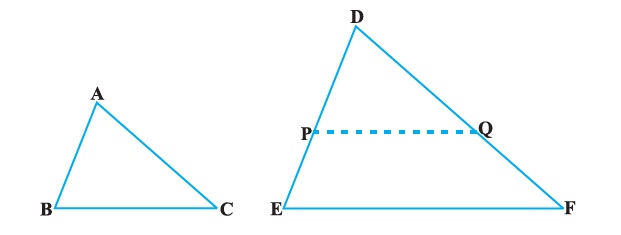
Cut DP = AB and DQ = AC and join PQ.
It can be seen that \(\frac{\mathrm{DP}}{\mathrm{PE}}=\frac{\mathrm{DQ}}{\mathrm{QF}} \text { and } \mathrm{PQ} \text { II EF }\)
So, ∠ P = ∠ E and ∠ Q = ∠ F.
Therefore, \(\frac{\mathrm{DP}}{\mathrm{DE}}=\frac{\mathrm{DQ}}{\mathrm{DF}}=\frac{\mathrm{PQ}}{\mathrm{EF}}\)
So, \(\frac{\mathrm{DP}}{\mathrm{DE}}=\frac{\mathrm{DQ}}{\mathrm{DF}}=\frac{\mathrm{BC}}{\mathrm{EF}}\)
So, BC = PQ
Thus, \(\Delta\) ABC ≅ \(\Delta\) DPQ
So, ∠ A = ∠ D, ∠ B = ∠ E and ∠ C = ∠ F
8.
Let rays BP and CQ intersect each other at A and rays ER and FS intersect each other at D. In the two triangles ABC and DEF, you can see that ∠ B = ∠ E, ∠ C = ∠ F and Ð A = ∠ D. That is, corresponding angles of these two
triangles are equal. What can you say about their corresponding sides. Note that \(\frac{\mathrm{BC}}{\mathrm{EF}}=\frac{3}{5}=0.6\) What about \(\frac{\mathrm{AB}}{\mathrm{DE}} \text { and } \frac{\mathrm{CA}}{\mathrm{FD}} \) On measuring AB, DE, CA and FD, you will find that \(\frac{\mathrm{AB}}{\mathrm{DE}} \text { and } \frac{\mathrm{CA}}{\mathrm{FD}}\) are also equal to 0.6 (or nearly equal to 0.6, if there is some error in the measurement). Thus, \(\frac{\mathrm{AB}}{\mathrm{DE}}=\frac{\mathrm{BC}}{\mathrm{EF}}=\frac{\mathrm{CA}}{\mathrm{FD}}\) You can repeat this activity by constructing several pairs of triangles having their corresponding angles equal. Every time, you will find that their corresponding sides are in the same ratio (or proportion). This activity leads us to the following criterion for similarity of two triangles.
9.
In \(\Delta\)ACB, LM || CB [given]
\(\Rightarrow \quad \frac{A M}{M B}=\frac{A L}{L C}\) ....(i)
[ by basic proportionality theorem]
In \(\Delta\)ACD, LN ||CD [given]
\(\Rightarrow \quad \frac{A N}{N D}=\frac{A L}{L C}\) ....(ii)
[by basic proportionality theorem]
From Eqs. (i) and (ii), we get
\(\frac{A M}{M B}=\frac{A N}{N D} \Rightarrow \frac{M B}{A M}=\frac{N D}{A N}\)
[on taking reciprocal of the terms]
\(\Rightarrow \quad \frac{M B}{A M}+1=\frac{N D}{A N}\) + 1 [adding 1 on both sides]
\(\begin{aligned} & \Rightarrow \quad \frac{M B+A M}{A M}=\frac{N D+A N}{A N} \\ \end{aligned}\)
\(\begin{aligned} \Rightarrow \quad \frac{A M}{A M+M B}=\frac{A N}{A N+N D} \end{aligned}\)
[on taking reciprocal of the terms]
\(\therefore \quad \frac{A M}{A B}=\frac{A N}{A D} \quad\left[\begin{array}{c} \because A D=A N+N D \\ \text { and } A B=A M+M B \end{array}\right]\)
Hence proved.
10.
Given \(\triangle PQR\) is a right angled triangle \(\angle Q\) = 90°, QS = SR.
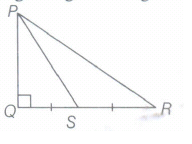
To show PR2 = 4 PS2 - 3 PQ2
Proof \(\triangle PQR\),
PR2 = PQ2 + OR2 [by Pythagoras theorem] ... (i)
Now, QS = SR [given]
QR = SR = \(\frac{1}{2}\) QR
QR = 2QS ... (ii)
Put QR = 2QS in Eq.(i),
then, PR2 = PQ2 + (2QS)2 = PQ2 + 4QS2
In \(\triangle PQS\),
PS2 = PQ2 + QS2
\(\Rightarrow \) QS2 = PS2 - PQ2 ... (iii)
\(\Rightarrow \) PR2 = PQ2 + 4 (PS2 - PQ2) [from Eq.(iii)]
= PQ2 + 4 PS2 - 4 PQ2
\(\therefore \) PR2 = 4 PS2 - 3 PQ2
11.
Given, in \(\triangle ABC\), \(DE\parallel BC\)
By Thales theorem, we get
\(\frac { AD }{ DB } =\frac { AE }{ EC } \)
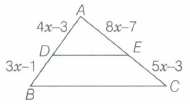
\(\Rightarrow \frac { 4x-3 }{ 3x-1 } =\frac { 8x-7 }{ 5x-3 } \)
[\(\because \) AD = 4x - 3, DB = 3x - 1, AE = 8x - 7, EC = 5x - 3]
\(\Rightarrow \) (4x - 3)(5x - 3) = (8x - 7)(3x - 1)
\(\Rightarrow \) 20x2 - 12x + 9 - 15x = 24x2 - 21x - 8x + 7
\(\Rightarrow \) 4x2 - 2x - 2 = 0
\(\Rightarrow \) 2x2 - x - 1 = 0 [dividing both sides by 2]
\(\Rightarrow \) 2x2 - 2x + x - 1 = 0 [by splitting the middle term]
\(\Rightarrow \) 2x(x - 1) + 1 (x - 1) = 0
\(\Rightarrow \) (2x + 1) (x - 1) = 0 \(\therefore x=-\frac { 1 }{ 2 } \) or x = 1
If \(x=-\frac { 1 }{ 2 } \), then AD = \(4\times -\frac { 1 }{ 2 } -3=-5<0\) [not possible]
Hence, x = 1 is the required value.
12.
Join BX
In ΔABX, U is mid-Point of AB and Y is mid-Point AX
(given)
∴ UY || BX(using mid-Point theorem) ..(i)
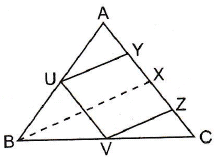
In ΔBCX, V is mid-Point of BC and Z is mid-Point of XC
∴ VZ || BX ....(ii)
From (i) and (ii)
UY || VZ
In ΔABC, U is mid-point of AB and V is mid-point of BE
∴ UV || AC
⇒ UV || YZ
Hence Proved
13.
Suppose ABCD is a rhombus in which
AB = BC = CD = DA = a [say]
Here, diagonals AC and BD are right angle bisectors of each other at O.
In \(\triangle AOB,\angle AOB={ 90 }^{ ° }\)
\(OA=\frac{1}{2}AC\) \([\because OA=OC]\) ... (i)
and \(OB=\frac{1}{2}BD\) \([\because OB=OD]\) ... (ii)
Using Pythagoras theorem, we get
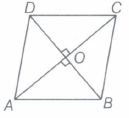
OA2 = OB2 = AB2
\(\Rightarrow \left( \frac { 1 }{ 2 } AC \right) ^{ 2 }+\left( \frac { 1 }{ 2 } BD \right) ^{ 2 }={ AB }^{ 2 }\) [from Eqs.(i) and (ii)]
\(\Rightarrow\) AC2 + BD2 = 4 AB2
\(\Rightarrow\) AB2 + BC2 + CD2 + DA2 = AC2 + BD2
\([\because AB = BC = CD = DA]\)
14.
Consider a trapezium ABCD such that \(AB\parallel DC\) and draw its diagonals AC and BD which intersect at point O.
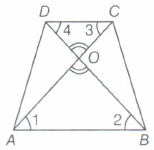
In \(\triangle OCD\) and \(\triangle OAB\),
\(AB\parallel DC\) [given]
\(\therefore \angle 1=\angle 3,\angle 2=\angle 4\) [alternate interior angles]
Also, \(\triangle DOC=\triangle BOA\) [vertically opposite angles]
\(\therefore \triangle OCD\sim \triangle OAB\) [by AAA similarity criterion]
\(\Rightarrow \frac { OC }{ OA } =\frac { OD }{ OB } \)
[since, ratios of the corresponding sides of the similar triangles are equal]
\(\therefore \frac { OA }{ OC } =\frac { OB }{ OD } \) [on taking reciprocal of the terms]
Hence proved.
15.
Quadrilateral PQRS and ABCD are not similar as their corresponding sides are proportional, i.e. 1:2, but their corresponding angles are not equal.
16.
(d)
24/7 cm
17.
(c)
∠B = ∠E
18.
(c)
∠B = ∠P
19.
(b)
140°
20.
(b)
3
21.
(d)
0.8 cm
22.
(b)
10 cm
23.
(c)
ㄥB = ㄥD
24.
(b)
2 cm
25.
(b)
1:1
26.
(b)
1/2
27.
(b)
similar
28.
(d)
ΔDAC ~ ΔDABA
29.
(b)
2 cm and 6 cm
30.
(d)
2/3
31.
(a)
20°
32.
(d)
4 + 3√3
33.
(c)
\(\frac { \sqrt { 3 } a }{ 2 } \)
34.
(b)
100
35.
(d)
9 cm, 5 cm, 7cm
36.
(i) Let the length of roads connecting X to Y, Y to Z and Z to X be 5x, 3x and 4x, respectively.
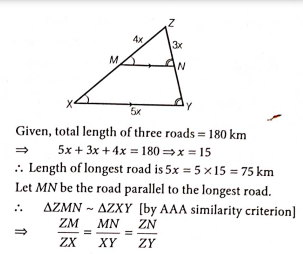
Mayank, Biju and Shanti had drawn similar triangles as angles in them are of same measure and sides in them are of same proportion.
(ii) Hint Distance of Village Y from the meeting point of the roads = 3/2 x x
Ans : 22.5 km
(iii) The length of the road would be the same in all three scale drawings as the line parallel to a side in a triangle and cutting the other two sides in a specific ratio is unique.
37.
Given OB = x, OD = x + 3, OC = 3x + 19 and OA = 3x + 4
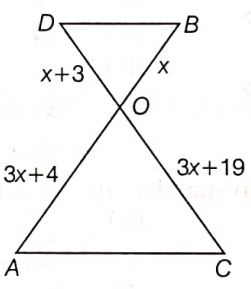
and AC || BD
To prove \(\triangle O A C \sim \triangle O B D\)
Proof In \(\triangle O A C \text { and } \triangle O B D\)
\(\angle D O B=\angle C O A\)
[vertically opposite angles]
As, AC is parallel to BD, AB and DC are transversal
\(\begin{aligned} & \angle B A C=\angle A B D \end{aligned}\)
and \(\begin{aligned} & \angle C D B=\angle D C A \end{aligned}\)
[\(\because\)alternate interior angles]
\(\triangle O A C \sim \triangle O B D\)
[by AA similarity criteria]
Hence proved.
(ii) To prove \(\frac{O A}{A C}=\frac{O B}{B D}\)
Proof From part (i) we know that
\(\triangle O A C \sim \triangle O B D\)
Corresponding sides of \(\Delta\)OAC and \(\Delta\)OBD must be proportional
\(\begin{aligned} \frac{O A}{O B} & =\frac{A C}{B D} \\ \end{aligned}\)
\(\begin{aligned} \Rightarrow \quad & \frac{O A}{A C}=\frac{O B}{B D} \end{aligned}\) Hence proved.
(iii) (a) From part (i)
\(\begin{aligned} \triangle O A C & \sim \triangle O B D \\ \end{aligned}\)
\(\begin{aligned} \Rightarrow \quad \frac{O A}{O B} & =\frac{O C}{O D} \Rightarrow \frac{3 x+4}{x}=\frac{3 x+19}{x+3} \end{aligned}\)
[given OA = 3x +4, OB = x, OC = 3x+19, OD = x+3]
\(\Rightarrow\) (3x + 4)(x + 3) = (3x + 19)x
\(\Rightarrow\) 3x2 + 9x + 4x + 12 = 3x2 + 19x
\(\Rightarrow\) 13x + 12 = 19x \(\Rightarrow\) x = 2
Given, OC = 3x + 19
On substituting x = 2, we get
OC = 3 \(\times\) 2 + 19 = 6 + 19 = 25
Therefore, OC = 25
(b) From part (ii), we have
\(\begin{aligned} & \frac{O A}{A C}=\frac{O B}{B D} \\ \end{aligned}\)
\(\begin{aligned} & \Rightarrow \quad \frac{B D}{A C}=\frac{O B}{O A} \\ \end{aligned}\)
\(\begin{aligned} & \Rightarrow \quad \frac{B D}{A C}=\frac{x}{3 x+4} \end{aligned}\)
[given, OB = x and OA = 3x + 4]
On substituting x = 2, we get
\(\frac{B D}{A C}=\frac{2}{3 \times 2+4}=\frac{2}{10} \Rightarrow \frac{B D}{A C}=\frac{1}{5}\)
Therefore, \(\frac{B D}{A C}=\frac{1}{5}\)
38.
(i) (a): Speed = 1200 km/hr
\(\text { Time }=1 \frac{1}{2} \mathrm{hr}=\frac{3}{2} \mathrm{hr}\)
\(\therefore\) Required distance = Speed x Time
\(=1200 \times \frac{3}{2}=1800 \mathrm{~km}\)
(ii) (c): Speed = 1500 km/hr
Time = \(\frac{3}{2}\) hr.
\(\therefore\) Required distance = Speed x Time
\(=1500 \times \frac{3}{2}=2250 \mathrm{~km}\)
(iii) (b): Clearly, directions are always perpendicular to each other.
\(\therefore \quad \angle P O Q=90^{\circ}\)
(iv) (a): Distance between aeroplanes after \(1\frac{1}{2}\) hour
\(\begin{array}{l} =\sqrt{(1800)^{2}+(2250)^{2}}=\sqrt{3240000+5062500} \\ =\sqrt{8302500}=450 \sqrt{41} \mathrm{~km} \end{array}\)
(v) (d): Area of \(\Delta\)POQ= \(\frac{1}{2}\)x base x height
\(=\frac{1}{2} \times 2250 \times 1800=2250 \times 900=2025000 \mathrm{~km}^{2}\)

10th Standard CBSE Syllabus & Materials
10th Standard CBSE
CBSE 10th Social Science PS - Federalism - New Model Questions Papers Study Material - QB365 Set A
NEW10th Standard CBSE
CBSE 10th Social Science PS - Power Sharing - New Model Questions Papers Study Material - QB365 Set A
NEW10th Standard CBSE
CBSE 10th Social Science GEO - Manufacturing Industries - New Model Questions Papers Study Material - QB365 Set A
NEW10th Standard CBSE
CBSE 10th Social Science GEO - Minerals and Energy Resources - New Model Questions Papers Study Material - QB365 Set A



NCERT Books

Syllabus

Exam Pattern

Sample Question Papers

Previous year Question Papers

Important Notes

MCQ Practice test

NCERT Exemplers

Case study Questions

Image Based Questions

Passage based Questions

HOT Questions

Value Based Questions

Model Questions Papers
NCERT ( Book Back ) Questions

Assertion and Reason
Important Questions And Answers

CBSE 10th Standard CBSE Subjects
CBSE Standards