 100% FREE ACCESS
10th Standard CBSE Syllabus & Materials
10th Standard CBSE
CBSE 10th Social Science ECO - Globalisation and the Indian Economy - New Model Questions Papers Study Material - QB365 Set A
NEW10th Standard CBSE
CBSE 10th Social Science ECO - Money and Credit - New Model Questions Papers Study Material - QB365 Set A
NEW10th Standard CBSE
CBSE 10th Social Science ECO - Sectors of the Indian Economy - New Model Questions Papers Study Material - QB365 Set A
NEW10th Standard CBSE
CBSE 10th Social Science ECO - Development - New Model Questions Papers Study Material - QB365 Set A
NEW10th Standard CBSE
CBSE 10th Social Science PS - Outcomes of Democracy - New Model Questions Papers Study Material - QB365 Set A
NEW10th Standard CBSE
CBSE 10th Social Science PS - Gender, Religion and Caste - New Model Questions Papers Study Material - QB365 Set A

Published on: 20/10/2025
Download CBSE Class 10th Standard CBSE Science question papers, sample papers, important questions, and previous year solved papers in PDF format. Get free study materials, NCERT solutions, and exam preparation resources for Class 10th Standard CBSE Science
Questions + Answers key
Take MCQ Science Test
1.
Below given is the pattern of sex-determination in human beings. Study the same and choose the correct statement.
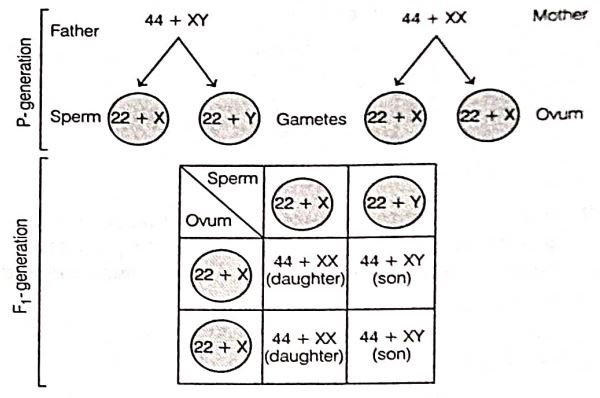
Both mother and father have 22 pairs of chromosomes including sex chromosomes
The gametes of both mother and father are haploid (n) in nature
It is Y-chromosome that decides the sex of a child
Both (b) and (c)
2.
A cross between pea plant with white flowers (vv) and pea plant with violet flowers (VV) resulted in F2-progeny in which ratio of violet (VV) and white (vv) flowers will be
1 : 1
2 : 1
3 : 1
1 : 3
3.
Consider the following two statements
(i) The trait that expresses itself in F1-generation.
(ii) The trait that keeps on passing from one generation to another.
The appropriate terms for the statements (i) and (ii) respectively are
| (i) | (ii) |
| Recessive trait, | Dominant trait |
| (i) | (ii) |
| Dominant trait, | Recessive trait |
| (i) | (ii) |
| Dominant trait, | Inherited trait |
| (i) | (ii) |
| Recessive trait, | Inherited trait |
4.
The maleness of a child is determined by
the X chromosome in the zygote
the Y chromosome in zygote
the cytoplasm of germ cell which determines the sex.
sex is determined by chance
5.
An example of homologous organs is
Our arm and a dog's fore-leg
Our teeth and an elephant's tusks.
Potato and runners of grass.
all of the above
6.
The most obvious outcome of the reproductive process is the generation of individuals of similar design, but in sexual reproduction they may not be exactly alike. The resemblances as well as differences are marked. The rules of heredity determine the process by which traits and characteristics are reliably inherited. Many experiments have been done to study the rules of inheritance.
(i) Why an offspring of human being is not a true copy of his parents in sexual reproduction?
(ii) While performing experiments of inheritance in plants, what is the difference between F1 and F2- generation?
(iii) Why do we say that variations are useful for the survival of a species over time?
Or (iii) Study Mendel's cross between two plants with a pair of contrasting characters.
RRYY \(\times\) rryy
Round Yellow Wrinkled Green
He observed 4 types of combinations in F2 - generation. Which of these were new combinations? Why do new features which are not present in the parents appear in F2-generation ?
7.
A blue colour flower plant denoted by BB is crossbred with that of white colour flower plant denoted by bb.
(a) State the colour of flower you would expect in their F1 generation plants.
(b) What must be the percentage of white flower plants in F2 generation if flowers of F1 plants are self-pollinated?
(c) State the expected ratio of the genotype BB and Bb in the F2 progeny.
8.
How are the areas of study - evolution and classification - interlinked?
9.
Species A shares -ten characteristics with species B, species C share fifteen characteristics with D which of the two pairs share closer relation.
10.
Name the chemicals which were essential for origin of life.
11.
What will be the percentage of 'ab' gametes produced by AaBb parent?
12.
If the sperm bearing Y - Chromosome fertilizes an egg, the child born will not be entirely like his father? Why?
13.
Give reasons why acquired characters are not inherited.
14.
(i) Why is the F1-progeny always tall, when a tall pea plant is crossed with a short pea plant?
(ii) How is F2-progeny obtained by self-pollination of F1-progeny different from F1-progeny? Give reason for this observation.
(iii) State a conclusion that can be drawn on the basis of this observation.
15.
Explain the following:
(a) Speciation (b) Natural Selection
16.
"It is possible that a trait is inherited but may not be expressed." Give a suitable example to justify this statement.
17.
Define the term 'evolution'. "Evolution cannot be equated with progress". Justify this statement
18.
What is natural selection?
19.
Assertion: In grasshoppers, females are heterogametic and males are homogametic.
Reason: In grasshoppers, male has only one sex chromosome (XO) whereas the female has sex chromosomes (XX).
Codes:
(a) Both A and R are true and R is correct explanation of the assertion
(b) Both A and R are true but R is not the correct explanation of the assertion
(c) A is true but R is false
(d) A is false but R is true.
20.
Assertion: A child which has inherited X chromosome from father will develop into a girl child.
Reason: Girl child inherits X chromosome from father and Y chromosome from mother.
Codes:
(a) Both A and R are true and R is correct explanation of the assertion
(b) Both A and R are true but R is not the correct explanation of the assertion
(c) A is true but R is false
(d) A is false but R is true.
21.
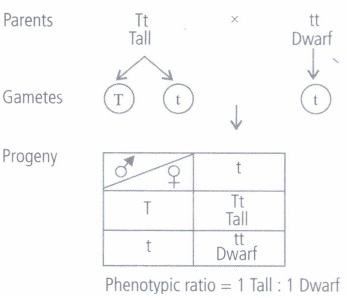
Assertion: A heterozygous tall plant when crossed with homozygous dwarf plant will produce tall and dwarf plants in the ratio of 3 : 1.
Reason: A heterozygous tall plant will produce two types of gametes, i.e., one with T and other with t whereas homozygous dwarf plant produce all gametes with t only.
Codes:
(a) Both A and R are true and R is correct explanation of the assertion
(b) Both A and R are true but R is not the correct explanation of the assertion
(c) A is true but R is false
(d) A is false but R is true.
22.
Assertion: A tall plant which always produces tall offsprings is considered heterozygous for height and is represented by genotype (Tt).
Reason: A tall plant which always produces tall offspring is homozygous dominant and will always produce only one type of gamete (T).
Codes:
(a) Both A and R are true and R is correct explanation of the assertion
(b) Both A and R are true but R is not the correct explanation of the assertion
(c) A is true but R is false
(d) A is false but R is true.
23.
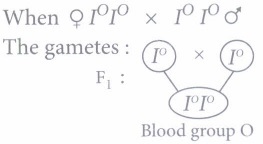
Assertion: If blood group of both mother and father is 'O' then the blood group of children will also be O.
Reason: Blood group in humans is determined by many alleles of a gene viz. IA, IB, IO.
Codes:
(a) Both A and R are true and R is correct explanation of the assertion
(b) Both A and R are true but R is not the correct explanation of the assertion
(c) A is true but R is false
(d) A is false but R is true.
24.
Assertion: A DNA can change the number of chromosomes in it.
Reason: Two cells with different number of nucleus cannot fuse.
Codes
(a) If both assertion and reason are true and the reason is correct explanation of assertion.
(b) If both assertion and reason are true but reason is not a correct explanation of assertion.
(c) If assertion is true and reason is false.
(d) If both assertion and reason are false.
25.
Assertion: Darwin's theory of evolution tells us how life evolved from simple to more complex forms.
Reason: Mendel's experiments give us the mechanism for the inheritance of traits from one generation to the next.
Codes
(a) If both assertion and reason are true and the reason is correct explanation of assertion.
(b) If both assertion and reason are true but reason is not a correct explanation of assertion.
(c) If assertion is true and reason is false.
(d) If both assertion and reason are false.
26.
Pea plants can have smooth seeds or wrinkled seeds. One of the phenotypes is completely dominant over the other. A farmer decides to pollinate one flower of a plant with smooth seeds using pollen from plant with wrinkled seeds. The resulting pea pod has all smooth seeds.
(i) Which of the following conclusions can be drawn?
1. The allele for smooth seeds is dominated over that of wrinkled seeds.
2. The plant with smooth seeds is heterozygous.
3. The plant with wrinkled seeds is homozygous.
| (a) 1 only | (b) 1 and 2 only |
| (c) 1 and 3 only | (d) 1, 2 and 3 |
(ii) Which of the following crosses will give smooth and wrinkled seeds in same proportion?
| (a) RR x rr | (b) Rr x rr |
| (c) RR x Rr | (d) rr x rr |
(iii) Which of the following cross can be used to determine the genotype of a plant with dominant phenotype?
| (a) RR x RR | (b) Rr x Rr |
| (c) Rr x RR | (d) RR x rr |
(iv) On crossing of two heterozygous smooth seeded plants (Rr), a total of 1000 plants were obtained in F1 generation. What will be the respective number of smooth and wrinkled seeds obtained in F1 generation?
| (a) 750,250 | (b) 500,500 |
| (c) 800,200 | (d) 950,50 |
(v) The characters which appear in the first filial generation are called
| (a) recessive characters | (b) dominant characters |
| (c) lethal characters | (d) non-mendelian characters |
27.
Gregor Mendel conducted hybridisation experiments on garden peas for seven years and proposed the laws of inheritance in living organisms. He investigated characters in the garden pea plant that were manifested as two opposing traits, e.g., tall or dwarf plants, yellow and green seeds, etc.
(i) Among the seven pairs of contrasting traits in pea plant as studied by Mendel, the number of traits related
to flower, pod and seed respectively were
| (a) 2,2,2 | (b) 2,2,1 |
| (c) 1,2,2 | (d) 1,1,2. |
(ii) The colour based contrasting traits in seven contrasting pairs, studied by Mendel in pea plant were
| (a) 1 | (b) 2 |
| (c) 3 | (d) 4. |
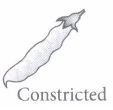
(iii) Refer to the given table of contrasting traits in pea plants studied by Mendel.
| Character | Dominant trait | Recessive trait |
| (i) Seed colour |  |
 |
| (ii) Flower colour | 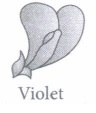 |
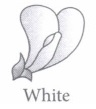 |
| (iii) Pod shape | 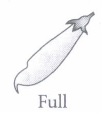 |
 |
| (iv) Flower position | 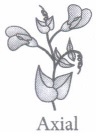 |
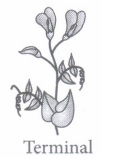 |
Which of the given traits is correctly placed?
(a) (i), (ii) and (iii) only
(b) (ii), (iii) and (iv) only
(c) (ii) and (iii) only
(d) (i), (ii), (iii) and (iv)
(iv) Some of the dominant traits studied by Mendel were
(a) round seed shape, green seed colour and axial flower position
(b) terminal flower position, green pod colour and inflated pod shape
(c) violet flower colour, green pod colour and round seed shape
(d) wrinkled seed shape, yellow pod colour and axial flower position.
(v) Which of the following characters was not chosen by Mendel?
| (a) Pod shape | (b) Pod colour |
| (c) Position of flower | (d) Position of pod |
1.
(d)
Both (b) and (c)
2.
(c)
3 : 1
3.
(c)
| (i) | (ii) |
| Dominant trait, | Inherited trait |
4.
(b)
the Y chromosome in zygote
5.
(d)
all of the above
6.
(i) In the sexual reproduction, the offspring of a human being is not a true copy of its parents because it inherits half of its genetic material from each parent. During the formation of sperm and egg cell, the genetic material undergoes the process of crossing over that leads to variation in progeny.
(ii)
| F1- Generation | F2-Generation |
| It refers to first filial generation | It refers to second filial generation. |
| It is the cross between two pure breed parents that have different genotypes. | It is the cross between two F1-generation plants. |
| The offspring will be heterozygous. | F2-generation may have heterozygous and homozygous offspring. |
(iii) Variations are useful for the survival of species over time because they provide the raw material for natural selection to act upon. In any population, there is always some degree of variations present that can be beneficial, neutral or deterimental to the individual.
Or
(iii) This resulted in 4 different combinations of seeds in F2-generation while wrinkled-green and round-yellow were parental type. The wrinkled-yellow and round-green are new combination. Therefore, the phenotypic ratio is 9 : 3 : 3 : 1. The reason of new feature in F2 - generation is when two pairs of traits are combined in a hybrid, one pair of character segregate independent of the other pair of character in progeny.
7.
-s.png)
-s.png)
-s.png)
8.
Classification involves grouping of organism into a formal system based on similarities in internal and external structure or evolutionary history. Two species are more closely related if they have more characteristics in common. And if two species are more closely related, then it means they have a more recent ancestor. For example, in a family, a brother and sister are closely, related and they have a recent common ancestor i.e., their parents. A brother and his cousin are also related but less than the sister and her brother. This is because the brother and his cousin have a common ancestor i.e., their grandparents in the second generation whereas the parents were from the first generation. With subsequent generations, the variations make organisms more different than their ancestors.
9.
C and D.
10.
Proteins and nucleic acid
11.
25%
12.
This is because, the X - chromosome will also have its effect and show their characteristics.
13.
Only those changes in the DNA or germ cells will be passed on to the progeny resulting in the variations in them. Since acquired characters do not produce any change in the DNA of germ cells, they cannot be inherited.
14.
(i) When tall pea plant (TT) is crossed with dwarf pea plant tt, every progeny is inherited with tall and dwarf gene together. Tall is dominant character, so plant becomes tall.
(ii) The genotype of F1 progeny is Tt.
The selfing between these plants is done in the follow way to obtain F2 progeny
 |
T | t |
| T | TT Tall (homozygous) |
Tt Tall (Heterozygous) |
| t | Tt Tall (Heterozygous) |
tt Dwarf (Homozygous) |
Here, recessive and dominant gene get segregated and we obtain one tall (homozygous), one dwarf (homozygous) and two tall (heterozygous) plants.
(iii) This cross shows the law of segregation of character. lt means character like tall and dwarf plant height do not mix while crossing them.
15.
Speciation: It is the process of evolution of a new species from pre-existing species. Occurring due to accumulation of variations. The processes like genetic drift/geographical barriers like mountains, rivers, etc., lead to incapability to reproduce amongst themselves in the population.
Natural selection: Change in frequency of some genes in a population gives survival advantage to a species from elimination.
Example: In a population of beetles, a new variation (green colour) gets survival benefit/advantage to green beetles whereas other (red) perishes.
16.
Yes, it is possible.
Example: When pure tall pea plants are crossed with pure dwarf pea plants, only tall pea plants are obtained in F1 generation. On selfing tall plants of Fl, both tall and dwarf plants are obtained in F2 generation in the ratio 3:1. Reappearance of the dwarf character, a recessive trait in F2 generation shows that the dwarf trait/character was present in individuals of F1 but it did not express due to the present of tallness, a dominant trait/character.
17.
Evolution is sequence of gradual changes which takes place in living organisms over millions of years to give rise to new species. Evolution does not mean progress in every case. This can be proved by example of bacteria. Bacteria are the simplest and one of the oldest organisms on the earth. Their simple body design does not make them weak. Bacteria are known to survive some of the harshest climates like volcanoes and sulfur springs. Many animals have certain features which hamper even their routine activities. For example the branch-like horns of antelope are a handicap for them. When an antelope runs for its life there are times when its horns get entangled in branches or bushes. This results in the death of the antelope.
18.
According to Darwin, natural selection is the process which brings about evolution of new species of plants and animals. It consists of the following processes:
(i) He noted that the size of population tends to remain constant despite the fact that more offsprings are produced than needed.
(ii) Variations provide adaptations.
(iii) The best adopted survive in the changing environment (survival of the fittest).
(iv) Nature selects the best organisms with better adaptations and after many generations new species are formed (natural selection).
19.
(d): In grasshoppers, the male has only one sex chromosome (XO) whereas the female has two sex chromosomes i.e., homogametic. This type of sex determination mechanism is called XX- XO mechanism
20.
(c): Father produces two types of sperms) one with X and one with Y chromosome whereas mother produces all egg with X chromosome. Zygote that inherits X chromosome from father has XX chromosomes and develops into baby girl whereas zygote which inherits Y chromosome from father has XY chromosomes and develops into baby boy.
21.
(d): A heterozygous tall plant when crossed with dwarf plant will give following result.
22.
(d): A tall plant which always produces tall offspring is homozygous dominant with genotype (TT). It will always produce only one type of gamete (T).
23.
(b): The blood group system in humans is determined by a gene which has 3 different alleles viz. IA, IB and IO. IA and IB are dominant to IO but codominant to each other. Blood group A is indicated by genotype IAIA or IAIO, Blood group B \(\Rightarrow\) IBIB or IBIO, Blood group AB \(\Rightarrow\) IAIB and blood group O \(\Rightarrow\) IOIO
24.
(b) If both assertion and reason are true but reason is not a correct explanation of assertion.
25.
(b) If both assertion and reason are true but reason is not a correct explanation of assertion.
26.
(i) (c)
(ii) (b)
(iii) (d)
(iv) (a): The crossing between two heterozygous smooth seeded (Rr) plants would give phenotypic ratio of 3 smooth seeded plant : 1 wrinkled seeded plant. If plants obtained were 1000, then the number of smooth and wrinkled plants will be closed to 750 and 250 respectively.
(v) (b)
27.
(i) (a): Characters studied by Mendel are as follows:
| Trait studied | Dominant | Recessive | |
| 1 | Plant height | Tall (T) | Dwarf (t) |
| 2 | Flower position | Axial (A) | Terminal (a) |
| 3 | Flower colour | Violet (V) or (W) | White (v) or (w) |
| 4 | Pod shape | Full or Inflated (I) or (C) | Constricted (i) or (c) |
| 5 | Pod colour | Green (G) or (Y) | Yellow (g) or (y) |
| 6 | Seed shape | Round (R) or (W) | Wrinkled (r) or (w) |
| 7 | Seed colour | Yellow (Y) or (G) | Green (y) or (g) |
(ii) (c)
| Trait studied | Dominant | Recessive | |
| 1 | Plant height | Tall (T) | Dwarf (t) |
| 2 | Flower position | Axial (A) | Terminal (a) |
| 3 | Flower colour | Violet (V) or (W) | White (v) or (w) |
| 4 | Pod shape | Full or Inflated (I) or (C) | Constricted (i) or (c) |
| 5 | Pod colour | Green (G) or (Y) | Yellow (g) or (y) |
| 6 | Seed shape | Round (R) or (W) | Wrinkled (r) or (w) |
| 7 | Seed colour | Yellow (Y) or (G) | Green (y) or (g) |
(iii) (d)
| Trait studied | Dominant | Recessive | |
| 1 | Plant height | Tall (T) | Dwarf (t) |
| 2 | Flower position | Axial (A) | Terminal (a) |
| 3 | Flower colour | Violet (V) or (W) | White (v) or (w) |
| 4 | Pod shape | Full or Inflated (I) or (C) | Constricted (i) or (c) |
| 5 | Pod colour | Green (G) or (Y) | Yellow (g) or (y) |
| 6 | Seed shape | Round (R) or (W) | Wrinkled (r) or (w) |
| 7 | Seed colour | Yellow (Y) or (G) | Green (y) or (g) |
(iv) (c)
| Trait studied | Dominant | Recessive | |
| 1 | Plant height | Tall (T) | Dwarf (t) |
| 2 | Flower position | Axial (A) | Terminal (a) |
| 3 | Flower colour | Violet (V) or (W) | White (v) or (w) |
| 4 | Pod shape | Full or Inflated (I) or (C) | Constricted (i) or (c) |
| 5 | Pod colour | Green (G) or (Y) | Yellow (g) or (y) |
| 6 | Seed shape | Round (R) or (W) | Wrinkled (r) or (w) |
| 7 | Seed colour | Yellow (Y) or (G) | Green (y) or (g) |
(v) (d)
| Trait studied | Dominant | Recessive | |
| 1 | Plant height | Tall (T) | Dwarf (t) |
| 2 | Flower position | Axial (A) | Terminal (a) |
| 3 | Flower colour | Violet (V) or (W) | White (v) or (w) |
| 4 | Pod shape | Full or Inflated (I) or (C) | Constricted (i) or (c) |
| 5 | Pod colour | Green (G) or (Y) | Yellow (g) or (y) |
| 6 | Seed shape | Round (R) or (W) | Wrinkled (r) or (w) |
| 7 | Seed colour | Yellow (Y) or (G) | Green (y) or (g) |

10th Standard CBSE Syllabus & Materials
10th Standard CBSE
CBSE 10th Social Science PS - Federalism - New Model Questions Papers Study Material - QB365 Set A
NEW10th Standard CBSE
CBSE 10th Social Science PS - Power Sharing - New Model Questions Papers Study Material - QB365 Set A
NEW10th Standard CBSE
CBSE 10th Social Science GEO - Manufacturing Industries - New Model Questions Papers Study Material - QB365 Set A
NEW10th Standard CBSE
CBSE 10th Social Science GEO - Minerals and Energy Resources - New Model Questions Papers Study Material - QB365 Set A



NCERT Books

Syllabus

Exam Pattern

Sample Question Papers

Previous year Question Papers

Important Notes

MCQ Practice test

NCERT Exemplers

Case study Questions

Image Based Questions

Passage based Questions

HOT Questions

Value Based Questions

Model Questions Papers
NCERT ( Book Back ) Questions

Assertion and Reason
Important Questions And Answers

CBSE 10th Standard CBSE Subjects
CBSE Standards