
 100% FREE ACCESS
10th Standard CBSE Syllabus & Materials
10th Standard CBSE
CBSE 10th Social Science ECO - Globalisation and the Indian Economy - New Model Questions Papers Study Material - QB365 Set A
NEW10th Standard CBSE
CBSE 10th Social Science ECO - Money and Credit - New Model Questions Papers Study Material - QB365 Set A
NEW10th Standard CBSE
CBSE 10th Social Science ECO - Sectors of the Indian Economy - New Model Questions Papers Study Material - QB365 Set A
NEW10th Standard CBSE
CBSE 10th Social Science ECO - Development - New Model Questions Papers Study Material - QB365 Set A
NEW10th Standard CBSE
CBSE 10th Social Science PS - Outcomes of Democracy - New Model Questions Papers Study Material - QB365 Set A
NEW10th Standard CBSE
CBSE 10th Social Science PS - Gender, Religion and Caste - New Model Questions Papers Study Material - QB365 Set A

Published on: 20/10/2025
Download CBSE Class 10th Standard CBSE Science question papers, sample papers, important questions, and previous year solved papers in PDF format. Get free study materials, NCERT solutions, and exam preparation resources for Class 10th Standard CBSE Science
Questions + Answers key
Take MCQ Science Test
1.
Sex determination depends upon the environment in
birds
amphibians
reptiles
fishes
2.
A homozygous cross between a pea plant having purple flowers is done with the homozygous pea plant having white flower. What will be the phenotypic ratio of the offspring obtained is F2-generation
2 : 1
1 : 1
1 : 2 : 2
3 : 1
3.
Which Mendelian law states that inheritance of one character is always independent to the inheritance of other character within the same individual?
Law of dominance
Law of segregation
Law of independent assortment
Both (b) and (c)
4.
Below given is the pattern of sex-determination in human beings. Study the same and choose the correct statement.
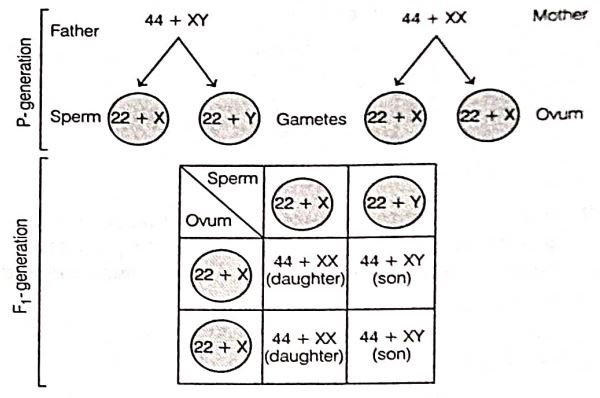
Both mother and father have 22 pairs of chromosomes including sex chromosomes
The gametes of both mother and father are haploid (n) in nature
It is Y-chromosome that decides the sex of a child
Both (b) and (c)
5.
Which pair of sex chromosome will determine a male ?
XO
XX
XY
YY
6.
The statement that correctly describes the characteristic of a gene is
in individuals of a given species, a specific gene is located on a particular chromosome
a gene is not the information source for making proteins in the cell
each chromosome has only one gene located all along its length
all the inherited traits in human beings are not controlled by genes
7.
A homozygous dominant guinea pig with black fur is crossed with a homozygous guinea pig with white fur. The F1-generation is crossed with itself.
What percentage of F2 - generation is expected to show white fur coat?
25%
50%
75%
100%
8.
A cross between two tall pea plants resulted in offsprings having a few dwarf plants. The gene-combination of the parental plants must be
Tt and Tt
Tt and tt
TT and tt
TT and Tt
9.
If a tall pea plant is crossed with a pure dwarf pea plant then, what percentage of F1 and F2-generation respectively will be tall?
25%, 25%
50%, 50%
75%, 100%
100%, 75%
10.
A cross between pea plant with white flowers (vv) and pea plant with violet flowers (VV) resulted in F2-progeny in which ratio of violet (VV) and white (vv) flowers will be
1 : 1
2 : 1
3 : 1
1 : 3
11.
Consider the following two statements
(i) The trait that expresses itself in F1-generation.
(ii) The trait that keeps on passing from one generation to another.
The appropriate terms for the statements (i) and (ii) respectively are
| (i) | (ii) |
| Recessive trait, | Dominant trait |
| (i) | (ii) |
| Dominant trait, | Recessive trait |
| (i) | (ii) |
| Dominant trait, | Inherited trait |
| (i) | (ii) |
| Recessive trait, | Inherited trait |
12.
The below given figure gives details about different contrasting pairs of characters selected by Mendel for his experiments to observe carefully and select the number of traits related to flower pod and seed, respectively.
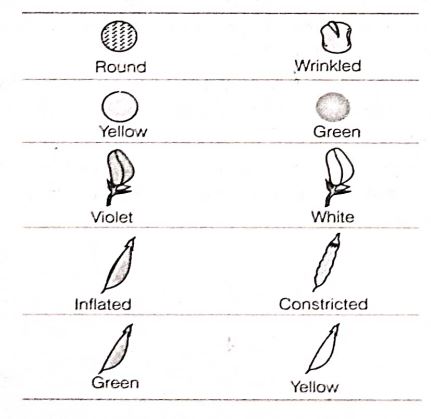
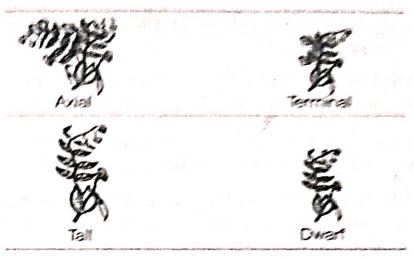
2, 2, 2
2, 2, 1
1, 1, 2
1, 1, 1
13.
Which of the following statements is not true with respect to variation?
All variations in a species have equal chance of survival
Change in genetic composition results in variation
Selection of variants by environmental factors forms the basis of evolutionary processes
Variation is minimum in asexual reproduction
14.
Organism A recently carne into existence while B was formed millions of years ago. What does this indicate?
(i) A is more efficient than B (ii) A is more complex than B.
Only (i)
Only (ii)
Both (i) and (ii)
Either (i) or (ii)
15.
Wild cabbage is being cultivated for thousands of years and humans have generated broccoli, cauliflower, kala etc. from it. This is an example of
Natural selection
Genetic drift
Geographic isolation
Artificial selection
16.
Which one of the following strongly indicates that bird and dinosaurs are closely related?
They both have feathers
They both respire
They both reproduce
They both have eyes
17.
How can we know how old fossils are:
Fossils found closer to surface are recent than those found much below
Detecting ratios of isotopes
Studying its characteristics
All of these
18.
Fossils helps
To study evolution
To understand climatic conditions in past
For a hierarchy of organisms (classification
They help in all the above
19.
Analogous organs have
Same structure, same function
Different structure, different function
Same structure, different function
Same function, different structure
20.
Homologous organs have
Same structure, same function
Different structure, different function
Same structure, different function
Same function, different structure
21.
If A and B have n characteristics common while A and C have n/2 characteristics common, then which of the two organisms are more closely related?
A and C
A and B
Characteristics need to be known
None of these
22.
Which of the following can be called a characteristic?
Plants can photosynthesise
We have 2 eyes
Mango tree is multicellular
All of these
23.
Formation of 2 independent species due to genetic drift, geographical isolation, natural selection is specifically referred as-
Evolution
Classification
Speciation
Reproduction
24.
With whom we associate theory of evolution
Charles Darwin
Mendel.
Stanley Miller
Harold Urey
25.
If we breed a group of squirrels and surgically remove their tails, then amongst the progeny of these tailless squirrels
All have no tail
All have a tail
Some of them have tails
Cannot be determined
26.
Which one of the following gives a survival advantage and thus alters frequency of inherited trait.
(i) natural selection (ii) genetic drift
only (i)
only (ii)
both (i) and (ii)
none of these
27.
There is an inbuilt tendency of variation during reproduction because of-
(i) Errors in DNA copying (ii) Sexual reproduction
only (i)
only (ii)
both (i) and (ii)
none of them
28.
Who have a perfect pair of sex chromosomes
Girls only
Boys only
Both girls and boys
It depends on many other factors
29.
What is the probability that a human progeny will be a boy
50%
56%
47.34%
It varies
30.
Amongst which of the following animals, sex of the off springs not genetically determined
Humans
Snails
Birds
Dogs
31.
Which one of the following is present in the nucleus?
Gene
DNA
Chromosomes
All of these
32.
Which of the following is controlled by genes?
(i) Weight of a person (ii) Height of a person
only 1 (i)
only (ii)
both (i) and (ii)
Sometimes (i) and sometimes (ii)
33.
Which of the following is a totally impossible outcome of Mendel's Experiment (cross breeding pure breed tall and short pea plants)
3 tall 1 short plant
24 tall and 8 short plants
8 tall and 0 short plants
4 tall plants and 1 medium-height plant.
34.
A section of DNA providing information for one protein is called
Nucleus
Chromosomes
Trait
Gene
35.
Which one is a possible progeny in F2 generation of pure breed tall plant with round seed and short plant with wrinkled seeds?
Tall plant with round seeds
Tall plant with wrinkled seeds
Short plant with round seed
All of the above
36.
Which one of the following is not one of the direct conclusions that can be drawn from Mendel's experiment?
Only one parental trait is expressed
Two copies of each trait is inherited in sexually reproducing orgainsm
For recessive trait to be expressed, both copies should be identical
Natural selection can alter frequency of an inherited trait
37.
Some dinosaurs had feathers although they could not fly but birds have feathers that help them to fly. In the context of evolution this means that
reptiles have evolved from birds
there is no evolutionary connection between reptiles and birds
feathers are homologous structures in both the organisms
birds have evolved from reptiles.
38.
The theory of evolution of species by natural selection was given by
Mendel
Darwin
Morgan
Lamarck
39.
The number of pair (s) of sex chromosomes in the zygote of humans is
one
two
three
four
40.
In peas, a pure tall plant (TT) is crossed with a short plant (tt). The ratio of pure tall plants to short plants in F2 is
1 : 3
3 : 1
1 : 1
2 : 1
41.
Select the statements that describe characteristics of genes
(i) genes are specific sequence of bases in a DNA molecule
(ii) a gene does not code for proteins
(iii) in individuals of a given species, a specific gene located on a particular chromosome
(iv) each chromosome has only one gene.
(i) and (ii)
(i) and (iii)
(i) and (iv)
(ii) and (iv)
42.
The two versions of a trait (character) which are brought in by the male and female gametes are situated on
copies of the same chromosome
two different chromosomes
sex chromosomes
any chromosome
43.
From the list given below, select the character which can be acquired but not inherited
colour of eye
colour of skin
size of body
nature of hair
44.
Select the correct statement
Tendril of a pea plant and phylloclade of Opuntia are homologous.
Tendril of a pea plant and phylloclade of Opuntia are analogous
Wings of birds and limbs of lizards are analogous
Wings of birds and wings of bat are homologous
45.
A basket of vegetables contains carrot, potato, radish and tomato. Which of them represent the correct homologous structures?
Carrot and potato
Carrot and tomato
radish and carrot
radish and potato
46.
Two pea plants one with round green seeds (RRyy) and another with wrinkled yellow (rrYY) seeds produce F1 progeny that have round, yellow (RrYy) seeds. When F1 plants are selfed, the F2 progeny will have new combination of characters. Choose the new combination from the following:
(i) Round, yellow
(ii) Round, green
(iii) Wrinkled, yellow
(iv) Wrinkled, green
(i) and (ii)
(i) and (iv)
(ii) and (iii)
(i) and (iii)
47.
New species may be formed if
(i) DNA undergoes significant changes in germ cells
(ii) chromosome number changes in the gamete
(iii) there is no change in the genetic material
(iv) mating does not take place
(i) and (ii)
(i) and (iii)
(ii), (iii) and (iv)
(i), (ii) and (iii)
48.
Select the incorrect statement
Frequency of certain genes in a population change over several generations resulting in evolution.
Reduction in weight of the organism due to starvation is genetically controlled.
Low weight parents can have heavy weight progeny
Traits which are not inherited over generations do not cause evolution.
49.
A zygote which has an X - chromosome inherited from the father will develop into a
boy
girl
X - chromosome does not determine the sex of a child
either boy or girl
50.
The maleness of a child is determined by
the X chromosome in the zygote
the Y chromosome in zygote
the cytoplasm of germ cell which determines the sex.
sex is determined by chance
51.
In human males all the chromosomes are paired perfectly except one. This/these unpaired chromosome is/are.
(i) large chromosome
(ii) small chromosome
(iii) Y - chromosome
(iv) X - chromosome
(i) and (ii)
(iii) only
(iii) and (iv)
(ii) and (iv)
52.
If a round, green seeded pea plant (RR yy) is crossed with wrinkled, yellow seeded pea plant, (rr YY) the seeds produced in FI generation are
round and yellow
round and green
wrinkled and green
wrinkled and yellow
53.
Which of the following statement is incorrect?
For every hormone there is a gene
For every protein there is a gene
For production of every enzyme there is a gene.
For every molecule of fat there is a gene.
54.
A cross between a tall plant (TT) and short pea plant (tt) resulted in progeny that were all tall plants because
tallness is the dominant trait
shortness is the dominant trait
tallness is the recessive trait
height of pea plant is not governed by gene 'T' or 't'
55.
Two pink coloured flowers on crossing resulted in 1 red, 2 pink and 1 white flower progeny. The nature of the cross will be
double fertilisation
self pollination
cross fertilisation
no fertilisation
56.
Exchange of genetic material takes place in
vegetative reproduction
asexual reproduction
sexual reproduction
budding
57.
In evolutionary terms, we have more in common with
A Chinese school-boy.
A chimpanzee
A spider
A bacterium
58.
An example of homologous organs is
Our arm and a dog's fore-leg
Our teeth and an elephant's tusks.
Potato and runners of grass.
all of the above
1.
(c)
reptiles
2.
(d)
3 : 1
3.
(c)
Law of independent assortment
4.
(d)
Both (b) and (c)
5.
(c)
XY
6.
(a)
in individuals of a given species, a specific gene is located on a particular chromosome
7.
(a)
25%
8.
(a)
Tt and Tt
9.
(d)
100%, 75%
10.
(c)
3 : 1
11.
(c)
| (i) | (ii) |
| Dominant trait, | Inherited trait |
12.
(a)
2, 2, 2
13.
(a)
All variations in a species have equal chance of survival
14.
(c)
Both (i) and (ii)
15.
(d)
Artificial selection
16.
(a)
They both have feathers
17.
(d)
All of these
18.
(d)
They help in all the above
19.
(d)
Same function, different structure
20.
(c)
Same structure, different function
21.
(c)
Characteristics need to be known
22.
(d)
All of these
23.
(c)
Speciation
24.
(a)
Charles Darwin
25.
(b)
All have a tail
26.
(a)
only (i)
27.
(b)
only (ii)
28.
(a)
Girls only
29.
(a)
50%
30.
(b)
Snails
31.
(d)
All of these
32.
(b)
only (ii)
33.
(d)
4 tall plants and 1 medium-height plant.
34.
(d)
Gene
35.
(d)
All of the above
36.
(d)
Natural selection can alter frequency of an inherited trait
37.
(d)
birds have evolved from reptiles.
38.
(b)
Darwin
39.
(a)
one
40.
(c)
1 : 1
41.
(b)
(i) and (iii)
42.
(a)
copies of the same chromosome
43.
(c)
size of body
44.
(a)
Tendril of a pea plant and phylloclade of Opuntia are homologous.
45.
(c)
radish and carrot
46.
(b)
(i) and (iv)
47.
(a)
(i) and (ii)
48.
(b)
Reduction in weight of the organism due to starvation is genetically controlled.
49.
(b)
girl
50.
(b)
the Y chromosome in zygote
51.
(c)
(iii) and (iv)
52.
(a)
round and yellow
53.
(d)
For every molecule of fat there is a gene.
54.
(a)
tallness is the dominant trait
55.
(b)
self pollination
56.
(c)
sexual reproduction
57.
(a)
A Chinese school-boy.
58.
(d)
all of the above

10th Standard CBSE Syllabus & Materials
10th Standard CBSE
CBSE 10th Social Science PS - Federalism - New Model Questions Papers Study Material - QB365 Set A
NEW10th Standard CBSE
CBSE 10th Social Science PS - Power Sharing - New Model Questions Papers Study Material - QB365 Set A
NEW10th Standard CBSE
CBSE 10th Social Science GEO - Manufacturing Industries - New Model Questions Papers Study Material - QB365 Set A
NEW10th Standard CBSE
CBSE 10th Social Science GEO - Minerals and Energy Resources - New Model Questions Papers Study Material - QB365 Set A



NCERT Books

Syllabus

Exam Pattern

Sample Question Papers

Previous year Question Papers

Important Notes

MCQ Practice test

NCERT Exemplers

Case study Questions

Image Based Questions

Passage based Questions

HOT Questions

Value Based Questions

Model Questions Papers
NCERT ( Book Back ) Questions

Assertion and Reason
Important Questions And Answers

CBSE 10th Standard CBSE Subjects
CBSE Standards