
 100% FREE ACCESS
10th Standard CBSE Syllabus & Materials
10th Standard CBSE
CBSE 10th Social Science ECO - Globalisation and the Indian Economy - New Model Questions Papers Study Material - QB365 Set A
NEW10th Standard CBSE
CBSE 10th Social Science ECO - Money and Credit - New Model Questions Papers Study Material - QB365 Set A
NEW10th Standard CBSE
CBSE 10th Social Science ECO - Sectors of the Indian Economy - New Model Questions Papers Study Material - QB365 Set A
NEW10th Standard CBSE
CBSE 10th Social Science ECO - Development - New Model Questions Papers Study Material - QB365 Set A
NEW10th Standard CBSE
CBSE 10th Social Science PS - Outcomes of Democracy - New Model Questions Papers Study Material - QB365 Set A
NEW10th Standard CBSE
CBSE 10th Social Science PS - Gender, Religion and Caste - New Model Questions Papers Study Material - QB365 Set A

Published on: 20/10/2025
Download CBSE Class 10th Standard CBSE Science question papers, sample papers, important questions, and previous year solved papers in PDF format. Get free study materials, NCERT solutions, and exam preparation resources for Class 10th Standard CBSE Science
Questions + Answers key
Take MCQ Science Test
1.
(i) A person suffering from myopia (nearsightedness) was advised to wear corrective lens of power-25D. A spherical lens of same focal length was taken in the laboratory. At what distance should a student place an object from this lens, so that it forms an image at a distance of 10 cm from the lens?
(ii) Draw a ray diagram to shown the position and nature of the image formed in the above case.
2.
(a) Write the importance of ciliary muscles in the human eye. Name the defect of vision that arises due to gradual weakening of the ciliary muscles in old age. What type of lenses are required by the persons suffering from this defect to see the objects clearly?
(b) Akshay, sitting in the last row in his class, could not see clearly the words written on the blackboard. When the teacher noticed it, he announced if any student sitting in the front row could volunteer to exchange his seat with Akshay. Salman immediately agreed to exchange his seat with Akshay. He could now see the words written on the blackboard clearly. The teacher thought it fit to send the message to Akshay's parents advising them to get his eyesight checked. In the context of the above event, answer the following questions :
(i) Which defect of vision is Akshay suffering from? Which type of lens is used to correct this defect?
(ii) State the values displayed by the teacher and Salman.
(iii) In your opinion, in what way can Akshay express his gratitude towards the teacher and Salman?
3.
(a) One - half of a convex lens is covered with a black paper. Will such a lens produce an image of the complete object? Support your answer with a ray diagram.
(b) An object 5 cm high is held 25 cm away from a converging lens of focal length 10 cm.
(i) Draw the ray diagram and
(ii) Calculate the position and size of the image formed.
(iii) What is the nature of the image?
4.
It is desired to obtain an erect image of an object, using concave mirror of focal length of 12 cm
(i) What should be the range of distance of an object placed in front of the mirror?
(ii) Will the image be smaller or larger than the object? Draw ray diagram to show the formation of image in this case.
(iii) Where will the image of this object be, if its placed 24 cm in front of the mirror?
Draw a ray diagram for this situation also to justify your answer.
Show the positions of the pole, the principal and the centre of curvature in the above ray diagrams.
5.
State the laws of refraction of light. If the speed of light in vacuum is \({ 3\times 10 }^{ 8 }\) ms-1 , find the speed of light in a medium of absolute refractive index 1.5.
6.
An object 5 cm in length is held 25 cm away from a converging lens of focal length 10 cm. Draw the ray diagram and find the position, size and the nature of the image formed.
7.
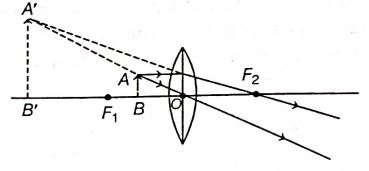
The above lens has a focal length of 10 cm. The object of height 2 mm is placed at a distance of 5 cm from the pole. Find the height of the image.
4 cm
6.67 mm
4 mm
3.33 mm
8.
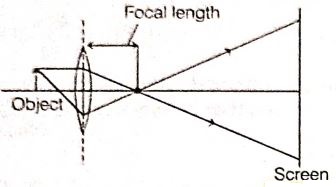
Which diagram shows image formation of an object on a screen by a converging lens?
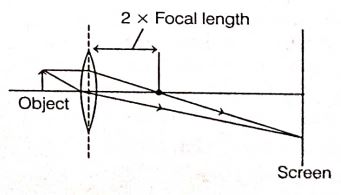
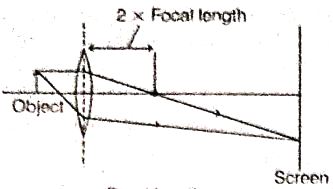
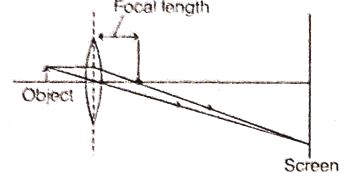
9.
The angle of Incidence from air to glass at the point O on the hemispherical glass slab is
45o
0o
90o
180o
10.
If a beam of red light and a beam of violet light are Incident at the same angle on the Inclined surface of a prism from air medium and produce angles of refraction rand v respectively, which of the following Is correct?
r = v
r > v
r = 1/v
r < v
11.
When a ray of light passes through a glass prism, it suffers two refractions. During these refractions, the ray bends
away from the base in both cases
towards the base in both cases
towards the base in first case and away from the base in second case
away from the base in first case and towards the base in second case
12.
The image formed on the retina of human eye is
virtual and erect
real and inverted
virtual an inverted
real and erect
13.
The refractive indices of some media are given below
| Medium | Refractive index |
| X y Z W |
1.51 1.72 1.83 2.42 |
In which of these is the speed of light minimum and maximum, respectively
X-minimum, W-maximum
Z-minimum, W-maximum
W-minimum, X-maximum
X-minimum, Z-maximum
14.
Convex lens forms a real, point sized image at focus, the object is placed
at focus
between F and 2F
at infinity
at 2F
15.
16.
Which of the following ray diagram is correct for the ray of light incident on a lens shown in Figure?
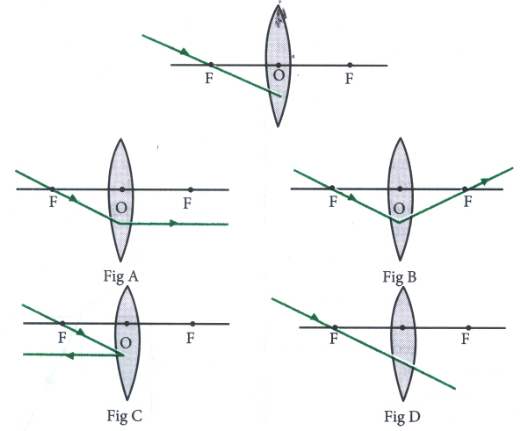
Fig. A
Fig. B
Fig. C
Fig. D
17.
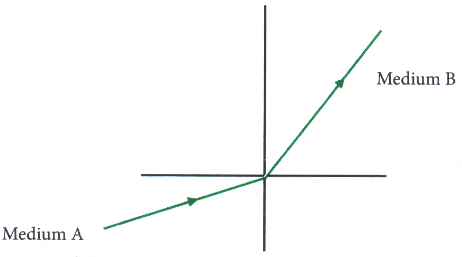
A light ray enters from medium A to medium B as shown in Figure. The refractive index of medium B relative to A will be
greater than unity
less than unity
equal to unity
zero
18.
The bluish colour of water in deep sea is due to
the presence of algae and other plants found in water
reflection of sky in water
scattering of light
absorption of light by the sea
19.
Which of the following statements is correct regarding the propagation of light of different colours of white light in air?
Red light moves fastest
Blue light moves faster than green light
All the colours of the white light move with the same speed
Yellow light moves with the mean speed as that of the red and the violet light
20.
At noon the sun appears white as
light is least scattered
all the colours of the white light are scattered away
blue colour is scattered the most
red colour is scattered the most
21.
A student sitting on the bench can read the letters written on the blackboard but is not able to read the letters written in his text book. Which of the following statement is correct?
The near point of his eyes has receded away
The near point of his eyes has come closer to him
The far point of his eyes has come closer him
The far point of his eyes has receded away
22.
A full length image of a distant tall building can definitely be seen by using.
a concave mirror
a convex mirror
a plane mirror
both concave as well as plane mirror
23.
Magnification produced by a rear view mirror fitted in vehicles
is less than one
is more than one
is equal to one
can be more than or less than one depending upon the position of the object in front of it.
24.
A 10 mm long awl pin is placed vertically in front of a concave mirror. A 5 mm long image of the awl pin is formed at 30 cm in front of the mirror. The focal length of this mirror is.
- 30 cm
- 20 cm
- 40 cm
- 60 cm
25.
Define incident ray, reflected ray, normal ray, angle of incidence and reflection.
26.
Explain in brief the reason for each of the following
(a) Advanced sunrise
(b) Delayed sunset
(c) Twinkling of stars
27.
Draw a ray diagram and also state the position, the relative size and the nature of image formed by a concave mirror when the object is placed at the centre of curvature of the mirror
28.
Which phenomenon occurs when light falls on
(a) highly polished surface
(b) a transparent medium?
29.
A girl was playing with a thin beam of light from her laser torch by directing it from different directions on a convex lens held vertically. She was surprised to see that in a particular direction the beam of light continues to move along the same direction after passing through the lens. State the reason for this observation.
30.
Shoba finds out that sharp image of the window pane of her science laboratory is formed at a distance of 15 cm from the lens. She now tries to focus the building visible to her outside the window instead of the window pane without disturbing the lens. In which direction will she move the screen to obtain a sharp image of the building? What is the approximate focal length of this lens?
31.
Why does the sun appear reddish at sunrise?
32.
An object is placed at a distance of 60 cm from a concave lens of focal length 30 cm.
(i) Use lens formula to find the distance of the image from the lens.
(ii) List four characteristics of the image (nature, position, size, erect/inverted) formed by the lens in this case.
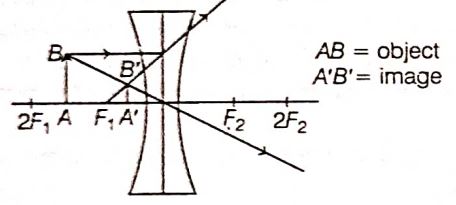
(iii) Draw the ray diagram to justify your answer of part (ii).
33.
(i) State the relation between colour of scattered light and size of the scattering particle.
(ii) The apparent position of an object, when seen through the hot air, fluctuates or waves. State the basic cause of this observation.
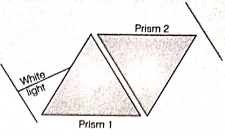
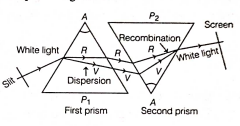
(iii) Complete the path of white light when it passes through two identical prisms placed as shown
34.
How can change in size of eyeball be one of the reason for
(i) myopic and
(ii) hypermetropic eye?
Compare the size of eyeball with that of a normal eye In each case. How does this change of size affect the position of image in each case?
35.
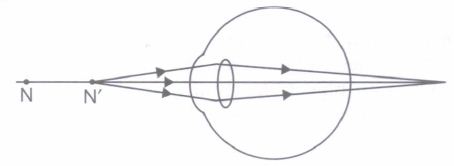
Study the diagram given below and answer the question that it follows:
(a) Which defect of vision is represented in this case? Give reason for your answer.
(b) What could be the two causes of this defect?
(c) With the help of a diagram show how this defect can be corrected by the use of a suitable lens
36.
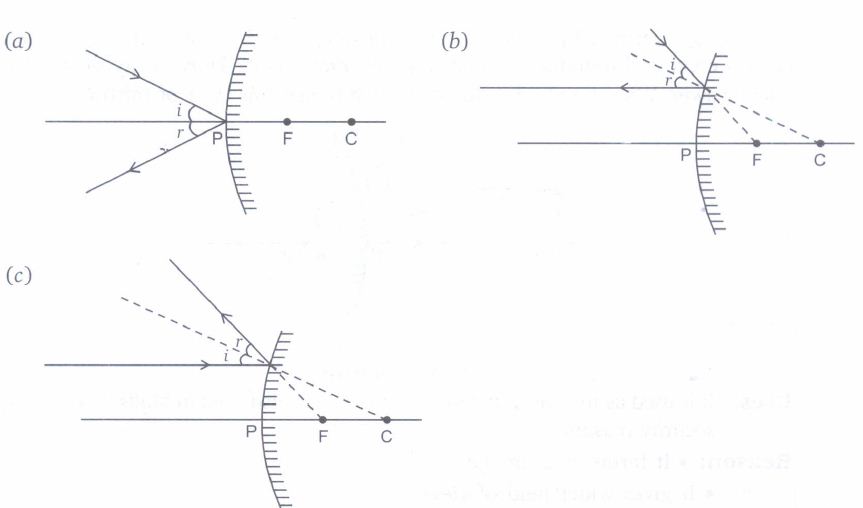
Draw a ray diagram to show the path of the reflected ray in each of the following cases. A ray of light incident on a convex mirror
(a) strikes at its pole making an angle from the principal axis.
(b) is directed towards its principal focus.
(c) is parallel to its principal axis.
37.
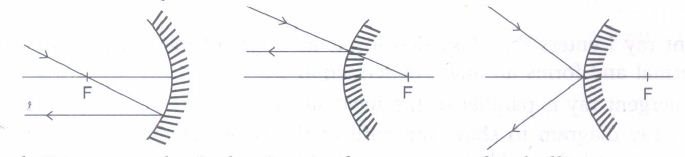
Draw the following diagram, in which a ray of light is incident on a concave/convex mirror, on your answer sheet. Show the path of this ray, after reflection, in each case.
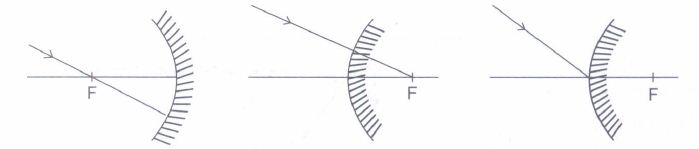 .
.
38.
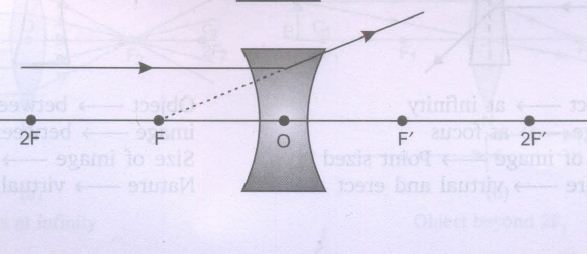
Take down this diagram on to your answer book and complete the path of the ray.
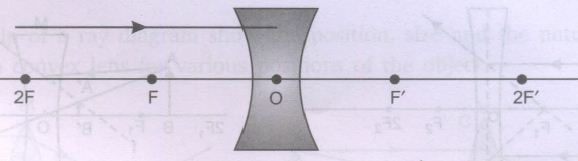
39.
Assertion (A) : Red light signals are used to stop the vehicles on the road.
Reason (R) : Red coloured light is scattered the most so as to be visible from a large distance.
(a) If both Assertion and Reason are true and Reason is the correct explanation of Assertion.
(b) If both Assertion and Reason are true, but Reason is not the correct explanation of Assertion.
(c) If Assertion is true, but Reason is false.
(d) If Assertion is false, but Reason is true.
40.
Assertion: The dentists use convex mirrors to see large images of the teeth of patients.
Reason: The convex mirrors always produces the enlarged image of the object.
Codes
(a) If both assertion and reason are true and the reason is correct explanation of assertion.
(b) If both assertion and reason are true but reason is not a correct explanation of assertion. -.
(c) If assertion is true and reason is false.
(d) If both assertion and reason are false.
41.
Dispersion is the splitting up of white light into seven colors on passing through a transparent medium like a glass prism. When a white light beam is passed through a prism, a band of seven colors are formed is known as spectrum of white light as shown in below figure.
When white light consisting of seven colors falls on a transparent medium (glass prism) , each color in it is refracted ( or deviated ) by a different angle , with the result that seven colors are spread out to form a spectrum
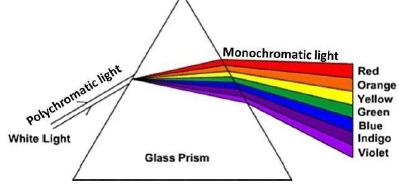
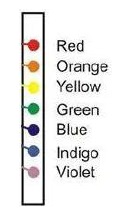
(i) A beam of white light falls on a glass prism. The colour of light which undergoes the least bending on passing through the glass prism is :
| (a) violet | (b) red | (c) green | (d) blue |
(ii) The colour of white light which suffers the maximum bending (or maximum refraction) on passing through a glass prism is :
| (a) yellow | (b) orange | (c) red | (d) violet |
(iii) Which of the following colour of white light is least deviated by the prism ?
| (a) green | (b) violet | (c) indigo | (d) yellow |
(iv) The colour of white light which is deviated the maximum on passing through the glass prism is :
| (a) blue | (b) indigo | (c) red | (d) orange |
(v) The splitting up of white light into seven colours on passing through a glass prism is called :
| (a) refraction | (b) deflection | (c) dispersion | (d) scattering |
42.
The relationship between the distance of object from the lens (u), distance of image from the lens (v) and the focal length (j) of the lens is called lens formula. It can be written as\(\begin{equation} \frac{1}{f}=\frac{1}{v}-\frac{1}{u} \end{equation}\)
The size of image formed by a lens depends on the position of the object from the lens. A lens of short focal length has more power whereas a lens of long focal length has less power. When the lens is convex, the power is positive and for concave lens, the power is negative.
The magnification produced by a lens is the ratio of height of image to the height of object as the size of the image relative to the object is given by linear magnification (m).
When, m is negative, image formed is real and when m is positive, image formed is virtual. If m < 1, size of image is smaller than the object. If m > 1, size of image is larger than the object.
(i) An object 4 cm in height is placed at a distance of 10 cm from a convex lens of focal length 20 cm. The position of image is
| (a) - 20 cm | (b) 20 cm |
| (c) -10 cm | (d) 10 cm |
(ii) In the above question, the size of image is
| (a) 16 cm | (b) 8 cm |
| (c) 4 cm | (d) 2 cm |
(iii) An object is ,placed 50 cm from a concave lens and produces a virtual image at a distance of 10 cm in front of lens. The focal length of lens is
| (a) - 25 cm | (b) -12.5 cm |
| (c) 12.5 cm | (d) 10 cm |
(iv) A convex lens forms an image of magnification -2 of the height of image is 6 cm, the height of object is
| (a) 6 cm | (b) 4 cm |
| (c) 3 cm | (d) 2 cm |
(v) A concave lens of focal length 5 cm, the power of lens is
| (a) 20D | (b) -20D |
| (c) 90D | (d) -5 D |
43.
The refraction of light on going from one medium to another takes place according to two laws which are known as the laws of refraction of light. These laws are
1. The ratio of sine of angle of incidence to the sine of angle of refraction is always constant for the pair of media in contact.
\(\frac{\sin i}{\sin r}=\mu=\text { constant }\)
This constant is called refractive index of the second medium with respect to the first medium.
Refractive index is also defined as the ratio of speed of light in vacuum to the speed of light in medium.
2. The incident ray, refracted ray and normal all lie in the same plane.
This law is called Snell's law of refraction.
(i) When light travels from air to glass,
(a) angle of incidence > angle of refraction
(b) angle of incidence < angle of refraction
(c) angle of incidence = angle of refraction
(d) can't say
(ii) When light travels from air to medium, the angle of incidence is 45° and angle of refraction is 30°. The refractive index of second medium with respect to the first medium is
| (a) 1.41 | (b) 1.50 |
| (c) 1.23 | (d) 1 |
(iii) In which medium, the speed of light is minimum?
| (a) Air | (b) Glass |
| (c) Water | (d) Diamond |
(iv) If the refractive index of glass is 1.5 and speed of light in air is 3 x 10⁸ m/s. The speed of light in glass is
| (a) 2 x 10⁸ mls | (b) 2.9 x 10⁸ mls |
| (c) 4.5 x 10⁸ mls | (d) 3 x 10⁸ mls |
(v) Refractive index of a with respect to b is 2. Find the refractive index of b with respect to a.
| (a) 0.4 | (b) 0.5 |
| (c) 0.25 | (d) 2. |
1.
(i) Focal length, \(f(\mathrm{~m})=\frac{1}{P(D)}\)
\(f =\frac{1}{-2.5 D}=\frac{-10}{25} =-04 \mathrm{~m}=40 \mathrm{~cm} \)
\(f =-40 \mathrm{~cm}, v=-10 \mathrm{~cm}, u=\text { ? (to find) }\)
Using lens formula, \(\frac{1}{v}-\frac{1}{u}=\frac{1}{f}\)
\(\frac{-1}{u} =\frac{1}{40}+\frac{1}{-10}-\frac{1}{u}=\frac{1}{-40} =\frac{-1+4}{40}=\frac{3}{40}\)
\(\therefore \quad u =\frac{-40}{3}=-13.3 \mathrm{~cm}\)
(ii) The lens is concave as the power is -ve.
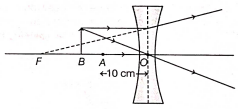
OA = v=-10 cm, OB=-13.3 cm, OF = f=-40cm
2.
(a) Ciliary muscles modify the curvature of the eye lens to enable the eye to focus objects at varying distances and help in adjusting the focal length of the eye lens. The gradual weakening of the ciliary muscles in old age causes presbyopia. The persons suffering from this defect need to use bifocal lenses.
(b) (i) Akshay is suffering from Myopia/Near sightedness. Concave/Diverging lens is used to correct this defect.
(ii) The values displayed by the teacher and Salman are concerned and caring respectively.
(iii) Akshay can express his gratitude by thanking the teacher and Salman.
3.
(a) As we can see in the figure given, when the lower half of the convex lens is covered with a black paper, it still forms lens. However the intensity of the image is reduced when the convex lens is covered with black paper.
-S-1.png)
(b) (i) Converging lens (Convex lens):
Height of the object, h1= 5 cm
Object distance, u = -25 cm
Focal length, f= +10 cm
-S-2.png)
(ii) Image distance, v ?
Image size, h2 = ?
According to lens formula:
\(\frac { 1 }{ v } -\frac { 1 }{ u } =\frac { 1 }{ f } \)
\(\Rightarrow \frac { 1 }{ v } -\frac { 1 }{ -25 } =\frac { 1 }{ 10 } \)
\(\Rightarrow \frac { 1 }{ v } +\frac { 1 }{ 25 } =\frac { 1 }{ 10 } \)
\(\frac { 1 }{ v } =\frac { 1 }{ 10 } -\frac { 1 }{ 25 } \)
\(\Rightarrow \frac { 1 }{ v } =\frac { 5-2 }{ 50 } =\frac { 3 }{ 50 } \)
\(\Rightarrow v=\frac { 50 }{ 3 } =+16.6cm\)
\(\frac { { h }_{ 2 } }{ { h }_{ 1 } } =\frac { v }{ u } \)
\(\Rightarrow \frac { { h }_{ 2 } }{ 5 } =\frac { 50 }{ 3\times -25 } \)
-S.png)
(iii) Nature of the image
(a) The +ve of v shows that image is real.
(b) The -ve sign of h2 shows that image is inverted.
∴ Size of image = 3.3 cm
4.
In a concave mirror an erect image will be obtained when the object is placed between pole and focus of the mirror.
-S.png)
Since, focal length is 12 cm,
(i) Therefore, the range of object distance is between 0 cm to <12 cm (from zero to less than 12 cm).
(ii) Image formed wall be magnified. i.e. larger than the object.
(iii) If the object is placed at 24 cm in front of the mirror, it means that object is placed at 2F. ie., at the centre of curvature (at C) of the mirror.
-S.png)
The real, inverted and same size (of the object) image will also be formed at 24 cm.
5.
(1) The incident, the refracted ray and the normal at the point of incidence. all lie in the same plane.
(2) The second law of refraction is called Snell's law of refraction. According to Snell's law. "The ratio of sine of angle of incidence to the sine of angle of refraction is a constant for a given pair of mediums"
-S.png)
\(\frac { sin\ \ i }{ sin \ r } =n(constant)\)
\(\frac { Speed \ of \ light \ in \ vacuum }{ Speed \ of \ light \ in \ medium } =\)
Refractive index of the medium
\(\Rightarrow \frac { 3\times { 10 }^{ 8 }m/s }{ x } =1.5\)
\(\Rightarrow \frac { 3\times { 10 }^{ 8 } }{ 1.5 } =2\times { 10 }^{ 8 }m/s\)
∴ Speed of lightin the medium = 2 x 10⁸ m/s
6.
Object distance, u = -25 cm, Object height, h = 5 cm, Focal length, f = +10 cm Substituting the values in the lens formula,
\(\frac { 1 }{ u } +\frac { 1 }{ v } =\frac { 1 }{ f } \)
We get v = 16.66 cm
The positive value of v shows that the image is formed at the other side of the lens.
Magnification =\(\frac { h' }{ h } =-\frac { v }{ u } \) =-16.66/25=-0.66
The negative sign shows that the image is real and formed behind the lens.
Magnification m=\(\frac { h' }{ h } \)
h' =-3.3 cm
The negative value of image height indicates that the image formed is inverted. The position, size, and nature of image are shown in the following ray diagram.
-S.png)
7.
(c)
4 mm
8.
(c)
9.
(b)
0o
10.
(d)
r < v
11.
(b)
towards the base in both cases
12.
(b)
real and inverted
13.
(c)
W-minimum, X-maximum
14.
(c)
at infinity
15.
(b)
16.
(a)
Fig. A
17.
(a)
greater than unity
18.
(c)
scattering of light
19.
(c)
All the colours of the white light move with the same speed
20.
(a)
light is least scattered
21.
(a)
The near point of his eyes has receded away
22.
(b)
a convex mirror
23.
(a)
is less than one
24.
(b)
- 20 cm
25.
Incident ray - light which falls on the mirror/ polished surface is called incident ray.
Reflected ray - ray of light which goes back in the same medium after striking the surface is called reflected ray.
Normal - the perpendicular drawn to the reflecting surface is called normal at that point.
Angle of incidence - the angle between the incident ray and the normal is known angle of incidence.
Angle of reflection - the angle between reflected ray and the normal is known angle of reflection.
26.
(a) Advanced sunrise: When the sun is slightly below the horizon light rays coming from the sun travel from the rarer to denser medium layers of air because of atmospheric refraction of light, light appears to come from a higher position above the horizon. Thus the sun appears earlier than actual sunrise.
(b) Delayed sunset: Same reason as similar refraction occurs at the sunset.
(c) Stars twinkle :due to atmospheric refraction of light from the stars and changing density of air around the earth
27.
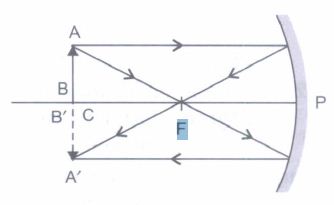
Position of object: At C F
Position of image: At C - Nature of image: Real, inverted and of same size
28.
(a) Reflection of light
(b) Refraction of light.
29.
A ray of light passing through the optical centre of the convex lens will continue to move along the same direction after refracting through the lens.
30.
To obtain a sharp image of the building instead of the window pane, Shoba will have to move the screen slightly towards the lens. The focal length of this lens will be 15 cm approximately.
31.
At sunrise, the sun looks almost reddish because only red colour which is least scattered is received by our eye and appears to come from the sun
32.
(i) Given, u = - 60 cm, f = - 30 cm
By lens formula, \(\frac{1}{v}-\frac{1}{u}=\frac{1}{f}\)
\(\Rightarrow \frac{1}{v}=\frac{1}{f}+\frac{1}{u}=\frac{1}{-30}+\frac{1}{-60}=\frac{2+1}{-60}=-\frac{1}{20}\)
\(\Rightarrow\) v = -20 cm
(ii) Since, v is negative, therefore image is formed an same side of object.
Nature of image is virtual, erect and diminished and image is formed between focus and optical centre.
(iii)
33.
(i) The relation between colour of scattered light and size of the scattering particle is that the small size particles scatter shorter wavelength (víolet) and large sized particles scatter larger wavelength (red).
(ii) The basic cause of this observation is due to the variation in physical condition of hot air etc.
(iii) Complete diagram is
34.
(i) The eye suffering from myopia, has longer eyeball than that of a normal eye due to which the retina is at a larger distance from the eye lens. This results in the formation of the image in front of the retina.
(ii) The eye suffering from hypermetropia has short eyeball than that of normal eye due to which the retina is at smaller distance from the eye lens. This results in the formation of the image behind the retina.
35.
(a) The defect is hypermetropia, as the image of near point is formed beyond retina.
(b) Two causes
(i) Focal length of the lens increases
(ii) Eye ball becomes smaller
(c) Correction: It can be corrected by using a convex lens. It is a converging lens which shifts the image of the object on the retina.
36.
37.
38.
39.
(c) The primary reason, why the colour red is used for danger signals is that red light is scattered the least by air molecules present in the atmosphere.
40.
(d) If both assertion and reason are false.
41.
(i) (b) red
(ii) (d) violet
(iii) (d) yellow
(iv) (b) indigo
(v) (c) dispersion
42.
(i) (a):Given, f= 20 cm, U = -10 cm
Using, \(\begin{equation} \frac{1}{f}=\frac{1}{v}-\frac{1}{u} \end{equation}\)
\(\begin{equation} \frac{1}{20}=\frac{1}{v}-\left(-\frac{1}{10}\right) \Rightarrow v=-20 \mathrm{~cm} \end{equation}\)
(ii) (b): As,\(\begin{equation} m=\frac{v}{u}=\left(\frac{-20}{-10}\right)=2 \end{equation}\)
\(\begin{equation} \begin{array}{l} m=\frac{h_{2}}{h_{1}} \\ 2=\frac{h_{2}}{4} \Rightarrow h_{2}=8 \mathrm{~cm} \end{array} \end{equation}\)
(iii) (b): Here u = -50 cm, v = 10 cm,f=?
Using, \(\begin{equation} \frac{1}{f}=\frac{1}{10}-\frac{1}{50} \Rightarrow f=-12.5 \mathrm{~cm} \end{equation}\)
(iv) (c): Here, m = - 2
h2 = - 6 cm
h1 =?
As,\(\begin{equation} m=\frac{h_{2}}{h_{1}} \Rightarrow-2=\frac{-6}{h_{2}} \Rightarrow h_{1}=3 \mathrm{~cm} \end{equation}\)
(v) (b):As \(\begin{equation} P=\frac{1}{f}(\because f=5 \mathrm{~cm}) \end{equation}\)
\(\begin{equation} P=\frac{-1}{0.05 \mathrm{~m}}=-20 \mathrm{D} \end{equation}\)
43.
(i) (a): According to Snell's law of refraction,
\(\frac{\sin i}{\sin r}>1 \text { or } \sin i>\sin r\)
or i > r.
(ii) (a:) As, 1 \(\mu^{2}=\frac{\sin i}{\sin r}\)
\(\frac{\sin 45^{\circ}}{\sin 30^{\circ}}=\frac{1 / \sqrt{2}}{1 / 2}=1.41\)
(iii) (d): As diamond has maximum value of refractive index, therefore it has minimum speed of light in medium.
(iv) (a): As, \(\mu_{\text {glass }}=1.5, c=3 \times 10^{8} \mathrm{~m} / \mathrm{s}\)
\(\begin{equation} \begin{array}{l} \mu=\frac{c}{v} \text { or } 1.5=\frac{3 \times 10^{8}}{v} \\ v=2 \times 10^{8} \mathrm{~m} / \mathrm{s} \end{array} \end{equation}\)
(v) (b): Given, refractive index of a with respect to b is \(\begin{equation} { }^{b} \mu_{a}=2 \end{equation}\)
Refractive index of b with respect to a is
\(\begin{equation} \frac{1}{b_{\mu_{a}}}={ }^{a} \mu_{b}=\frac{1}{2}=0.5 \end{equation}\)

10th Standard CBSE Syllabus & Materials
10th Standard CBSE
CBSE 10th Social Science PS - Federalism - New Model Questions Papers Study Material - QB365 Set A
NEW10th Standard CBSE
CBSE 10th Social Science PS - Power Sharing - New Model Questions Papers Study Material - QB365 Set A
NEW10th Standard CBSE
CBSE 10th Social Science GEO - Manufacturing Industries - New Model Questions Papers Study Material - QB365 Set A
NEW10th Standard CBSE
CBSE 10th Social Science GEO - Minerals and Energy Resources - New Model Questions Papers Study Material - QB365 Set A



NCERT Books

Syllabus

Exam Pattern

Sample Question Papers

Previous year Question Papers

Important Notes

MCQ Practice test

NCERT Exemplers

Case study Questions

Image Based Questions

Passage based Questions

HOT Questions

Value Based Questions

Model Questions Papers
NCERT ( Book Back ) Questions

Assertion and Reason
Important Questions And Answers

CBSE 10th Standard CBSE Subjects
CBSE Standards