
 100% FREE ACCESS
10th Standard CBSE Syllabus & Materials
10th Standard CBSE
CBSE 10th Social Science ECO - Globalisation and the Indian Economy - New Model Questions Papers Study Material - QB365 Set A
NEW10th Standard CBSE
CBSE 10th Social Science ECO - Money and Credit - New Model Questions Papers Study Material - QB365 Set A
NEW10th Standard CBSE
CBSE 10th Social Science ECO - Sectors of the Indian Economy - New Model Questions Papers Study Material - QB365 Set A
NEW10th Standard CBSE
CBSE 10th Social Science ECO - Development - New Model Questions Papers Study Material - QB365 Set A
NEW10th Standard CBSE
CBSE 10th Social Science PS - Outcomes of Democracy - New Model Questions Papers Study Material - QB365 Set A
NEW10th Standard CBSE
CBSE 10th Social Science PS - Gender, Religion and Caste - New Model Questions Papers Study Material - QB365 Set A

Published on: 20/10/2025
Download CBSE Class 10th Standard CBSE Science question papers, sample papers, important questions, and previous year solved papers in PDF format. Get free study materials, NCERT solutions, and exam preparation resources for Class 10th Standard CBSE Science
Questions + Answers key
Take MCQ Science Test
1.
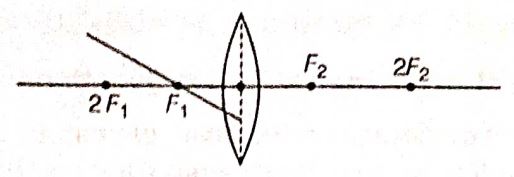
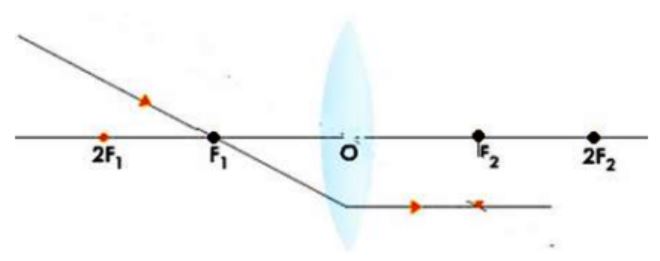
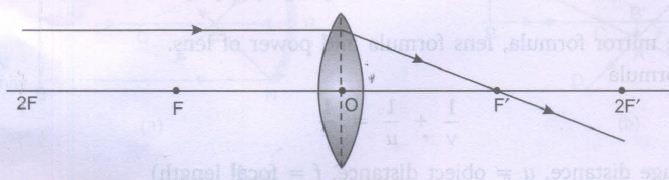
Redraw the ray diagram given below in your answer book and complete the path of ray.
2.
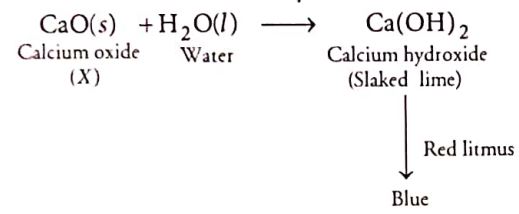
A substance X, which is an oxide of a group 2 element, is used intensively in the cement industry. This element is present in bones also. On treatment with water it forms a solution which turns red litmus blue. Identify X and also write the chemical reactions involved.
3.
Grapes hanging on the plant do not ferment but after being plucked from the plant can be fermented.
a. Under what conditions do these grapes ferment?
b. Is it a chemical or a physical change?
4.
Write the balanced chemical equations for the following reactions:
(a) Sodium carbonate on reaction with hydrochloric acid in equal in equal molar concentrations gives sodium chloride and sodium hydrogen carbonate.
(b) Sodium hydrogen carbonate on reaction with hydrochloric acid gives sodium chloride, water and liberates carbon dioxide.
(c) Copper sulphate on treatment with potassium iodide precipitates cuprous iodide(CuI), liberates iodine gas and also forms potassium sulphate.
5.
Identify the oxidising agent (oxidant) in the following reactions
(a) Pb3O4 + 8HCl \(\rightarrow\) 3PbCl2 + Cl2 + 4H2O
(b) 2Mg + O2 \(\overset { V_2O_5 }{ \rightarrow } \) 2MgO
(c) CuSO4 + Zn \(\rightarrow\) Cu + ZnSO4
(d) V2O5 + 5Ca \(\rightarrow\) 2V + 5CaO
(e) 3Fe + 4H2O \(\rightarrow\) Fe3O4 + 4H2
(f) CuO + H2 \(\rightarrow\) Cu + H2O
6.
Write the balanced chemical equations for the following reactions and identify the type of reaction in each case.
(a) Thermite reaction, iron (III) oxide reacts with aluminium and gives molten iron and aluminium oxide.
(b) Magnesium ribbon is burnt in an atmosphere of nitrogen gas to form solid magnesium nitrate.
(c) Chloride gas is passed in an aqueous potassium iodide solution to form potassium chloride solution and solid iodine.
(d) Ethanol is burnt in air to form carbon dioxide, water and releases heat.
7.
A metal ribbon X burns in oxygen with a dazzling white flame forming a white ash Y. The correct description of X, Y and the type of reaction are
X = Ca; Y = CaO, Type of reaction = Decomposition
X = Mg; Y = MgO, Type of reaction = Combination
X = Al; Y = Al2O, Type of reaction = Thermal decomposition
X = Zn; Y = ZnO, Type of reaction = Endothermic
8.
Consider the following chemical equation:
aAl2O3 + bHCl \(\rightarrow\) cAlCl3 + dH2O
In order to balance this chemical equation, the values of a, b, c and d must be
1, 6, 2 and 3
1, 6, 3 and 2
2, 6, 2 and 3
2, 6, 3 and 2
9.
A drop of colourless liquid is poured over blue litmus paper and it turns to red. The colourless liquid is
sodium chloride solution
pure water
potassium hydroxide solution
dilute hydrochloric acid
10.
The reactions in which precipitate is formed are known as
Exothermic reactions
Endothermic reactions
Precipitation reactions
Combustion reactions
11.
In torches search lights and headlights of vehicles the bulb is placed
between the pole and the focus of the reflector
very near to the focus of the reflector
between the focus and centre of curvature of the reflector
at the centre of curvature of the reflector.
12.
Rays from Sun converge at a point 15 cm in front of a concave mirror. Where an object should be placed so that size of its image is equal to the size of the object?
30 cm in front of the mirror
15 cm in front of the mirror
between 15 cm and 30 cm in front of the mirror
more than 30 cm in front of the mirror.
13.
Under which of the following conditions a concave mirror can form an image larger than the actual object?
When the object is kept at a distance equal to its radius of curvature
When object is kept at a distance less than its focal length
When object is placed between the focus and centre of curvature
When object is kept at a distance greater than its radius of curvature
14.
A 10 mm long awl pin is placed vertically in front of a concave mirror. A 5 mm long image of the awl pin is formed at 30 cm in front of the mirror. The focal length of this mirror is.
- 30 cm
- 20 cm
- 40 cm
- 60 cm
15.
Which of the following can make a parallel beam of light when light from a point source is incident on it?
Concave mirror as well as convex lens
Convex mirror as well as concave lens
Two plane mirrors placed at 90o to each other
Concave mirror as well as concave lens
16.
In the reaction, SO2(g) + 2H2S(g) \(\rightarrow\) 2H2O(l) + S(s), the reducing agent is
SO2
H2S
H2O
S
17.
(i) An object of 5 cm height is placed at a distance of 20 cm from the optical centre of a concave lens of focal length 18 cm. Calculate (a) image distance and (b) the magnification in this case.
(ii) (a) Compare the values of magnification obtained by a concave lens and a convex lens when both the lenses form virtual images.
Or
(b) A convex lens can form a (I) real, inverted and magnified image as well as (II) virtual, erect and magnified image of an object. If the focal length of the lens is 10 cm, what should be the range of the object distance in both cases? Draw ray diagrams to justify your answer.
18.
A light ray enters from medium A to medium B as shown in the figure.
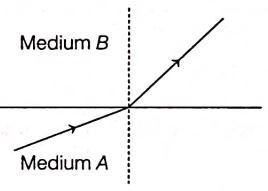
(i) Which one of the two media is denser w.r.t. other medium? Justify your answer.
(ii) If the speed of light in medium A is va and in medium B is vb, what is the refractive index of B with respect to A.
Or
A ray of light starting from diamond is incident on the interface separating diamond and water. Draw a labelled ray diagram to show the refraction of light in this case.
(iii) Absolute refractive indices of diamond and water are 2.42 and 1.33, respectively. Find the value of refractive index of water W.r.t. diamond.
19.
(i) Water has refractive index 1.33 and alcohol has refractive index 1.36. Which of the two medium is optically denser? Give reason for your answer.
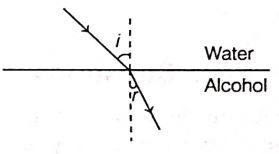
(ii) Draw a ray diagram to show the path of a ray of light passing obliquely from water to alcohol.
(iii) State the relationship between angle of incidence and angle of refraction in the above case.
20.
Ahmad took a magnesium ribbon (cleaned) and burned it on a flame. The white powder formed was taken in a test tube and water was added to it. He then tested the solution formed with red and blue litmus paper. What change was seen and why?
21.
The following diagram displays a chemical reaction.
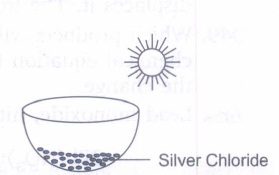
Observe carefully and answer the following questions
(a) Identify the type of chemical reaction that will take place and define it. How will the colour of the salt change?
(b) Write the chemical equation of the reaction that takes place.
(c) Mention one commercial use of this salt.
22.
(a) A solution of substance 'X' is used for white washing. What is the substance 'X'? State the chemical reaction of 'X' with water.
(b) Why does the colour of copper sulphate solution change when an iron nail is dipped in it?
23.
An object of 2 cm high is placed at a distance of 64 cm from a white screen on placing a convex lens at a distance of 32 cm from the object it is found that a distant image of the object is formed on the screen. What is the focal length of the convex lens and size of the image formed on the screen? Draw a ray diagram to show the formation of the image in this position of the object with respect to the lens.
24.
The speed of light in air is 3.0 x 10⁸ m/s.
The speed of light in a transparent liquid is 2.0 x 10⁸ m/s.
A ray of light is incident on the surface of the liquid at an angle of incidence of 40°.
Calculate
(i) the refractive index of the liquid.
(ii) the angle of refraction in the liquid.
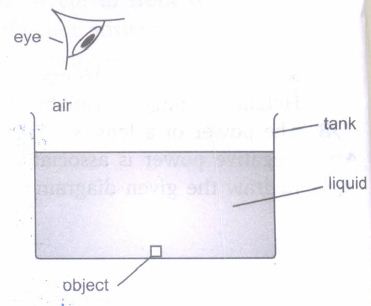
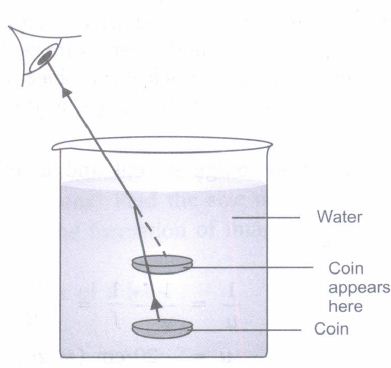
(iii) Draw two rays in the above diagram to show (how light reaches our eye from the object placed in water).
25.
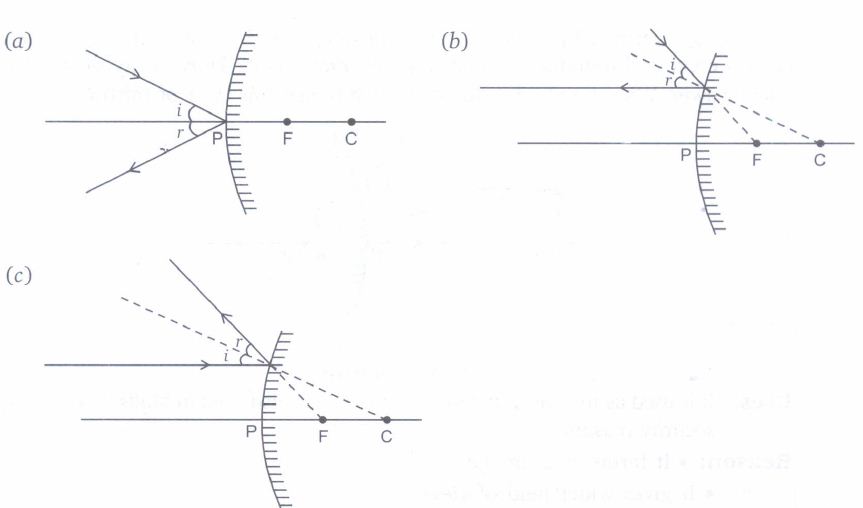
Draw a ray diagram to show the path of the reflected ray in each of the following cases. A ray of light incident on a convex mirror
(a) strikes at its pole making an angle from the principal axis.
(b) is directed towards its principal focus.
(c) is parallel to its principal axis.
26.
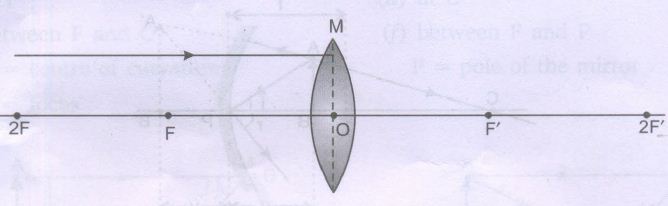
Draw the given diagram in your answer book and complete it for the path of ray of light beyond the lens
27.
When the rays of light travels from one transparent medium to another, the path of light is deviated. This phenomena is called refraction of light. The bending of light depends on the optical density of medium through which the light pass.
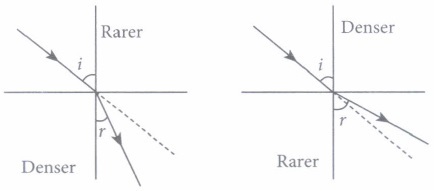
The speed of light varies from medium to medium. A medium in which the speed of light is more is optically rarer medium whereas in which the speed of light is less is optically denser medium. Whenever light goes from one medium to another, the frequency of light does not change however, speed and wavelength change. It concluded that change in speed of light is the basic cause of refraction.
(i) When light travels from air to glass, the ray of light bends
| (a) towards the normal | (b) away from normal |
| (c) anywhere | (d) none of these |
(ii) A ray of light passes from a medium A to another medium B. No bending of light occurs if the ray of light hits the boundary of medium B at an angle of
| (a) 0° | (b) 45° |
| (c) 90° | (d) 120° |
(iii) When light passes from one medium to another, the frequency of light
| (a) increases | (b) decreases |
| (c) remains same | (d) none of these |
(iv) When light passes from glass to water, the speed of light
| (a) increases | (b) decreases |
| (c) remains same | (d) first increases then decrease |
(v) The bottom of pool filled with water appears to be ______ due to refraction of light
| (a) shallower | (b) deeper |
| (c) at same depth | (d) empty |
28.
The relation between distance of an object from the mirror (u), distance of image from the mirror (v) and the focal length (F) is called mirror formula. This formula is valid in all situations for all spherical mirrors for all positions of the object. The size of image formed by a spherical mirror depends on the position of the object from the mirror. The image formed by a spherical mirror can be bigger than the object, equal to the object or smaller than the object. The size of the image relative to the object is given by the linear magnification (m). Thus, the magnification is given by the ratio of height of image to the height of object. If magnification is negative, image is real and if it is positive, image is virtual.
(i) What is the position of an image when an object is placed at a distance of 20 em from a concave mirror of
focal length 20 cm?
| (a) 5 cm | (b) 20 cm |
| (c) 10 cm | (d) infinity |
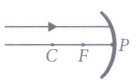
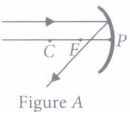
(ii) Which of the following ray diagrams is correct for the ray of light incident on a concave mirror as shown in figure?
 (a) Figure A |
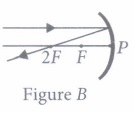 (b) Figure B |
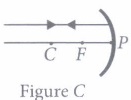 (C) Figure C |
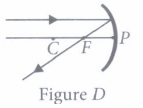 (d) Figure D |
(iii) If the magnification of an image is -2, the characteristic of image will be
| (a) real and inverted | (b) virtual and enlarged |
| (c) virtual and inverted | (d) real and small |
(iv) The mirror formula holds for
| (a) concave mirror | (b) convex mirror |
| (c) plane mirror | (d) all of these |
(v) A parallel beam of light is made to fall on a concave mirror. An image is formed at a distance of7.5 from the mirror. The focal length of the mirror is
| (a) 15 cm | (b) 7.5 cm |
| (c) 3.75 cm | (d) 10 cm |
1.
When the ray of light passes through the focus of the convex lens it becomes parallel to the principal axis as shown in the figure below.
2.
X is calcium oxide (CaO), also called quick lime. It reacts with water to form calcium hydroxide as follows
3.
a. Because of the action of a fungus, called yeast over the sugar fermentation takes place. Ethanol and carbon dioxide formed because of fermentation of sugar. Sugar found in grapes ferment because of the action of fungi, yeast when it is plucked from plant, but while grapes are on plants the action of fungi, is nullified by the self defense mechanism of plants and grapes. Thus, grapes do not ferment in the case when hanging on plant.
b. It is a chemical change.
4.
(a)\(\underset{sodium\ Carbonate}{Na_2CO_3}+\underset{Hydrochloride\ acid}{HCl}\rightarrow\underset{Sodium\ chloride}{NaCl}+\underset{Sodium\ hydrogen\ carbonate}{NaHCO_3}\)
(b)\(\underset{sodium\ Hydrogen\\ Carbonate}{NaCHO_3}+\underset{Hydrochloric\\ acid}{HCl}\rightarrow\underset{sodium\ Chloride}{NaCl}+\underset{Water}{H_2O}+\underset{Carbon\ dioxide}{CO_2}\)
(c)\(\underset{Copper\ sulphate}{2CuSO_4(aq)}+\underset{Potassium\ Iodide}{4KI(aq)}\rightarrow\underset{Cuprous\ iodide(ppt)}{2CuI(s)\downarrow}+\underset{Iodine}{I_2(g)}+\underset{Potassium\ sulphate}{2K_2SO_4(aq)}\)
5.
(a) Pb3O4
(b) O2
(c) CuSO4
(d) V2O5
(e) H2O
(f) CuO
6.
(a) \(\underset{Iron(III)oxide}{Fe_2O_3}+\underset{Aluminium}{2Al} \rightarrow\underset{Iron}{2Fe}+\underset{Aluminium\ oxide}{Al_2O_3}+Heat+Light\)
It is an exothermic redox reaction.
(b) \(\underset{Magnesium}{3Mg(s)}+\underset{Nitrogen\ gas}{N_2}\rightarrow\underset{Magnesium\ nitride}{{}Mg_3N_2(s)}\)
It is a combination reaction.
(c) \(\underset{Potassium\ Iodide}{2K(aq)}+\underset{Chlorine}{Cl_2(g)}\rightarrow\underset{Potassium\ chloride}{2KCl(aq)}+\underset{Iodine}{I_2(s)}\)
It is a redox reaction.
Potassium chloride Iodine
(d)\(\underset{Ethanal}{C_2H_5OH}+\underset{Oxygen}{3O_2}\rightarrow\underset{Carbon\ dioxide}{2CO_2}+\underset{Water}{3H_2O}+Heat\)
It is an exothermic - redox reaction.
7.
(b)
X = Mg; Y = MgO, Type of reaction = Combination
8.
(a)
1, 6, 2 and 3
9.
(d)
dilute hydrochloric acid
10.
11.
(b)
very near to the focus of the reflector
12.
(a)
30 cm in front of the mirror
13.
(c)
When object is placed between the focus and centre of curvature
14.
(b)
- 20 cm
15.
(a)
Concave mirror as well as convex lens
16.
(b)
H2S
17.
(i) (a) Given, height of object = 5 cm
Object distance, u = - 20 cm (front of the lens)
Focal length, f = - 18 cm (concave lens)
Image distance, v = ?
The lens formula for a concave lens,
\(\begin{aligned}
& & \frac{1}{f} & =\frac{1}{v}-\frac{1}{u}
\end{aligned}\)
\(\begin{aligned}
\Rightarrow & & \frac{1}{-18} & =\frac{1}{v}-\frac{1}{(-20)} \\
\end{aligned}\)
\(\begin{aligned}
\Rightarrow & & \frac{1}{v} & =-\frac{1}{18}-\frac{1}{20}
\end{aligned}\)
\(\Rightarrow\) v = -9.47 cm
(b) Magnification, \(m=\frac{v}{u}=\frac{(-9.47)}{-20}\)
\(\Rightarrow\) m = 0.473
(ii) (a) When a convex lens form a virtual image, then the size of image is enlarged but when a concave lens forms a virtual image, then its size is diminished.
Or (b) I. Real, inverted and magnified- 10 cm to 20 cm.
II. Virtual, erect and magnified-less than 10 cm.
18.
(i) When a light ray travel from a rarer medium to a denser medium it bends towards normal so, medium B is denser w.r.t. medium A.
(ii) Refractive index of medium A w.r.t. air,
\(\begin{aligned} { }_a \mu_A=\frac{\text { Velocity of light in air }}{\text { Velocity of light in medium } A} \end{aligned}\)
\(\begin{aligned} a \mu_A=\frac{c}{v_A} \end{aligned}\) ...(i)
Refractive index of medium B w.r.t. air
\(\begin{aligned} { }_a \mu_B=\frac{\text { Velocity of light in air }}{\text { Velocity of light in medium } B} \\ \end{aligned}\)
\(\begin{aligned} { }_A \mu_B=\frac{c}{v_B} \end{aligned}\) ...(ii)
On dividing Eq. (ii) by Eq. (i), we get
\(\frac{{ }_a \mu_B}{{ }_a \mu_A}=\)\(\frac{\frac{c}{v_B}}{\frac{c}{v_A}}\)\(=\frac{v_A}{v_B}\)
\(\therefore \quad{ }_A \mu_B=\frac{v_A}{v_B}\)
So, refractive index on medium B with respect to medium A is \(\frac{v_A}{v_B}\)
Or
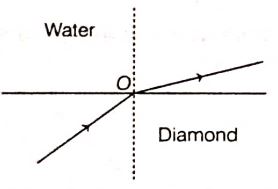
(iii) Given, refracting index of diamond,
\(\mu\)d = 2.42
Refracting index of water, \(\mu\)w = 1.33
\(\therefore \quad{ }_d \mu_w=\frac{\mu_w}{\mu_d}=\frac{1.33}{2.42}=0.549\)
19.
(i) Given, refractive index of water, \(\mu\) = 1.33
and refractive index of alcohol, \(\mu\) = 1.36
\(\because \mu < \mu\)
Hence, alcohol is denser than water.
(ii) Ray diagram is given below
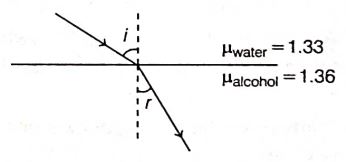
(iii) Here, relation between angle of incidence and angle of refraction is \(\frac{\sin i}{\sin r}=\frac{\mu_{\text {alcohol }}}{\mu_{\text {water }}}=\frac{1.36}{1.33}\)
\(\Rightarrow\) 1.33 sin i = 1.36 sin r
20.
Red litmus turned blue.
Blue litmus remained blue.
This is because the magnesium ribbon on burning in air, forms the white magnesium oxide. When this is dissolved in water, it forms magnesium hydroxide, which is basic in nature.
21.
(a) Photochemical decomposition reaction: Those reactions in which a compound breaks down into simple substances in presence of light are called photochemical decomposition reaction. The colour of salt will change from white to grey.
(b) \( 2 \mathrm{AgCl}(\mathrm{s}) \stackrel{\text { Sunlight }}{\longrightarrow} 2 \mathrm{Ag}(\mathrm{s})+\mathrm{Cl}_{2}(\mathrm{~g}) \)
(c) Silver chloride is used in photography.
22.
(a) 'X' is calcium oxide (CaO).
CaO(s) + H2O(l) ) \(\longrightarrow\)Ca(OH)2(aq) + heat
(b) It is because iron displaces copper from CuS04 to form FeSO4 which is pale green.
Fe(s) + CuSO4(aq) \(\longrightarrow\)FeSO4(aq) + Cu(s)
Blue Pale green
23.
Since the object-screen distance is double of object-lens separation, the object is at a distance of 2f from lens and the image should be of the same size of the object.
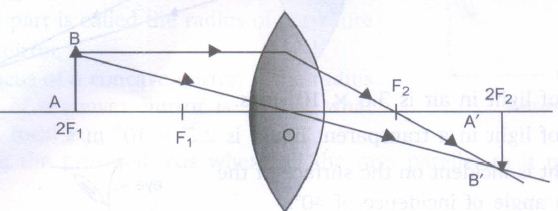
So 2f = 32 \(\Rightarrow\) f = 16 cm
Height of image = Height of object = 2 cm
24.
(i) n = speed of light in air/speed of light in liquid
\(n=3 \times { 10 }^{ 8 }/2.0 \times{ 10 }^{ 8 }\)
n =1.5
(ii) n = sin i / sin r \(\Rightarrow sin \ r=\overset { sin \ i }{ \underset { n }{ \_ \_ \_ } } \)
sin r = sin 40°/1.5 (which is 25°)
(iii)
25.
26.
27.
(i) (a): When, a ray of light travels from air to glass, it bends towards the normal.
(ii) (c): No bending of light occurs when light is incident normally or perpendicularly on a boundary of two media since angle of incidence and angle of refraction both are zero.
(iii) (c): When light goes from one medium to other medium, its frequency does not change
(iv) (a): The speed to light increases when light passes from glass to water as water is optically rarer medium.
(v) (a): The bottom of a pool of water appears to be less deep than it actually is due to refraction.
28.
(i) (d): When an object is placed at the focus of a concave mirror, the image is formed at infinity.
(ii) (d): When a light ray parallel to the principal axis is incident on a concave mirror, it passes through the principal focus after reflection. Therefore, figure D is correct.
(iii) (a) : If m is negative, the image will be real and inverted.
(iv) (d)
(v) (b): The distance of object from mirror = \(\infty\)
Using, \(\frac{1}{v}+\frac{1}{u}=\frac{1}{f}\)
\(\frac{1}{\infty}-\left(-\frac{1}{7.5}\right)=\frac{1}{f}\)
f = 7.5 cm

10th Standard CBSE Syllabus & Materials
10th Standard CBSE
CBSE 10th Social Science PS - Federalism - New Model Questions Papers Study Material - QB365 Set A
NEW10th Standard CBSE
CBSE 10th Social Science PS - Power Sharing - New Model Questions Papers Study Material - QB365 Set A
NEW10th Standard CBSE
CBSE 10th Social Science GEO - Manufacturing Industries - New Model Questions Papers Study Material - QB365 Set A
NEW10th Standard CBSE
CBSE 10th Social Science GEO - Minerals and Energy Resources - New Model Questions Papers Study Material - QB365 Set A



NCERT Books

Syllabus

Exam Pattern

Sample Question Papers

Previous year Question Papers

Important Notes

MCQ Practice test

NCERT Exemplers

Case study Questions

Image Based Questions

Passage based Questions

HOT Questions

Value Based Questions

Model Questions Papers
NCERT ( Book Back ) Questions

Assertion and Reason
Important Questions And Answers

CBSE 10th Standard CBSE Subjects
CBSE Standards