
 100% FREE ACCESS
10th Standard CBSE Syllabus & Materials
10th Standard CBSE
CBSE 10th Social Science ECO - Globalisation and the Indian Economy - New Model Questions Papers Study Material - QB365 Set A
NEW10th Standard CBSE
CBSE 10th Social Science ECO - Money and Credit - New Model Questions Papers Study Material - QB365 Set A
NEW10th Standard CBSE
CBSE 10th Social Science ECO - Sectors of the Indian Economy - New Model Questions Papers Study Material - QB365 Set A
NEW10th Standard CBSE
CBSE 10th Social Science ECO - Development - New Model Questions Papers Study Material - QB365 Set A
NEW10th Standard CBSE
CBSE 10th Social Science PS - Outcomes of Democracy - New Model Questions Papers Study Material - QB365 Set A
NEW10th Standard CBSE
CBSE 10th Social Science PS - Gender, Religion and Caste - New Model Questions Papers Study Material - QB365 Set A

Published on: 20/10/2025
Download CBSE Class 10th Standard CBSE Science question papers, sample papers, important questions, and previous year solved papers in PDF format. Get free study materials, NCERT solutions, and exam preparation resources for Class 10th Standard CBSE Science
Questions + Answers key
Take MCQ Science Test
1.
Suggest any four activities in daily life which are eco-friendly.
2.
Which pancreatic enzyme is effective in digesting proteins?
3.
Match the terms in Column (A) with those in Column (B)
| Column (A) | Column (B) |
| (a) Trypsin | (i) Pancreas |
| (b) Amylase | (ii) Liver |
| (c) Bile | (iii) Gastric glands |
| (d) Pepsin | (iv) Saliva |
4.
Answer the following:
(a) Which hormone is responsible for the changes noticed in females at puberty?
(b) Dwarfism results due to deficiency of which hormone?
(c) Blood sugar level rises due to deficiency of which hormone?
(d) Iodine is necessary for the synthesis of which hormone?
5.
Plants use completely different process for excretion as compared to animals. Which one of the following processes is not followed by plants for excretion?
They can get rid of excess water by transpiration
They selectively filter toxic substances through their leaves
Waste products are stored as resins and gums in old xylem
They excrete waste substances into the soil around them
6.
Given below is the diagram showing the role of different types of neuron in the reflex action mechanism.
Choose the correct label for A, B and C from the table below by identifying different neurons.
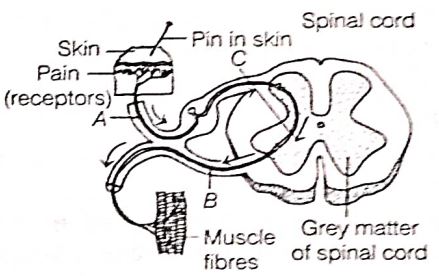
| A | B | C |
| Sensory | Relay | Motor |
| A | B | C |
| Motor | Sensory | Relay |
| A | B | C |
| Motor | Relay | Sensory |
| A | B | C |
| Sensory | Motor | Relay |
7.
Analogous organs have
Same structure, same function
Different structure, different function
Same structure, different function
Same function, different structure
8.
What is the puberty age in human males?
8-10
10-12
12-14
14-16
9.
Name the artificial method for the removal of liquid nitrogenous waste from body
Excretion
Dialysis
Urination
All of these
10.
A zygote which has an X - chromosome inherited from the father will develop into a
boy
girl
X - chromosome does not determine the sex of a child
either boy or girl
11.
Which organelle of the cell is known as powerhouse?
ATP
Golgi bodies
Mitochondria
Nucleus
12.
Mendel crossed tall and dwarf pea plants to study the inheritance of one gene. He collected the seeds produced as a result of this cross and grew them to generate plants of the first hybrid generation which is called the first filial progeny or F1: Mendel then self pollinated the tall F1 plants and he obtained F2 generation.
(i) In garden pea, round shape of seeds is dominant over wrinkled shape. A pea plant heterozygous for round shape of seed is selfed and 1600 seeds produced during the cross are subsequently germinated. How many seedlings would have non-parental phenotype?
| (a) 1600 | (b) 1200 |
| (c) 400 | (d) 800 |
(ii) If 'A' represents the dominant gene and 'a' represents its recessive allele, which of the following would be the most likely result in the first generation offspring when Aa is crossed with aa ?
(a) All will exhibit dominant phenotype.
(b) All will exhibit recessive phenotype.
(c) Dominant and recessive phenotypes will be 50% each.
(d) Dominant phenotype will be 75%.
(iii) Which of the following crosses will give tall and dwarf pea plants in same proportions?
A) 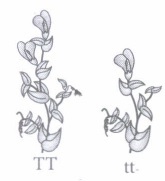 |
B)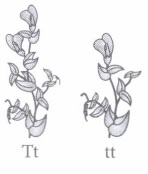 |
c) 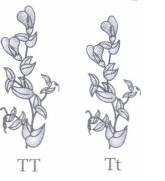 |
D) 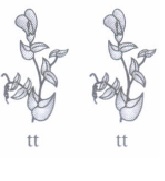 |
(iv) What result Mendel would have got, if he self pollinated a homozygous tall F2 plant?
(a) TT and Tt
(b) All Tt
(c) All TT
(d) All tt
(v) In plant, tall phenotype is dominant over dwarf phenotype, and the alleles are designated as T and t, respectively. Upon crossing one tall and one dwarf plant, total 250 plants were obtained, out of which 124 displayed tall phenotype and rest were dwarf. Thus, the genotype of the parent plants were
(a) TT x TT
(b) TT x tt
(c) Tt x Tt
d) Tt x tt.
13.
Assertion (A) A geneticist crossed a pea plant having violet flowers with a pea plant having white flowers, he got all violet flowers in first generation.
Reason (R) White colour gene is not passed on to next generation.
(a) Both A and R are true and R is the correct explanation of A
(b) Both A and R are true, but R is not the correct explanation of A
(c) A is true, but R is false
(d) A is false, but R is true
14.
Assertion: The large intestine is the largest part of the alimentary canal.
Reason: Tiger has a shorter small intestine, than herbivores.
Codes
(a) Both A and R are true and R is correct explanation of the assertion.
(b) Both A and R are true but R is not the correct explanation of the assertion.
(c) A is true but R is false.
(d) A is false but R is true.
15.
Two major forces help in the transport of water in a plant. Force A is the driving force In the movement of water during the day, whereas force B helps the movement of water in a plant during the night or during the day when humidity is very high.
(i) Identify force A and force В.
(ii) Describe how each of these forces helps in the movement of water in plant?
16.
(i) Define ecosystem.
(ii) Autotrophs are at the first level of food chain. Give reason.
(iii) In a food chain of frogs, grass, insects and snakes assign trophic level of frogs. To which category of consumers do they belong to?
17.
‘DNA copies generated will be similar, but may not be completely identical to the original.’ Explain the statement with reference to the asexually reproducing organisms.
18.
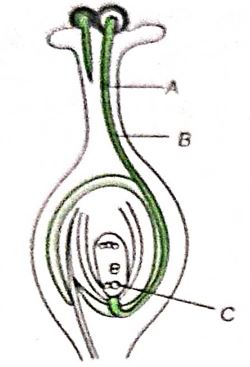
(i) Study the diagram given below and name the parts marked as A, B and C. What happens when B reaches C in the ovary? Mention its significance.
(ii) Write the post fertilisation changes that occur in a flower.
1.
(a) Walking and cycling for commute.
(b) Using jute/cloth shopping bag.
(c) using public transport.
(d) Switching off light/fans in unoccupied rooms.
2.
Pancreatic trypsin
3.
(a) (i), (b) (iv), (c) (ii), (d) (iii)
4.
(a) Oestrogen
(b) Growth hormone
(c) Insulin
(d) Thyroxine
5.
(b)
They selectively filter toxic substances through their leaves
6.
(d)
| A | B | C |
| Sensory | Motor | Relay |
7.
(d)
Same function, different structure
8.
(c)
12-14
9.
(b)
Dialysis
10.
(b)
girl
11.
(c)
Mitochondria
12.
(i) (c): Since this pea plant is heterozygous for round shape, its genotype would be Rr.
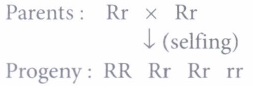
Phenotypically, the ratio will be 3 : 1, i.e., only rr seedlings will show wrinkled seed phenotype, rest will show round seed shape.
1200 \(\Rightarrow\) Round shape (RR, Rr)
400 \(\Rightarrow\) Wrinkled (rr)
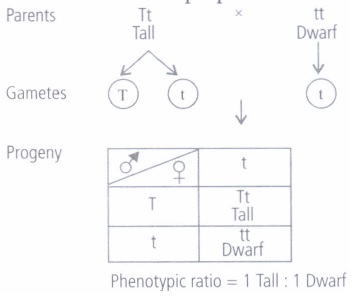
(ii) (c): 'A'. represents the dominant gene and 'a' represents its recessive allele. The most likely result in the first generation offspring when Aa is crossed with aa is:
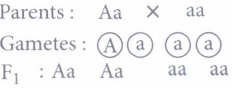
Hence, Aa: aa
1 : 1
(iii) (b): This is an example of a test cross in which a cross is made between heterozygous tall and homozygous dwarf individuals and tall and dwarf plants are obtained in same proportion.
(iv) (c): Self pollination of homozygous tall F2 plant (TT) will give rise to all individuals of genotype TT.
(v) (d)
13.
(c) A is true, but R is false. R can be corrected as White colour flower shows its trait in the second generation, after the selfing of two plants of the first generation.
14.
(d): The small intestine is the largest part of the alimentary canal. It is about 6.5 metres long in an adult man. Though small intestine is very long, it is called small intestine because it is very narrow. The length of small intestine differs in various animals depending on the type of food they eat. Meat is a food which is easier to digest. So, tiger which is a carnivorous animal has a shorter small intestine than herbivores.
15.
(i) Force A: transpirational pull
Force B: root pressure
(ii) Evaporation of water from leaves of a plant is called transpiration. This results in reduced pressure at the top of the xylem vessels and creates a suction which pulls up water through the xylem cells of roots. Transpiration cannot occur at night/on a humid day when rate of evaporation is low.
Root pressure is a force or the osmotic pressure generated in the roots. It drives the fluids and other ions from the soil in upwards directions into the plant's vascular tissue. The effect of root pressure in transport of water is more important at night.
16.
(i) Ecosystem is the structural and functional unit of biosphere and is a stable ecological unit where regular input of energy and circulation of matter takes place
(ii) Autotrophs are the producers, i.e. green plants. They are the only ones that can make use of solar radiation for photosynthesis and prepare food materials for themselves and others.
(iii) In a food chain of frogs, grass, insects and snakes, frogs occupy third trophic level.
Grass → Insects → Frogs → Snakes
They belongs to the category of secondary consumers.
17.
In asexual reproduction there is involvement of only one parent, hence the offspring receives DNA from a single parent only. Now, this DNA divides or duplicates during the process of replication and cell division. During this division mostly what happens is there is the creation of clones because the similar DNA is being passed on to both daughter cells. However, DNA transferred is not identical because during replication there could be certain environmental factor or any other factors that caused certain changes in the DNA sequences of both.
18.
(i) The parts marked as A, B and C are
A-Pollen grain (male gamete)
B-Pollen tube
C-Ovule
When part B (pollen tube) reaches the part C (ovule) the male gamete (pollen grain) enters into the ovule to fuse with the female gamete (egg) for fusion.
(ii) The post fertilisation changes that occurs in a flower are given below
(a) The ovule develops a tough coat and gets converted into a seed.
(b) The ovary grows rapidly and ripens into a fruit.
(c) All petals, stamens, style and stigma gets sherivel and fall off.

10th Standard CBSE Syllabus & Materials
10th Standard CBSE
CBSE 10th Social Science PS - Federalism - New Model Questions Papers Study Material - QB365 Set A
NEW10th Standard CBSE
CBSE 10th Social Science PS - Power Sharing - New Model Questions Papers Study Material - QB365 Set A
NEW10th Standard CBSE
CBSE 10th Social Science GEO - Manufacturing Industries - New Model Questions Papers Study Material - QB365 Set A
NEW10th Standard CBSE
CBSE 10th Social Science GEO - Minerals and Energy Resources - New Model Questions Papers Study Material - QB365 Set A



NCERT Books

Syllabus

Exam Pattern

Sample Question Papers

Previous year Question Papers

Important Notes

MCQ Practice test

NCERT Exemplers

Case study Questions

Image Based Questions

Passage based Questions

HOT Questions

Value Based Questions

Model Questions Papers
NCERT ( Book Back ) Questions

Assertion and Reason
Important Questions And Answers

CBSE 10th Standard CBSE Subjects
CBSE Standards