
 100% FREE ACCESS
10th Standard CBSE Syllabus & Materials
10th Standard CBSE
CBSE 10th Social Science ECO - Globalisation and the Indian Economy - New Model Questions Papers Study Material - QB365 Set A
NEW10th Standard CBSE
CBSE 10th Social Science ECO - Money and Credit - New Model Questions Papers Study Material - QB365 Set A
NEW10th Standard CBSE
CBSE 10th Social Science ECO - Sectors of the Indian Economy - New Model Questions Papers Study Material - QB365 Set A
NEW10th Standard CBSE
CBSE 10th Social Science ECO - Development - New Model Questions Papers Study Material - QB365 Set A
NEW10th Standard CBSE
CBSE 10th Social Science PS - Outcomes of Democracy - New Model Questions Papers Study Material - QB365 Set A
NEW10th Standard CBSE
CBSE 10th Social Science PS - Gender, Religion and Caste - New Model Questions Papers Study Material - QB365 Set A

Published on: 20/10/2025
Download CBSE Class 10th Standard CBSE Science question papers, sample papers, important questions, and previous year solved papers in PDF format. Get free study materials, NCERT solutions, and exam preparation resources for Class 10th Standard CBSE Science
Questions + Answers key
Take MCQ Science Test
1.
Examine the picture depicting a nephron.
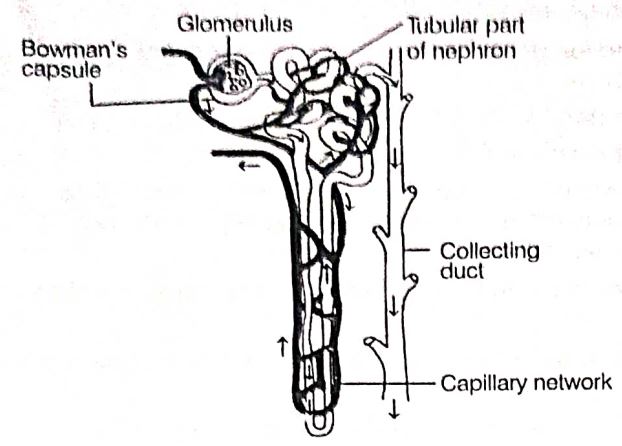
In a healthy adult, the initial filtrate in the kidneys is about 180 L daily. However, the volume actually excreted is only a litre or two a day. This happens because the remaining filtrate is reabsorbed.
In which part of the nephron could the water be getting reabsorbed?
In the Bowman's capsule
In the long tubular part
In the collecting duct
In the glomerulus
2.
A homozygous cross between a pea plant having purple flowers is done with the homozygous pea plant having white flower. What will be the phenotypic ratio of the offspring obtained is F2-generation
2 : 1
1 : 1
1 : 2 : 2
3 : 1
3.
Which of the following is an example of non-biodegradable substance?
Virgin plastic
Plastic
Plants
Plant products
4.
Name the thing in our body which helps us to digest food?
hormone
enzymes
stomach
mouth
5.
What is the surgical method of contraception in female and male respectively
Tubectomy and Vasectomy
Vasectomy and Copper-T
Tubectomy and Copper-T
None of these
6.
Hormone secreted by males and females, respectively during puberty is
Testosterone, oestrogen
Oestrogen, progesterone
Progesterone, testosterone
Testosterone, progesterone
7.
Which of the following is most appropriate for aerobic respiration?
Glucose \(\overset { mitochondria }{ \longrightarrow } \) pyruvate \(\overset { Cytoptasm }{ \longrightarrow } \) CO2+H2O+Energy
Glucose \(\overset { Cytoptasm }{ \longrightarrow } \) pyruvate \(\overset { mitochondria }{ \longrightarrow } \) CO2+H2O+Energy
Glucose \(\overset { Cytoptasm }{ \longrightarrow } \) pyruvate+energy \(\overset { mitochondria }{ \longrightarrow } \) CO2+H2O
Glucose \(\overset { Cytoptasm }{ \longrightarrow } \) pyruate+energy \(\overset { mitochondria }{ \longrightarrow } \) CO2+H2O+Energy
8.
(a) Draw a diagram showing germination of pollen on stigma of a flower and mark on it the following organs/parts
(i) Pollen tube
(ii) Pollen grain
(iii) Stigma
(iv) Female germ cell
(b) State the significance of pollen tube.
(c) Name the parts of flower that develop after fertilisation into
(i) Seed (ii) Fruit
9.
What is pollination? How does it occur in plants? How does pollination lead to fertilization? Explain.
10.
Name any 4 stimuli which acts on plants
11.
State one reason to justify the position of man at the apex of most of the food chains?
12.
With the help of suitable examples, explain why certain traits cannot be passed onto the next generation. what are such traits called?
13.
Is it true that when a new species is emerged, the old species will be eliminated? Why?
14.
The leaves of a plant were covered with alumninium foil, how would it affect the physiology of the plant?
15.
Explain the Monohybrid Cross.
16.
Assertion: Hospital wastes like used syringes, urine bags, etc. can be incinerated.
Reason: Incineration burns the waste at very high temperature and converts it to ashes.
Codes
(a) Both A and R are true and R is correct explanation of the assertion.
(b) Both A and R are true but R is not the correct explanation of the assertion.
(c) A is true but R is false.
(d) A is false but R is true
17.
Assertion: If mother has two dominant alleles for black hair and father has two recessive alleles for blonde hair then their child will inherit one dominant allele from mother and one recessive allele from father and will have black hair.
Reason: Progeny inherits one genes for each trait from its parents but the trait shown by progeny depends on inherited alleles.
Codes:
(a) Both A and R are true and R is correct explanation of the assertion
(b) Both A and R are true but R is not the correct explanation of the assertion
(c) A is true but R is false
(d) A is false but R is true.
18.
Given are the sections of two pipes, A and B. If you need to represent blood vessels with these, which of the pipes would correspond to the artery and which one to a vein. Identify it and answer the following questions.
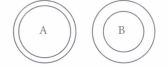
(i) B is best defined as the vessel which
(a) always supply oxygenated blood to the different organs
(b) always carry blood away from the heart to different organs
(c) always break up into capillaries that reunite to form a vein
(d) always carry blood from one visceral organ to another visceral organ.
(ii) In A, valves are present to check backward flow of blood flowing at
| (a) atmospheric pressure | (c) low pressure |
| (b) high pressure | (d) all of these |
(iii) Which of the following statements is correct regarding A?
(a) Carries blood from an organ towards the heart
(b) Always carry oxygenated blood with single exception
(c) Carries blood from heart towards the organ
(d) All of these
(iv) Which of the following statements is incorrect?
(a) A has typically larger lumen than B.
(b) Walls of B are elastic enabling them to stretch and shrink during changes in blood pressure
(c) Flow of blood is slower in A than in B
(d) None of these
(v) Blood pressure in the pulmonary artery is
| (a) more than that of pulmonary vein | (b) less than that in the vena cava |
| (c) same as that in aorta | (d) less than pulmonary vein. |
1.
(b)
In the long tubular part
2.
(d)
3 : 1
3.
(b)
Plastic
4.
(b)
enzymes
5.
(a)
Tubectomy and Vasectomy
6.
(a)
Testosterone, oestrogen
7.
(d)
Glucose \(\overset { Cytoptasm }{ \longrightarrow } \) pyruate+energy \(\overset { mitochondria }{ \longrightarrow } \) CO2+H2O+Energy
8.
(a)
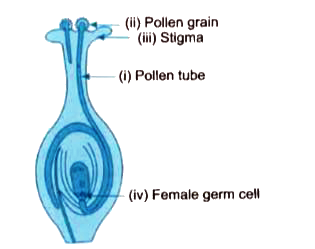
(b) The pollen tube moves through the style and reaches the ovule. It carries male gerrn cells to the ovule for fertilisation.
(c) (i) Ovules develops into seed.
(ii) Ovary develops into fruit.
9.
The transfer of pollen grains from anthers (male sexual parts) of a flower to the stigma part of the pistil (female sexual part) is known as pollination. Pollination is done by insects, birds, wind and water.
Pollination can occur in two ways:
1. Self pollination: When the pollen grains from the anther of a flower are transferred to the stigma of the same flower or another flower on the same plant, it is called self pollination.
2. Cross pollination: When the pollen grains from the anther of a flower on one plant are transferred to the stigma of a flower on another similar plan it is called cross pollination.
When a pollen grain falls on the stigma of the carpel, it grows a pollen tube downwards through the style towards the female gamete in the ovary. A male gamete moves down the tube. When the pollen tube enters the ovule, its tip bursts open and male gamete comes out of the pollen tube and combings with the nucleus of the female gamete and forms zygote. This process is known as fertilization.
10.
Light, water, gravity, touch and chemical substance
11.
The position of man is at the apex of most food chains as he is an intelligent organism and can take any advantageous position by manipulation.
12.
A trait (or characteristic) of an organism which is 'not inherited' but develops in response to the environment is called an acquired trait.
The acquired traits of an organism cannot be passed on to its future generations.
For example, 'low weight' of beetle, 'cut tail' of a mouse. Changes brought in the non-reproductive tissues cannot be passed on to the DNA of the germ cells. So the experiences of an individual during its lifetime cannot be passed on to its progeny. Thus acquired characters of an individual cannot be inherited.
13.
No this is because when there is a change in any species, there is change only in a part or a few members of the species population.
14.
If leaves of a plant were covered with aluminium foil, then leaves may not get sunlight, which is the basic requirement for all the processes occurring in the plant. As a result, no photosynthesis will occur, so no glucose will be made. Also, no respiration will take place as no oxygen will be taken in due to blocked stomata. No transpiration will occur, so there would be no upward movement of water or minerals from the soil as there will be no transpirational pull. Temperature regulation of leaf will be affected.
15.
The cross in which just two contrasting characters are studied is called monohybrid cross. Mendel did monohybrid cross for his first experiment. He selected a pair of contrasting characters. For example cross between tall plants and short plants. IT represents the genotype of tall plant and tt represents the genotype of short plants. In the F2 generation, all plants were tall but their genotype was Tt; which means they were not pure tall plants. This could be established by the appearance of the character of shortness in the F2 generation; in which most of the plants were tall and some of the plants were short. This experiment showed that the character of shortness was recessive in F1 generation and hence could not be observed. The ratio of number of tall plants to that of short plants in F2 generation was 3 : 1.
16.
(a): Hospital waste contains a lots of germs so it should not be disposed openly. Burning the waste kills the germs and disposes the waste in proper way.
17.
(a): Both A and R are true and R is correct explanation of the assertion
18.
(i) (b): In the given figures B represents artery that carry blood away from the heart to different organs.
(ii) (c): In the given figures, A represents vein. Veins bring blood from different body parts to the heart. The flow of blood in veins is not so fast because the blood in veins is under low pressure. Veins possess valves which prevent backward flow of blood.
(iii) (a): Veins carry deoxygenated blood with single exception, i.e., pulmonary vein. Arteries carry blood from heart towards the organ.
(iv) (d)
(v) (a)

10th Standard CBSE Syllabus & Materials
10th Standard CBSE
CBSE 10th Social Science PS - Federalism - New Model Questions Papers Study Material - QB365 Set A
NEW10th Standard CBSE
CBSE 10th Social Science PS - Power Sharing - New Model Questions Papers Study Material - QB365 Set A
NEW10th Standard CBSE
CBSE 10th Social Science GEO - Manufacturing Industries - New Model Questions Papers Study Material - QB365 Set A
NEW10th Standard CBSE
CBSE 10th Social Science GEO - Minerals and Energy Resources - New Model Questions Papers Study Material - QB365 Set A



NCERT Books

Syllabus

Exam Pattern

Sample Question Papers

Previous year Question Papers

Important Notes

MCQ Practice test

NCERT Exemplers

Case study Questions

Image Based Questions

Passage based Questions

HOT Questions

Value Based Questions

Model Questions Papers
NCERT ( Book Back ) Questions

Assertion and Reason
Important Questions And Answers

CBSE 10th Standard CBSE Subjects
CBSE Standards