
 100% FREE ACCESS
10th Standard CBSE Syllabus & Materials
10th Standard CBSE
CBSE 10th Social Science ECO - Globalisation and the Indian Economy - New Model Questions Papers Study Material - QB365 Set A
NEW10th Standard CBSE
CBSE 10th Social Science ECO - Money and Credit - New Model Questions Papers Study Material - QB365 Set A
NEW10th Standard CBSE
CBSE 10th Social Science ECO - Sectors of the Indian Economy - New Model Questions Papers Study Material - QB365 Set A
NEW10th Standard CBSE
CBSE 10th Social Science ECO - Development - New Model Questions Papers Study Material - QB365 Set A
NEW10th Standard CBSE
CBSE 10th Social Science PS - Outcomes of Democracy - New Model Questions Papers Study Material - QB365 Set A
NEW10th Standard CBSE
CBSE 10th Social Science PS - Gender, Religion and Caste - New Model Questions Papers Study Material - QB365 Set A

Published on: 20/10/2025
Download CBSE Class 10th Standard CBSE Science question papers, sample papers, important questions, and previous year solved papers in PDF format. Get free study materials, NCERT solutions, and exam preparation resources for Class 10th Standard CBSE Science
Questions + Answers key
Take MCQ Science Test
1.
The amount of light entering the human eye is controlled by
Ciliary muscles
Pupil
Cornea
Iris
2.
The light sensitive cell present on retina and is sensitive to the intensity of light is:
cones
rods
both rods and cones
none of these
3.
The bluish colour of water in deep sea is due to
the presence of algae and other plants found in water
reflection of sky in water
scattering of light
absorption of light by the sea
4.
Twinkling of stars is due to atmospheric
dispersion of light by water droplets
refraction of light by different layers of varying refractive indices
scattering of light by dust particles
internal reflection of light by clouds
5.
A person cannot see distinctly objects kept beyond 2m.This defect can be corrected by using a lens of power
+0.5 D
-0.5 D
+0.2 D
-0.2 D
6.
The pH of the gastric juices released during digestion is
less than 7
more than 7
equal to 7
equal to 0
7.
If a few drops of a concentrated acid accidentally spills over the hand of a student, what should be done?
Wash the hand with saline solution
Wash the hand immediately with plenty of water and apply a paste od sodium hydrogen carbonate
After washing with plenty of water apply solution of solution hydroxide on the hand
Neutralise the acid with a strong alkali
8.
Calcium phosphate is present in tooth enamel. Its nature is
basic
acidic
neutral
amphoteric
9.
During the preparation of hydrogen chloride gas on a humid day, the gas is usually passed through the guard tube containing calcium chloride. The role of calcium chloride taken in the guard tube is to
absorb the evolved gas
moisten the gas
absorb moisture from the gas
absorb Cl- ions from the evolved gas
10.
What happens when a solution of an acid is mixed with a solution of a base in a test tube?
(a) The temperature of the solution increases
(b) The temperature of the solution decreases
(c) The temperatures of the solution remains the same
(d) Salt formation takes place
(i) only
(i) and (iii)
(ii) and (iii)
(i) and (iv)
11.
(i) A person is suffering from both myopia and hypermetropia. (a) What kind of lenses can correct this defect? (b) How are these lenses prepared?
(ii) A person needs a lens of power + 3D for correcting his near vision and-3D for correcting his distant vision. Calculate the focal lengths of the lenses required to correct these defects.
12.
Name three refractive defects of vision with the help of diagram. Explain the reasons and correction of these defects.
13.
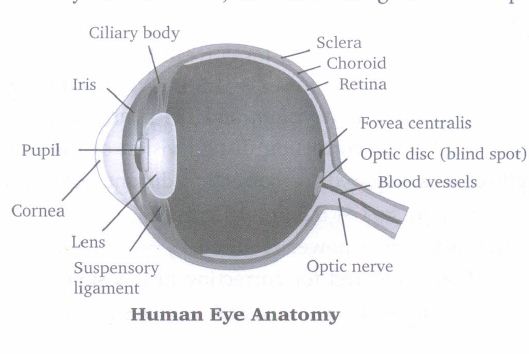
Draw a neat labelled diagram of human eye and explain the working of each part of it.
14.
What is meant by 'water of crystallisation' of a substance? Describe an activity to show that blue copper sulphate crystals contain water of crystallisation.
15.
A metal carbonate X on reacting with an acid gives a gas which when passed through a solution Y gives the carbonate back. On the other hand, a gas G that is obtained at anode during electrolysis of brine is passed on dry Y; it gives a compound Z, used for disinfecting drinking water. Identity X, Y, G and Z.
16.
Name and explain the phenomenon of light due to which the path of a beam of light becomes visible when it enters a smoke filled room through a small hole. Also, state the dependence of colour of the light we receive on the size of the particle of the medium through which the beam of light passes.
17.
How can change in size of eyeball be one of the reason for
(i) myopic and
(ii) hypermetropic eye?
Compare the size of eyeball with that of a normal eye In each case. How does this change of size affect the position of image in each case?
18.
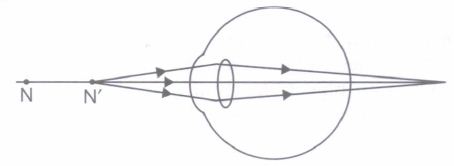
Study the diagram given below and answer the question that it follows:
(a) Which defect of vision is represented in this case? Give reason for your answer.
(b) What could be the two causes of this defect?
(c) With the help of a diagram show how this defect can be corrected by the use of a suitable lens
19.
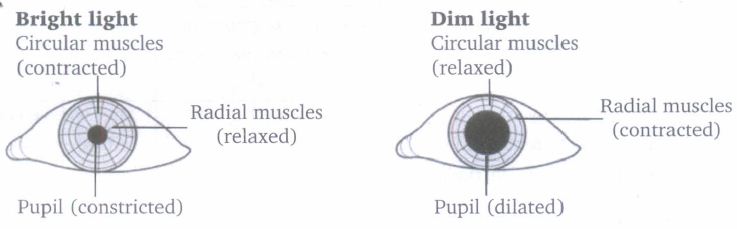
What do understand by the term pupil reflex? Explain with the diagram
20.
State the difference between rods and cones cells in the retina of human eye. Draw a neat diagram of human eye.
21.
15 mL of water and 10 mL of sulphuric acid are to be mixed in a beaker
(i) State the method that should be followed with reason.
(ii) What is this process called?
22.
Name the acid present in the following:
(i) Tomato, (ii) Vinegar, (iii) Tamarind
23.
Differentiate between strong and weak acids. Identify the strong and weak acids from the following list of acids: hydrochloric acid, acetic acid, formic acid, nitric acid.
24.
What are the uses of washing soda?
25.
What is 'Plaster of Paris' chemically? How is it obtained from gypsum? Write the condition and chemical equation involved in its manufacture.
1.
(b)
Pupil
2.
(b)
rods
3.
(c)
scattering of light
4.
(b)
refraction of light by different layers of varying refractive indices
5.
(b)
-0.5 D
6.
(a)
less than 7
7.
(b)
Wash the hand immediately with plenty of water and apply a paste od sodium hydrogen carbonate
8.
(a)
basic
9.
(c)
absorb moisture from the gas
10.
(d)
(i) and (iv)
11.
(i) (a) Bi-focal lenses
(b) These lenses prepared in which upper part of lens is concave and lower part is convex.
(ii) As we know, power of lens, \(P=\frac{1}{f}\)
\(\Rightarrow \quad f=\frac{1}{P}\)
Hence, for first lens, focal length
\(f=\frac{1}{+3}=+0.33\)
or +33.33 cm (convex lens)
Similarly, for second lens focal length
\(f=\frac{1}{-3}=-0.33 \mathrm{~m} \text { or }-33.33 \mathrm{~cm} \text { (concave lens) }\)
12.
The three refractive defects of vision are
(i) Myopia:(a) Myopia or short-sightedness-Eye can see objects at short distance. Inability of the eye in viewing long distant objects. The image falls before retina.
Causes: (i) Elongation of eye ball.
(ii) Excessive curvature in cornea and focal length of lens decreases.
Correction: By using concave lens (diverging lens), which shifts the image to the retina by diverging the rays further.
(b) The near point of human eye is 25 cm which cannot be changed further hence the objects within 10 cm of the eye cannot be viewed (ii) Hypermetropia (iii) Presbyopia
(ii)Hypermetropia: Also called long-sightedness. Person can see long distant objects but cannot see nearby objects distinctly. This is because the eye ball becomes smaller, focal length increases. It can be corrected by using converging lens called convex lens.
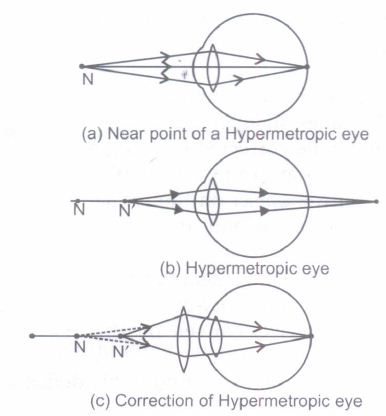
(iii)Presbyopia: The person suffering from this disease cannot see nearby as well as far off objects. It is caused due to weakening of ciliary muscles. This defect is caused due to ageing. The lens is not able to change the focal length. It can be corrected by using bi-focal lens.
13.
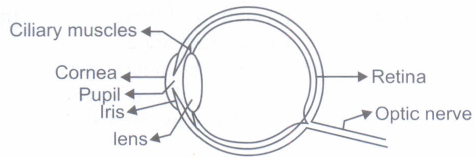
Working of Human eye
Human eye consists of various parts which helps us in seeing the objects, the function of various parts are:
(a) Cornea: It is the transparent membrane which refracts the light entering our eye.
(b) Iris: Iris controls the size of pupil.
(c) Pupil: It allows the light entering our eye to pass through it.
(d) Lens: Refracts the light of the objects at different places on retina.
(e) Ciliary muscles: Helps in changing the focal length of the lens.
(f) Retina: It is the screen of the eye on which image is formed. It consists of rods and cones .
(g) Optic nerve: It carries the electrical signals from retina to brain.
14.
The water molecules associated with a crystalline substance is called 'water of crystallisation' .
Activity \(\longrightarrow\)Take few crystals of blue copper sulphate in dry boiling tube. Heat it on flame, the blue crystals change to white dry powder and the inner surface of the test tube condenses with water.
This proves that crystals contain water molecules in it. If we add some water in the white powder it regains the lost water molecules and become blue again.
15.
The gas evolved at anode during electrolysis of brine is chlorine (G) When chlorine gas is passed through dry \(Ca(OH)_2\ (Y)\) produces bleaching powder (Z) used for disinfecting drinking water.
\(Ca(OH)_2+Cl_2\rightarrow CaOCl_2+H_2O\)
Since Y and Z are calcium salts, therefore X is also a calcium salt and is calcium carbonate.
\(CaCO_3+2HCl\rightarrow CaCl_2+CO_2+H_2O\)
\(Ca(OH)_2+CO_2 \rightarrow CaCO_3+H_2O\)
16.
Tyndall effect. The earth's atmosphere is a heterogeneous mixture of minute particles of smoke, tiny water droplets, suspended particles of dust and molecules of air.
So, when a beam of light strikes such particles of smoke filled room through a small hole, the path of the beam of light become visible. This happens due to Tyndall effect. It's a phenomena based on scattering of light.
The colour of scattered light depend on the size of the particle of the medium through which the beam of light passes and wavelength of light.
and scattering \(\alpha\) diameter. [Where d = diameter of particle of medium]
17.
(i) The eye suffering from myopia, has longer eyeball than that of a normal eye due to which the retina is at a larger distance from the eye lens. This results in the formation of the image in front of the retina.
(ii) The eye suffering from hypermetropia has short eyeball than that of normal eye due to which the retina is at smaller distance from the eye lens. This results in the formation of the image behind the retina.
18.
(a) The defect is hypermetropia, as the image of near point is formed beyond retina.
(b) Two causes
(i) Focal length of the lens increases
(ii) Eye ball becomes smaller
(c) Correction: It can be corrected by using a convex lens. It is a converging lens which shifts the image of the object on the retina.
19.
The changes in the size of the pupil to control the amount of light entering the eye is called pupil reflex. In bright light, pupil size is reduced as too much light falling on the retina could damage it. The reduced size of the pupil allows only limited amount of light to enter. In dim light, pupil she is increased to allow as much light as possible to enter the eye. The retina detects the brightness of light that is entering the eye. An impulse pass to the brain along sensory neurons and the message travels back to the muscles of the iris by motor neurons, triggering a response - the change in size of the pupil due to contraction of radial or circular muscles.
20.
| Function | Location | Remarks | |
| Rods | Sensitive to low light intensity. Detects shades of grey | Found throughout the fovea retina except at the blind spot | Provides night vision |
| cones | Sensitive only to high intensity. Detects colour and cannot operate in poor light |
Concentrated in the fovea | They are sensitive to red, green and blue light |
Fovea: In the eye, a tiny pit located in the macula of the retina that provides the clearest vision of all. Only in the fovea are the layers of the retina spread aside to let light fall directly on the cones, the cells that give the sharpest image.
21.
(i) The acid is to be added slowly in water to prevent the mixture to be splashed. The reaction is highly exothermic, therefore, constant cooling should be done.
(ii) The process is called dilution.
22.
(i) Tomato - Malic acid and citric acid
(ii) Vinegar - Acetic acid
(iii) Tamarind - Tartaric acid and citric acid.
23.
Acids which ionize completely in aqueous solution-strong acids.
Acids which ionize partially in aqueous solution-weak acids.
Hydrochloric acid, nitric acid-strong acid.
Acetic acid, formic acid-weak acid.
24.
(i) Sodium carbonate (washing soda) is used in glass, soap and paper industries.
(ii) It is used in the manufacture of sodium compounds such as borax.
(iii) Sodium carbonate can be used as a cleaning agent for domestic purposes.
(iv) It is used for removing permanent hardness of water.
25.
Plaster of Paris is calcium sulphate hemihydrate \((CaSO_4.{1\over2}H_2O).\)
Gypsum, when heated at a temperature of about 380 K in a kiln. loses its three-fourth water of crystallisation and changes to plaster of Paris.
Following is the reaction involved:
\(\underset{Gypsum}{CaSO_4.2H_2O}\xrightarrow {Heat} \underset{Plaster\ of\ Paris}{CaSO_4.{1\over2}H_2O}+\underset{Water}{1{1\over2}H_2O}\)

10th Standard CBSE Syllabus & Materials
10th Standard CBSE
CBSE 10th Social Science PS - Federalism - New Model Questions Papers Study Material - QB365 Set A
NEW10th Standard CBSE
CBSE 10th Social Science PS - Power Sharing - New Model Questions Papers Study Material - QB365 Set A
NEW10th Standard CBSE
CBSE 10th Social Science GEO - Manufacturing Industries - New Model Questions Papers Study Material - QB365 Set A
NEW10th Standard CBSE
CBSE 10th Social Science GEO - Minerals and Energy Resources - New Model Questions Papers Study Material - QB365 Set A



NCERT Books

Syllabus

Exam Pattern

Sample Question Papers

Previous year Question Papers

Important Notes

MCQ Practice test

NCERT Exemplers

Case study Questions

Image Based Questions

Passage based Questions

HOT Questions

Value Based Questions

Model Questions Papers
NCERT ( Book Back ) Questions

Assertion and Reason
Important Questions And Answers

CBSE 10th Standard CBSE Subjects
CBSE Standards