
 100% FREE ACCESS
10th Standard CBSE Syllabus & Materials
10th Standard CBSE
CBSE 10th Social Science ECO - Globalisation and the Indian Economy - New Model Questions Papers Study Material - QB365 Set A
NEW10th Standard CBSE
CBSE 10th Social Science ECO - Money and Credit - New Model Questions Papers Study Material - QB365 Set A
NEW10th Standard CBSE
CBSE 10th Social Science ECO - Sectors of the Indian Economy - New Model Questions Papers Study Material - QB365 Set A
NEW10th Standard CBSE
CBSE 10th Social Science ECO - Development - New Model Questions Papers Study Material - QB365 Set A
NEW10th Standard CBSE
CBSE 10th Social Science PS - Outcomes of Democracy - New Model Questions Papers Study Material - QB365 Set A
NEW10th Standard CBSE
CBSE 10th Social Science PS - Gender, Religion and Caste - New Model Questions Papers Study Material - QB365 Set A

Published on: 20/10/2025
Download CBSE Class 10th Standard CBSE Science question papers, sample papers, important questions, and previous year solved papers in PDF format. Get free study materials, NCERT solutions, and exam preparation resources for Class 10th Standard CBSE Science
Questions + Answers key
Take MCQ Science Test
1.
Sex determination depends upon the environment in
birds
amphibians
reptiles
fishes
2.
ldentify the correct parts of the diagram labelled as 1 and 2
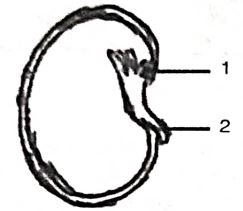
| 1 | 2 |
| Micropyle | Epicotyl |
| 1 | 2 |
| Cotyledon | Embryo |
| 1 | 2 |
| Radicle | Plumule |
| 1 | 2 |
| Plumule | Radicle |
3.
If a tall pea plant is crossed with a pure dwarf pea plant then, what percentage of F1 and F2-generation respectively will be tall?
25%, 25%
50%, 50%
75%, 100%
100%, 75%
4.
Select the statement which is true for the plant hormones.
All hormones are produced naturally in plants
Different plant hormones helps to control growth development and responses to environment
Cytokinin promotes cell division in plants
All of the above
5.
Which of the following mirror is used by a dentist to examine a small cavity In a patient's teeth?
Convex mirror
Plane mirror
Concave mirror
Any spherical mirror
6.
When light enters the atmosphere It strikes on extremely fine particles, which deflect the rays of light In all possible directions. This is due to
reflection of light
atmospheric refraction
scattering of light
dispersion of light
7.
In domestic electric circuits, the wiring with 15 A current rating is for the electric devices which have
higher power ratings such as geyser
lower power ratings such as fan
metallic bodies and low power ratings
non-metallic bodies and low power ratings
8.
Where does fertilisation occur in human females
Uteru
Cervix
Oviduct
None of these
9.
Pulmonary artery carries blood
Away from the heart
Towards the heart
None of these
Both of these
10.
Which one of the following metals do not react with cold as well as hot water?
Na
Ca
Mg
Fe
11.
Aluminium is used for making cooking utensils. Which of the following properties of aluminium are responsible for the same?
(i) Good thermal conductivity
(ii) Good electrical conductivity
(iii) Ductility
(iv) High melting point
(i) and (ii)
(i) and (iii)
(ii) and (iii)
(i) and (iv)
12.
The main function of abscisic acid in plants is to
Increase the length of cells
Promote cell division
Inhibit growth
Promote growth of stem
13.
Which is the correct sequence of parts in human alimentary canal?
Mouth \(\longrightarrow\)Stomach\(\longrightarrow\)Small intestine \(\longrightarrow\) Oesophagus \(\longrightarrow\) large intestine
Mouth \(\longrightarrow\) oesophagus \(\longrightarrow\) stomach \(\longrightarrow\) large intestine \(\longrightarrow\) small intestine
Mouth \(\longrightarrow\) stomach \(\longrightarrow\) oesophagus \(\longrightarrow\) small intestine \(\longrightarrow\) large intestine
Mouth \(\longrightarrow\) oesophagus \(\longrightarrow\) stomach \(\longrightarrow\)small intestine \(\longrightarrow\) large intestine
14.
Electric potential is
Neither scalar nor vector
Scalar quantity
Vector quantity
Sometimes scalar sometimes vector
15.
Sodium hydrogen carbonate when added to acetic acid evolves a gas. Which of the following statements are true about the gas evolved?
(i) It turns lime water milky
(ii) It extinguishes a burning splinter
(iii) It dissolves in a solution of sodium hydroxide
(iv) It has a pungent odour
(i) and (ii)
(i), (ii) and (iii)
(ii), (iii) and (iv)
(i) and (iv)
16.
Which of the following is not a physical change?
Boiling of water to give water vapour.
Melting of ice to give water.
Dissolution of salt in water.
Combustion of Liquefied Petroleum Gas(LPG).
17.
Define resistance, Give its SI unit.
18.
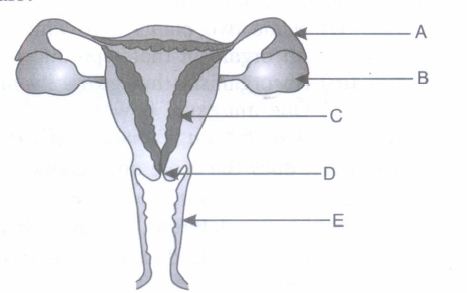
(a) Name the parts labelled A, B, C, D, and E
(b) Where do the following functions occurs?
(i) Production of an egg
(ii) Fertilisation
(iii) Implantation of zygote
(c) What happens to the lining of uterus
(i) before release of fertilised egg. (ii) if no fertilisation occurs
19.
When is lactic acid formed in our muscles?
20.
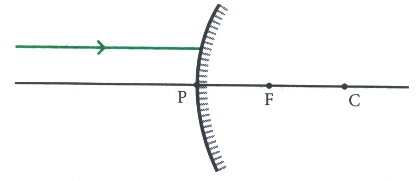
A ray of light is incident on a convex mirror as shown. Redraw the diagram and complete the path of this ray after reflection from the mirror. Mark angle of incidence and angle of reflection on it.
21.
" The father is responsible for the sex of the child. not the mother." Justify this statement.
22.
The following reaction takes place when aluminium powder is heated with MNO2
\({ 3MnO }_{ 2 }+4Al(s)\rightarrow 3Mn(l)+{ 2Al }_{ 2 }{ O }_{ 3 }+Heat\)
(a) Is aluminium getting reduced?
(b) Is MnO2 getting oxidised?
23.
What health disorder may occur if the following hormones are not secreted properly?
(a) Growth hormone
(b) Insulin
(c) Thyroxine
(d) Testosterone
24.
Study the following cross and showing self-polination in F1, fill in the blank and answer the questions that follow.
RRYY \(\times\) rryy Parents
(Round yellow) (Wrinkled green)
RrYy \(\times\) ...... F1-generation
(Round yellow)
(i) ln above question, what is the combination of characters in the F2-progeny? What are the ratios?
(ii) Give reasons for the appearance of new combination of characters in the F1-progeny.
25.
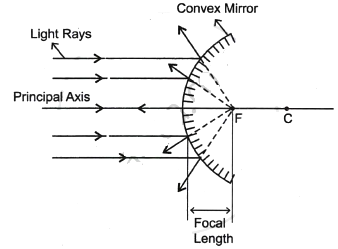
Define the following terms in the context of a diverging lens.
(a) Principal focus
(b) Focal length
Draw a labelled ray diagram to illustrate your answer.
26.
The thermite process is used for repairing cracks in railway tracks on site.
(i) Write the equation for the reaction taking place in the process, mentioning the physical state of the reactants and products.
(ii) What information in the chemical equation indicates that the reaction is exothermic?
27.
(i) State the relation between colour of scattered light and size of the scattering particle.
(ii) The apparent position of an object, when seen through the hot air, fluctuates or waves. State the basic cause of this observation.
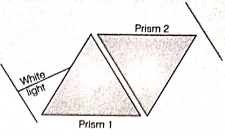
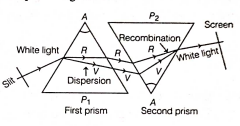
(iii) Complete the path of white light when it passes through two identical prisms placed as shown
28.
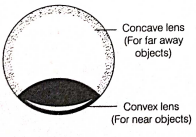
List two causes of presbyopia. Draw labelled diagram of a lens used for the correction of this defect of vision.
29.
List three advantage of parallel circuits in domestic wiring.
30.
Give reasons:
(i) Use of a mild base like baking soda provides relief on the area stung by honeybee.
(ii) Baking powder is added to make the cakes spongy and soft.
(iii) The colour of blue copper sulphate crystals changes to white on heating.
31.
Complete and balance the following chemical equations:
(i) CaCO3 + HCl
(ii) Al + HCl
(iii) MnO2 + HCI
32.
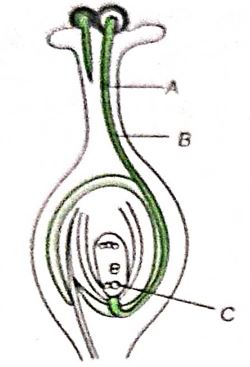
(i) Study the diagram given below and name the parts marked as A, B and C. What happens when B reaches C in the ovary? Mention its significance.
(ii) Write the post fertilisation changes that occur in a flower.
33.
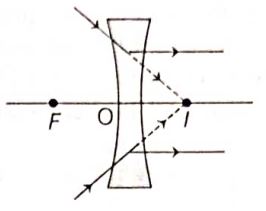
(i) Draw a ray diagram to show the path of the refracted ray in each of the following cases A ray of light Incident on a concave lens
(a) parallel to its principal axis and
(b) is directed towards its principal focus.
(ii) A 4 cm tall object is placed perpendicular to the principal axis of convex lens of focal length 24 cm. The distance of object from the lens is 16 cm. Find the position and size of image formed.
34.
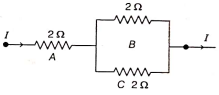
Three \(2 \Omega\) resistors A, B and C are connected as shown in figure. Each of them dissipates energy and can withstand a maximum power of 18 W without melting. Find the maximum current that can flow through the three resistors.
35.
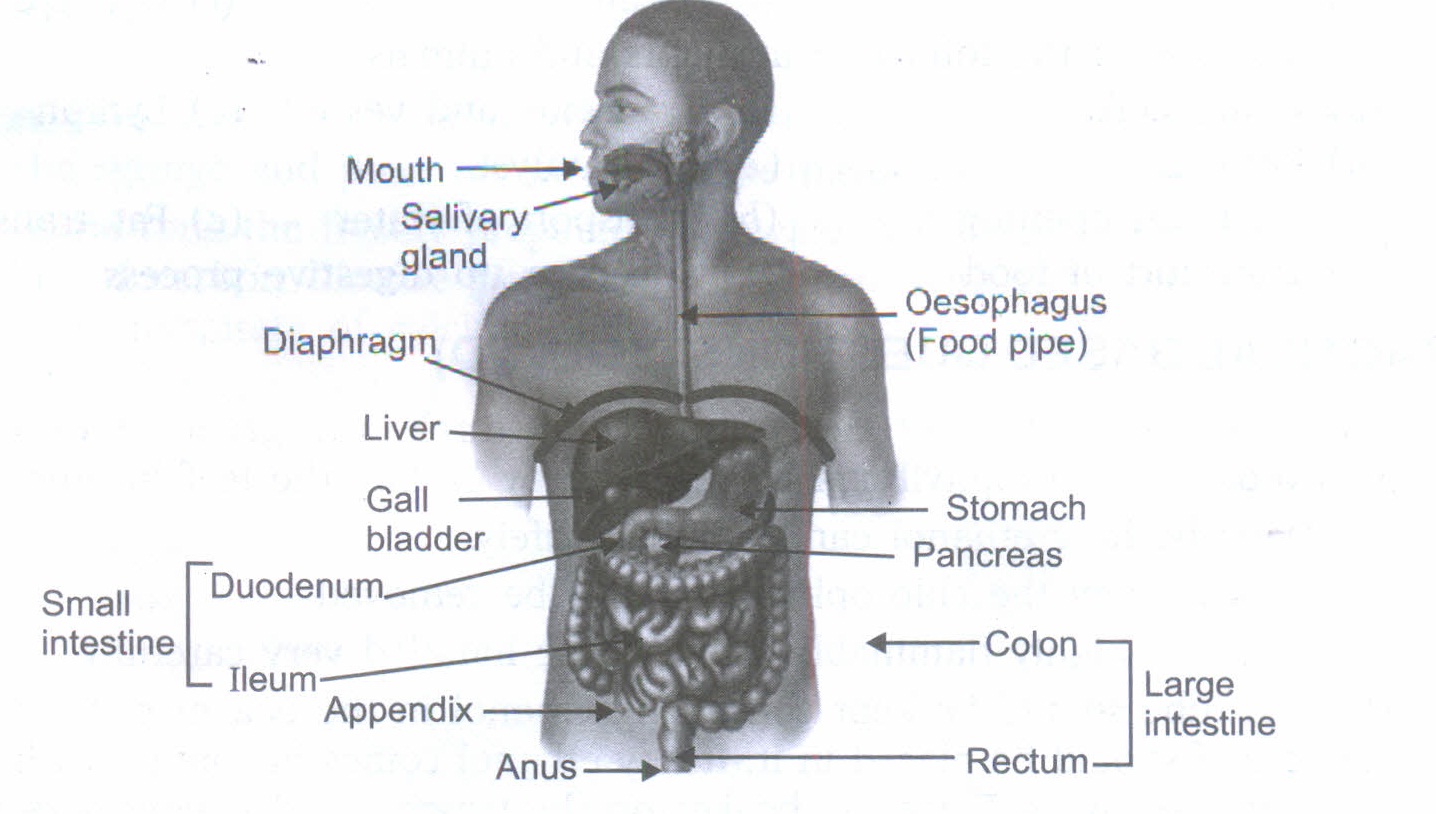
Answer the following questions based dn the above figure.
(i) The organ that produces pepsin.
(ii) The alkaline medium producing organ.
(iii) It helps in absorbtion of digested food.
(iv) It help in absorbtion of water.
(v) The part that controls the exit of the waste materials.
36.
(a) Differentiate between roasting and calcination. Explain the two with the help of suitable chemical equations. How is zinc extracted from its ore?
(b) Name two metals that can be used to reduce metal oxides to metals.
37.
(a) A metal compound 'X' reacts with dil. H2SO4 to produce effervescence. The gas evolved extinguishes a burning candle. If one of the compound formed is calcium sulphate, then what is 'X' and the gas evolved? Also, write a balanced chemical equation for the reaction which occurred.
(b) (i) Name one antacid. How does it help to relieve indigestion in stomach?
(ii) A farmer treats the soil with quicklime or calcium carbonate. What is the nature of soil? Why does the farmer treat the soil with quicklime?
38.
Assertion (A) : Red light signals are used to stop the vehicles on the road.
Reason (R) : Red coloured light is scattered the most so as to be visible from a large distance.
(a) If both Assertion and Reason are true and Reason is the correct explanation of Assertion.
(b) If both Assertion and Reason are true, but Reason is not the correct explanation of Assertion.
(c) If Assertion is true, but Reason is false.
(d) If Assertion is false, but Reason is true.
39.
Assertion (A) Silver bromide decomposition is used in black and white photography.
Reason (R) Light provides energy for this exothermic reaction.
(a) Both Assertion and Reason are true and Reason is the correct explanation of Assertion.
(b) Both Assertion and Reason are true, but Reason is not the correct explanation of Assertion.
(c) Assertion is true, but Reason is false.
(d) Assertion is false, but Reason is true.
40.
Assertion: Pancreatic juice digests starch, proteins and fats.
Reason: Pancreatic juice contains digestive enzymes like pancreatic amylase, trypsin and lipase.
Codes
(a) Both A and R are true and R is correct explanation of the assertion.
(b) Both A and R are true but R is not the correct explanation of the assertion.
(c) A is true but R is false.
(d) A is false but R is true.
41.
Assertion: Gold occurs in native state.
Reason: Gold is a reactive metal.
Codes
(a) Both A and R are true, and R is correct explanation of the assertion.
(b) Both A and R are true, but R is not the correct explanation of the assertion.
(c) A is true, but R is false.
(d) A is false, but R is true.
42.
Shyam made one circuit for his Physics. He used five resistances: two 3Ω, one 1Ω, one 6Ω, one 3.6 Ω and a battery of 4.5 V. The circuit diagram is given below:
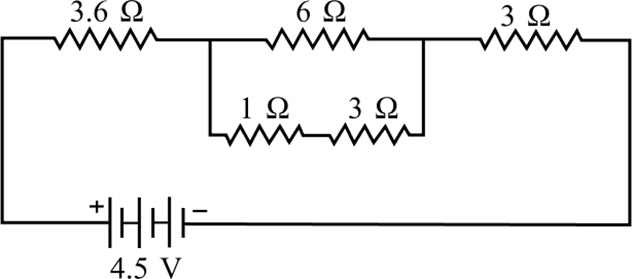
(i) Total resistance of parallel combination is :
(a) 2.4 Ω (b) 3 Ω (c) 6 Ω (d) 2 Ω
(ii) Equivalent resistance of total circuit is :
(a) 5 Ω (b) 9 Ω (c) 11 Ω (d) 13 Ω
(iii) Total current in the circuit is :
(a) 2 A (b) 4.5 A (c) 0.5 A (d) 10 A
(iv) Current in 6 ohm resistance is
(a) 0.3 A (b) 0.2 A (c) 4 A (d) 6 A
(v) Potential across 3.6 ohm resistance will be :
(a) 1.8 V (b) 2.6 V (c) 9 V (d) 4.5 V
43.
A group of students measured the pH of some substances they found in their homes. Their results are given in the following table :
| Substance | pH | Substance | pH |
| Apples | 3.0 | Vinegar | 3.0 |
| Salt | 7.0 | Lemon juice | 2.5 |
| Baking soda | 8.5 | Washing soda | 11.5 |
| Sugar | 7.0 | Milk | 6.5 |
| Black coffee | 5.0 | Household ammonia | 12.0 |
| Toothpaste | 9.0 |
(i) Which solution is the most acidic?
(a) Apples (b) Vinegar (c) Lemon Juice (d) Black Coffee
(ii) Which solution is the most alkaline?
(a) Household ammonia (b) Washing soda
(c) Baking soda (d) Toothpaste
(iii) Which solutions are neutral?
(a) Salt (b) Sugar
(c) Milk (d) Both (i) and (ii)
(iv) What will be the litmus test if the solution is basic?
(a) Red litmus will turn to blue
(b) Blue litmus will turn to red
(c) No change in colour
(d) It will change into orange pink.
(v) Arrange the following in order of the increasing basic strengths.
Baking soda, Toothpaste, Household ammonia, Washing soda
(a) Baking soda, Toothpaste, Household ammonia, Washing soda
(b) Baking soda, Toothpaste, Washing soda, Household ammonia
(c) Washing soda, Baking soda, Toothpaste, Household ammonia
(d) Baking soda, Household ammonia, Toothpaste, Washing soda
Higher the pH, the stronger the base
44.
Transpiration is the evaporative loss of water by plants. It occurs mainly through the stoma in the leaves. Besides the loss of water vapour in transpiration, exchange of oxygen and carbon dioxide in the leaf also occurs through pores called stomata. Normally stomata remain open in the day time and close during the night
(i) Which of the following will not directly affect transpiration?
| (a) Temperature | (b) Light |
| (c) Wind speed | (d) Chlorophyll content of leaves |
(ii) Water vapour comes out from the plant leaf through the stomatal opening. Through the same stomatal opening, carbon dioxide diffuses into the plant during photosynthesis. Reason out the above statements . using one of following options.
(a) The above processes happen only during night time.
(b) One process occurs during day time and the other at night.
(c) Both processes cannot happen Simultaneously.
(d) Both processes can happen together at day time.
(iii) Which of the following statements is not true for stomatal apparatus?
(a) Guard cells invariably possess chloroplasts and mitochondria.
(b) Guard cells are always surrounded by subsidiary cells.
(c) Stomata are involved in gaseous exchange.
(d) Inner wall of guard cells are thick.
(iv) Which of the following is not a purpose of transpiration?
(a) Helps in absorption and transport in plants
(b) Prevents loss of water
(c) Maintains shape and structure of plants by keeping the cells turgid
(d) Supplies water for photosynthesis
(v) Refer to the given graphs regarding factors affecting transpiration rate and select the correct option.
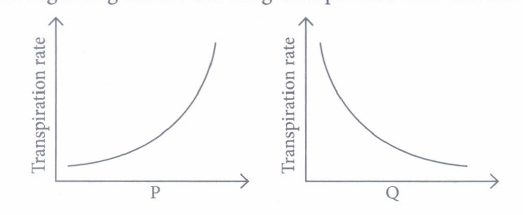
(a) P-Atmospheric temperature; Q-Atmospheric pressure
(b) P-Relative humidity; Q-Atmospheric temperature
(c) P-Air movement; Q-Light
(d) P-Atmospheric pressure; Q-Relative humidity
1.
(c)
reptiles
2.
(d)
| 1 | 2 |
| Plumule | Radicle |
3.
(d)
100%, 75%
4.
(d)
All of the above
5.
(c)
Concave mirror
6.
(c)
scattering of light
7.
(a)
higher power ratings such as geyser
8.
(d)
None of these
9.
(a)
Away from the heart
10.
(d)
Fe
11.
(d)
(i) and (iv)
12.
(c)
Inhibit growth
13.
(d)
Mouth \(\longrightarrow\) oesophagus \(\longrightarrow\) stomach \(\longrightarrow\)small intestine \(\longrightarrow\) large intestine
14.
(b)
Scalar quantity
15.
(a)
(i) and (ii)
16.
(d)
Combustion of Liquefied Petroleum Gas(LPG).
17.
Resistance is the property of a conductor to resist the flow of current through it. Its SI unit is ohm and it is represented by 2Ω.
18.
(a) A - Fallopian tube
B - Ovary
C - Uterus
D - Cervix
E - Vagina
(b) (i) Production of an egg - ovary
(ii) Fertilisation - fallopian tubes
(iii) Implantation of zygote - lining of the uterus
(c) (i) Before release of fertilized egg - the uterus wall becomes thick.
(ii) If no fertilisation occurs - the lining of uterus slowly breaks down and comes out in the form of bleeding.
19.
Sometimes there is lack of oxygen in our muscle cells hence the pyruvate breaks down to form lactic acid (three carbon compound). The build up of lactic acid in our muscles during sudden activity causes cramps.
20.

21.
(a) A male individual contains one X chromosome and one Y chromosome.So male produces two different kinds of. gametes.Therefore, male are called heterogametic. A female individual contains two similar X chromosomes.So produces only one kind of gamete. Therefore, female are called homogametic.The sex of the child is determined at the time of fertilization when male and female gametes fuse to form zygote.If a sperm carrying X chromosome fertilizes an egg carrying X chromosome, then the offspring will be a female, because the offspring will have XX chromosomes.If a sperm carrying Y chromosome fertilizes an egg carrying X chromosome, then the offspring will be a male, because the offspring will have XY chromosomes.Thus there is 50% chance of a male child being born and a 50% chance of a female child being born.Thus, it is the sperm which determines the sex of the child.
(b) In some reptiles, the temperature at which the fertilised egg is incubated before hatching plays a role in determining the sex of the offspring.Example: In a turtle, high
incubation temperature leads to female offspring.
22.
(a) No, because oxygen is added to aluminium therefore, it is getting oxidised.
(b) No, since manganese has lost oxygen therefore, it is getting reduced.
23.
(a) Dwarfism if less hormone; Gigantism if secreted more.
(b) Diabetes
(c) Goitre
(d) Masculine characters will not develop properly in male.
24.
RRYY \(\times\) rryy Parents
(Round yellow) (Wrinkled green)
RrYy \(\times\) RrYy F1-generation
(Round yellow) (Round yellow)
(i) In F1 - generation the combination of characters is
Round yellow = 9, Round green = 3
Wrinkled yellow = 3, Wrinkled green = 1
Thus, the genotypic ratio is 9 : 3 : 3 : 1
(ii) In F1 - generation, the production of all round yellow seeds explains that the round shape and yellow colour of the seeds were dominant traits over the wrinkled shape and green colour of the seeds which segregated during F2 - generation.
25.
(a) Principal focus: The principal focus of the diverging mirror is the point on the principal axis from which all incident rays appear to diverge from behind the mirror.
(b) Focal length: The distance between the pole and the principal focus of a spherical mirror is called the focal length.
26.
(a) Physical state of the reactants and products
2Al(s) + Fe2O3(s) \(\rightarrow\) 2 Fe (l) + Al2O3 (s)
(b) The iron formed is in the molten(liquid) state due to the heat generated in the reaction.
27.
(i) The relation between colour of scattered light and size of the scattering particle is that the small size particles scatter shorter wavelength (víolet) and large sized particles scatter larger wavelength (red).
(ii) The basic cause of this observation is due to the variation in physical condition of hot air etc.
(iii) Complete diagram is
28.
Presbyopia In this defect, a person suffers from both myopia as well as hypermetropia due to less power of accommodation of the eye
The two causes of presbyopia are
(i) Weakness of ciliary muscles. -2.5
(ii) Hardening or loss of elasticity of eye lens.
This defect can be corrected by using bifocal lenses.
29.
(i) In parallel combination each appliance gets the full voltage.
(ii) If one appliance is switched on, others are not affected.
(iii) The parallel circuit divides the current through the appliances.
30.
(i) When a honeybee stings a person, this means it releases an acidic liquid (formic acid) into the body. This causes too much pain and irritation. As we know that baking soda (sodium hydrogen carbonate NaHCO3 is a mild non-corrosive base. It can be used to neutralize an acid.
Hence, when it is applied to the stung area, it reduces the effect of acid by neutralizing the excess acid. As a result, the pain and irritation is reduced.
(ii) Baking powder, which is a mixture of baking soda and tartaric acid. When baking soda is heated or mixed in water, the reaction takes place is given as:
NaHCO3 + H+ \(\rightarrow\) CO2 + H2O + Sodium salt of acid
(releases from acid)
Carbon dioxide released during the reaction causes the bread or cake dough to rise which makes them soft and spongy.
(iii) The colour of blue copper sulphate crystals changes to white on heating because:
a. Blue copper sulphate crystals contain water of crystallization.
b. When we heat the crystals, the water is removed.
c. As a result, the salt turns white.
31.
(i) CaCO3(s) + 2HCl(aq) \(\longrightarrow \) CaCl2(s)+ H2O(I) + CO2(g)
(ii) 2Al(s) + 6HCl(aq)\(\longrightarrow \) 2AlCI3(aq) + 3H2(g)
(iii) MnO2 + 4HCl(aq) \(\longrightarrow \) MnCl2 + 2H20(I) +Cl2(g)
32.
(i) The parts marked as A, B and C are
A-Pollen grain (male gamete)
B-Pollen tube
C-Ovule
When part B (pollen tube) reaches the part C (ovule) the male gamete (pollen grain) enters into the ovule to fuse with the female gamete (egg) for fusion.
(ii) The post fertilisation changes that occurs in a flower are given below
(a) The ovule develops a tough coat and gets converted into a seed.
(b) The ovary grows rapidly and ripens into a fruit.
(c) All petals, stamens, style and stigma gets sherivel and fall off.
33.
(i) Ray diagram when a ray of light incident on concave lens.
(a) Parallel to its principal axis.
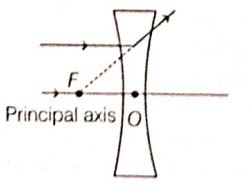
(b) Directed towards its principal focus.
(ii) Focal length of convex lens, f = - 24 cm
Object distance, u = - 16 cm
Height of the object, h0 = 4 cm
Using lens formula,
\(\begin{array}{ll} \Rightarrow & \frac{1}{v}-\frac{1}{u}=\frac{1}{f} \Rightarrow \frac{1}{v}=\frac{1}{f}+\frac{1}{u}=\frac{1}{-24}+\frac{1}{-16} \end{array}\)
\(\begin{array}{ll} \Rightarrow & \frac{1}{v}=\frac{-(16+24)}{16 \times 24}=\frac{-40}{384} \end{array}\)
\(\Rightarrow\) v = -9.6 cm
Magnification of lens,
\(m=\frac{v}{u}=\frac{-9.6}{-16}=0.6\)
We also knows that,
\(m=\frac{\text { height of image }}{\text { height of object }}=\frac{h_i}{h_0}=\frac{h_i}{4}\)
\(\Rightarrow 0.6=\frac{h_i}{4} \Rightarrow h_i=2.4 \mathrm{~cm}\)
the And position of the image formed is -9.6 cm on the same side as object is and size of the image formed is 2.4 cm.
34.
Given, resistance, \(R=2 \Omega\)
Maximum power, \(P_{\max }=18 \mathrm{~W}\)
Maximum current, \(I_{\max }=\) ?
As we know, \( P=I^2 R\)
\(\Rightarrow \quad I=\sqrt{\frac{P}{R}}=\sqrt{\frac{18}{2}}=3 \mathrm{~A}=I_{\max }\)
Maximum current that can flow through \(2 \Omega\) resistor is 3 A . This current divides along B and C because they are in parallel combination.
Voltage across B and C remain same and hence \(I \propto \frac{1}{R}\). Since, B and C have same resistance same current flows through them.
i.e. \(\frac{3}{2}=15, A\) flows through B and C.
35.
(i) Stomach
(ii) Liver
(iii) Villi
(iv) Large intestine
(v) Rectum
36.
(a) Roasting: It is a process in which sulphide ore is heated in the presence of oxygen to convert into oxide.
2ZnS + 3O2 \(\longrightarrow \) 2ZnO + 2SO2
Calcination: It is a process in which carbonate ore is heated in the absence of air to form oxide.
ZnCO3(s) \(\longrightarrow \) ZnO(s) + CO2(g)
After calcination, Zn can be extracted by reduction with carbon.
Reduction: ZnO + C \(\overset { heat }{ \longrightarrow } \) Zn + CO
(b) Aluminium, Magnesium.
37.
(a) 'X' is CaCO3 (calcium carbonate). The gas evolved is CO2.
CaCO3 + H2SO4 (dil.) \(\longrightarrow \) CaSO4 + H2O + CO2
Calcium sulphate
(b) (i) NaHCO3 is antacid. It neutralizes excess of acid formed in the stomach.
(ii) The soil is acidic in nature. The farmer wants to make it neutral by adding quicklime which neutralise the acid in the soil.
38.
(c) The primary reason, why the colour red is used for danger signals is that red light is scattered the least by air molecules present in the atmosphere.
39.
(c) Assertion is true but Reason is false. The correct form of Assertion is as follows
Silver bromide used in photography because it is photosensitive. It decomposes and is converted into metallic silver grains when light is incident on it.
40.
(a): Pancreas secretes pancreatic juice which contains digestive enzymes like pancreatic amylase, trypsin and lipase. The enzyme amylase breaks down the starch, the enzyme trypsin digests the proteins and the enzyme lipase breaks down the emulsified fats.
41.
(c): Gold is a noble metal.
42.
(i) (a) 2.4 Ω
(ii) (b) 9 Ω
(iii) (c) 0.5 A
(iv) (b) 0.2 A
(v) (a) 1.8 V
43.
(i) (c) Lemon Juice
(ii) (a) Household ammonia
(iii) (d) Both (i) and (ii)
(iv) (a) Red litmus will turn to blue
(v) (b) Baking soda, Toothpaste, Washing soda, Household ammonia
44.
(i) (d)
(ii) (d)
(iii) (b): The epidermal surface of the leaf exhibits a large number of minute openings called stomata. The stomata are bordered by two specialized epidermal cells - the guard cells which in some cases are accompanied by subsidiary cells. The walls of guard cells are unevenly thickened. Each guard cell has thick, inelastic inner wall and thin, elastic outer wall. Stomatal aperture is present in between the guard cells. Guard cells are not always surrounded by accessory cells or subsidiary cells.
(iv) (b)
(v) (a)

10th Standard CBSE Syllabus & Materials
10th Standard CBSE
CBSE 10th Social Science PS - Federalism - New Model Questions Papers Study Material - QB365 Set A
NEW10th Standard CBSE
CBSE 10th Social Science PS - Power Sharing - New Model Questions Papers Study Material - QB365 Set A
NEW10th Standard CBSE
CBSE 10th Social Science GEO - Manufacturing Industries - New Model Questions Papers Study Material - QB365 Set A
NEW10th Standard CBSE
CBSE 10th Social Science GEO - Minerals and Energy Resources - New Model Questions Papers Study Material - QB365 Set A



NCERT Books

Syllabus

Exam Pattern

Sample Question Papers

Previous year Question Papers

Important Notes

MCQ Practice test

NCERT Exemplers

Case study Questions

Image Based Questions

Passage based Questions

HOT Questions

Value Based Questions

Model Questions Papers
NCERT ( Book Back ) Questions

Assertion and Reason
Important Questions And Answers

CBSE 10th Standard CBSE Subjects
CBSE Standards