10th Standard Syllabus & Materials
10th Standard
TN 10th English Prose - 4 - The Attic Important Questions And Answers Study Material - QB365 Set A
NEW10th Standard
TN 10th English Supplementary - 3 - The Story of Mulan Important Questions And Answers Study Material - QB365 Set A
NEW10th Standard
TN 10th English Poem - 3 - I am Every Woman Important Questions And Answers Study Material - QB365 Set A
NEW10th Standard
TN 10th English Prose - 3 - Empowered Women Navigating The World Important Questions And Answers Study Material - QB365 Set A
NEW10th Standard
TN 10th English Supplementary - 2 - Zigzag Important Questions And Answers Study Material - QB365 Set A
NEW10th Standard
TN 10th English Poem - 2 - The Grumble Family Important Questions And Answers Study Material - QB365 Set A

Published on: 22/10/2025
Download Tamil Nadu 10th Standard Social Science question papers, model tests, one-mark questions, important questions, and public exam papers in PDF format. Free study materials and answer keys for TN State Board students.
Questions + Answers key
Take MCQ Social Science Test
1.
__________ is the process of providing or obtaining the food necessary for health and growth.
Health
Nutrition
Sanitation
Security
2.
Buffer stock is the stock of food grains, namely wheat and rice, procured by the government through the __________.
FCI
Consumer Co-operatives
ICICI
IFCI
3.
who granted the English “golden Fireman” in 1632
Jahangir
Sultan of Golconda
Akbar
Aurangzeb
4.
5.
India is ______ larger producer in agricultural product.
1st
3rd
4th
2nd
6.
7.
The city which is called as the Manchester of South India is _____________.
Chennai
Salem
Madurai
Coimbatore
8.
The most important constituents of petroleum are hydrogen and ____________.
Oxygen
Water
Carbon
Nitrogen
9.
The longest dam in the world is ___________.
Mettur dam
Kosi dam
Hirakud dam
Bhakra-Nangal dam
10.
Black soils are also called as:
Arid soils
Saline soils
Regur soils
Mountain soils
11.
_________ is not a part of the world network biosphere reserves of UNESCO.
Nilgiri
Agasthiyamalai
Great Nicobar
Kachchh
12.
Sesahachalam hills, a Biosphere reserve is situated in _________.
Tamil Nadu
Andhra Pradesh
Madhya Pradesh
Karnataka
13.
Pulicat Lake is located between the states of
West Bengal and Odisha
Karnataka and Kerala
Odisha and Andhra Pradesh
Tamil Nadu and Andhra Pradesh
14.
_______ Plains are formed by the older alluviums.
Bhabar
Tarai
Bhangar
Khadar
15.
What is the role of FCI in Green Revolution?
16.
Write any two principles of Fair Trade Practices.
17.
Write the name of economic policies in India.
18.
Define the value added approach with example.
19.
Mention the major areas of jute production in India.
20.
What are minerals and state its type?
21.
Write a brief note on the categories of fisheries in India?
22.
Name the types of soil found in India.
23.
Name the areas which receive heavy rainfall.
24.
Write a brief note on the island group of Lakshadweep.
25.
Elaborate the Public Distribution System.
26.
Write the importance of Himalayas.
27.
Write the challenges of Globalization.
28.
Explain the following the economic policies
a) Agricultural Policy
b) Industrial policy
c) New economic policy
29.
Write about the distribution of cotton textile industries in India.
30.
What is Multipurpose projects and write about any two Multipurpose projects of India.
31.
Write about South West Monsoon.
32.
33.
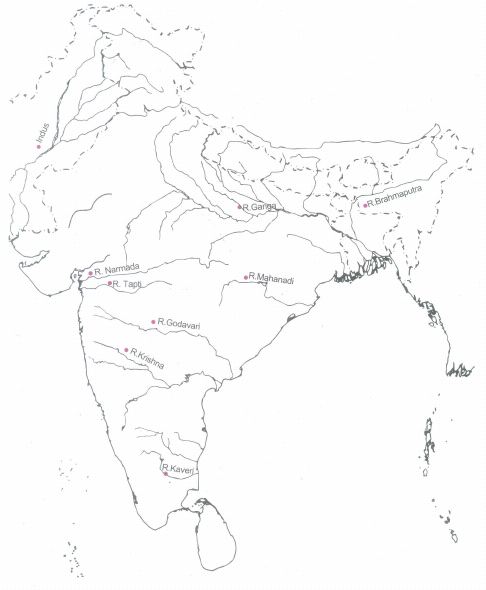
Mark the following in the outline map of India
Major rivers – Indus, Ganga, Brahmaputra, Narmada, Tapti, Mahanadi, Godavari, Krishna & Kaveri.
1.
(b)
Nutrition
2.
(a)
FCI
3.
(b)
Sultan of Golconda
4.
(d)
5.
(d)
2nd
6.
(b)
7.
(d)
Coimbatore
8.
(c)
Carbon
9.
(c)
Hirakud dam
10.
(c)
Regur soils
11.
(d)
Kachchh
12.
(b)
Andhra Pradesh
13.
(d)
Tamil Nadu and Andhra Pradesh
14.
(c)
Bhangar
15.
The FCI had built huge storage godowns and built buffer stocks of food grain were stored during the harvest season to be distributed all through the year.
16.
i) Creating Opportunities for economically disadvantaged producers.
ii) Transparency and accountability
iii) Fair trading practices and payment of a Fair Price
iv) Ensuring no child labour and forced labour.
v) Respect for the environment.
17.
Economic policies in India:
i) Agricultural policy
ii) Industrial policy
iii) New Economic policy
18.
a) In the value added approach the value added by each intermediate goods is summed to estimate the value of the final goods.
b) The sum of the value added by all the intermediate goods used in production gives us the total value of the final goods produced in the economy.
Example:
To measure the market value of a cup of tea is, to add the value of each intermediate goods used to produce it such as tea powder, milk and sugar.
19.
a) The major jute producing areas are in West Bengal and is concentrated along the Hooghly river.
b) Andhra Pradesh, Bihar, Uttar Pradesh, Assam, Chhattisgarh and Odisha are the other Jute goods producing areas.
20.
a) Mineral is a natural substance of organic or inorganic origin with definite chemical and physical properties.
b) Minerals are broadly grouped under two categories. They are metallic and non-metallic minerals.
21.
Fisheries in India are a very important economic activity and a flourishing sector with varied resources and potentials.
There are 2 types of fishing categories. They are:
1) Marine or Sea Fisheries
2) Inland or Fresh Water Fisheries
22.
1. Alluvial soil.
2. Black soils.
3. Red soils.
4. Laterite soils.
5. Forest and mountain soil.
6. Arid and desert soils.
7. Saline and alkaline soils.
8. Peaty and marshy soils.
23.
The western coast, Assam, South Meghalaya, Tripura, Nagaland and Arunachal Pradesh are the heavy rainfall areas.
24.
i) This is a small group of coral islands located off the west coast of India. It covers an area of 32 sq. km.
ii) Lakshadweep islands are separated from the Maldive islands by the Eight Degree Channel.
iii) The uninhabited Pitts island of this group has a bird sanctuary.
iv) Kavaratti is its administrative capital.
25.
i) TamilNadu has adopted an Universal PDS the rest of the states in India had a targeted PDS.
a) Universal PDS:
i) Under Universal PDS all the family ration card holders are entitled to the supplies from PDS.
b) Targeted PDS:
i) In the targeted PDS the beneficiaries are identified based on certain criteria and given their entitlements, leaving out the rest. Both the union and the state governments subsidised the supplies distributed through PDS.
ii) The level and quantum of subsidy also varied across states,
iii) Subsequently the National Food Security Act (NFSA) was passed by the Indian Parliament in 2013.
iv) The NFSA covers 50% of urban households and 75% of the rural households.
v) These households are known as priority households identified based on a set of criteria.
vi) Priority households of this country now have the right to food supply through PDS.
vii) The Union government supplies rice at the rate of 3 per kg, wheat at the rate of 2 kg, and millets at the rate of 1 per kg under NFSA.
viii) Tamil Nadu continues to have the universal system of PDS and supplies rice at free of cost to all card holders
ix) Tamil Nadu has issued bio-metric smart family cards.
26.
(i) Himalayas blocks southwest monsoon winds and causes heavy rainfall to north India.
(ii) It forms a natural barrier to the subcontinent.
(iii) It is the source for many perennial rivers like Indus, Ganges, Brahmaputra, etc.
(iv) The Northern Mountains are described as the paradise of tourists due to its natural beauty.
(v) Many hill stations and pilgrim centers like Amarnath, Kedarnath, Badrinath, and Vaishnavi Devi temples are situated here.
(vi) It provides raw material for many forest based industries.
(vii) It prevents the cold winds blowing from the central Asia and protects India from severe cold.
(viii) Himalayas are renowned for the rich biodiversity.
27.
i) The benefits of globalization extend to all countries that will not happen automatically.
ii) The fear that globalization leads to instability in the developing world.
iii) The industrial world that increased global competition will lead in race to the bottom in wages, labour right and employment practice.
iv) It leads to global imbalance.
v) Globalization has resulted with the embarrassment
vi) Globalization has led to an increase in activities such as child labour and slavery.
vii) Consumption of more junk food that led to the degradation of health and spread of disease.
viii) Globalization has led to environmental degradation
28.
The government of India has framed many economic policies for increasing the rate of economic growth. The important economic policies are:
a) Agricultural policy:
i) Agricultural policy is the set of government decisions and actions relating to domestic agriculture and imports of foreign agricultural products.
Some agricultural policies:
i) Price policy
ii) Land reform policy
iii) Green Revolution
iv) Irrigation policy
v) Food policy
vi) Agricultural labour policy
vii) Co-operative policy
b) Industrial policy:
i) It is an important aspect of any economy.
ii) It creates employment.
iii) It promotes research and development
iv) It leads to modernization and ultimate makes the economy self-sufficient.
v) It is closely related to development of trade.
Some industrial policies:
i) Textile industry policy
ii) Sugar industry policy
iii) Price policy of industrial growth
iv) Small scale industrial policy
v) Industrial Labour policy
c) New Economic policy:-
The economy of India had undergone policy in the beginning of the 1990s.
Some economic reforms:
i) New model economic reforms is commonly known as the LPG known as Liberalization, Privatization and Globalization
ii) These economic reforms had influenced the overall economic growth of the country in a significant manner.
29.
i) Textile is a broad term which includes cotton, jute, wool, silk and synthetic fibre textiles.
ii) This sector in India is the second largest in the world.
iii) Traditional sectors like handloom, handicrafts and small power loom units are the biggest sources of employment.
iv) Currently, India is the third largest producer of cotton and has the largest loom are and ring spindles in the world.
In India:
i) At present, cotton textile industry is the largest organised modern industry of India.
ii) The highest concentration of textile mills in and around Mumbai, makes it as 'Manchester of India'.
iii) The major cotton textile industries are concentrated in the states of Maharashtra, Gujarat, West Bengal, Uttar Pradesh and Tamil Nadu.
In Tamil Nadu:
i) Coimbatore is the most important centre in Tamil Nadu with 200 mills out of its 435 and hence called as "Manchester of South India".
ii) Erode, Tirupur, Karur, Chennai, Tirunelveli, Madurai, Thoothukudi, Salem and Virudhunagar are the other major cotton textile centres in the state.
30.
(i) Multipurpose Project is a scientific management of water resources in our country. Construction of dam across rivers is aimed at many purposes.
(ii) The various purposes of a dam serves are irrigation, hydro power generation, water supply for drinking and industrial purpose, controlling floods, development of fisheries,navigation,etc. Irrigation and hydro-power are the major aims of the projects.
Two import river valley projects (Multipurpose projects):
Bhakra Nangal project:
i) Bhakra Nangal project is constructed across the river Sutlej.
ii) It is the highest gravity dam in India.
iii) The states of Punjab, Haryana and Rajasthan are benefited by this project.
Hirakud project:
i) Hirakud project is constructed across the river Mahanadi in Odisha.
ii) This is the longest dam in the world.
iii) The state benefited by this project is Odisha.
31.
i) The Southwest Monsoon is the most significant feature of the Indian Climate.
ii) The onset of the Southwest Monsoon takes place normally over the southern tip of the country by the first week of June, advances along the Konkan coast in early June and covers the whole country by 15th July.
iii) The sudden approach of monsoon wind over south India with lightning and thunder is termed as the 'break' or 'burst of monsoon'.
iv) The monsoon wind strikes against the southern tip of Indian landmass and gets divided into two branches.
a) Arabian Sea branch
b) Bay of Bengal branch
The Arabian Sea branch:
i) It gives heavy rainfall to west coast of India as it is located in the windward side of the Western Ghats.
ii) The other part which advances towards north is obstructed by Himalayan Mountains and results in heavy rainfall in north.
iii) As Aravalli Mountain is located parallel to the wind direction, Rajasthan and Western part do not get much rainfall from this branch.
Bay of Bengal branch:
i) The wind from Bay of Bengal branch moves towards northeast India and Myanmar.
ii) This wind is trapped by a chain of mountains namely Garo, Khasi and Jaintia which are mainly responsible for the heaviest rainfall caused at Mawsynram located in Meghalaya.
iii)Later on this wind it travels towards west which results in decrease in rainfall from east to west.
iv) Over all about 75% of Indian rainfall is received from this monsoon.
32.
33.

10th Standard Syllabus & Materials
10th Standard
TN 10th English Prose - 2 - The Night the Ghost Got in Important Questions And Answers Study Material - QB365 Set A
NEW10th Standard
TN 10th English Supplementary - 1 - The Tempest Important Questions And Answers Study Material - QB365 Set A
NEW10th Standard
TN 10th English Poem - 1 - Life Important Questions And Answers Study Material - QB365 Set A
NEW10th Standard
TN 10th English Prose - 1 - His First Flight Important Questions And Answers Study Material - QB365 Set A



Tamilnadu Stateboard 10th Standard Subjects
Tamilnadu Stateboard Standards