
10th Standard Syllabus & Materials
10th Standard
TN 10th English Prose - 4 - The Attic Important Questions And Answers Study Material - QB365 Set A
NEW10th Standard
TN 10th English Supplementary - 3 - The Story of Mulan Important Questions And Answers Study Material - QB365 Set A
NEW10th Standard
TN 10th English Poem - 3 - I am Every Woman Important Questions And Answers Study Material - QB365 Set A
NEW10th Standard
TN 10th English Prose - 3 - Empowered Women Navigating The World Important Questions And Answers Study Material - QB365 Set A
NEW10th Standard
TN 10th English Supplementary - 2 - Zigzag Important Questions And Answers Study Material - QB365 Set A
NEW10th Standard
TN 10th English Poem - 2 - The Grumble Family Important Questions And Answers Study Material - QB365 Set A

Published on: 22/10/2025
Download Tamil Nadu 10th Standard Social Science question papers, model tests, one-mark questions, important questions, and public exam papers in PDF format. Free study materials and answer keys for TN State Board students.
Questions + Answers key
Take MCQ Social Science Test
1.
GATT’s first round held in
Tokyo
Uruguay
Torquay
Geneva
2.
India’s life expectancy at birth is ______ years.
65
60
70
55
3.
What is minimum age laid down for a candidate to seek election to the Lok Sabha?
18 years
21 years
25 years
30 years
4.
A foreigner can acquire Indian citizenship through
Descent
Registration
Naturalisation
All of the above
5.
Which of the following is associated with helicopter service?
Air India
Indian Airlines
Vayudoot
Pavan Hans
6.
The highest peak in South India is
Ooty
KodaiKanal
AnaiMudi
Jindhagada
7.
In which year was Sati abolished?
1827
1829
1826
1927
8.
Who said “imperialism is the highest stage of capitalism”?
Lenin
Marx
Sun Yat-sen
Mao Tsetung
9.
Write any two positive impact of Globalization.
10.
What is per capita income?
11.
Write short note: Money Bill.
12.
What is a Writ?
13.
What is communication? What are its types?
14.
15.
Write a note on reforms of Ramalinga Adigal.
16.
What were the three militant forms of nationalism in Europe?
17.
18.
What are the methods of calculating Gross Domestic Product? Explain its.
19.
20.
Discuss the Circumstances that led to the Reform movements of 19th Century.
21.
North Indian Rivers are perennial.
22.
Internal trade and International trade.
23.
Western Ghats and Eastern Ghats.
24.
i) Total members of the Rajya Sabha is 250.
ii) The 12 nominated members shall be chosen by the President from amongst persons experienced in the field of literature, science, art, and social service.
iii) The members of the Rajya Sabha should not be less than 30 years of age.
iv) The members of the Rajya Sabha are directly elected by the peoples.
a) ii & iv are correct
b) iii & iv are correct
c) i & iv are correct
d) i, ii & iii are correct
25.
Mark the following places in the OUTLINE MAP of the WORLD.
a) Hawaii b) Germany c) Serbia d) Japan e) Great Britain
26.
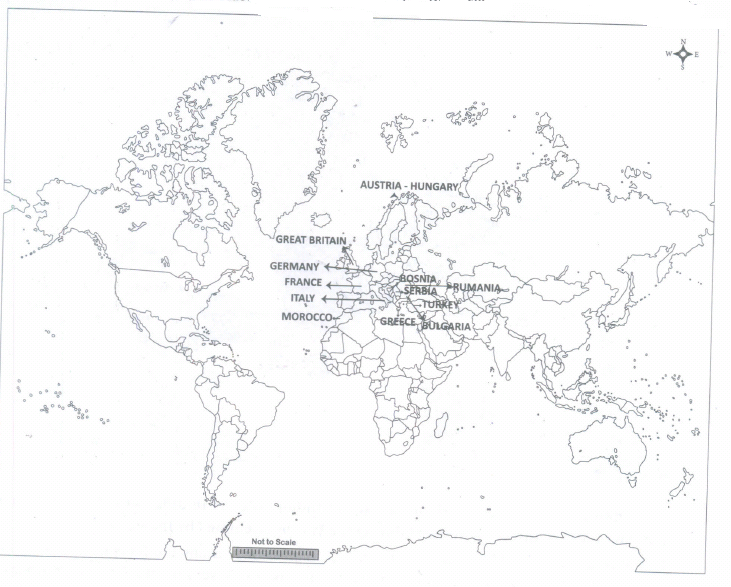
Mark the following countries on the world map.
1. Italy
2. Morocco
3. Turkey
4. Serbia
5. Bosnia
6. Greece
7. Austria-Hungary
8. Bulgaria
9. Rumania
27.
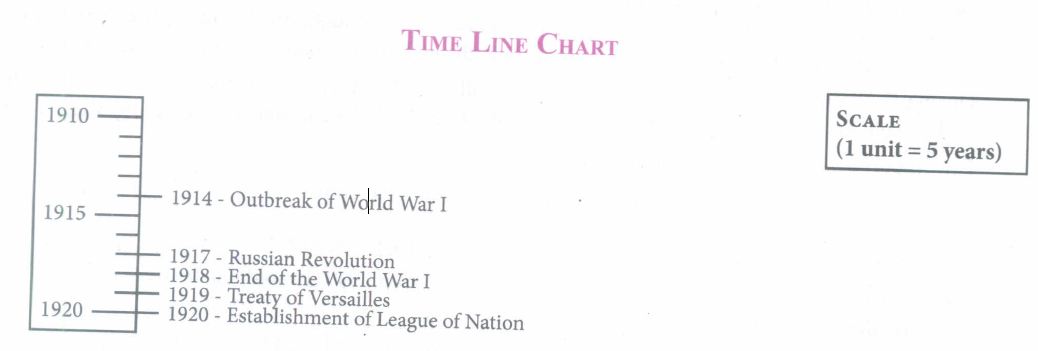
Draw Time Line Chart between 1910 - 1920
1.
(d)
Geneva
2.
(a)
65
3.
(c)
25 years
4.
(c)
Naturalisation
5.
(d)
Pavan Hans
6.
(c)
AnaiMudi
7.
(b)
1829
8.
(a)
Lenin
9.
i) A better economy introduces rapid development of the capital market.
ii) Standard of living has increased.
iii) Globalization rapidly increases better trade so that more people are employed.
iv) Introduced new technologies and new scientific research patterns
v) Globalization increases the GDP of a country.
10.
Per Capita Income (PCI) or output per person is an indicator to show the living standard of people in a country. It is obtained by dividing the national income by the population of a country
\(\text {Per capita Income } = \frac { \text { National Income }}{\text { Population }} \)
11.
a) A bill which covers income and expenditure of the government is called Money Bill.
b) Bills connected with tax policy of the government is also called Money Bill.
c) Lok Sabha can only introduce Money bill and once it is approved by the Lok Sabha, it is passed to Rajya Sabha for its approval.
12.
i) A writ is an order or command issued by a court in writing under its seal.
ii) It is in the nature of a command or prohibition from performing certain acts that are specified in the orders of the court.
iii) Both the Supreme Court and the High Courts are empowered to issue five kinds of writs.
iv) They are Habeas Corpus, Mandamus, Prohibition, Certiorari and Quo Warranto.
13.
Communication is a process that involves exchange of information, thoughts and ideas.
Communication is categorized into
(1) Personal communication and
(2) Mass communication
14.
15.
i) Ramalinga emphasised the bonds of responsibility and compassion between living beings.
ii) Ramalinga showed his compassion and mercy on all living things including plants. This he called 'Jeeva Karunya'.
iii) He established Samarasa Vedha Sanmarga Sangam.
iv) He also established a free feeding house for everyone irrespective of caste at Vadalur.
v) His songs were compiled under the title "Thiruvarutpa".
16.
The three militant forms of nationalism in Europe:
i) England's jingoism
ii) France's chauvinism
iii) Germany's Kultur.
17.
18.
Synopsis:
a) Expenditure Approach
b) The income Approach period.
c) Value added Approach
a. Expenditure Approach:
In this method GDP is measured by adding the expenditure on all the final goods and services produced in the country during a specific period.
Y= C + I + G + (X - M)
b. The income Approach:
In this method GDP is calculated from the perspective of the earnings of the men and women who are involved in producing goods and services.
Y = wages + rent + interest + profit
c. Value added Approach:-
In this method GDP is calculated by including the values of intermediate goods to estimate the value of final goods.

19.
20.
English education:
i) English education introduced with the objective of producing clerks also produced a new English educated middle class.
ii) This class came under the influence of western ideas and thoughts.
Role of Christianity:
i) Christianity also had its effect on the newly emerging middle class.
ii) The educated middle class began to take a lead in political as well as in reform movements.
Western ideas:
i) The Indian reformers were quite hesitant to subject their old notions and habits to critical scrutiny. Instead they attempted to harmonize both Indian and western cultures.
ii)Their ideas and their actions helped to mitigate social evils such as sati, female infanticide and child marriage and various superstitious beliefs.
Role of scholars and writers:
i) The scholars and writers were an inspiration for the people towards the reform movements.
ii) As the society was having a number of evil practices like sati, child marriage and polygamy there was an urgent need for reform in the society.
iii) These were the circumstances that led to the reform movement in the 19th century.
21.
The North Indian rivers originate from the snow covered mountains of Himalayas. They get water from the melting of snow from the peaks and also from monsoons.
22.
| S.No |
Internal trade |
International trade |
|---|---|---|
| 1. | The trade carried on within the domestic territory of a country is internal trade. | International trade refers to trade carried on between two or more countries. |
| 2. | It is also called as Domestic trade or Local trade. | It is also called as External trade or Foreign trade. |
| 3. | Land transport (roadways and railways) plays a major role in this trade. | Waterways and Airways plays a vital role in this type of trade. |
| 4. | Local currency is used in this trade. | Foreign currency is involved in this trade. |
23.
| S. No. |
Western Ghats |
Eastern Ghats |
|---|---|---|
| 1. | Western Ghats forms the western edge of the Deccan plateau | Eastern Ghats forms the eastern edge of the Deccan plateau. |
| 2. | It runs parallel to the Arabian sea coast. | It runs parallel to the Bay of Bengal. |
| 3. | The northern part of this range is called as Sahyadris. | It is also called as Poorvadri |
| 4. | It is a continuous range. | It is not a continuous range. |
24.
d) i, ii & iii are correct
25.
26.
27.
10th Standard Syllabus & Materials
10th Standard
TN 10th English Prose - 2 - The Night the Ghost Got in Important Questions And Answers Study Material - QB365 Set A
NEW10th Standard
TN 10th English Supplementary - 1 - The Tempest Important Questions And Answers Study Material - QB365 Set A
NEW10th Standard
TN 10th English Poem - 1 - Life Important Questions And Answers Study Material - QB365 Set A
NEW10th Standard
TN 10th English Prose - 1 - His First Flight Important Questions And Answers Study Material - QB365 Set A

Tamilnadu Stateboard 10th Standard Subjects
Tamilnadu Stateboard Standards