10th Standard Syllabus & Materials
10th Standard
TN 10th English Prose - 4 - The Attic Important Questions And Answers Study Material - QB365 Set A
NEW10th Standard
TN 10th English Supplementary - 3 - The Story of Mulan Important Questions And Answers Study Material - QB365 Set A
NEW10th Standard
TN 10th English Poem - 3 - I am Every Woman Important Questions And Answers Study Material - QB365 Set A
NEW10th Standard
TN 10th English Prose - 3 - Empowered Women Navigating The World Important Questions And Answers Study Material - QB365 Set A
NEW10th Standard
TN 10th English Supplementary - 2 - Zigzag Important Questions And Answers Study Material - QB365 Set A
NEW10th Standard
TN 10th English Poem - 2 - The Grumble Family Important Questions And Answers Study Material - QB365 Set A

Published on: 22/10/2025
Download Tamil Nadu 10th Standard Social Science question papers, model tests, one-mark questions, important questions, and public exam papers in PDF format. Free study materials and answer keys for TN State Board students.
Questions + Answers key
Take MCQ Social Science Test
1.
__________ revolution was born in India paving way for self sufficiency in food grain production.
Blue Revolution
White Revolution
Green Revolution
Grey Revolution
2.
Who can nominate one representative of the Anglo-Indian Community to the State Legislative Assembly?
The President
The Governor
The Chief Minister
The Speaker of State legislature
3.
The Anthracite coal has _____________.
80 to 90% Carbon
Above 70% Carbon
60 to 70% Carbon
Below 50% Carbon
4.
____________ is the highest gravity dam in India.
Hirakud dam
Bhakra Nangal dam
Mettur dam
Nagarjuna Sagar Dam
5.
When was the Charter of the UN signed?
June 26, 1942
June 26, 1945
January 1, 1942
January 1, 1945
6.
___________ play an important role in the supply of quality goods at responsible rates to common people.
7.
The ____________ is the body of UN in which each member state is represented.
8.
The Chairman and Members of the State Public Service Commission can be removed only by the _______.
9.
The treaty of _____________ provided for mandates in Turkish - Arab Empire.
10.
The alliance between Italy, Germany and Japan is known as_________.
11.
Explain Minimum Support Price.
12.
What are the powers and functions of the Chief Minister?
13.
Write about the distribution of cotton textile industries in India.
14.
Estimate the role of Mao Tse tung in making China a communist country.
15.
Analyse the effects of the World War II.
16.
Write some name of the nutrition programmes in Tamil Nadu.
17.
18.
What is natural gas?
19.
Define Agriculture.
20.
Write a note on Third World Countries.
21.
What are the objectives of IMF?
22.
Describe the Pearl Harbour incident.
23.
Rain water harvesting is necessary.
24.
Renewable and non-renewable resources.
25.
Alluvial soils and Black soils.
26.
Mark the following incidents 1930 - 1965
1.
(c)
Green Revolution
2.
(b)
The Governor
3.
(a)
80 to 90% Carbon
4.
(b)
Bhakra Nangal dam
5.
(b)
June 26, 1945
6.
()
Consumer Cooperatives
7.
()
General Assembly
8.
()
President
9.
()
Versailles
10.
()
Rome - Berlin - Tokyo - Axis
11.
i) Minimum support price is a price fixed by an expert group for a particular crop by considering various costs involved in the cultivation of that crop,
ii) After announcing the MSP the state will open procurement centers in places where these crops are widely grown.
iii) However, the farmers are free to sell in the open market if they get a better price for their crop produce.
iv) On the other hand if the open market price is lower than the MSP, the farmers would get an assured price (the MSP) by selling their produce to the FCI.
v) Minimum support price (MSP) for the crops were announced at the beginning of the season and the state procured the harvested grains through the Food Corporation of India (FCI).
12.
The Chief Minister is the real executive head of the state administration. He has the following powers and functions.
Relating to the Council of Ministers:
i) The Chief Minister recommends the persons who can be appointed as ministers by Governor.
ii) He allocates the portfolios among the ministers.
iii) He shuffles and reshuffles his ministry.
iv) He presides over the meetings of the Council of Ministers and influences its decisions
v) He guides, directs, controls and coordinates the activities of all the Ministers.
Relating to the Governor:
He advises the Governor in relation to the appointment of the following officials:
i) Advocate General of the State,
ii) State Election Commissioner.
iii) Chairman and Members of the State Public Service Commission
iv) Chairman and Members of the State Planning Commission.
v) Chairman and Members of the State Finance Commission
Relating to State Legislature:
i) The Chief Minister advises the Governor with regard to the summoning and proroguing the sessions of the State Legislature.
ii) He announces the government policies on the floor of the House,
iii) He can introduce the bills in the Legislative Assembly.
iv) He can recommend for the dissolution of the Legislative Assembly to the Governor any time.
13.
i) Textile is a broad term which includes cotton, jute, wool, silk and synthetic fibre textiles.
ii) This sector in India is the second largest in the world.
iii) Traditional sectors like handloom, handicrafts and small power loom units are the biggest sources of employment.
iv) Currently, India is the third largest producer of cotton and has the largest loom are and ring spindles in the world.
In India:
i) At present, cotton textile industry is the largest organised modern industry of India.
ii) The highest concentration of textile mills in and around Mumbai, makes it as 'Manchester of India'.
iii) The major cotton textile industries are concentrated in the states of Maharashtra, Gujarat, West Bengal, Uttar Pradesh and Tamil Nadu.
In Tamil Nadu:
i) Coimbatore is the most important centre in Tamil Nadu with 200 mills out of its 435 and hence called as "Manchester of South India".
ii) Erode, Tirupur, Karur, Chennai, Tirunelveli, Madurai, Thoothukudi, Salem and Virudhunagar are the other major cotton textile centres in the state.
14.
a) After the death of Sun Yat - Sen, Chiang Kai Shek became the leader of the Kuomintang,
b) The communist party was under Mao Tse -Tung and Chou En Lai.
c) The communists increased their influence among the workers and peasants and recruited them in the army
Retreat of Communists:
i) The Kuomintang represented the interests of the landlords and capitalists.
ii) Mao understood that the Kuomintang grip on the towns was very strong. A few hundred communists led by Mao retreated into the wild mountains. There they stayed for seven years.
iii) Kuomintang was unable to enter the mountains as Chiang Kai Shek had deal with a lot of problems.
Long March:
i) In 1934, the communist army of about 100,000 set out on a Long March. In 1935 only 20,000 reached northern Sheni after crossing 6,000 miles.
ii) By 1937, Mao had become the leader of over 10 million people of China.
Rise of Mao:
i) However Mao was keen on getting the support of the middle class.
ii) He declared that the communists wanted the rule of the people but not of the dictator.
iii) In 1949, the People's Republic of China emerged under the leadership of Mao Tse-tung.
15.
i) World War II began in 1939 and ended in 1945.
ii) In World War II, had an extensive area of conflict and very high death toll of civilians as well as armed combatants.
New geo-political power Alignment:
i) The world was polarized into two main blocs led by superpowers:
a) United States (Anti communist ideology)
b) Soviet Russia (Communist ideology)
ii) Europe was divided into,
a) Communist
b) Non-Communist
Nuclear Proliferation:
i) The United States and the Soviet Union entered into a race to have more nuclear powered weapons. They built a large stockpile of such weapons.
ii) Defence spending sky-rocketed in many countries.
International Agencies:
i) Many international agencies, in particular the United Nations, the World Bank and the International Monetary Fund came into existence providing a forum for countries large and small.
Social and Economic changes:
i) Social and Economic changes took place in the post-war world.
ii) Colonial powers were forced to give independence to former colonies in a process of decolonization. India was the first to achieve Independence.
16.
(i) Puratchi Thalaivar MGR Nutrition Meal Programme
(ii) Pradhan Manthri Gramodaya Yojana Scheme.
(iii) Tamil Nadu Integrated Nutrition Programme
(iv) Mid-day Meal Programme.
17.
18.
i) Natural gas is naturally occurring hydro carbon gas mixture consisting primarily of methane, but commonly includes varying amounts of other higher alkanes. Sometimes it includes at small percentage of carbon dioxide, nitrogen and hydrogen sulphides.
ii) It is formed when layers of decomposed plants and animals are exposed to intense heat and pressure over thousands of years.
19.
Agriculture is the process of producing food for people, fodder for cattle, fiber and many other desired products by the cultivation of certain plants and the raising of domesticated animals livestock.
20.
a) The capitalist countries led by the U.S. were politically designated as the First World.
b) The Communist States led by the Soviet Union came to be known as the Second world.
c) States outside these two were called Third World.
21.
i) The primary objective of IMF is to ensure financial stability and development across the world.
ii) The objectives of the IMF are "to foster global monetary cooperation, secure financial stability, facilitate international trade, promote high employment and sustainable economic growth and reduce poverty around the world".
22.
i) On December 1941, Japan attacked American naval installations in Pearl Harbour, Hawaii without any warning
ii) The idea was to cripple America's Pacific fleet so that Japan would not face any opposition
iii) Many battleships and numerous fighter planes were destroyed.
iv) The United States declared war on Japan, with Britain and China also joining in.
v) This brought together both the Asia Pacific and the European war into one common cause.
vi) Most importantly, it brought the United States with its enormous resources into the war as a part of the Allies.
23.
In India rainfall is not uniform and is highly erratic. Most of the time the rainfall is scanty. So it is necessary to save the available rainwater. In order to prevent surface run off rainwater harvesting is necessary.
24.
| S.No |
Renewable Resources |
Non-renewable Resources |
|---|---|---|
| 1. | Renewable resources are the resources that can be regenerated after their utilisation. | Non renewable resources are the resources that cannot be replaced again after utilisation. |
| 2. | The time taken to renew differs from one resource to another. | They are formed over a long geological periods.. |
| 3. | Eg: Solar energy, Wind energy. Tidal energy, Bio gas, Wave energy, etc. | Eg: Coal, Petroleum, Natural gas, etc.. |
25.
S.No. | Alluvial soils | Black soils |
|---|---|---|
1. | Alluvial soils is formed by sediments deposited by streams and rivers. | Black soil is derived from basalts of Deccan trap. |
2. | It is sandy-loam-silt-clay. | It is sticky when wet. |
3. | Its profile shows no marked differentiation. | It has high degree of moisture retentivity. |
4. | Rich in Potash, Phosphoric acid, lime and Carbon compounds. | Rich in Potash lime, Aluminium, Calcium and Magnesium. |
5. | Crops like Rice, Wheat, Sugarcane and Oilseeds grow here. | Crops like Cotton, Millets, Tobacco and Sugarcane grow here. |
26.
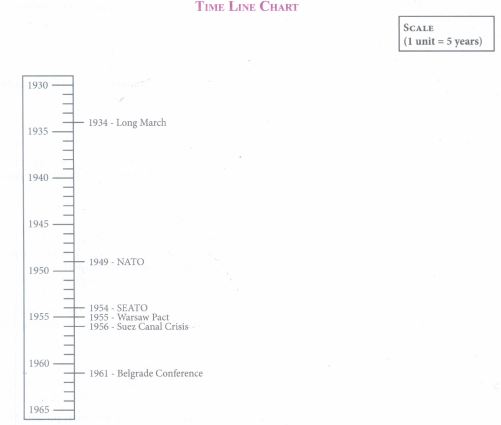
1. 1934 - Long March
2. 1949 - NATO
3. 1954 - SEATO
4. 1955 - Warsaw Pact
5. 1956 - Suez Canal Crisis
6. 1961 - Belgrade Conference

10th Standard Syllabus & Materials
10th Standard
TN 10th English Prose - 2 - The Night the Ghost Got in Important Questions And Answers Study Material - QB365 Set A
NEW10th Standard
TN 10th English Supplementary - 1 - The Tempest Important Questions And Answers Study Material - QB365 Set A
NEW10th Standard
TN 10th English Poem - 1 - Life Important Questions And Answers Study Material - QB365 Set A
NEW10th Standard
TN 10th English Prose - 1 - His First Flight Important Questions And Answers Study Material - QB365 Set A



Tamilnadu Stateboard 10th Standard Subjects
Tamilnadu Stateboard Standards