
 100% FREE ACCESS
10th Standard CBSE Syllabus & Materials
10th Standard CBSE
CBSE 10th Social Science ECO - Globalisation and the Indian Economy - New Model Questions Papers Study Material - QB365 Set A
NEW10th Standard CBSE
CBSE 10th Social Science ECO - Money and Credit - New Model Questions Papers Study Material - QB365 Set A
NEW10th Standard CBSE
CBSE 10th Social Science ECO - Sectors of the Indian Economy - New Model Questions Papers Study Material - QB365 Set A
NEW10th Standard CBSE
CBSE 10th Social Science ECO - Development - New Model Questions Papers Study Material - QB365 Set A
NEW10th Standard CBSE
CBSE 10th Social Science PS - Outcomes of Democracy - New Model Questions Papers Study Material - QB365 Set A
NEW10th Standard CBSE
CBSE 10th Social Science PS - Gender, Religion and Caste - New Model Questions Papers Study Material - QB365 Set A

Published on: 22/10/2025
Download CBSE Class 10th Standard CBSE Social Science question papers, sample papers, important questions, and previous year solved papers in PDF format. Get free study materials, NCERT solutions, and exam preparation resources for Class 10th Standard CBSE Social Science
Questions + Answers key
Take MCQ Social Science Test
1.
Write a note on:
(a) Giuseppe Mazzini.
(b) Count Camillo de Cavour
(c) the Greek war of independence.
(d) Frankfurt parliament
(e) the role of women in nationalist struggles.
2.
Name the refineries in the following states:
Uttar Pradesh
Bihar
Haryana
3.
Examine the role of women in the Civil Disobedience Movement.
4.
What do you mean by Ho Chi Minh Trail? Examine its importance.
5.
Account for the absence of minerals in the Northern plains.
6.
What are rural roads? Under which scheme every village is linked to a major town?
7.
Mention any two factors that have contributed to a healthy growth of the automobile industry in India? Name two centres where this industry is located.
8.
What were the objectives of the National Jute Policy formulated in 2005?
9.
Differentiate between conventional and non-conventional source of energy with example
10.
Mention any three measures adopted by the French revolutionaries to create a sense of collective identity among the French people.
11.
The French were driven by the idea of a "civilising mission". Explain.
12.
What challenge does the Jute industry face in India?
Poor labour turnover
Low productivity of labour
Poor market price
Competition from synthetic substitutes
13.
Which one of the following fuels is considered as environment-friendly?
Natural gas
Petroleum
Coal
Firewood
14.
Who was Sir Mohammad Iqbal?
Congress President
President of the Muslim League, 1930
Gandhiji's devout disciple
None of these
15.
Which act as a bulk carrier within India?
Airways
Roadways
Railways
Waterways
16.
In Germany the measuring unit "Elle" was used to measure
height
Thread
Cloth
Land
17.
In 1911, the monarchy in china was overthrown by
Ho Chi Minh
Sun Yat-sen
Bao Dai
Ngo Dinh Diem
18.
Why did the nationalists in India tour villages?
19.
Which city is known as the electric capital of India?
20.
Which are the primary road systems?
21.
How did Karol Kurpinski celebrate the national struggle?
22.
Mention the features of the Gudem Hills rebellion? What methods were adopted by the tribals to gain swaraj?
23.
Mention tree main problems faced by the textile industry. What is the contribution of the textile industry to Indian economy?
24.
What are the advantages of waterways as a means of transport?
25.
Explain any four merits of pipeline transport in India.
26.
How could Non-cooperation Movement become a movement? Explain with examples.
27.
Explain the pro-active approach by the National Thermal Power Corporation (NTPC) for preserving the natural environment and resources.
28.
Name any three major iron ore belts found in India. Write main features of each.
29.
Describe the process of unification of Germany.
30.
Locate and label the following items with appropriate symbols on the same map:
(a) Chauri-Chaura-The place of calling off the Non-Cooperation Movement (N.C.M.)
(b) Amritsar-The place where Jallianwalla Bagh incident took place.
31.
Two features - A and B are marked in the given political outline map of India. Identify these features with the help of the following information and write their correct names on the lines marked in the map:
(a) The place where Indian national Congress Session was held in September 1920.
(b) The place where the Peasant Satyagraha was help in Gujarat.
32.
Study the given outline map of India showing major Software Technology Parks in India.
33.
Observe and study the following map showing iron ore belts. Write the names of iron mines and where are they located?
34.
What were the developmental projects undertaken by France in Vietnam?
35.
What were the two different visions in opposing foreign domination in Vietnam? Discuss.
1.
(a) Giuseppe Mazzini was an Italian revolutionary, who was born in Genoa in 1807. He was a member of the secret society of the Carbonari. In 1831, at the age of 24, he was sent to exile for attempting a revolution in Liguria. He founded underground societies named 'Young Italy' in Marseilles and 'Young Europe' in Berne, whose members were like-minded young men from Poland, France, Italy and the German States. He believed that God had intended nations to be the natural units of mankind. He opposed monarchy and supported the vision of democratic republic.
(b) Cavour was the Chief Minister of Sardinia-Piedmont state, who led the movement to unify the regions of Italy. He was neither a revolutionary nor a democrat. Like many other wealthy and educated members of the Italian elite, he spoke French much better than he did Italian. He engineered a careful diplomatic alliance with France, which helped Sardinia-Piedmont to defeat the Austrian forces in 1859, and thereby free the northern part of Italy from the Austrian Habsburgs.
(c) The Greek war of independence was a successful war of independence waged by Greek revolutionaries from 1821 against the Ottoman Empire. The Greeks were supported by the West European countries, while poets and artists hailed Greece as the cradle of European civilisation. Finally, the Treaty of Constantinople of 1832 recognised Greece as an independent nation.
(d) Frankfurt parliament was an all-German National Assembly formed by the middle-class professionals, businessmen and prosperous artisans belonging to the different German regions. It was convened on l8 May 1848 in the Church of St Paul, in the city of Frankfurt. This assembly drafted a constitution for a German nation to be headed by a monarchy subject to a parliament. However, it faced opposition from the aristocracy and military. Also, as it was dominated by the middle classes, it lost its mass support base. In the end, it was forced to disband.
(e) The Role of Women in nationalist struggles a large number of women had participated in the liberal and national movements in European countries. Women formed their own political associations, founded newspapers and took part in political meetings and demonstrations. However, they were still denied the suffrage rights or right to vote and could not enter the Frankfurt Parliament (1848) as representatives but attended only as observers.
2.
Mathura - Uttar Pradesh
Barauni - Bihar
Panipat - Haryana
3.
There was a large scale participation of women in the Civil Disobedience Movement.
(a) During the Salt March, thousands of women came out of their homes to listen to Gandhiji.
(b) They took active part in protest marches, produced salt, picketed foreign cloth and liquor shops/ Many of them even went to jail.
(c) In urban and the rural areas, women from rich and upper castes were more closely associated with the movement.
4.
Ho Chi Minh Trail was a network of roads and footpaths. Most of the trail was in Laos and Cambodia.
(a) The trail was used by the Vietnamese in their war against the US forces.
(b) It was used to transport goods and people from North Vietnam to South Vietnam.
(c) It led to the quick movement of forces from one war front to the other and maintained quick supply of food, arms and ammunition to the soldiers.
5.
The Northern plains consists mainly of fertile silt and the geological structure does not allow for the formation of minerals
6.
Roads which link rural areas and villages with towns are classified as rural roads. Under the Pradhan Mantri Grameen Sadak Yojana scheme special provisions are made so that every village in the country is linked to a major town in the country by an all season motorable road.
7.
Two factors contributing to healthy growth of the automobile sector are
(i) Liberalisation is one of the major factors which provided boost in the growth of the automobile industry in India. With the introduction of new and contemporary models of automobiles in the country, the demand for these vehicles increased at a faster pace.
(ii) With the introduction of new technology in this sector, Indian industries are now capable to compete with the global technologies. this could happen by Foreign Direct Investment (FDI).
Two major centres where this industry is located are Gurugram and Indore.
8.
(i) Increasing jute productivity,
(ii) Improving its quality,
(iii) Ensuring good prices for crops to the jute farmers.
(iv) Enhancing the yield per hectare of jute crops.
9.
| S.No | Conventional Source of Energy | Non-conventional Source of Energy |
| 1. | Used since ages. | New technology |
| 2. | They are exhaustible except hydel power. | They inexhaustible. |
| 3. | They create pollution. | They are pollution-free and eco-friendly. |
| 4. | It is expensive. | It is a cheaper source |
| 5. | Limited availability except water | Abundant availability. |
| 6. | Non-dependable source of energy. | Future energy resources |
10.
(a) The idea of a fatherland among the citizens laid stress on the enjoying equal rights under a constitution.
(b) Choosing a new French flag, the tricolour replacing the former royal standard.
(c) The Estate General was elected by the active citizens.
(d) The Estate General was renamed as National Assembly.
(e) New hymns were composed, oaths takes in the name of the nation.
(f) A centralized administrative system was set up to produce uniform laws for all the citizens within its territory.
(g) Internal customs and duties were abolished.
(h) New system of weight and measures were adopted.
(i) Regional dialects were discouraged.
(j) French was spoken and written in Paris.
(k) French became the common language of the nation.
11.
(i) Like the British in India, the French claimed that they were bringing modern civilisation to the Vietnamese.
(ii) The French felt that it was their duty to introduce the modern ideas to the colony. Education was seen as one way to civilise the 'native'.
(ii) The French needed an educated local labour force but they feared that education might create problems. They feared to give the Vietnames full access to French education.
12.
(d)
Competition from synthetic substitutes
13.
(a)
Natural gas
14.
(b)
President of the Muslim League, 1930
15.
(c)
Railways
16.
(c)
Cloth
17.
(a)
Ho Chi Minh
18.
Nationalists in India toured to gather folk songs and legends so as to produce a true picture of traditional Indian culture to discover one's identity and restore a sense of pride in one's past.
19.
Bengaluru is known as the electronic capital of India
20.
National highways
21.
Karol Kurpinski celebrated the national struggle through his operas and music, turning folk dances like the Polonaise and Mazurka into nationalist symbols.
22.
The following were the features of the Gudem Hills rebellion.
(a) It was a guerrilla militant movement initiated by Alluri Sitaram Raju against the colonial misrule.
(b) This rebellion was against preventing the forest people entering the forests for grazing cattle, collecting fuel wood and fruits. It denied them their traditional rights over the forests and affected their livelihoods.
(c) The tribal people were also forced to do begar for road building which enraged the forest people.
The tribal people took the following steps to gain swaraj.
(a) Alluri Sitaram Raju inspired by Gandhiji and his Non-Cooperation Movement persuaded people to adopt khadi and give up drinking habits. But at the same time he asserted that India could only be liberated by the use of force.
(b) The Gudem rebels attacked police stations and attempted to kill British officials. They carried on their guerilla warfare and inflict losses on the British.
23.
The following are the three major problems faced by the cotton textile industries in India:
(a) Erratic power supply.
(b) Old and obsolete machinery.
(c) Stiff competition from the synthetic fibre industry.
The textile industry occupies a unique position in the Indian economy.
(a) It contributes significantly to the industrial production as 14 per cent of the total production of industries, comes from textiles.
(b) It provides direct employment to about 35 million people.
(c) It contributes considerable foreign exchange to the GDP.
24.
(a) Waterways are the cheapest mode of transport.
(b) Neither construction cost, nor maintenance cost is required for the waterways as they use the rivers, lakes, seas and oceans as highways.
(c) They are suited for the transport of bulky and heavy raw materials.
(d) Waterways are a fuel efficient and environment friendly mode of transportation.
(e) The boats and steamers, even if mechanised, consume much lesser fuel and do not pollute the surrounding.
25.
(i) They are used for transporting crude oil, petroleum products and natural gas from oil fields and natural gas field to refineries, fertilizer factories and big thermal power plants.
(ii) Solids can also be transported through a pipeline when converted into slurry.
(iii) Because of pipelines, refineries at Barauni, Mathura, Panipat and gas based fertilizer Plants, could be located in the interiors of India.
(iv) Initial cost of laying pipelines is high but subsequent running costs are minimal.
(v) Pipelines rules out trans-shipment (during transportation) losses or delays.
26.
Mahatma Gandhi felt that British rule was established in India with the cooperation of the Indian people. If the Indians would refuse to cooperate, British rule would collapse.
(i) According to Gandhiji, non-cooperation could become a movement by unfolding in stages.
(ii) It would begin with the surrender of titles that the government awarded and a boycott of civil services, army, police, courts and legislative councils, schools and foreign goods. Then if the Government used repression, a full civil disobedience campaign would be launched.
(iii) Throughout 1920, Gandhiji and Shaukat Ali toured extensively mobilising popular support for the movement.
(iv) In the cities, the movement started with middle class participation. Thousands of students left government controlled schools and colleges. Headmasters and teachers resigned and lawyers gave up their legal practices.
(v) The Council election were boycotted, foreign goods and foreign cloth was boycotted. Traders and merchants also refused to trade in foreign goods.
27.
NTPC stands for National Thermal Power Corporation. NTPC has adopted a pro-active approach to preserve the natural environment and resources around the thermal power plants it sets-up.
To ensure minimum pollution of the environment near these plants, the measures it adopts while setting-up these plants are
1. Using the latest techniques and upgrading existing equipment to minimise generation of polluting by-products.
2. Maximising the utilisation of ash generated so that the waste generated is reduced.
3. Establishing green belts and forests to maintain an ecological balance around the power plants being set-up.
4. Setting-up ash pond management, ash water recycling and liquid waste management systems in the plants to reduce environmental pollution.
5. Monitoring, reviewing and managing the databases online for all the power plants set-up.
28.
(a) Odisha- Jharkhand Belt:
Badampahar mines in the Mayurbhanj and Kendujhar districts of Orissa have high grade hematite ore. Additionally, hematite iron ore is mined in Gua and Noamundi in Singhbhum district of Jharkhand.
(b) Durg- Bastar-ChandrapurBelt:
This belt lies in Chhattisgarh and Maharashtra. The Bailadila range of hills in the Bastar district of Chhattisgarh has very high grade hematite ore. This hilly range as 14 deposits of super high grade hematite ore. Iron from these mines is exported to Japan and South Korea via Vishakapatnam port.
(c) Bellary-Chitradurga-Chikmaglur- Tumkur Belt:
This belt lies in Karnataka. The Kudremukh mines located in the Western Ghats are a 100 percent export unit. The ore from these mines is transported as slurry through a pipeline to a port near Mangalore.
(d) Maharashtra-Goa Belt:
This belt includes the state of Goa and Ratnagiri district of Maharashtra. The ores in these mines are not of very high quality. They' are exported through Marmagao port.
29.
The German people did not exist as a united nation. Men and women of middle classes combined their demands for constitution with national unification. In 1848, the popular effort was failure to succeed in forming constitution (Frankfurt Parliament) in Germany due to the combined forces of the monarchy and the military, supported by the large landowners (Junkers) of Prussia. Prussia took on the leadership of the movement for national unification with its chief minister as Otto Von Bismarck. He reached his goal with the help of Prussian army and bureaucracy. The process of unification was ended with three wars over 7 years with Austria, Denmark and France. In Jan 1871, an assembly consisting of the princes of German states, representatives of the army, important Prussian ministers including Otto von Bismarck gathered in the Hall of Mirrors in the Palace of Versailles to proclaim the new German head as Kaiser William I of Prussia. The new state placed a strong prominence on modernizing the currency, banking, legal and judicial systems in Germany. Prussian measures and practices became a model for the rest of Germany.
30.
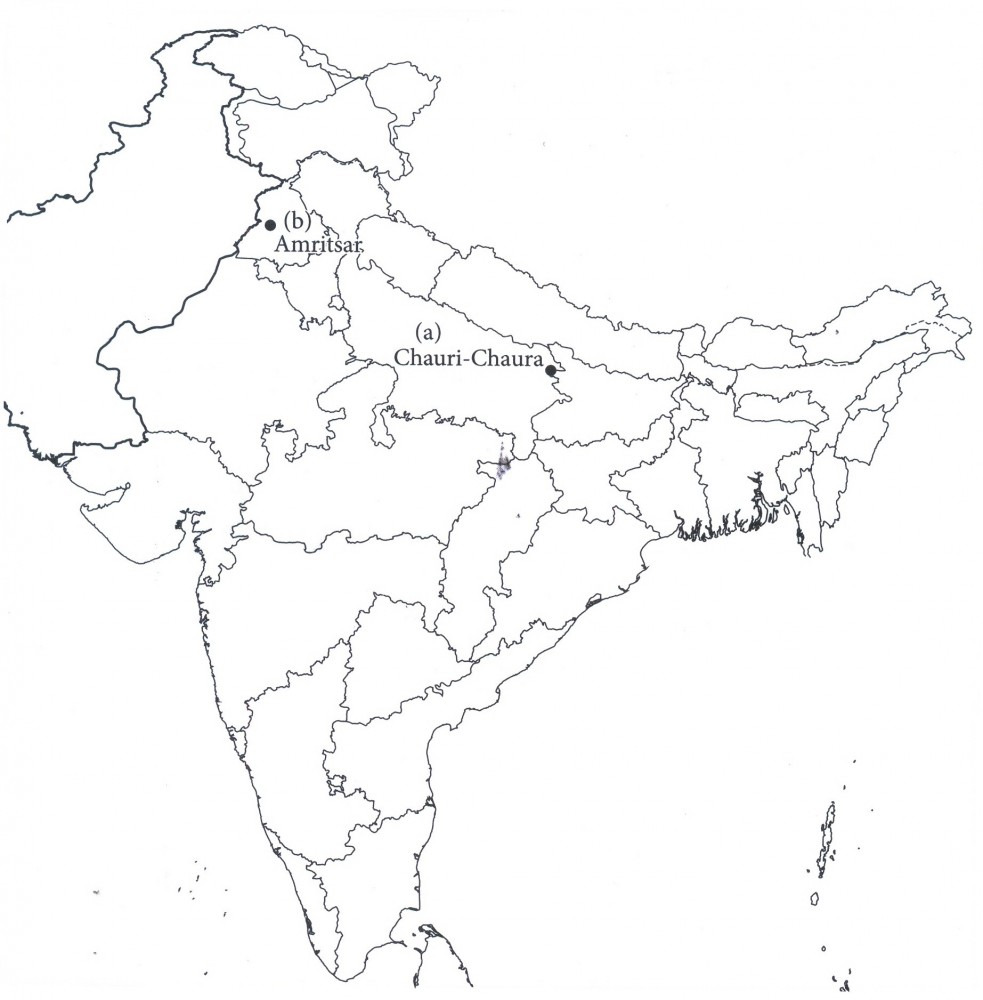
31.
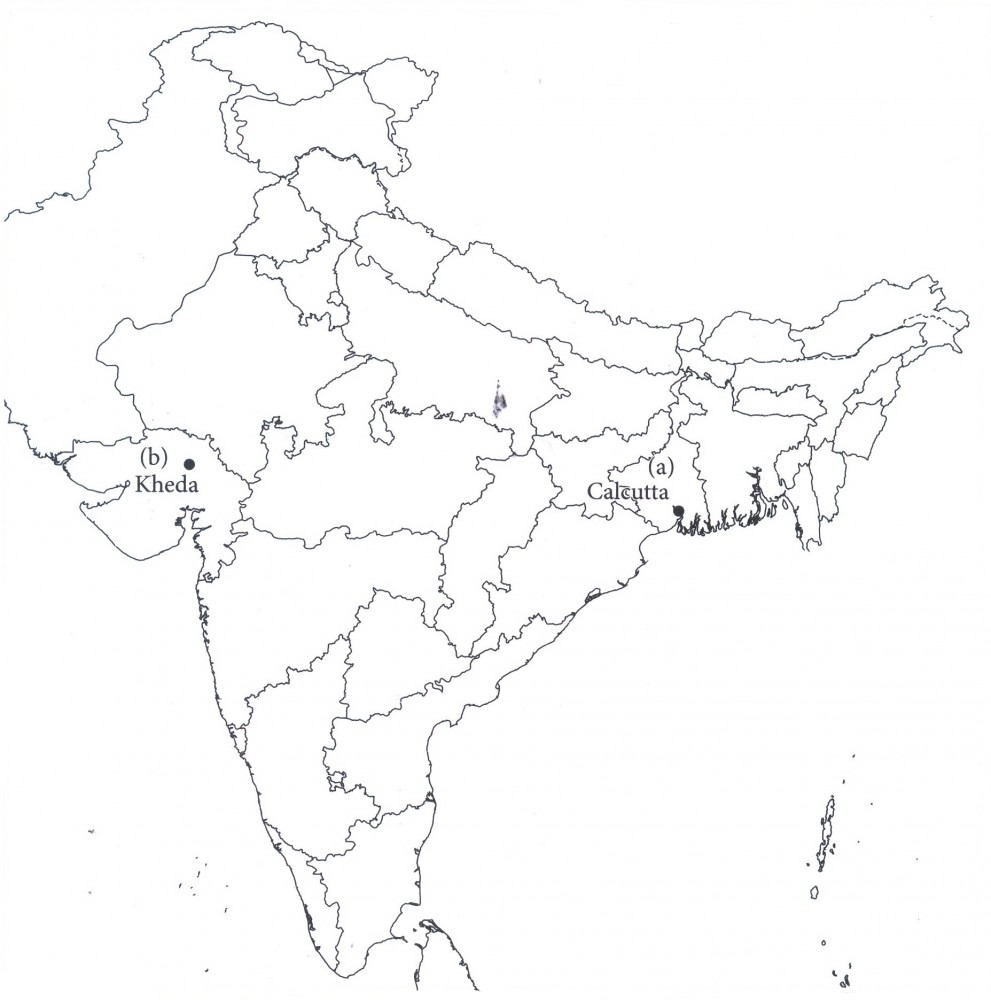
32.
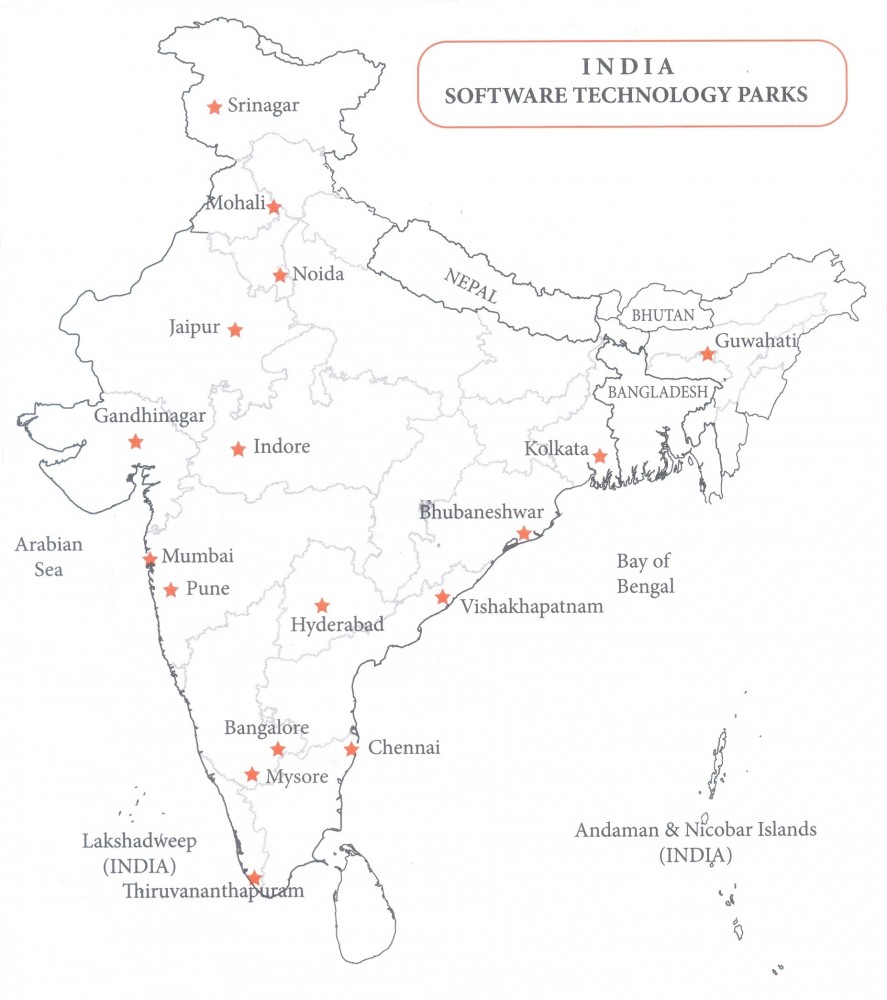
33.
(i) Gua : Jharkhand
(ii) Mayurbhanj, Kendujhar: Odisha
(iii) Durg, Bailadila: Chhattisgarh
(iv) Ratnagiri, Chandrapur: Maharashtra
(v) Goa: Goa
(vi) Tumkur, Bellary, Chitradurga, Chikmanglur, Kudremukh: Karnataka
34.
The following were the developmental projects undertaken by the French in Vietnam.
(a) The French built irrigation canals. They drained the Mekong delta and encouraged rice cultivation.
(b) Roads and railways lines were laid for easy movement of goods and garrison. For example: trans-Indo-China railway route.
(c) The French introduced rubber plantation in Vietnam.
(d) Land reform measures were undertaken to increase production.
(e) Modern education based on french ideology was introduced.
35.
The following were the two different visions in opposing foreign domination in Vietnam.
(a) Some intellectuals felt that the Vietnamese traditions had to be strengthened to resist the domination of the west. (b) While the others felt that Vietnam had to learn from the west even while opposing foreign domination.
The differing vision led to complex debates. In late 19th century resistance to French domination was very often led by Confucian scholars and revolutionists like Phan Boi Chan who formed the Revolutionary Society. Other nationalists strongly differed with him. For example Phan Chu Trinh was intensely hostile to the monarchy and was opposed to the idea of resisting the French with the help of the court. His desire was to establish a democratic republic. He was influenced by western democratic ideals

10th Standard CBSE Syllabus & Materials
10th Standard CBSE
CBSE 10th Social Science PS - Federalism - New Model Questions Papers Study Material - QB365 Set A
NEW10th Standard CBSE
CBSE 10th Social Science PS - Power Sharing - New Model Questions Papers Study Material - QB365 Set A
NEW10th Standard CBSE
CBSE 10th Social Science GEO - Manufacturing Industries - New Model Questions Papers Study Material - QB365 Set A
NEW10th Standard CBSE
CBSE 10th Social Science GEO - Minerals and Energy Resources - New Model Questions Papers Study Material - QB365 Set A



NCERT Books

Syllabus

Exam Pattern

Sample Question Papers

Previous year Question Papers

Important Notes

MCQ Practice test

NCERT Exemplers

Case study Questions

Image Based Questions

Passage based Questions

HOT Questions

Value Based Questions

Model Questions Papers
NCERT ( Book Back ) Questions

Assertion and Reason
Important Questions And Answers

CBSE 10th Standard CBSE Subjects
CBSE Standards