
 100% FREE ACCESS
10th Standard CBSE Syllabus & Materials
10th Standard CBSE
CBSE 10th Social Science ECO - Globalisation and the Indian Economy - New Model Questions Papers Study Material - QB365 Set A
NEW10th Standard CBSE
CBSE 10th Social Science ECO - Money and Credit - New Model Questions Papers Study Material - QB365 Set A
NEW10th Standard CBSE
CBSE 10th Social Science ECO - Sectors of the Indian Economy - New Model Questions Papers Study Material - QB365 Set A
NEW10th Standard CBSE
CBSE 10th Social Science ECO - Development - New Model Questions Papers Study Material - QB365 Set A
NEW10th Standard CBSE
CBSE 10th Social Science PS - Outcomes of Democracy - New Model Questions Papers Study Material - QB365 Set A
NEW10th Standard CBSE
CBSE 10th Social Science PS - Gender, Religion and Caste - New Model Questions Papers Study Material - QB365 Set A

Published on: 20/10/2025
Download CBSE Class 10th Standard CBSE Social Science question papers, sample papers, important questions, and previous year solved papers in PDF format. Get free study materials, NCERT solutions, and exam preparation resources for Class 10th Standard CBSE Social Science
Questions + Answers key
Take MCQ Social Science Test
1.
Who was the main force behind the unification of Italy? Mention two features of the unification movement.
2.
Why did the rich peasants take part in the Civil Disobedience Movement? Give reasons.
3.
State the facts about the coal found in India with reference to the following:
(a) Name its four varieties
(b) Name the geological ages in which it is found in India
(c) Mention its two main uses
4.
"Energy saved is energy produced". Justify the statement by giving any six measures to conserve the energy resources.
5.
What are the prime factors in the location of aluminium smelting industries? Where are the main aluminium smelting plants of the country located?
6.
Mention any six factors responsible for the location of jute mills in the Hugli basin.
7.
Mention the importance of water transport.
8.
Describe the changing nature of the international trade in the last fifteen years.
9.
What is meant by Balkan? Why did it turn into perennial sources of tension and proved the battlefield of the First World War?
10.
How did Vietnam because the third largest exporter of rice in the world?
11.
With reference to what you have read in this chapter, discuss the influence of China on Vietnam's culture and life.
12.
What type of education was provided by the Tonkin Free School?
13.
The rail gauge with a track width of 1.676m is
Broad guage
Metre guage
Narrow guage
None of these
14.
Which is the oldest oil producing state in India
Gujarat
Maharashtra
Assam
None of these
15.
What did Mahatma Gandhi in his book, Hind Swaraj, declare?
British ruled India because the latter was militarily weak
British ruled India because Indians cooperated with them
British ruled India because they got international support
None of these
16.
Largest producer of Jute and Jute made goods
Bangladesh
India
Sri Lanka
Brazil
17.
Wilhelm Wolff was a
Painter
Philosopher
Poet
Journalist
18.
Which one of the following was not the objective of Vietnamese ' Go East Movement' of 1907-08?
To acquire modern education
To drive out French from Vietnam
To strengthen emperor Bao Dai
To establish the Nguyen dynasty
19.
What was the basic philosophy of the conservatives?
20.
Which two end cities does the National Highway No 7 join?
21.
Which mineral is found in the Monazite sands?
22.
To which all categories do iron and steel industries fall?
23.
Who was Alluri Sitarama Raju?
24.
What are the factors that cause heavy damage to the railways?
25.
How did the people and colonial government react to the Civil Disobedience Movement? Explain.
26.
Name any two areas where large reserves of natural gas are found. Why is it called the fuel for the present century. Name any two popular uses of the natural gas today.
27.
Describe any four major problems faced by the road transportation in India.
28.
Explain the contributors of folklore, folk song and paintings in strengthening nationalist during the 1870's.
29.
Explain any three factors which influence industrial locations.
30.
Explain the any four factors which influence the location of an industry.
31.
Describe the process of unification of Italy.
32.
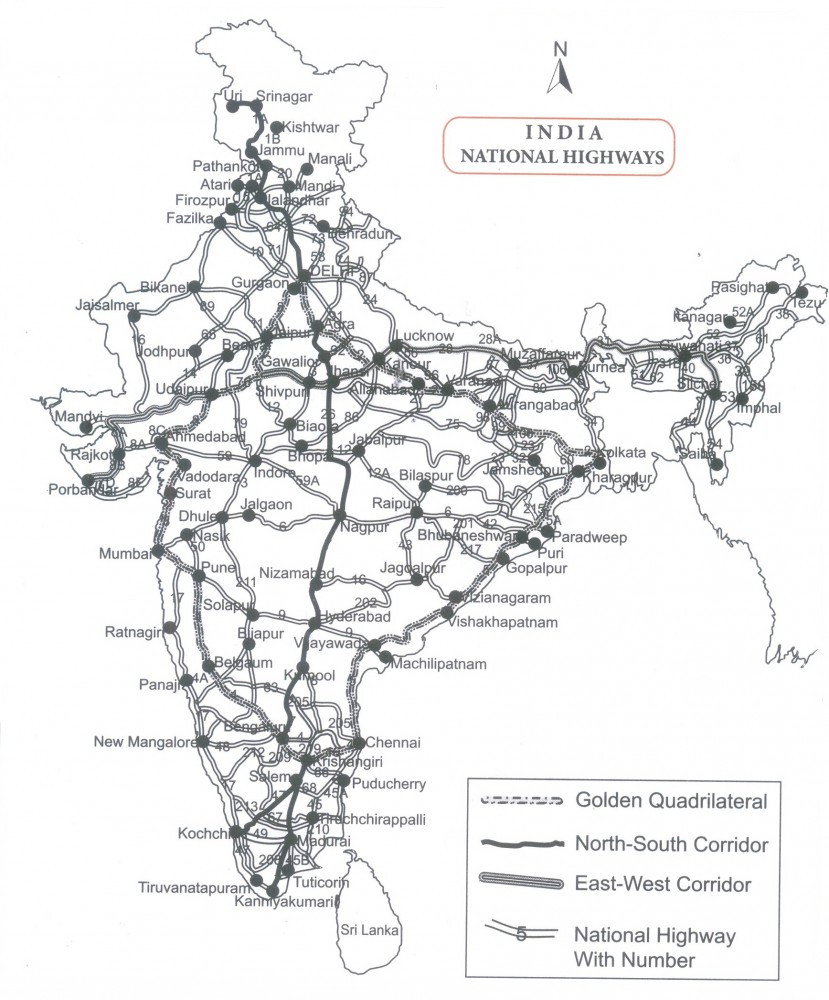
Locate and label the following on the political outline map of India:
(a) Two terminal cities of north-south corridor
(b) terminal station of east - west corridor.
33.
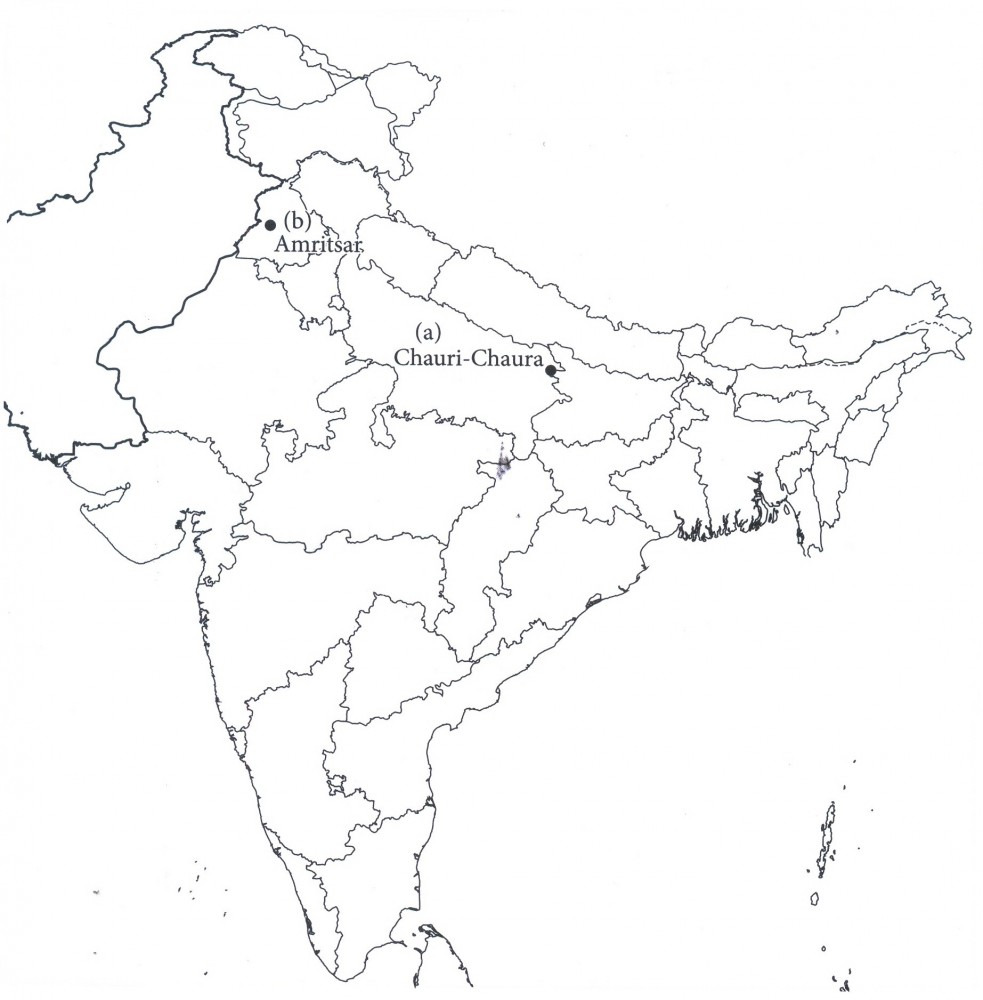
Locate and label the following items with appropriate symbols on the same map:
(a) Chauri-Chaura-The place of calling off the Non-Cooperation Movement (N.C.M.)
(b) Amritsar-The place where Jallianwalla Bagh incident took place.
34.
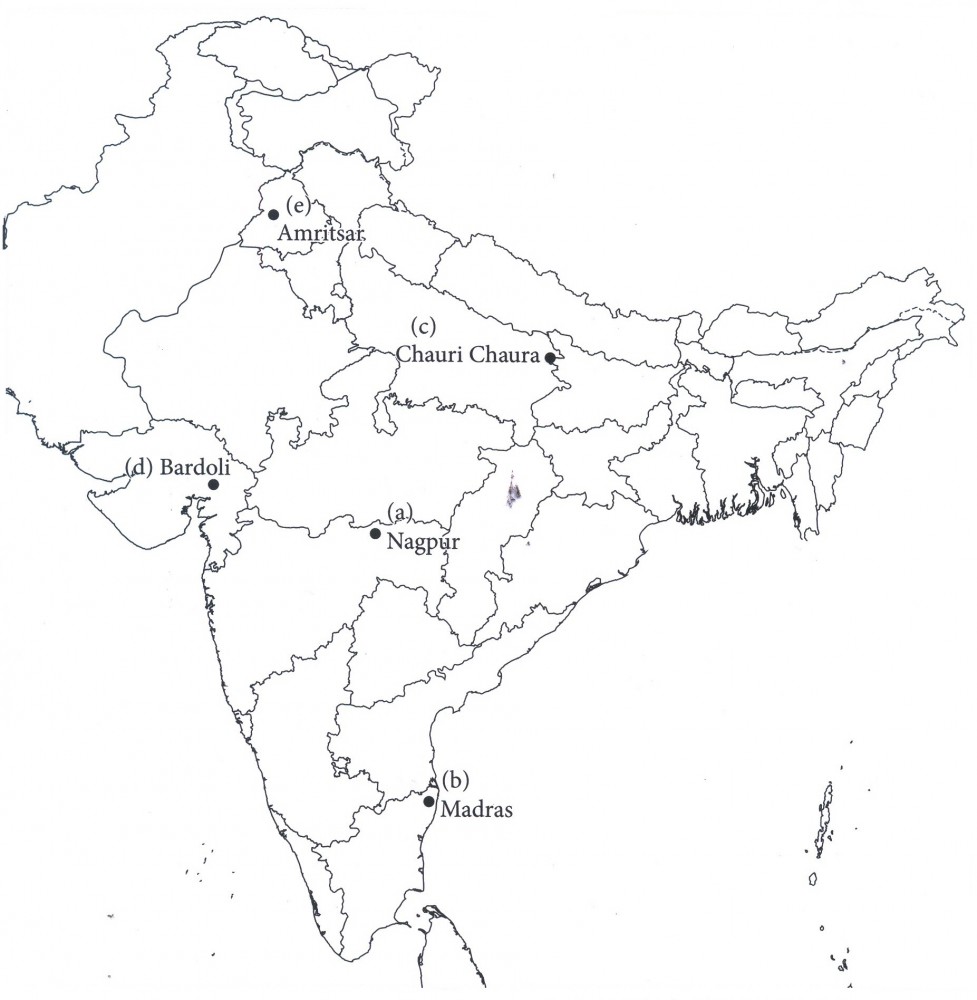
Five features with serial nos. (i) to (v) are marked in the given outline political map of India. Identify these features with the help of the following information and write their correct names on the lines marked in the map:
(a) A place where Indian National Congress Session was held in Dec. 1920.
(b) A place where Indian National Congress Session was held in 1927.
(c) A place where violence occurred due to which Mahatma Gandhi suddenly called off the Non-cooperation Movement.
(d) A place of peasants' Satyagraha in Gujarat.
(e) A place associated with Jallianwalla Bagh massacre.
35.
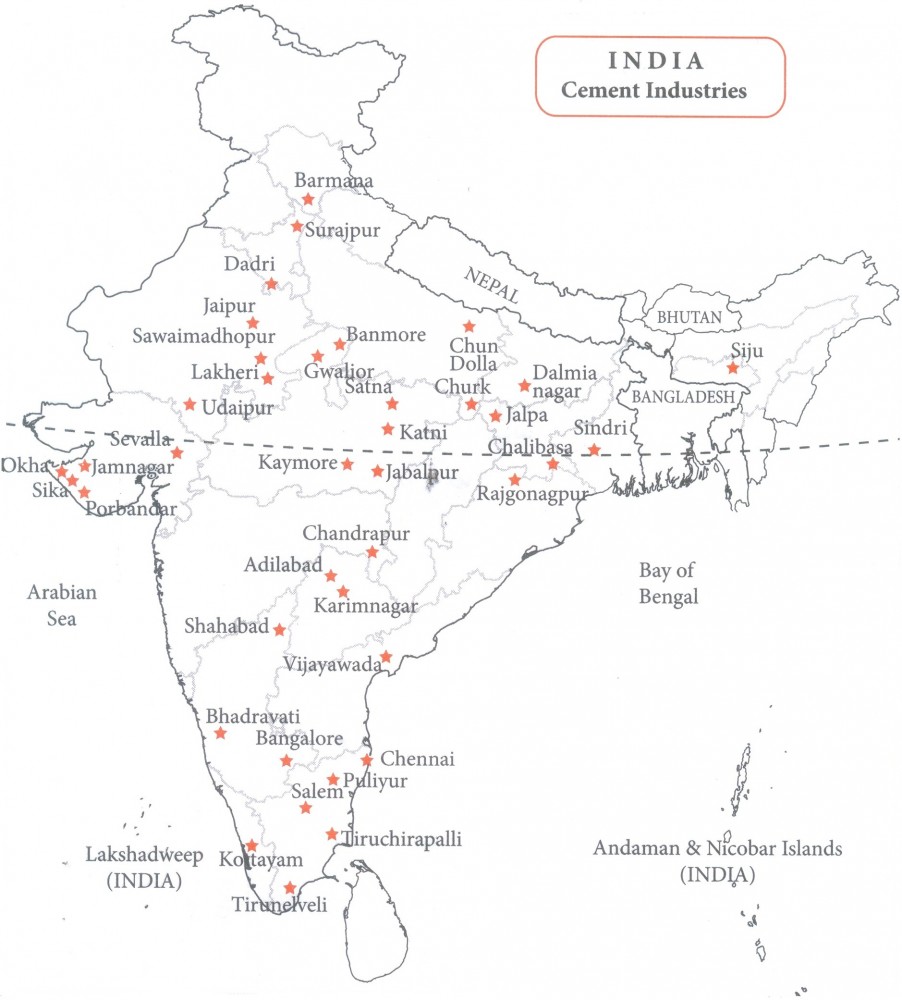
Study the given outline map of India showing the Cement Industries in India.
36.
Observe and study the following map showing iron ore belts. Write the names of iron mines and where are they located?
37.
Explain any five objectives of Vietnamese students who had gone to Japan for higher education during 1907-08.
38.
Explain any five points, how school textbooks in Vietnam glorified the French and justified colonial rule.
1.
Count Cavour, the Italian Chief Minister, was the main force behind the unification of Italy. Following were the features of the unification movement in Italy:
(a) Despite hurdles in the movement fo unification of Italy, liberty, equality and patriotism remained the ideals of the Italians which could not be suppressed.
(b) The unification movement saw the combined efforts of people from all walks of life. There was educated middle class that included professors, teachers, clerks and traders who carried out the movement.
2.
The rich peasants too-like the patidars of Gujarat and the Jats of Uttar Pradesh- had their own views about Swaraj. They joined the movement because of the following reasons.
(a) The rich peasants who produced commercial crops were hard hit by the trade depression and falling prices which decreases their cash income and in turn they could not pay the government's revenue.
(b) The government, on the other hand, was reluctant to reduce the revenue demand.
(c) This led to widespread resentment among the peasants and they began to support the Civil Disobedience Movement, believing they would be saved from this situation.
3.
The varieties of coal found in India are Peat, Lignite, Bituminous and Anthracite. The geological ages in which these were found in India are the Gondwana, some 200 million years and the Tertiary deposits only about 55 million years old. It is used for power generation and to supply energy to industries as well as for domestic needs.
4.
Energy saved is energy produced. Energy needs of the country are tremendously increasing with the growth of economy. It is therefore necessary to conserve energy resources. It can be justified in the following ways.
(a) Use public transport systems instead of individual vehicles to reduce loss of energy.
(b) Switching off electricity when it is not is use.
(c) Using power saving devices
(d) Stress on the use of non-conventional sources of energy
(e) Minimum use of high power consuming electrical gadgets like air conditioners, room heaters, etc.,
5.
Following are the prime factors for the location of aluminium smelting industries.
(a) Assured source of raw material, bauxite, at minimum cost, as it is a bulky material.
(b) Regular and quantitative supply of power.
Odisha produces about 45 per cent of the Indian's bauxite. Hence, aluminium smelting plants are located in Odisha. Also, the Hirakud Dam provides cheap hydroelectricity for the development of the aluminium industry in the state.
West bengal, Kerala, Uttar Pradesh, Chhattisgarh, Maharashtra, and Tamil Nadu are other states where aluminium smelting plants are located. INDAL, HINDALCO, MALCO, NALCO and Aluminium Corporation of India are names of the major smelting plants.
6.
Following are the factors that are responsible for the location of jute mills in the Hugli basin.
(a) Proximity of the jute producing areas.
(b) Cheap water transport facilities.
(c) Good network of railways, roadways and waterways to facilitate movement of raw materials to the mills.
(d) Abundant water for processing raw jute.
(e) Cheap labour from West Bengal, Bihar, Odisha and Uttar Pradesh.
(f) Bank, insurance and port facilities for the export of jute goods.
7.
(i) Waterways are the cheapest means of transport.
(ii) They are most suitable for carrying heavy and bulky goods.
(iii) It is a fuel-efficient and environment friendly mode of transport.
8.
International trade has undergone a sea change in the fifteen years. Exchange of commodities and goods have been superseded by the exchange of information and knowledge. India has emerged as a software giant at the international level and is earning large foreign exchange through the export of information technology.
9.
The Balkans was a region of geographical and ethnic variation. It includes Romania, Bulgaria, Albania, Greece, Macedonia, Bosnia, Croatia, Herzegovina, Slovenia, Serbia and Montenegro. The people of this region were called Slavs. A large part of the Balkans was under the control of Ottoman Empire. In 19th century it was collapsed. there were revolts by various nationalities for independence. The imperial powers of Europe competed with one another to extend control over Balkan region because of its strategic position. Due to this there arouse an intense rivalry among the powers. the people of Balkan regions were separated from each other due to the domination of other powers. The spread of nationalist ideas among Slavs, made this region very explosive. Balkan area thus became an area of intense conflict leading to wars resulting to wars resulting in the First World War [1914].
10.
(i) The French began by building canals and draining lands in the Mekong delta to increase cultivation.
(ii) The vast system of irrigation works canals and earthworks - built mainly with forced labour, increased rice production and allowed the export of rice to the international market. By 1931 it had become the third largest exporter of rice in the world.
11.
China was a large and close neighbour of Vietnam. It was obvious that the formerr would influence the latter. The two countries shared the same religious beliefs, namely Buddhism and Confucianism. The ideas spread by Confucius, a great Chinese thinker, religious leader and philosopher had deeply influenced the social and cultural aspect of Vietnam. The influence. Even when the latter gained independence in 1945, the rulers maintained the use of Chinese governance system and culture. The elites were vastly influenced by Chinese culture and life, as has been elucidated in Phan Boi Chau's book "The History of the Loss of Vietnam". In 1911, when the Chinese lanuages and Confucianism were followed by the upper classes in Vietnam. In 1911, when the Chinese Republic we set up, Vietnamese students followed suit in organising the Association for the Restoration of Vietnam. Vietnamese men also kept their hair long-a Chinese tradition
12.
()
Western style of education.
13.
(a)
Broad guage
14.
(c)
Assam
15.
(b)
British ruled India because Indians cooperated with them
16.
(b)
India
17.
(d)
Journalist
18.
(c)
To strengthen emperor Bao Dai
19.
The basic philosophy of the conservatives was to preserve the traditional institutions such as church, monarchy, social hierarchies, property and family ect.
20.
Varanasi and Kanyakumari
21.
Thorium is found in Monazite sands
22.
Mineral based, Basic, Heavy, large scale industries.
23.
He was the leader of the movement of tribal peasants of Gudem Hills of Andhra Pradesh.
24.
The factors that cause heavy damage to the railways are as follow:
Many passengers travel without tickets.
There are thefts and the railway property is often damaged.
Pulling of chains delays and disturbs the running of trains.
Carelessness on the part of officials in maintaining the tracks causes accidents.
The train drives are overworked and underpaid.
25.
Different people reacted differently to the Civil Disobedience Movement.
(a) It began with Gandhiji breaking salt law at Dandi. People, also openly defied the colonial laws like breaking salt laws, manufacturing salt and staging demonstrations in front of government salt factories.
(b) There was large scale boycott of foreign cloth and picketing of liquor shops. Peasants refused to pay revenue and chaukidari taxes.
(c) Village officials resigned and at many places forest people violated forest laws by going into Reserve Forests to collect wood and graze cattle.
On the other hand, colonial government too reacted with ruthless and brutal suppression.
(a) Fearing the intensity of the movement and huge loss to the government property. The government arrested many eminent nationalist leaders like Gandhiji and Khan Abdul Gaffar Khan. This led to violent clashes at many places.
(b) Peaceful satyagrahis were attacked, women and children were beaten and many were arrested.
(c) The Congress was declared illegal.
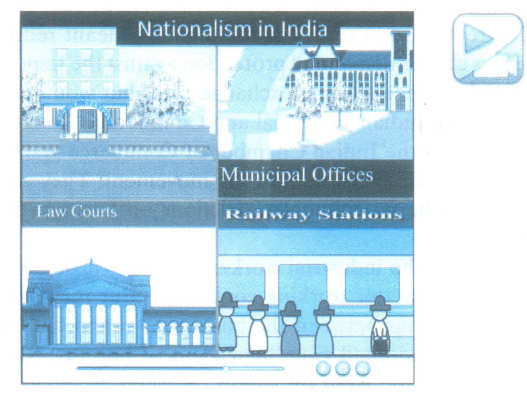
26.
The two areas where large reserves of natural gas are found are the Andaman and Nicobar Islands and the Mumbai High Region. Natural gas is called the fuel for the present century because it is pollution free and environment friendly. Besides being used as a source of power, natural gas is also used in vehicles as Compressed Natural Gas (CNG) and for purpose of cooking as Liquified Petroleum Gas (LPG).
27.
Road transportation is economical in transportation of smaller amount of goods and few passengers over short and medium distances. Though they are relatively cheap and easy to construct and maintain, road transportation in India is confronted with a number of problems.
(a) On account of its large population, India has large volumes of traffic and passengers which require a large number of vehicles. But the road network is not adequate to meet the requirement of handling heavy traffic.
(b) As most roads are kuccha or unmetalled, their usage is limited during the rainy season. The potholes on roads form muddy pools in the monsoon season and cause accidents.
(c) There are still more national highways to be built to connect the different parts of the country.
(d) The roads in the cities are highly congested and traffic jams are a constant problem. Most of the bridges and culverts are also old and narrow aggravating the problem.
(e) Roadside amenities like emergency medical facilities, telephone booths etc., are lacking. (f) Police patrolling on the highways in not adequate, so goods and passengers are not safe all the time.
28.
(i) A variety of cultural processes captured people's imagination with the fold of nationalism. History and fiction, folklore and songs, popular prints and symbols, all played a part in the making of nationalism.
(ii) Bharat Mata: The identity of India was visually associated with the image of Bharat Mata. Abanindranath Tagore painted Bharat Mata in his painting as an ascetic figure. She is calm, composed, divine and spiritual.
(iii) Folklore: Ideas of nationalism also developed through a movement to revive Indian folklore. The nationalists felt the folktales gave a true picture of traditional culture. It was essential to preserve this folk tradition in order to discover one's national identity and restore a sense of pride in one's past.
(iv) Icons and symbols: As the national movement developed, nationalist leaders became more and more aware of such icons and symbols in unifying people such as tricolour flag.
(v) Reinterpretation of history: Many Indians began feeling that to instill a sense of pride in the nation, Indian history had to be thought about differently. The British saw Indians as backward and primitive, incapable of governing themselves. Indians began looking into the past to discover India's great achievements. They wrote about the glorious developments in ancient times when art and architecture, science and mathematics, religion and culture, law and philosophy, crafts and trade had flourished. This glorious time, in their view, was followed by a history of decline, when India was colonised. These nationalist histories urged the readers to take pride in India's great achievements in the past and struggle to change the miserable conditions of life under British rule.
29.
(i) Market: Areas/regions having high purchasing power provide large market therefore such as luxury items producing industries are located in these regions.
(ii) Raw material: Raw material used by industries should be cheap and easy to transport.
(a) E.g. Industries based on cheap, bulky and weight-losing material (ores) are located close to the sources of raw material such as steel, sugar and cement industries.
(b) E.g. Industries using perishable raw material are located closer to the source of the raw material such as Agro-processing and dairy industries.
(iii) Labour Supply: Some types of manufacturing require skilled labour therefore IT industries are located near urban-educational centres where skilled labours are easily available.
(iv) Sources of energy: Industries which use more power are located close to the source of the energy supply such as the aluminium industry.
(v) Transportation and Communication Facilitis: Speedy and efficient transport facilities reduce the cost of transport. Therefore industries are attracted in regions having good transport facilities.
(vi) Government Policy: Governments adopt 'regional policies' to promote 'balanced' economic development and hence set up industries in backward and tribal areas.
(vii) Agglomeration Economies: Many industries takes benefit from nearness to a leader-industry and other industries.
30.
(i) Market: Areas/regions having high purchasing power provide large market therefore such as luxury items producing industries are located in these regions.
(ii) Raw material: Raw material used by industries should be cheap and easy to transport.
(a) E.g. Industries based on cheap, bulky and weight-losing material (ores) are located close to the sources of raw material such as steel, sugar and cement industries.
(b) E.g. Industries using perishable raw material are located closer to the source of the raw material such as Agro-processing and dairy industries.
(iii) Labour Supply: Some types of manufacturing require skilled labour therefore IT industries are located near urban-educational centres where skilled labours are easily available.
(iv) Sources of energy: Industries which use more power are located close to the source of the energy supply such as the aluminium industry.
(v) Transportation and Communication Facilities: Speedy and efficient transport facilities reduce the cost of transport. Therefore industries are attracted in regions having good transport facilities.
(vi) Government Policy: Governments adopt 'regional policies' to promote 'balanced' economic development and hence set up industries in backward and tribal areas.
(vii) Agglomeration Economies: Many industries takes benefit from nearness to a leader-industry and other industries.
31.
During the middle of the nineteenth century, Italy was divided into seven states, of which only one, Sardinia-Piedmont, was ruled by an Italian princely house. The north was ruled by Austrian Habsburgs, the centre by the Pope and the southern regions by the Bourbon kings of Spain. Italian language had varieties of dialects; therefore, it was not stable in its form. During the 1830s, Giuseppe Mazzini had sought to put together a coherent programme for a unitary Italian Republic. He had also formed a secret society called 'Young Italy' for the dissemination of his goals. The failure of revolutionary uprisings both in 1831 and 1848 fell on Sardinia-Piedmont under its ruler King Victor Emmanuel II to unify the Italian states through war. A unified Italy offered them the possibility of economic development and political dominance. Chief Minister Cavour who led the movement to unify the regions of Italy was neither a revolutionary nor a democrat. With a tactful diplomatic alliance with France by Cavour, Sardinia-Piedmont succeeded in defeating the Austrian forces in 1859. In 1859, a large number of armed volunteers under the leadership of Giuseppe Garibaldi joined the fray. In 1860, Sardinia- Piedmont's forces marched into south Italy and the Kingdom of the Two Sicilies and drove out the Spanish rulers. In 1861, Victor Emmanuel was declared as the king of united Italy and Rome was declared the capital of Italy.
32.
33.
34.
35.
36.
(i) Gua : Jharkhand
(ii) Mayurbhanj, Kendujhar: Odisha
(iii) Durg, Bailadila: Chhattisgarh
(iv) Ratnagiri, Chandrapur: Maharashtra
(v) Goa: Goa
(vi) Tumkur, Bellary, Chitradurga, Chikmanglur, Kudremukh: Karnataka
37.
Vietnamese students went to Japan with following objectives.
(a) Their primary objective was to gain support and arms to drive French from Vietnam, to remove the puppet emperor and to establish Nguyen Dynasty.
(b) Japan provided them with a confidence in modernising themselves and resisting colonisation through military capabilities.
(c) Japan inspired the Vietnamese nationalists as a modern nation which signified change. Vietnamese students were sent there to acquire modern education.
(d) Japan also provided a refuge to those who escaped French police.
(e) Japan provided a location from where a wider network of revolutionaries could be established.
38.
The French wanted to dismantle the traditional educational system of Vietnam and establish western culture. The school textbooks glorified the French and justified their rule over Vietnam in the following ways.
(a) The Vietnamese were represented as primitive and backward, capable only of manual work. They were away from intellectuals thus could work only in fields.
(b) Textbooks portrayed Vietnamese as incapable of ruling themselves and that only the French rule could ensure peace in Vietnam.
(c) The textbooks further stated that the Vietnamese were not at all creative but were rather skilled copyists.
(d) Students were taught that it was the French rule that brought out the Vietnamese peasants from the fear of pirates.
(e) Students were taught French and forced to adopt the western lifestyle like short hair.

10th Standard CBSE Syllabus & Materials
10th Standard CBSE
CBSE 10th Social Science PS - Federalism - New Model Questions Papers Study Material - QB365 Set A
NEW10th Standard CBSE
CBSE 10th Social Science PS - Power Sharing - New Model Questions Papers Study Material - QB365 Set A
NEW10th Standard CBSE
CBSE 10th Social Science GEO - Manufacturing Industries - New Model Questions Papers Study Material - QB365 Set A
NEW10th Standard CBSE
CBSE 10th Social Science GEO - Minerals and Energy Resources - New Model Questions Papers Study Material - QB365 Set A



NCERT Books

Syllabus

Exam Pattern

Sample Question Papers

Previous year Question Papers

Important Notes

MCQ Practice test

NCERT Exemplers

Case study Questions

Image Based Questions

Passage based Questions

HOT Questions

Value Based Questions

Model Questions Papers
NCERT ( Book Back ) Questions

Assertion and Reason
Important Questions And Answers

CBSE 10th Standard CBSE Subjects
CBSE Standards