100% FREE ACCESS
10th Standard CBSE Syllabus & Materials
10th Standard CBSE
CBSE 10th Social Science ECO - Globalisation and the Indian Economy - New Model Questions Papers Study Material - QB365 Set A
NEW10th Standard CBSE
CBSE 10th Social Science ECO - Money and Credit - New Model Questions Papers Study Material - QB365 Set A
NEW10th Standard CBSE
CBSE 10th Social Science ECO - Sectors of the Indian Economy - New Model Questions Papers Study Material - QB365 Set A
NEW10th Standard CBSE
CBSE 10th Social Science ECO - Development - New Model Questions Papers Study Material - QB365 Set A
NEW10th Standard CBSE
CBSE 10th Social Science PS - Outcomes of Democracy - New Model Questions Papers Study Material - QB365 Set A
NEW10th Standard CBSE
CBSE 10th Social Science PS - Gender, Religion and Caste - New Model Questions Papers Study Material - QB365 Set A

Published on: 20/10/2025
Download CBSE Class 10th Standard CBSE Social Science question papers, sample papers, important questions, and previous year solved papers in PDF format. Get free study materials, NCERT solutions, and exam preparation resources for Class 10th Standard CBSE Social Science
Questions + Answers key
Take MCQ Social Science Test
1.
Name most influential book, of Phan Boi Chau.
2.
Nationalism no longer retained its idealistic, liberal, democratic sentiments by the last quarter of the 19th century in Europe. Analyse the statement with examples.
3.
Explain the contribution made by the French in the development of agriculture in Vietnam.
4.
State the facts about the coal found in India with reference to the following:
(a) Name its four varieties
(b) Name the geological ages in which it is found in India
(c) Mention its two main uses
5.
Why did the traditional cotton textile industry of India receive a setback during the colonial period?
6.
What are super highways? Name three major highway projects.
7.
How has the world been converted into a global village? Explain.
8.
Why has 'Chotanagpur Region' maximum concentration of iron and steel industries? Explain any three reasons.
9.
What were the factors responsible for gradual slow down of the Non co-operation movement
10.
Write a newspaper report on:
(a) The Jallianwala Bagh massacre
(b) The Simon Commission
11.
Choose three examples to show the contribution of culture to the growth of nationalism in Europe.
12.
Explain the reasons for popularity of 'Go East Movement'.
13.
Mention the steps taken by the French to dismantle Chinese influence in Vietnam.
14.
How did students in Vietnam fight against the colonial government's effort to prevent Vietnamese from qualifying for 'white collar jobs'? explain
15.
Why did Metternich remark that “if France sneezes the rest of Europe catches cold”? Explain.
16.
Name the extreme locations connected by the east-west corridor.
17.
By whom was the first image of Bharat Mata painted?
18.
Name the states where aluminium plants are located.
19.
What are conventional source of energy?
20.
Which of the following statements is not true about the ferrous minerals?
Iron ore is a ferrous mineral
Ferrous minerals account for about three fourths of the total value of the production of the metallic minerals
Ferrous minerals provide a strong base for the development of metallurgical industries
India does not produce ferrous minerals in large quantities
21.
What was the 'Party of Young Annan'?
Haircutting charm
Student political party
Newspaper daily
None of these
22.
Which one of the following highways is the longest highway in India?
NH-1
NH-8
NH-7
NH-24
23.
'Swaraj' for plantation workers in Assam meant?
Political freedom
More wages
Retaining link with the villages from which they had come
None of the above
24.
Which is the electronic capital of India?
Chennai
Bengaluru
Hyderabad
New Delhi
25.
Which of the following is not true with reference to Napoleon?
He promoted democracy in France
He introduced Napoleonic Code
The Napoleonic Code was exported to all regions under French control
He made the administrative system more rational and efficient.
26.
Study the Gas Pipeline network in India.
27.
Study the railways network in India.
28.
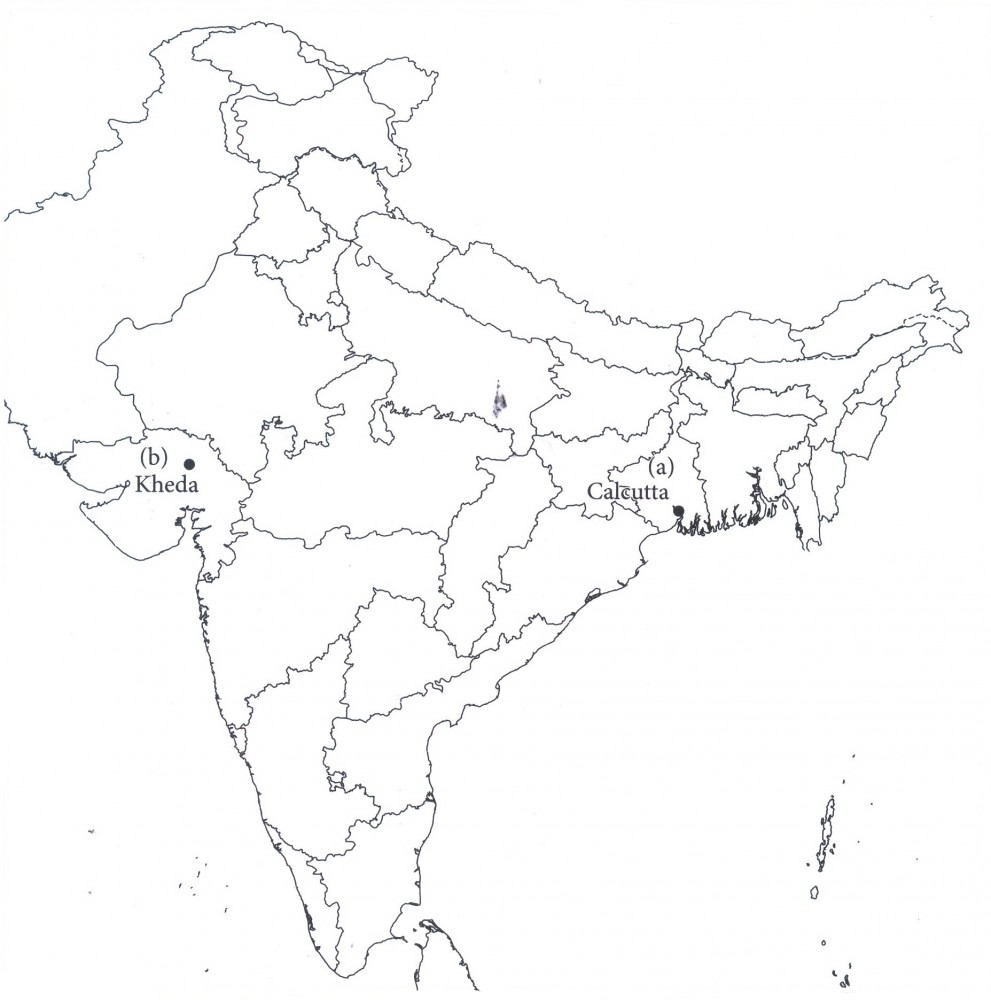
Two features - A and B are marked in the given political outline map of India. Identify these features with the help of the following information and write their correct names on the lines marked in the map:
(a) The place where Indian national Congress Session was held in September 1920.
(b) The place where the Peasant Satyagraha was help in Gujarat.
29.
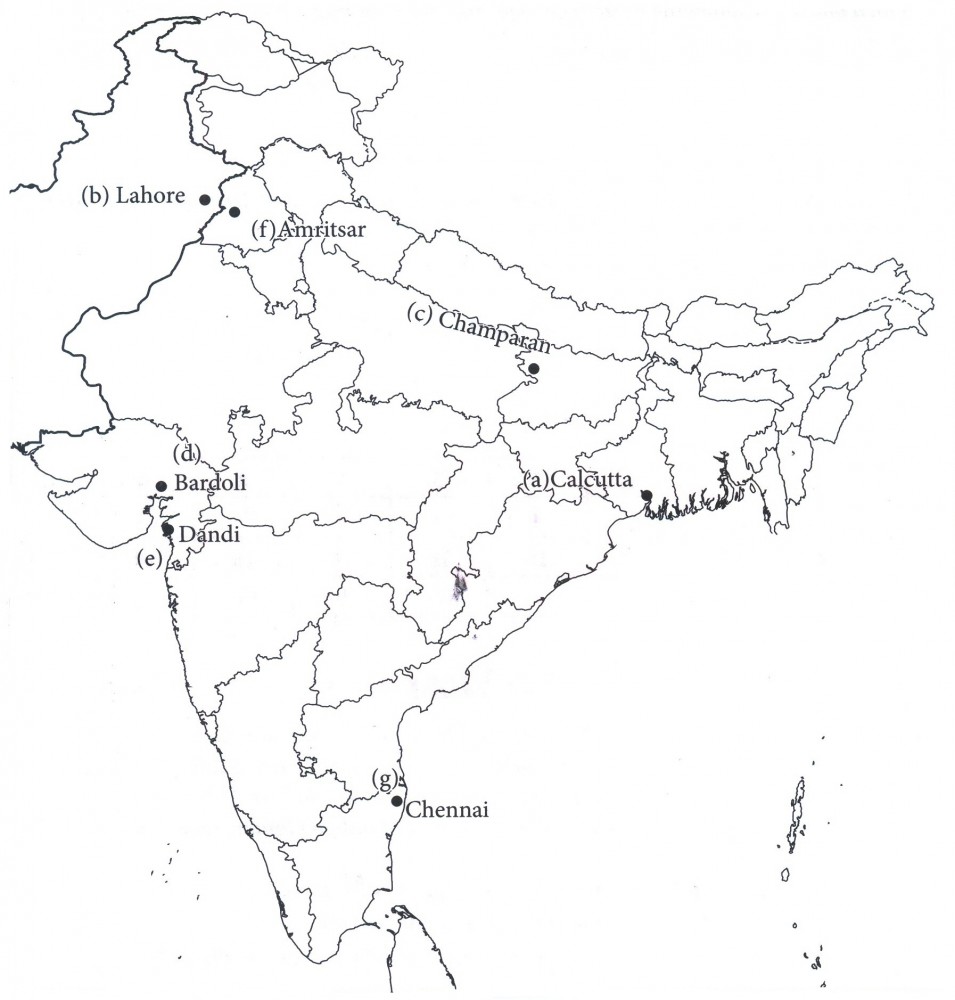
Locate and label the following on the given political outline map of India:
(a) A place where session of Indian National Congress was held in September 1920.
(b) A place where session of Indian National Congress was held in 1929.
(c) A place in Bihar where Satyagraha Movement of indigo planters took place.
(d) Baradoli, the place, from where No tax campaign was started.
(e) A place in Gujarat where Gandhiji violated the Salt law.
(f) a place in Punjab where Jalianwalla Bagh incident took place (or) Amritsar
(g) Chennai (Madras)
30.
Observe and study the following map showing distribution of minerals. Write the names of states where mica mines are located
31.
Who was the chief architect of the unification of Germany? Describe the stages in which Germany was unified.
32.
"Equality before law did not necessarily stand for universal suffrage in Europe." Discuss.
33.
Explain the features of the boycott and swadeshi Movement.
34.
Describe any five major problems faced by road transport in India.
35.
Why is conservation of minerals essential? Explain any four measures to conserve minerals.
36.
Name the two varieties of iron ore found in India having high content of iron. Mention the names of places in India which have the richest iron ore deposits.
37.
"Efficient means of transport and communication has converted the world into a large village". Explain this statement with the help of examples.
38.
Why did Mahatma Gandhi feel the need to launch a broad-based movement in 1920? Give reasons.
39.
Write a short note on the automobile industry in India.
40.
What are the challenges faced by the jute industry in India?
1.
()
'The History of the Loss of Vietnam'
2.
Towards the last quarter of the 19th century, nationalism could not retain its idealistic, liberal and democratic sentiments. Nationalism now developed into a narrow belief with limited ends to achieve. Intolerance among the nationalist groups emerged and they were always prepared for war to achieve their personal goals. The nationalist aspirations of their people were diverted towards domination of the colonies. Nationalism came to be identified with increasing control over more territories and came to be known as imperialism.
The examples of Balkans can be best analysed for such situation in Europe by the end of the 19th century.
Imperial powers like Russia, Germany, and England tried to strengthen their military and naval power and expand their influence over trade and to acquire colonies. They closely monitored the situation in the Balkans to fulfill their objectives.
3.
The following were the contributions made by the French for the development of agriculture in Vietnam:
(a) Vast irrigation system like canals and earthworks were built along with land drained in the Mekong delta to increase cultivation.
(b) Jute production was introduced to reduce dependency on rice cultivation.
(c) Various land reforms were carried out to increase productivity and reduce rural poverty.
4.
The varieties of coal found in India are Peat, Lignite, Bituminous and Anthracite. The geological ages in which these were found in India are the Gondwana, some 200 million years and the Tertiary deposits only about 55 million years old. It is used for power generation and to supply energy to industries as well as for domestic needs.
5.
The traditional cotton textile industry of India suffered a setback during the colonial period because of competition from mill-made cloth from England. In England cotton textiles were produced in large quantities with the help of the powerloom. The surplus was sold in India for profit as India was then a colony of England. Mill-made cloth was cheaper on account of large scale production. On the other hand, our traditional textiles used ancient techniques like handspinning and handloom weaving. Hence, its production could not compete with mill-made cloth of England.
6.
Super highways are six lane highways connecting major cities and ports of the country for speedy movement of goods and passengers. They are developed by NHAI for reducing time and distance.
The three super highways are:
(1) Golden Quadrilateral Super Highways: It links Delhi-Kolkata-Chennai-Mumbai and Delhi by six-lane Super Highways.
(2) The North-South corridors linking Srinagar (Jammu & Kashmir) and Kanyakumari (Tamil Nadu).
(3) East-West Corridor connecting Silcher (Assam) and Porbander (Gujarat).
7.
(i) It linked with the country with the rest of the world.
(ii) Roadways, railways, newspaper, internet etc have been contributing to socio-economic progress in many in many ways.
(iii) Trades from local to international levels have boosted the economy.
(iv) It enriched life with many amenities that comforts life.
8.
(i) This region is rich in the raw material needed to produce the steel such as iron ore, coal, limestone, etc.
(ii) These raw material are heavy and bulky therefore difficult and costly to transport to the plant.
(iii) This region has well connected railway lines which offter easy transportation of the finished products for their distribution to the markets and consumers.
(iv) This region gets its power supply from Damodar valley.
(v) Availability of cheap labour from surrounding regions.
9.
The effect of Non Co-operation on the economic front were more dramatic.
(a) Foreign goods were boycotted, liquor shops picketed and foreign cloth burnt in huge bonfires.
(b) The import of foreign cloth halved between 1921 and 1922. Its value dropped from Rs.102 crore to Rs. 57 crore.
(c) Merchants and traders refused to trade in foreign goods or finance trade.
(d) people began discarding imported clothes and started wearing only Indian clothes
(e) khadi was more expensive. The poor Indians could not afford to buy it.
(f) Many elated people had left their jobs to support the Non Co-operation movement. It resulted in unemployment. For the movement to be successful alternative Indian Institution had to be set up in place of the British ones. These were slow to come up. So students and teachers turned towards government schools and lawyers to government courts. Workers, Industrialists, Traders and peasants had Gandhiji's notion of 'Swaraj' differently. They started using violence to achieve their demands. This act disheartened Mahatma Gandhi.
10.
(a) Jallianwala Bagh is situated in Amritsar (Punjab). Here as a mark of protest against the Rowlatt Act, a peaceful assembly was going on. People from many surrounding villages were participating. Some came here to attend the annual Baisakhi fair.
This garden is enclosed on three sides and has only one entrance. In order to terrorise the people, General Dyer entered the park with troops.
Without giving any warning to the people, he ordered his sepoys to fire at them. In this firing, many people were killed and many wounded.
(b) Simon Commission arrived in India in 1928. It was greeted with black flags and slogans like 'Simon Go Back'. Both Congress and Muslim League unitedly protested against it.
This Commission was boycotted by the Indian people as it did not include any Indian member in it. Also the Commission did not give any hope of 'Swaraj for the Indians'.
11.
Examples of contribution of culture to the growth of nationalism in Europe are
(i) The idea of a nation can be created through stories, poems and writings. Music too can help in expressing nationalist feelings or sentiments. Collecting and recording the different forms of folk culture was important for building a national consciousness. Being a part of the lives of the common people, folk culture enabled nationalist to carry the message of nationalism to a large and diverse audience. For example, Karol Kurpinski celebrated the national struggle through his operas and music turning Folk dances like the Polonaise and Mazurka into nationalist symbol.
(ii) Romanticism, a cultural movement which emerged in Europe, sought to develop a particular form of nationalist sentiments or national feelings. The main aim of Romantic artists was to create a sense of a shared collective heritage and a common cultural past.
(iii) Language also played an important role in developing the national sentiments or nationalist feeling. For example, in Poland, language began to be used as a weapon of national resistance. The wide scale use of Polish language came to be seen as a symbol of struggle against national dominance.
12.
(i) 'Go East Movement' became popular with first decade of the twentieth century.
(ii) It aimed at aquring modern education from Japan mainly to drive out the French from Vietnam, overthrow the puppet emperor and re-establish the Nguyen dynasty. The Nationalist looked for foreign arms and help.
(iii) Vietnamese students established a branch of the Restoration Society in Tokyo. But after 1908, the Japanese Ministry clamped down on them.
(iv) As a result including Phan Bor Chau, many were deported and sought exile in China and Thailand.
13.
The following steps were taken by the French to dismantle the Chinese influence in Vietnam.
(a) French schools were established to spread western outlook.
(b) Medium of instruction was replaced either by French or by Vietnamese.
(c) Chinese language used by the elites in Vietnam was discouraged.
(d) The Vietnamese were forced to learn French culture.
(e) Tonkin Free School was set up to provide western-style education to spread French culture.
(f) In religion, the French introduction Christianity in Vietnam which challenged Confucianism, the Chinese religion followed by many Vietnamese.
14.
Vietnamese teachers and students who were rapidly increasing in numbers opposed the curriculum either through open opposition or silent resistance. The Vietnamese teachers subtly modified and criticised the texts. the students fought against the colonial government's efforts in providing the posts of white-collar jobs only for the Frech. In 1920s, students were forming various political parties such as the Party of Young Annan and publishing nationalist journals ("Annamese student"). The Vietnamese intellectuals feared the loss of both the Vietnamese territory and culture. They believed that the native culture and customers were being devalued and the development of a master-slave mentality was on the progress in the country. The colonial education and its resistance ultimately added to the larger picture of the entire revolution.
15.
Revolution in France sparks upraising in other European countries
16.
Silcher and Porbandar are the extreme locations connected by the east-west corridor.
17.
The first image of Bharat Mata was painted by Bankim Chandra Chattopadhyay.
18.
Chhattisgarth, Tamil Nadu, Kerala, Uttar Pradesh, Maharashtra and West Bengal.
19.
Coal, Petroleum, Natural gas and electricity
20.
(d)
India does not produce ferrous minerals in large quantities
21.
(b)
Student political party
22.
(c)
NH-7
23.
(c)
Retaining link with the villages from which they had come
24.
(b)
Bengaluru
25.
(a)
He promoted democracy in France
26.
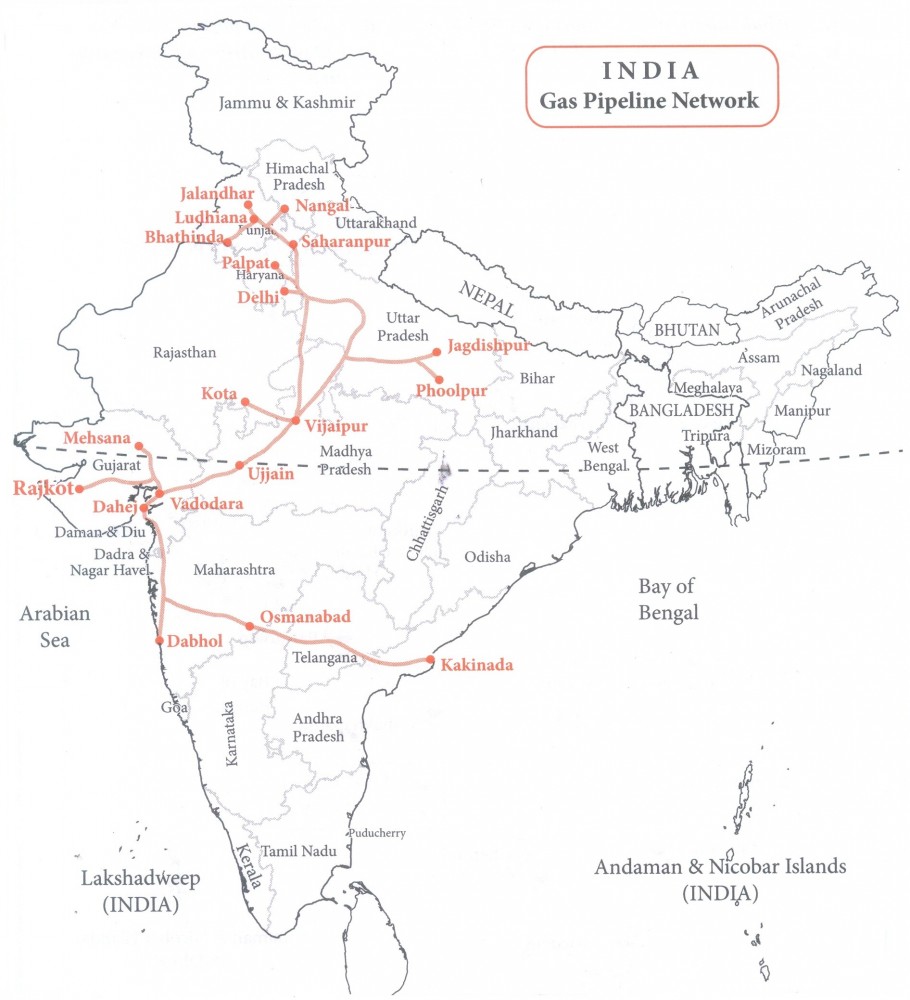
27.
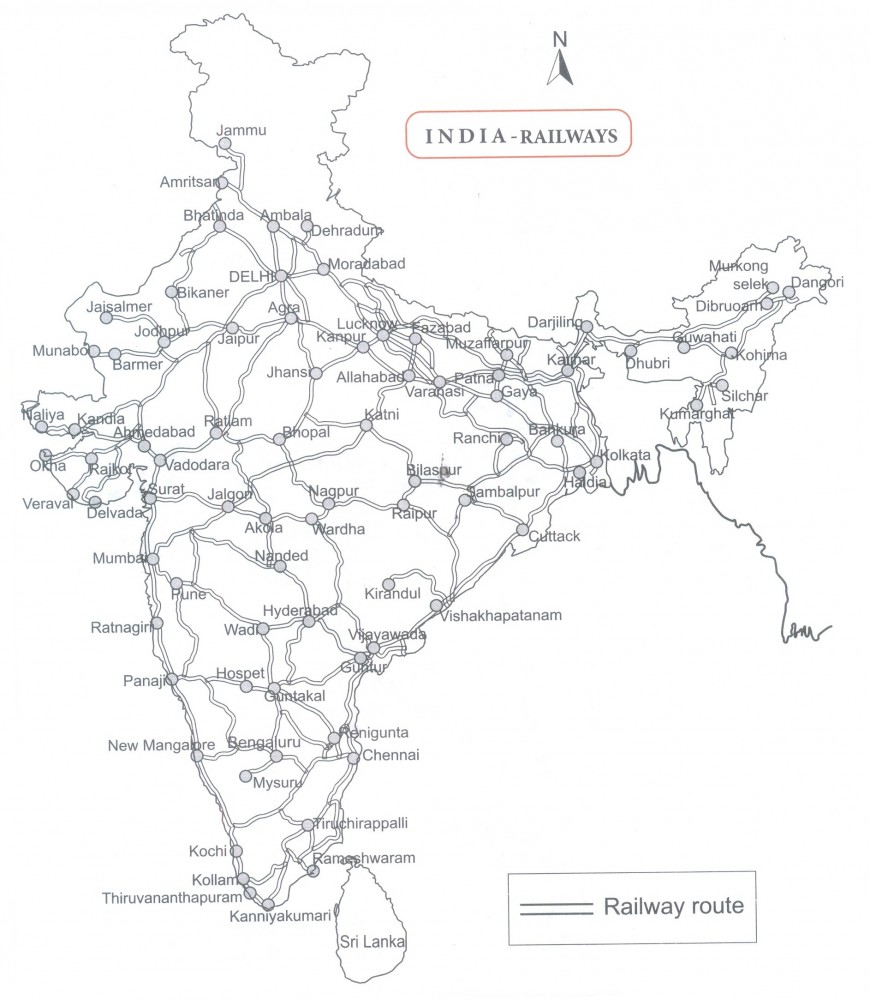
28.
29.
30.
(i) Nellore: Andra Pradesh
(ii) Gaya: Bihar
(iii) Ajmer, Bewar : Rajasthan
(iv) Hazaribagh, Kodarma: Jharkhand
31.
Chancellor of Prussia Otto von Bismarck was the chief architect of the unification of Germany. The process of German unification was carried out in the following ways.
(a) The first attempt for the unification of Germany was made in 1848 through the establishment of a constitutional monarchy under the Prussian king Wilhelm IV by convening a parliament at Frankfurt. The Prussian king rejected this move and joined the other monarch to oppose the elected assembly.
(b) There were widespread nationalist feelings among middle-class Germans, who in 1848, tried to unite the different regions of the German confederation into a nation-state.
(c) Prussia took the initiative and leadership of the movement for national unification. Otto von Bismarck, the Chief Minister of Prussia, with the help of the Prussian army and bureaucracy carried- the process further.
(d) He fought three wars over seven years against Austria, Denmark and France, which ended in Prussian victory. This victory completed the process of German unification.
(e) Prussian King William I was proclaimed as German emperor at Versailles. Thus on 18 January, 1871, the new German empire headed by Kaiser Wilhelm of Prussia was proclaimed.
32.
The new middle class in Europe advocated the concept of liberalism emphasising the concept of freedom and equality for all.
But at the same time, this was not visible in the political experiment around Europe. The right to vote was exclusively with the propertied class, that too only men. Women even with property rights were excluded from right to vote.
The Jacobins who stood for revolution for equality were also biased on this issue. They too granted right to vote to all adult male population only.
Napoleon who stood to end privileges too reduced women to the margin of the society with no political rights. For ling did these women and non-propertied male struggled to win political rights for themselves.
33.
The following were the features of boycott and swadeshi Movements.
(a) British institutions and services were denied by students, teachers and lawyers.
(b) Picketing of foreign liquor shops by women.
(c) Refusal and bonfires of foreign clothes.
(d) Reduction in imports of cloth.
(e) Refusal of traders to deal in foreign goods or finance foreign trade badly affected the British economy.
(f) Increase in the production of Indian handloom and textile and coming up of Indian industries.
34.
Five major problems faced by road transport in India are:
Road network is inadequate as volume of traffic and passengers is more.
Many roads are unmetalled which limits their usage.
Roads are congested in cities.
Quality of roads is poor (potholes)
Less roads to connect villages to cities.
35.
Minerals are required in all spheres of our life in agriculture, industries and for domestic purposes. We are rapidly consuming the mineral resources that required millions of years to be formed and concentrated. The geological processes of mineral formation are so slow that the rates of replenishment are infinitely small in comparison to the present rates of consumption. They are finite resources that are non-renewable, yet are getting exhausted due to rapid exploitation. Continued extraction bring down their quality as well as increases costs of extraction. To save these valuable resources from exhaustion and to preserve them for future generations as well, we should conserve our mineral resources. Methods of conserving minerals are as follows.
(a) Causing minimum wastage of minerals during the process of mining and processing of minerals.
(b) Improved technologies to utilize low-grade ores at low cost.
(c) Using minerals in a planned manner by adopting the policy of recycle and reuse. Recycling of metals, using scrap metals and other substitutes to reduce exploitation of the present deposits.
(d) Looking for some other eco-friendly options for its replacement like CNG.
36.
The two varieties of iron ore found in India having high iron content are magnetite and hematite. Magnetite is the finest quality iron ore with very high iron content up to 70 per cent. Hematite has an iron content of 50 to 60 percent but is the most important industrial iron ore in terms of the quantity used. Rich iron-ore deposits are found in the following regions of India.
(a) Odisha-Jharkhand belt with high grade haematite iron ore in Badampahar mines in the Mayurbhanj and Keonjhar districts of Odisha, and Gua and Noamundi in the Singhbhum district of Jharkhand.
(b) Durg-Bastar-Chandrapur belt in Chhattisgarh and Maharashtra with super-high grade hematite iron ore, in the Bailadila range of hills in the Bastar district of Chhattisgarh.
(c) Ballary-Chitradurga-Chikkamaguluru-Tumakuru belt in Karnataka has large reserves of iron ore. The Kudremukh mines located in the Western Ghats are known to be one of the largest deposits in the world.
(d) Maharashtra-Goa belt includes Ratnagiri in Maharashtra and some areas in Goa
37.
(a) Through transport and communication we are well-linked with the rest of the world.
(b) India is united despite its vast size, diversity and linguistic and socio-cultural plurality.
(c) Railways, airways, water ways, newspapers, radio, television, cinema and internet, etc. have been contributing to India's socio-economic progress in many ways.
(d) The trades from local to international levels have added to the strength of our economy.
(e) It has enriched our life and added amenities and facilities for the comforts of life.
38.
Indians felt that their hardships would be brought to an end after the First World War. But that did not happen.
The Rowlatt Act of 1919:
The Rowlatt Act been hurriedly passed through the Imperial Legislative Council. It gave the government enormous powers to repress political activities, and allowed detention of political prisoners without trial for two years. Mahatma Gandhi launched a movement against these unjust laws. But when people were violent, he called off the movement. This had been a wide spread movement but limited to cities and towns. Mahatma Gandhi now planned to launch a more broad-based movement.
The Khilafat issue : The First World war ended with the defeat of Ottoman Turks. A harsh peace treaty was to be imposed on the Ottoman emperor - the spiritual head of the Islamic world (the Khalifa). At the Calcutta session of 1920, Gandhiji expressed the need for a Non-Cooperation movement in support of Khilafat issue as well as for Swaraj. In his famous book "Hind Swaraj" (1909) Mahatma Gandhi declared that the British rule was established in India with the cooperation of Indians. It had survived only because of this cooperation. If Indians refused to cooperate, British rule would collapse within a year, and swaraj would come. Hence he started the Non-cooperation movement in full swing.
39.
(i) Trucks, buses, cars, motor cycles, scooters, three wheelers, and multi utility vehicles are produced in India.
(ii) This industry had experienced a quantum jump in less than 15 years. Foreign Direct Investment brought new technology to India and aligned the industry with global developments.
(iii) At present, there are 15 passenger car and multi utility vehicle industries, 9 commercial vehicle industries and 14 two and three wheelers industries in India.
(iv) The industires are located at Delhi, Gurgaon, Mumbai, Pune, Chennai, Kolkata, Lucknow, Indore, Hyderabad, Jamshedpur and Bangalore.
40.
(i) Stiff competition in the international market from synthetic substitutes.
(ii) Stiff competition from other competitors like Bangladesh, Brazil, Philippines, Egypt and Thailand.
(iii) The internal demand needs to be increased; however it has increased recently due to the Government policy of mandatory use of jute packaging.
(iv) There is urgent need to increase the jute productivity and the quality.
(v) The jute farmer needs to get good prices for their jute crops.
(vi) The yield per hectare to be improved,
(vii) To stimulate demand the jute products needs to be diversified.

10th Standard CBSE Syllabus & Materials
10th Standard CBSE
CBSE 10th Social Science PS - Federalism - New Model Questions Papers Study Material - QB365 Set A
NEW10th Standard CBSE
CBSE 10th Social Science PS - Power Sharing - New Model Questions Papers Study Material - QB365 Set A
NEW10th Standard CBSE
CBSE 10th Social Science GEO - Manufacturing Industries - New Model Questions Papers Study Material - QB365 Set A
NEW10th Standard CBSE
CBSE 10th Social Science GEO - Minerals and Energy Resources - New Model Questions Papers Study Material - QB365 Set A



NCERT Books

Syllabus

Exam Pattern

Sample Question Papers

Previous year Question Papers

Important Notes

MCQ Practice test

NCERT Exemplers

Case study Questions

Image Based Questions

Passage based Questions

HOT Questions

Value Based Questions

Model Questions Papers
NCERT ( Book Back ) Questions

Assertion and Reason
Important Questions And Answers

CBSE 10th Standard CBSE Subjects
CBSE Standards