 100% FREE ACCESS
10th Standard CBSE Syllabus & Materials
10th Standard CBSE
CBSE 10th Social Science ECO - Globalisation and the Indian Economy - New Model Questions Papers Study Material - QB365 Set A
NEW10th Standard CBSE
CBSE 10th Social Science ECO - Money and Credit - New Model Questions Papers Study Material - QB365 Set A
NEW10th Standard CBSE
CBSE 10th Social Science ECO - Sectors of the Indian Economy - New Model Questions Papers Study Material - QB365 Set A
NEW10th Standard CBSE
CBSE 10th Social Science ECO - Development - New Model Questions Papers Study Material - QB365 Set A
NEW10th Standard CBSE
CBSE 10th Social Science PS - Outcomes of Democracy - New Model Questions Papers Study Material - QB365 Set A
NEW10th Standard CBSE
CBSE 10th Social Science PS - Gender, Religion and Caste - New Model Questions Papers Study Material - QB365 Set A

Published on: 26/10/2025
Download CBSE Class 10th Standard CBSE Social Science question papers, sample papers, important questions, and previous year solved papers in PDF format. Get free study materials, NCERT solutions, and exam preparation resources for Class 10th Standard CBSE Social Science
Questions + Answers key
Take MCQ Social Science Test
1.
Who were Khmer Cambodians?
2.
What is biodiversity? Why is biodiversity important for human lives?
3.
How does displaying the information about the product help consumers?
4.
Examine the following pairs that give the level of government in India and the powers of the government at that level to make laws on the subjects mentioned against each. Which of the following pairs is not correctly matched?
| (a) | State government | State List |
| (b) | Central government | Union List |
| (c) | Central and State governments | Concurrent List |
| (d) | Local governments | Residuary powers |
5.
Distinguish between industrialisation and proto-industrialisation.
6.
Briefly explain how the challenge of deepening of democracy can be met?
7.
How did the novels for the young boys idealise a new type of man? Explain.
8.
Why were the printed books popular even among illiterate people?
9.
Classify energy resource into two categories. Give two examples of each.
10.
What was the most powerful weapon of the Spanish conquerors?
11.
Mention a few Organizations that provide certification of standardization in India.
12.
Name the good from India which dominated the international market before the age of machine industries.
13.
What are Millets?
14.
Which is the most common route for investments by MNCs in countries around the world?
15.
Name the presidency cities of colonial India.
16.
Why money is called a medium of exchange?
17.
What is meant by defection in politics?
18.
Name the western terminal of the East-West Corridor.
19.
Where and when was the first cement industry set up in India?
20.
The challenge of deepening of democracy is faced by every democracy in one form or another. Support the statement with three suitable arguments.
21.
Distinguish between issue-specific movements and long term movements
22.
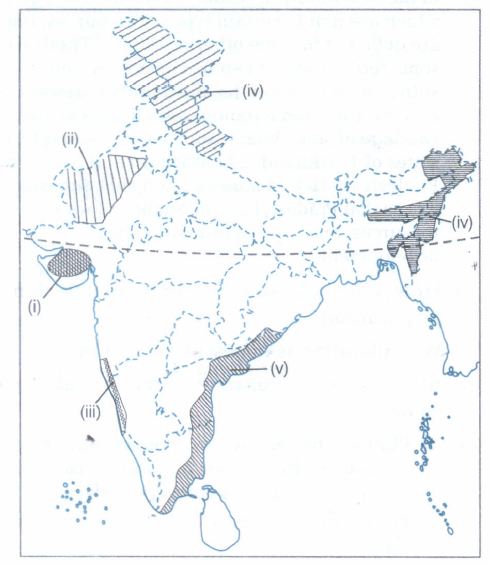
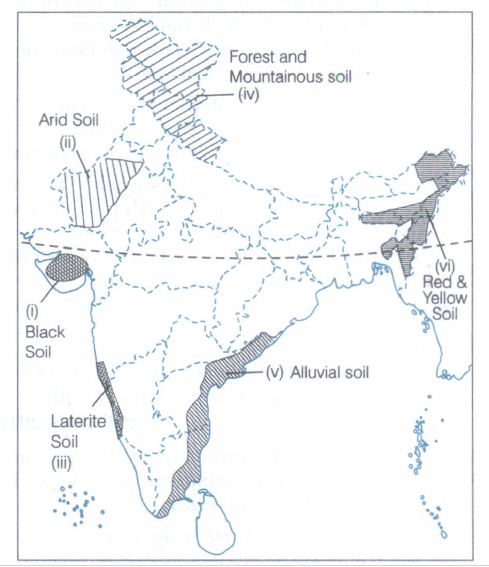
On the physical outline map of India given below, identify any four soil types of India.
23.
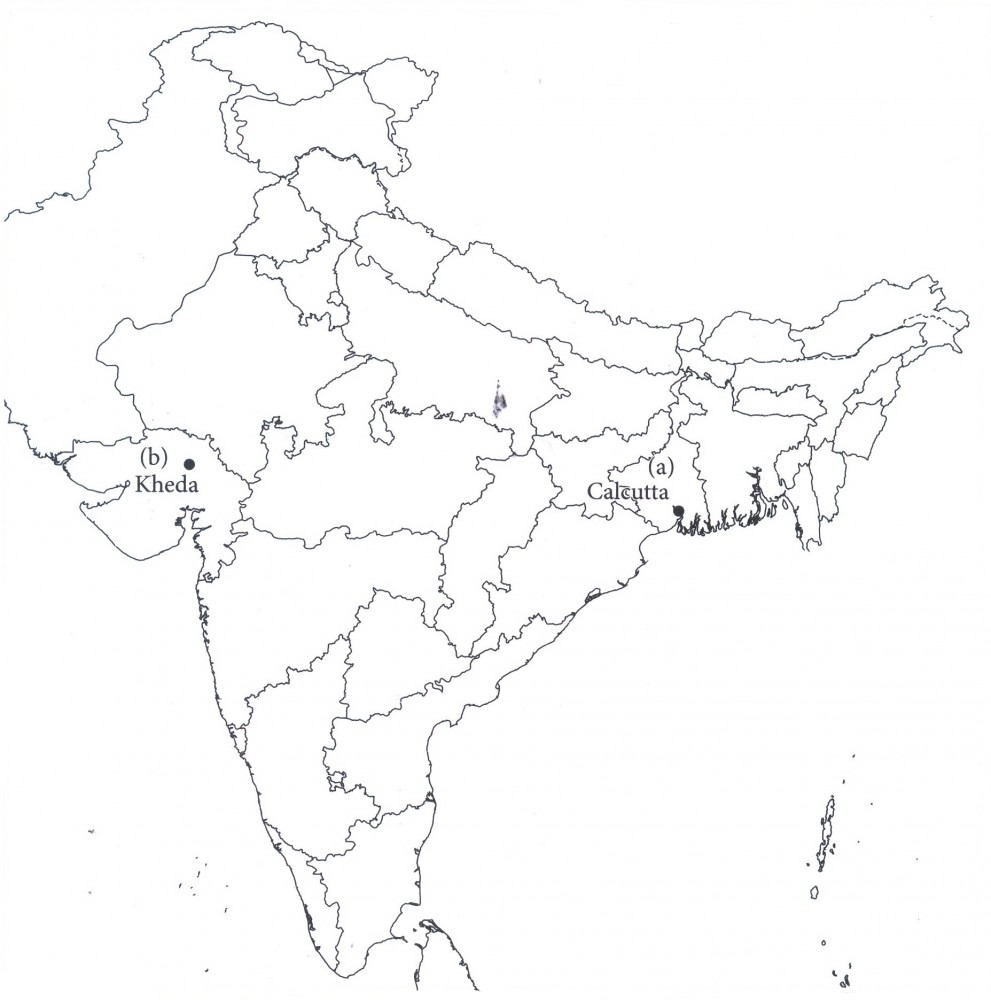
Two features - A and B are marked in the given political outline map of India. Identify these features with the help of the following information and write their correct names on the lines marked in the map:
(a) The place where Indian national Congress Session was held in September 1920.
(b) The place where the Peasant Satyagraha was help in Gujarat.
24.
How did the Balkan issue became the reason for First World War?
25.
How can the workers of unorganised sector be protected?
26.
Explain the impacts of scrapping of the Corn Law.
27.
Three-fourths of the earth's surface is covered with water, but still there is a scarcity of water across the globe. Explain giving three reasons.
28.
Who invented the printing press? How did he develop the print technology?
29.
Why do people prefer democracy? Explain with four reasons.
30.
who was chosen the new Prime minister of the interim government of Nepal?
1.
()
They were non-Vietnamese people lived in Vietnam.
2.
Biodiversity:
Biodiversity refers to rich flora and wildlife. In this diversity, species with diverse forms and functions live together.
Importance of Biodiversity for Human:
Biodiversity is important for human lives because the human being, along with the biodiversity, form a complete ecological system in which we are a part and are dependent on this system for our own existence.
3.
(a) It helps consumers to choose the best product after knowing the information given by different products. It helps the consumers to use the product effectively.
(b) It comply the right of the consumers to be informed and to seek remedy through courts.
4.
(d) Local Government - Residuary Powers
5.
| Industrialisation | Proto-industrialisation |
| The whole process of production was centralised. | The whole process of production was decentralised. |
| It is easy to supervise and maintain the quality. | It is difficult to supervise and maintain the quality. |
| Good were produced by professional workers. | Good were produced by a vast number of producers working within their farms not in factories. |
6.
It means strengthening the existing institutions of democracy and practices of democracy. As different people, different countries have different people, different countries have different expectations from democracy means that a democracy has to encourage people's participation and control on democratic institutions. It has to curb and cut down the role of money power, the influence of the rich on making governmental decisions.
7.
(i) He wrote about strange lands being conquered by the young Englishmen.
(ii) He wrote novels for young boys idealising a new type of man; someone who was powerful, assertive, independent and daring.
(iii) He represented the colonisers heroic and honourable.
(iv) His novels were about young boys who witness grand historical events, get involved in some military action and show what they called English courage.
8.
(i) Those who could not read enjoyed listening to books read out. So Printers began publishing popular ballads and folk tales illustrated with pictures.
(ii) These books were then sung and recited at gathering in villages and in taverns in towns.
(iii) Indian writers like Bankim Chandra Chattopadhyay himself used to read his novels for illiterate gathering.
9.
Energy resources can be classified as conventional and non-conventional sources. Conventional sources include firewood, cattle dung cake, coal, petroleum, natural gas, etc, Non-conventional sources include solar, wind, tidal, geothermal energy and biogas.
10.
Small Pox Germs
11.
(i) BIS and ISI
(ii) AGMARK
(iii) HALLMARK
It means International Organization for Standardization which has its headquarter at Geneva.
12.
Silk and Cotton
13.
Jowar, bajra and ragi are the important millets grown in India. These are coarse grains, with very high nutritional value.
14.
Buying the existing companies is the most common route for investments by MNCs in countries around the world.
15.
Calcutta and Madras.
16.
Since money acts as an intermediate in the exchange process, it is called a medium of exchange.
17.
It is the changing of party allegiance from the party on which a person got elected to a different party. It is now banned by the Anti-Defection law.
18.
Porbandar in Gujarat.
19.
The first cement plant was set up at Chennai in Tamil Nadu in 1904. There are 128 large and over 332 mini cement industries in India at present.
20.
A 'challenge' is a difficulty which carries within it an opportunity for progress. Three major challenge are :
(i) Foundational challenge is about making the transition to democracy and then instituting a democratic government. This involves bringing down the existing non-democratic regime, keeping military away from controlling the government and establishing a sovereign and functional state. Example : Myanmar, Chile, Nepal
(ii) Challenge of Expansion is faced (by most of the established democracies. This involves applying the basic principle of democratic government across all the regions, different social groups and various institutions. Most countries including India and other democracies like the U.S. face this challenge.
(iii) Deepening of democracy : This involves strengthening of the institutions and practices of democracy, especially those that help people's participation and control. This attempts to bring down the control and influence of the rich and powerful people in making governmental decision.
21.
(i) Single-issue movements are issue-specific movements that seek to achieve a single objectives within a limited frame.These movements have a clear leadership and supporting some organisations.But their active life is very short.The Nepalese movement for democracy and Narmada Bachao Andolan are good examples of single-issue movements.
(ii) Long-term movements are general or generic movement that seek to achieve a broad goal in the long terms and involve more than one issue.There is No single organisation that controls or guides such movements.The environmental movement and the women's movement are examples of such movements.All of these have separate organisations, independent leadership and often different views on policy related matters.Yet all of these share a board objective and have a similar approach.
22.
(I) Black soil (ii) Arid soil
(iii) Laterite soil (iv) Forest and Mountainous soil
(v) Alluvial soil (vi) Red and Yellow soil
23.
24.
The Balkan region during 1871 comprised modern-day states like Romania, Bulgaria, Albania, Greece, Macedonia, Croatia, Bosnia-Herzegovina, Slovenia, Serbia and Montenegro. Its inhabitants were known as Slavs.
(a) This region had various ethnic and geographical diversities and was under the Ottoman Empire for a long period. As the ideas of romantic nationalism spread in this region, it resulted in breaking up of the Ottoman Empire which made the situation even more serious.
(b) The Ottoman Empire could not do much to integrate these regions. As a result, most of the European subject nationalities broke away from the Ottoman Empire's control and declared their independence.
(c) The Balkan people based their claim to be independent on the basis of nationality. They referred to the examples from history as a proof that they were once independent and were subjugated by foreign powers. Therefore, they thought of their struggles as attempts to win back their long-lost independence.
(d) Because of this development, various other Slavic nationalities also struggled to define their identity and independence which made the Balkan a region of severe conflicts. At the same time they were jealous, of each other and wanted to gain more territory at the expense of the others.
(e) European powers like Russia, Germany, England, Austro-Hungary too fought with each other to control more colonies and establish their naval and military might. They were also keen to grab more of the Balkan region for expanding their trade. This made the situation more serious which ended up with the waging of the First World War.
25.
The workers in the unorganised sector need protection on the following issues
(i) Wages They are low and not regular. There is no provision for overtime, paid leave, etc. Minimum wages rules should be implemented strictly.
(ii) Safety Construction workers can get injured while working and they need to work under safe conditions. There should be a check on the working conditions along with the provision of insurance.
(iii) Health Long working hours and unhygienic working environment affect the health of the workers adversely. Health insurance along with a fixed number of working hours should be made mandatory.
26.
Under the pressure from industrialists and urban dwellers, the British Government abolished the Corn Laws. The effects of it were
(i) Food could be imported into Britain more cheaply than it would be produced within the country.
(ii) British agriculture was unable to compete with imports. Vast Areas of land were left uncultivated and people started migrated to cities or other countries.
(iii) As food prices fell, consumption in Britain rose. Faster industrial growth in Britain also led to higher incomes and therefore more food import.
(iv) Around the world in Eastern Europe, Russia, America and Australia land were cleared and food production expanded to meet the British demand.
27.
(a) It is predicted that large parts of India will join countries or regions having absolute water scarcity by 2025.
(b) Through, it is the fact that water is abundant and renewable, it is difficult to imagine that we may suffer from water scarcity.
(c) It is associated with regions having low rainfall or those that are drought prone.
(d) The availability of water resources varies over space and time, mainly due to the variations in seasonal and annual precipitation, but water scarcity in most due to the variations in seasonal and annual precipitation, but water scarcity in most cases is caused but over-exploitation, excessive use and unequal access to water among different social groups.
28.
Johann Gutenberg was a German goldsmith and inventor, credited with the inventing of the movable type printing in Europe. Gutenberg was the son of a merchant, and his childhood was spent on a large agricultural estate. From his childhood, he had seen wine and olive presses. By and by, he learnt the art of polishing stones, became a master goldsmith, and also acquired the expertise to create lead moulds used for making trinkets. Using this knowledge, Gutenberg adapted the existing technology to design his innovation. The olive press became the base model for the printing press and moulds were used for casting the metal types for the letters of the alphabet. By 1448, Gutenberg perfected the system. In 1445, Gutenberg published his 42-lines Bible, commonly known as the Gutenberg Bible. About 180 copies were printed most on paper and some on vellum.
29.
People prefer democracy because:
(i) People are their own masters. In a democracy, every individual has a right to vote and choose his representatives in the government. The government is of the people and the laws are made by the people in the government. Laws are made to protect the liberty and freedom of the people.
(ii) In a democracy, no particular religion, region, race or language is given special preference. All individuals are given equal rights and freedom, and there is no discrimination.
(iii) The government is not by force. The opposition parties are allowed to criticise the government.
(iv) Since every individual is given equal rights, there is less danger of conflicts in society. There are less conflict based on caste, religion or region and less social tensions in society. In politics, dignity of the individual is cared for.
30.
()
Girija Prasad Koirala was chosen the new Prime minister of the interim government of Nepal.

10th Standard CBSE Syllabus & Materials
10th Standard CBSE
CBSE 10th Social Science PS - Federalism - New Model Questions Papers Study Material - QB365 Set A
NEW10th Standard CBSE
CBSE 10th Social Science PS - Power Sharing - New Model Questions Papers Study Material - QB365 Set A
NEW10th Standard CBSE
CBSE 10th Social Science GEO - Manufacturing Industries - New Model Questions Papers Study Material - QB365 Set A
NEW10th Standard CBSE
CBSE 10th Social Science GEO - Minerals and Energy Resources - New Model Questions Papers Study Material - QB365 Set A



NCERT Books

Syllabus

Exam Pattern

Sample Question Papers

Previous year Question Papers

Important Notes

MCQ Practice test

NCERT Exemplers

Case study Questions

Image Based Questions

Passage based Questions

HOT Questions

Value Based Questions

Model Questions Papers
NCERT ( Book Back ) Questions

Assertion and Reason
Important Questions And Answers

CBSE 10th Standard CBSE Subjects
CBSE Standards