
 100% FREE ACCESS
10th Standard CBSE Syllabus & Materials
10th Standard CBSE
CBSE 10th Social Science ECO - Globalisation and the Indian Economy - New Model Questions Papers Study Material - QB365 Set A
NEW10th Standard CBSE
CBSE 10th Social Science ECO - Money and Credit - New Model Questions Papers Study Material - QB365 Set A
NEW10th Standard CBSE
CBSE 10th Social Science ECO - Sectors of the Indian Economy - New Model Questions Papers Study Material - QB365 Set A
NEW10th Standard CBSE
CBSE 10th Social Science ECO - Development - New Model Questions Papers Study Material - QB365 Set A
NEW10th Standard CBSE
CBSE 10th Social Science PS - Outcomes of Democracy - New Model Questions Papers Study Material - QB365 Set A
NEW10th Standard CBSE
CBSE 10th Social Science PS - Gender, Religion and Caste - New Model Questions Papers Study Material - QB365 Set A

Published on: 26/10/2025
Download CBSE Class 10th Standard CBSE Social Science question papers, sample papers, important questions, and previous year solved papers in PDF format. Get free study materials, NCERT solutions, and exam preparation resources for Class 10th Standard CBSE Social Science
Questions + Answers key
Take MCQ Social Science Test
1.
What was the impact of the Great Depression on USA? Explain.
2.
How can the workers of unorganised sector be protected?
3.
What is a multi-purpose river valley projects? Give any four objectives of the multi-purpose river valley project?
4.
Mention some of the innovations which have improved the printing technology after the 17th century.
5.
Why do people prefer democracy? Explain with four reasons.
6.
Briefly trace the process of unification of Italy.
7.
What are SHGs?
8.
Pragya bought an iron of a reputed brand for Rs.1,500 but it caused an electric shock while it was being used. Pragya wants to exercise her 'Right'. Identify the 'Right' under which she can be protected.
9.
What is the average density of roads in India?
10.
In which continent is the Chutney music popular?
11.
What technological helped in improving production of India industry during the 20th century?
12.
Name a commercial crop of punjab and Haryana, which is a subsistence crop in Odisha.
13.
Name the acts through which children were kept out of industrial work in London.
14.
What is meant by 'transparency'?
15.
When was BSP formed?
16.
Where and when was the first cement industry set up in India?
17.
Which issue related to the city of Cochabamba?
18.
Suggest any three ways in which political reforms can be made in India?
19.
Explain ant three common features of the popular struggle in Nepal and Bolivia.
20.
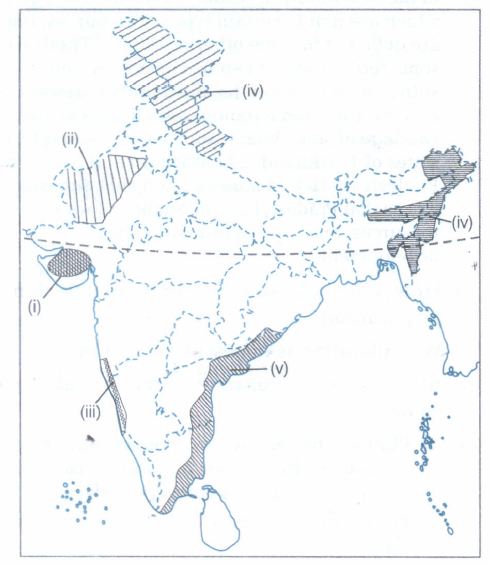
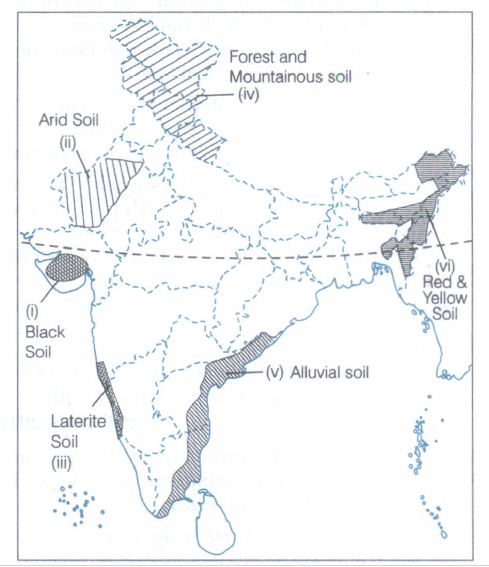
On the physical outline map of India given below, identify any four soil types of India.
21.
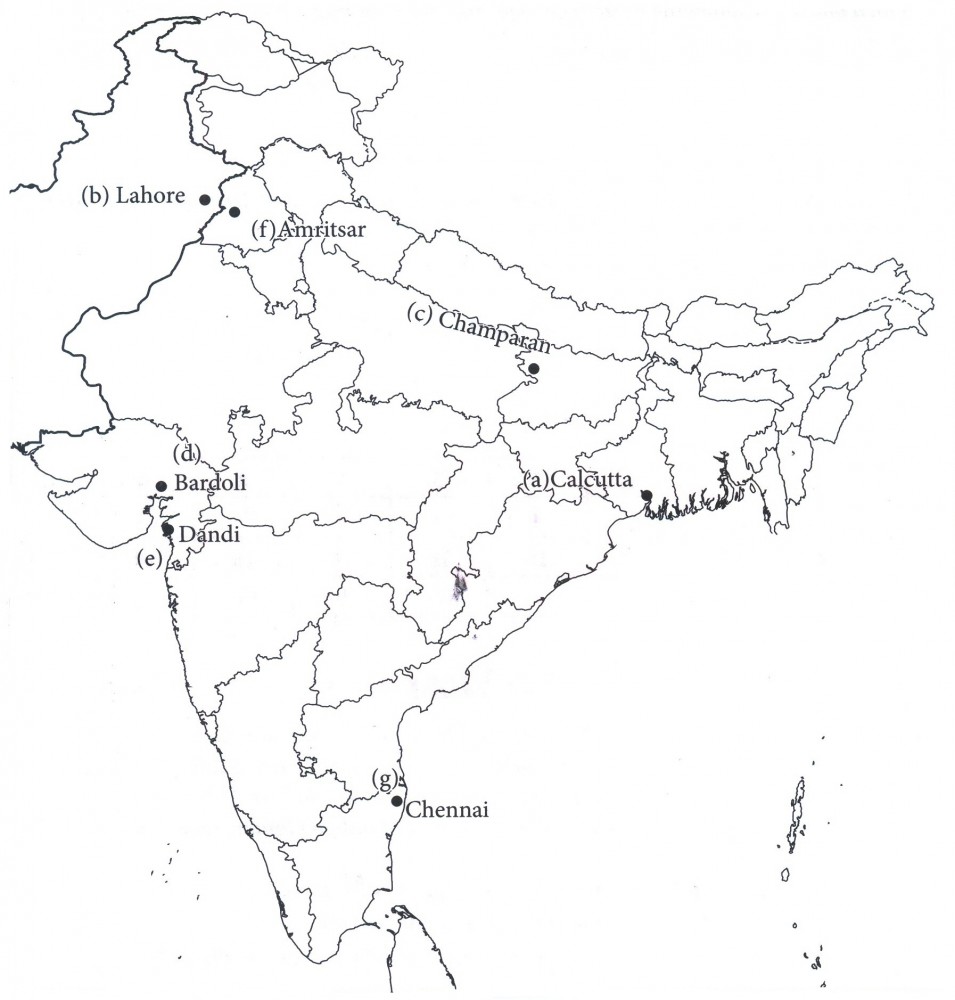
Locate and label the following on the given political outline map of India:
(a) A place where session of Indian National Congress was held in September 1920.
(b) A place where session of Indian National Congress was held in 1929.
(c) A place in Bihar where Satyagraha Movement of indigo planters took place.
(d) Baradoli, the place, from where No tax campaign was started.
(e) A place in Gujarat where Gandhiji violated the Salt law.
(f) a place in Punjab where Jalianwalla Bagh incident took place (or) Amritsar
(g) Chennai (Madras)
22.
Explain the judicial structure of consumer disputes in India.
23.
What are vulnerable species? Give four examples.
24.
The distinguishing feature of a federal government is:
(a)National government gives some powers to the provincial governments.
(b)Power is distributed among the legislature, executive, and judiciary.
(c)Elected officials exercise supreme power in the government
(d)Governmental power is divided between different levels of government
25.
Why in Victorian Britain, the upper classes preferred things produced by hand? Give three reasons.
26.
How did Gutenberg personalise the printed hooks suiting to the tastes and requirement of others?
27.
What led Chandu Menon to write Indulekha?
28.
Why did writers like Paul Bernard believe in developing the economy of the colonies?
1.
(i) With the fall in prices and the prospect of a depression, the banks also called domestic lending and called back loans.
(ii) Farms were unable to sell their harvests.
(iii) Faced with falling income, many households in the US could not repay what they had borrowed and were forced to give up their homes. cars and other consumer durables.
(iv) Industrial production registered a fail of about 35 per cent.
(v) The number of the unemployed started rising, and in 1933 it touched 17 million. As unemployment soared, people trudged long distances looking for any work they could find. Ultimately, the US banking system itself collapsed.
2.
The workers in the unorganised sector need protection on the following issues
(i) Wages They are low and not regular. There is no provision for overtime, paid leave, etc. Minimum wages rules should be implemented strictly.
(ii) Safety Construction workers can get injured while working and they need to work under safe conditions. There should be a check on the working conditions along with the provision of insurance.
(iii) Health Long working hours and unhygienic working environment affect the health of the workers adversely. Health insurance along with a fixed number of working hours should be made mandatory.
3.
A multi-purpose river project is a large-scale hydro project for water retention canals and irrigation, water processing and pipelines.
Objectives of Multi-purpose River Valley Projects:
1. The main objectives are:
(a) To produce electricity from water
(b) To improve the quality of groundwater by reducing the ground water pollution.
(c) To conserve water
(d) To avoid flooding of rivers.
(e) To meet the increasing demand of water.
(f) To augment the ground water storage and raise the water table.
4.
Invention which improved the printing technology after 17th century are listed below:
(i) Metal Press: In the 19th century, there were a series of innovations in the printing technology. Now the press was made out of metal.
(ii) Rotary Printing Press: Richard March Hoe, an American inventor designed and improved the printing press. He invented the Rotary Printing Press, a design much faster than the old flat-bed printing press. The new press could print about 8,000 sheets per hour. The new press was very useful for printing newspapers.
(iii) Offset Press: In the late nineteenth century, the offset press was developed which could print up to six colours at the same time.
(iv) Electrically Operated Presses: From the turn of the twentieth century, electrically operated presses accelerated printing operations. A series of many other developments followed. Methods of feeding paper improved, the quality of plates became better, automatic paper reels and photoelectric control of the colour register were introduced.
The accumulation of several individual mechanical improvements transformed the appearance of the printed texts.
5.
People prefer democracy because:
(i) People are their own masters. In a democracy, every individual has a right to vote and choose his representatives in the government. The government is of the people and the laws are made by the people in the government. Laws are made to protect the liberty and freedom of the people.
(ii) In a democracy, no particular religion, region, race or language is given special preference. All individuals are given equal rights and freedom, and there is no discrimination.
(iii) The government is not by force. The opposition parties are allowed to criticise the government.
(iv) Since every individual is given equal rights, there is less danger of conflicts in society. There are less conflict based on caste, religion or region and less social tensions in society. In politics, dignity of the individual is cared for.
6.
During the middle of the nineteenth century, Italy was divided into seven states, of which only one, Sardinia-Piedmont, was ruled by an Italian princely house. The north was ruled by Austrian Habsburgs, the centre by the Pope and the southern regions by the Bourbon kings of Spain. Italian language had varieties of dialects; therefore, it was not stable in its form. During the 1830s, Giuseppe Mazzini had sought to put together a coherent programme for a unitary Italian Republic. He had also formed a secret society called 'Young Italy' for the dissemination of his goals. The failure of revolutionary uprisings both in 1831 and 1848 fell on Sardinia-Piedmont under its ruler King Victor Emmanuel II to unify the Italian states through war. A unified Italy offered them the possibility of economic development and political dominance. Chief Minister Cavour who led the movement to unify the regions of Italy was neither a revolutionary nor a democrat. With a tactful diplomatic alliance with France by Cavour, Sardinia-Piedmont succeeded in defeating the Austrian forces in 1859. In 1859, a large number of armed volunteers under the leadership of Giuseppe Garibaldi joined the fray. In 1860, Sardinia- Piedmont's forces marched into south Italy and the Kingdom of the Two Sicilies and drove out the Spanish rulers. In 1861, Victor Emmanuel was declared as the king of united Italy and Rome was declared the capital of Italy.
7.
They are Self-Help Groups formed by the poor rural women.
8.
Right to safety.
9.
The average density of roads in India is 75 km.
10.
South America
11.
the introduction of fly shuttle
12.
Rice
13.
(i) Compulsory Elementary Education Act in 1870.
(ii) Various Factories Acts
14.
In a democratic government, a citizen has the right and the means to examine the decisions taken by the govt. It is known as transparency.
15.
It was established on April 14th 1984.
16.
The first cement plant was set up at Chennai in Tamil Nadu in 1904. There are 128 large and over 332 mini cement industries in India at present.
17.
()
Water right were sold to MNC's which led to increase in the prices of water.
18.
(i) Carefully devised changes in law can help to discourage wrong political practices and encourage good ones. At the same time, legal-constitutional changes by themselves cannot overcome challenges to democracy. They are to be carried out mainly by political activities, parties movements and politically conscious citizens.
(ii) Legal changes can sometimes be counter-productive. Generally, laws that seek to ban something are not very successful. Rather laws that give political actors incentives to do good things have more chances of working. For, example, the `Right to Information Act' empowers people to act as watchdogs of democracy.
(iii) The main focus of political reforms should be on ways to strengthen democratic practice. The most important concern should be to increase and improve the quality of political participation by ordinary citizens.
(iv) Any proposal for political reforms should think not only about what is a good solution but also about who will implement it and how measures that rely or democratic movements, citizens' organisations and the media are likely to succeed.
19.
There were similarities in the mass struggles of Nepal and Bolivia. They were both struggles for establishing or restoring democracy. There was mass mobilisation in both countries, and the resolution to struggle had come from the people.
(i) Both the struggles were against the people who exercised power. In Nepal, it was the monarchy, in Bolivia, it was against the elected government.
(ii) In both cases, public demonstrations of mass support clinched the dispute.
(iii) In both cases, it involved a critical role of political organisations.
(iv) In Bolivia, the power of the mass uprising and the people forced the government to concede all their demands. (v) Nepal became a republic.
(vi) In Nepal, the call was given by the SPA or the Seven-Party Alliance. It had members of big parties and some members of the Parliament.
(vii) The Nepalese Communist Party (Maoist) also joined, though they did not believe in parliamentary democracy. (viii) Non-political groups like all the major labour unions, their federations, teachers, lawyers and human rights movements also supported the movement.
(ix) The protest against water privatisation in Bolivia was not led by any political party. It was led by an organisation called FEDECOR. It comprised professionals, engineers, environmentalists, federations of farmers, factory worker unions, students from, the university of Cochabamba and city's growing population of homeless children.
(x) The movement was supported by the Socialist Party, which came into power in Bolivia in 2006.
20.
(I) Black soil (ii) Arid soil
(iii) Laterite soil (iv) Forest and Mountainous soil
(v) Alluvial soil (vi) Red and Yellow soil
21.
22.
A three-tier quasi-judicial machinery at the district, state and national level, was set up under COPRA, for redressal of consumer disputes in India.
(a) At the district level, consumer courts deal with cases involving claims up to Rs 20 lakh.
(b) At the state level, consumer courts deal with cases involving claims between Rs 20 lakh and Rs 1 crore.
(c) At the national level, consumer courts deal with cases involving claims exceeding Rs 1 crore. If the case is dismissed at the district level, then the consumer can appeal at the state and then at the national level, if required

23.
Vulnerable Species: The population of species which has decreased to the level into endangered category in the near future are known as vulnerable species. E.g. Asiatic elephant, blue sheep, Gangetic dolphin etc.
24.
Governmental power is divided between different levels of government
25.
the upper class people preferred to use hand products in the Victorian period because:
(i) They symbolized refinement and class.
(ii) They were better finish.
(iii) They were individually produced and carefully designed.
26.
(i) Borders were illuminated by hand with foliage and other patterns.
(ii) Illustrations were painted in the painting school of the buyer's choice.
(iii) In the books printed for the rich blank spares were left for decoration.
(iv) Each buyer could choose the design, verses were highlighted by hand with colours.
(v) The overall outlook of the book was properly taken care of.
27.
(i) The wirter has written about the marriage practices of upper caste Hindus in Kerala.
(ii) The writer has raised the issue of wedge between landlords and tenants.
(iii) The writer has raised the issue of marriage and property.
(iv) Chandu Menon clearly wants his readers to appreciate the new values of his hero and heroine and criticise the ignorance and immorality of Suri Nambuthire .
28.
()
To increase the profit opportunities, purchase of more goods, more business for French.

10th Standard CBSE Syllabus & Materials
10th Standard CBSE
CBSE 10th Social Science PS - Federalism - New Model Questions Papers Study Material - QB365 Set A
NEW10th Standard CBSE
CBSE 10th Social Science PS - Power Sharing - New Model Questions Papers Study Material - QB365 Set A
NEW10th Standard CBSE
CBSE 10th Social Science GEO - Manufacturing Industries - New Model Questions Papers Study Material - QB365 Set A
NEW10th Standard CBSE
CBSE 10th Social Science GEO - Minerals and Energy Resources - New Model Questions Papers Study Material - QB365 Set A



NCERT Books

Syllabus

Exam Pattern

Sample Question Papers

Previous year Question Papers

Important Notes

MCQ Practice test

NCERT Exemplers

Case study Questions

Image Based Questions

Passage based Questions

HOT Questions

Value Based Questions

Model Questions Papers
NCERT ( Book Back ) Questions

Assertion and Reason
Important Questions And Answers

CBSE 10th Standard CBSE Subjects
CBSE Standards