
 100% FREE ACCESS
10th Standard CBSE Syllabus & Materials
10th Standard CBSE
CBSE 10th Social Science ECO - Globalisation and the Indian Economy - New Model Questions Papers Study Material - QB365 Set A
NEW10th Standard CBSE
CBSE 10th Social Science ECO - Money and Credit - New Model Questions Papers Study Material - QB365 Set A
NEW10th Standard CBSE
CBSE 10th Social Science ECO - Sectors of the Indian Economy - New Model Questions Papers Study Material - QB365 Set A
NEW10th Standard CBSE
CBSE 10th Social Science ECO - Development - New Model Questions Papers Study Material - QB365 Set A
NEW10th Standard CBSE
CBSE 10th Social Science PS - Outcomes of Democracy - New Model Questions Papers Study Material - QB365 Set A
NEW10th Standard CBSE
CBSE 10th Social Science PS - Gender, Religion and Caste - New Model Questions Papers Study Material - QB365 Set A

Published on: 26/10/2025
Download CBSE Class 10th Standard CBSE Social Science question papers, sample papers, important questions, and previous year solved papers in PDF format. Get free study materials, NCERT solutions, and exam preparation resources for Class 10th Standard CBSE Social Science
Questions + Answers key
Take MCQ Social Science Test
1.
Explain with examples how democracy leads to a peaceful and harmonious life among citizens.
2.
"The 19th century world of faster economic growth still brought misery for many." Explain.
3.
How does tertiary sector help in the development of primary and secondary sectors? Explain with examples.
4.
Describe the traditional rainwater harvesting methods in India.
5.
Highlight any three innovations which have improved the printing technology from 19th century onwards.
6.
Briefly trace the process of unification of Italy.
7.
What are the major challenges to democracy in India? Explain.
8.
What is a single-issue movement?How does it differ from a long-term movement?Explain with examples.
9.
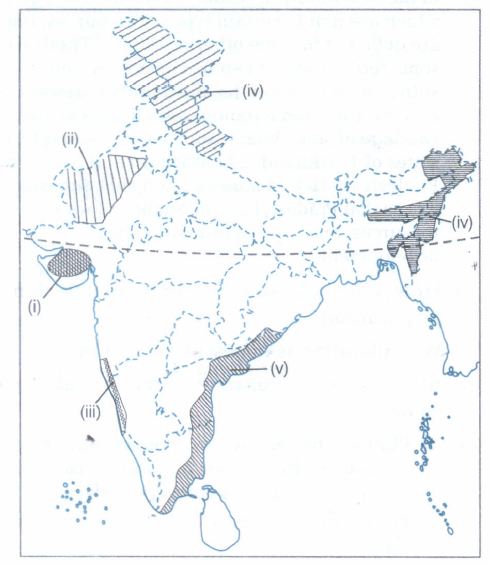
On the physical outline map of India given below, identify any four soil types of India.
10.
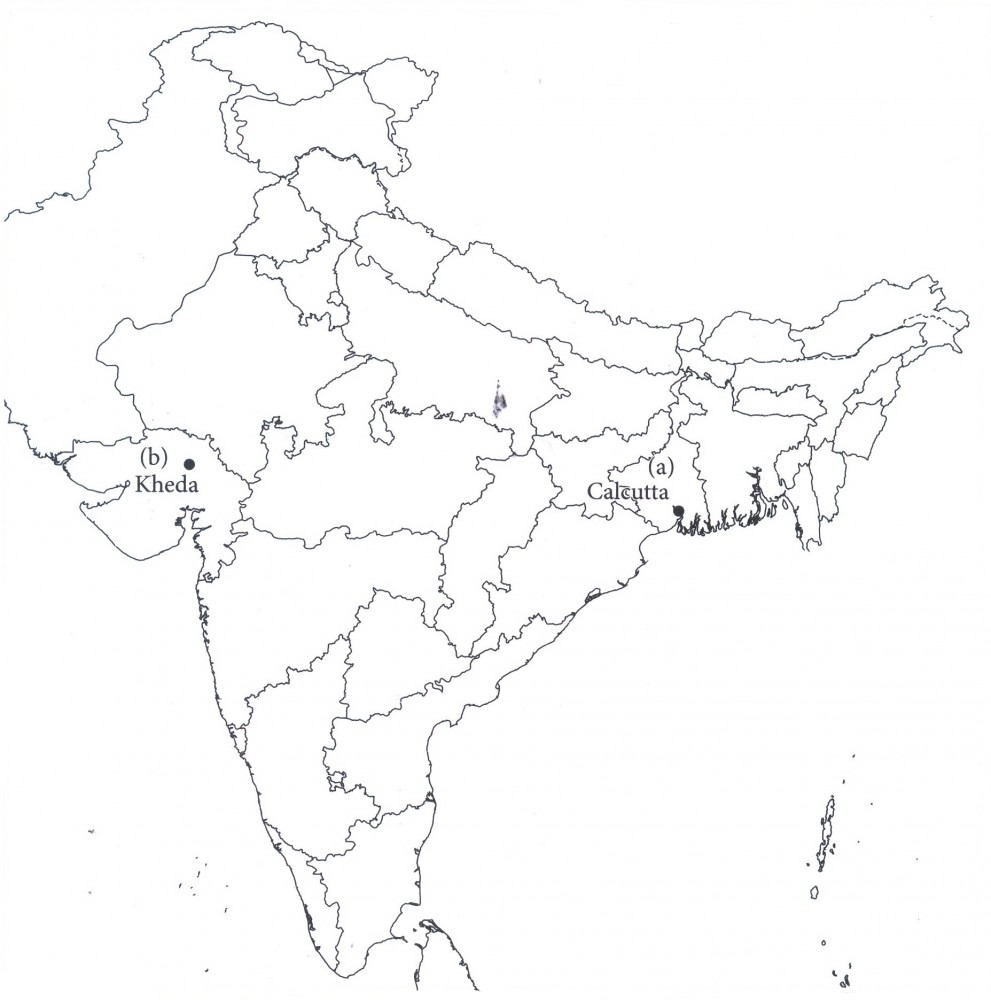
Two features - A and B are marked in the given political outline map of India. Identify these features with the help of the following information and write their correct names on the lines marked in the map:
(a) The place where Indian national Congress Session was held in September 1920.
(b) The place where the Peasant Satyagraha was help in Gujarat.
11.
Give one major factor that has stimulated the globalisation process.
12.
How many recognised national parties are there in India?
13.
Which type of transport is most important in India.
14.
What arose out of dissatisfaction of the consumers as many unfair practices were being indulged in by the sellers?
15.
Which factors influence the location of an industry?
16.
Why women works attacked the spinning jenny a machine which was introduced in Britain?
17.
Name the places where rabi crops grown due to the success of green revolution?
18.
Give reasons for the following:
(i) The Kent Act led to housing crisis in Bombay.
(ii) Expansion of the city has always posed a problem in Bombay.
19.
What are the factors on which economic development of a country depend?
20.
Why is the Himalayan Yew under great threat?
21.
Why is there a pressing need to use non-conventional sources of energy in India? Give three reasons.
22.
How are Federations contrasted with unitary government?
23.
Why jobber employed? How did jobber misuse his position and power? Explain.
24.
"The imperial state in China was the major producer of printed material." Support this statement with examples.
25.
What do you understand by the term 'foundational challenges'?
26.
In which way was women depicted in Charlotte Bronte's novel 'Jane Eyre'?
27.
Why did the French build canals systems in Vietnam?
1.
Democracy leads to peaceful and harmonious life among citizens as it gives to its citizens a sound political system based on social equality. We can prove the statement by citing the following instances.
(a) Democracy provides a conducive political environment to citizens for their popular participation in politics.
(b) Every citizen has the right to vote an right to contest election.
(c) Democracy stands for equal economic status to all citizens.
(d) In democracy, government undertakes extensive social welfare schemes and achieve universal literacy rate.
(e) In the social sphere, democracy tries to help its citizens to lead a peaceful and harmonious life by accommodating various social divisions and providing social equality to its citizens.
(f) Democratic governments try to resolve differences, respect differences and try mechanisms which can negotiate differences.
2.
(i) It was a world of faster economic growth as well as greater misery, higher income for some and poverty for others, technological advances in some areas and new forms of exploitation in others.
In India, indentured labourers were hired under contracts which promised the return travel to India, after they had worked for five years on their employer's plantation.
(ii) Most of the indentured workers migrated in hope for a bright furture, but they were exploited by the recruiting agent and the employer.
(iii) They had to pay a commission to the recruiting agent.
(iv) The agents used to provides false information to the workers regarding conditions.
(v) Sometimes, agents even forcibly abducted less willing migrants.
3.
(a) In any country several services such as hospitals, educational institutions, post and telegraph services, police stations, courts, village administrative offices , municipal corporations , defence, transport, banks, insurance companies, etc. are required. These can be considered as basic services. In a developing country the government has to take responsibility for the provision of these services.
(b) The development of agriculture and industry leads to the development of services such as transport, trade, storage and the like, as we have already seen. Greater the development of the primary and secondary sectors, more would be the demand for such services.
(c) As income levels rise, certain sections of people start demanding many more services like eating out, tourism, shopping, private hospitals, private schools, professional training etc. These changes can be seen in cities, especially in big cities.
(d) Over the past decade or so, certain new services such as those based on information and communication technology have become important and essential. The production of these services has been rising rapidly.
4.
(a) Roof-Top Rainwater Harvesting
(i) Here, the rainwater is collected in underground tanks connected to the rooftop through pipes.
(ii) Rain falling on rooftops travels down the pipes to the tanks and is stored for future usage.
(iii) It is also used for recharging hand pumps and tube wells.
(iv) 'Rooftop rain water harvesting' was commonly practised to store drinking water, particularly in Rajasthan.
(b) Bamboo Drip Irrigation System
(i) It was practised in Meghalaya.
(ii) It is a 200-year old system.
(iii) Here, the water from the streams is tapped using bamboo pipes and used for irrigating the roots of plants.
(iv) The long bamboo pipes are connected with each other to form a chain from the stream to the crops.
(v) The water flows through the pipes and drops directly at the site of the plant.
(c) Diversion Channels
(i) In hill and mountainous regions, people built diversion channels like the guls' or luls' of the Western Himalayas for agriculture. Diversion Channels.
(ii) In the flood plains of Bengal, people developed inundation channels to irrigate their fields.
(d) Rain fed Storage
(i) In arid and semi-arid regions, agricultural fields were converted into rain fed storage structures that allowed the water to stand and moisten the soil like the 'khadins' in Jaisalmer and `Johads' in other parts of Rajasthan.
5.
Invention which improved the printing technology after 17th century are listed below:
(i) Metal Press: In the 19th century, there were a series of innovations in the printing technology. Now the press was made out of metal.
(ii) Rotary Printing Press: Richard March Hoe, an American inventor designed and improved the printing press. He invented the Rotary Printing Press, a design much faster than the old flat-bed printing press. The new press could print about 8,000 sheets per hour. The new press was very useful for printing newspapers.
(iii) Offset Press: In the late nineteenth century, the offset press was developed which could print up to six colours at the same time.
(iv) Electrically Operated Presses: From the turn of the twentieth century, electrically operated presses accelerated printing operations. A series of many other developments followed. Methods of feeding paper improved, the quality of plates became better, automatic paper reels and photoelectric control of the colour register were introduced.
The accumulation of several individual mechanical improvements transformed the appearance of the printed texts.
6.
During the middle of the nineteenth century, Italy was divided into seven states, of which only one, Sardinia-Piedmont, was ruled by an Italian princely house. The north was ruled by Austrian Habsburgs, the centre by the Pope and the southern regions by the Bourbon kings of Spain. Italian language had varieties of dialects; therefore, it was not stable in its form. During the 1830s, Giuseppe Mazzini had sought to put together a coherent programme for a unitary Italian Republic. He had also formed a secret society called 'Young Italy' for the dissemination of his goals. The failure of revolutionary uprisings both in 1831 and 1848 fell on Sardinia-Piedmont under its ruler King Victor Emmanuel II to unify the Italian states through war. A unified Italy offered them the possibility of economic development and political dominance. Chief Minister Cavour who led the movement to unify the regions of Italy was neither a revolutionary nor a democrat. With a tactful diplomatic alliance with France by Cavour, Sardinia-Piedmont succeeded in defeating the Austrian forces in 1859. In 1859, a large number of armed volunteers under the leadership of Giuseppe Garibaldi joined the fray. In 1860, Sardinia- Piedmont's forces marched into south Italy and the Kingdom of the Two Sicilies and drove out the Spanish rulers. In 1861, Victor Emmanuel was declared as the king of united Italy and Rome was declared the capital of Italy.
7.
The following are the major challenges to democracy in India.
(a) Foundational Challenge: This challenge involves:
(i) making transition to democracy and then instituting democratic government.
(ii) bringing down the existing non-democratic regime.
(iii) keeping military away from controlling government.
(iv) establishing a sovereign and functional state.
(b) Challenge of expansion of democracy: This challenge signifies:
(i) extension of democratic power to local governments
(ii) expansion of federal principles to all the federal units
(iii) political empowerment to women and minorities.
(c) Challenge of deepening of democracy: This challenge ensures:
(i) strengthening of democratic institutions and democratic principles.
(ii) to check the influence of the wealthy and powerful people in democratic decisions.
(iii) empowering the general section of people through democratic institutions.
8.
(i)Single-issue movements are issue-specific movements that seek to achieve a single objectives within a limited frame.These movements have a clear leadership and supporting some organisations.But their active life is very short.The Nepalese movement for democracy and Narmada Bachao Andolan are good examples of single-issue movements.
(ii)Long-term movements are general or generic movement that seek to achieve a broad goal in the long terms and involve more than one issue.There is No single organisation that controls or guides such movements.The environmental movement and the women's movement are examples of such movements.All of these have separate organisations, independent leadership and often different views on policy related matters.Yet all of these share a board objective and have a similar approach.
9.
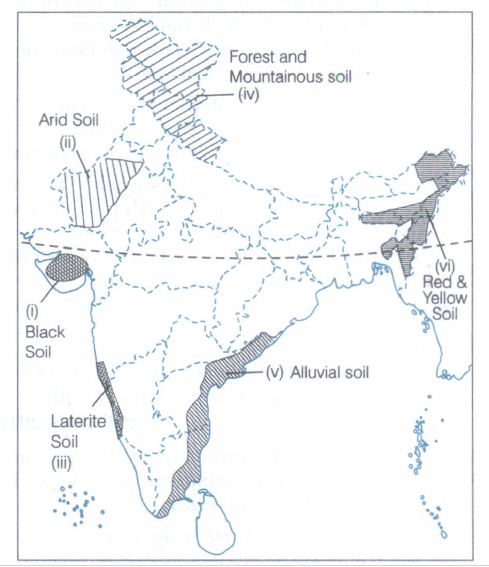
(I) Black soil (ii) Arid soil
(iii) Laterite soil (iv) Forest and Mountainous soil
(v) Alluvial soil (vi) Red and Yellow soil
10.
11.
Rapid improvement in technology has stimulated the globalisation process.
12.
There are six recognised national parties in India.
13.
Road Transport.
14.
Consumer Movement.
15.
Cost, government policies and specialized labour influence the location of industry.
16.
The fear of unemployment made workers hostile to the introduction of new technology.
17.
The rabi crops are grown due to the success of green revolution in Punjab, Haryana, western Uttar Pradesh and parts of Rajasthan.
18.
(i) Because landlords withdrew houses from the market.
(ii) Because of scarcity of land.
19.
It depends on country's population, size, global situation, cooperation from other countries, economic priorities adopted by the country, etc.
20.
(i) Himalayan Yew is a medicinal plant found in various parts of Himachal Pradesh and Arunachal Pradesh.
(ii) A chemical compound called 'taxol' is extracted from the bark, needles, twigs and roots of this tree.
(iii) This has been successfully used to treat some cancers.
(iv) The drug is now the biggest selling anti-cancer drug in the world.
(v) The spices is under great threat due to over-exploitation.
(vi) In the last one decade, thousands of yew trees have dried up in various parts of Himachal Pradesh and Arunachal Pradesh.
21.
The use of non-conventional sources of energy is becoming necessary in our country because of the following reasons:
(a) Rising prices of oil and gas.
(b) To save environmental pollution
(c) As a renewable source of energy
22.
(i) Under the Unitary system, either there is only one level of government or the sub units are subordinate to the central government.
(ii) The Central government can pass on orders to the provincial or the local government.
(iii) But in a federal system, the central government cannot order the state government to do something
(iv) State government has powers of its own which it is not answerable to the central government.
(v) Both these governments are separately answerable to the people.
23.
Getting jobs difficult, even mills multiplied and the demand for workers increased. The numbers seeking work more than the jobs available. Entry into the mills was also restricted. Industrialists usually employed a jobber to get new recruits. Very often, the jobber was an old and trusted worker. He got people from his village, ensured them jobs, helped them settle in the city and provided them money in times of crisis. The jobber, therefore became a person with some authority and power. He began demanding money and gifts for his favour, and began controlling the lives of the workers.
24.
(i) Textbooks for the civil service examination were printed in vast numbers under the sponsorship of the imperial state.
(ii) Merchants used print in their everyday life as they collected trade information.
(iii) The new readership preferred fictional naratives, poetry, romantic plays.
(iv) Rich women began to read and many women began publishing their poetry and plays.
25.
Many countries even now are not democratic. They have to make a transition from other forms of governments to democracy and then instituting democratic governments. Such countries face the foundational challenge.
26.
Charlotte Bronte was an English novelist. Her novels dealt with women who broke the established norms of the society before adjusting to them. Such stories allowed women readers to sympathise with rebellious actions. In Charlotte Bronte's, Jane Eyre, published in 1874, young Jane is shown as independent and assertive woman or girl. While girls of her time were expected to be quiet and well behaved, Jane at the age of ten protests, against the hypocrisy of her elders with startling bluntness. She tells her aunt, who is always unkind to Jane: "People think you a good woman, but you ar bad You are deceitful! I will never call you aunt as long as I live."
27.
()
The French built canals and draining land in order to increase cultivation. The vast system of irrigation was meant to increase rice production in Vietnam. Surplus rice could be exported to Europe. This export trade was proved highly profitable to the French.

10th Standard CBSE Syllabus & Materials
10th Standard CBSE
CBSE 10th Social Science PS - Federalism - New Model Questions Papers Study Material - QB365 Set A
NEW10th Standard CBSE
CBSE 10th Social Science PS - Power Sharing - New Model Questions Papers Study Material - QB365 Set A
NEW10th Standard CBSE
CBSE 10th Social Science GEO - Manufacturing Industries - New Model Questions Papers Study Material - QB365 Set A
NEW10th Standard CBSE
CBSE 10th Social Science GEO - Minerals and Energy Resources - New Model Questions Papers Study Material - QB365 Set A



NCERT Books

Syllabus

Exam Pattern

Sample Question Papers

Previous year Question Papers

Important Notes

MCQ Practice test

NCERT Exemplers

Case study Questions

Image Based Questions

Passage based Questions

HOT Questions

Value Based Questions

Model Questions Papers
NCERT ( Book Back ) Questions

Assertion and Reason
Important Questions And Answers

CBSE 10th Standard CBSE Subjects
CBSE Standards