
 100% FREE ACCESS
10th Standard Syllabus & Materials
10th Standard
TN 10th English Prose - 4 - The Attic Important Questions And Answers Study Material - QB365 Set A
NEW10th Standard
TN 10th English Supplementary - 3 - The Story of Mulan Important Questions And Answers Study Material - QB365 Set A
NEW10th Standard
TN 10th English Poem - 3 - I am Every Woman Important Questions And Answers Study Material - QB365 Set A
NEW10th Standard
TN 10th English Prose - 3 - Empowered Women Navigating The World Important Questions And Answers Study Material - QB365 Set A
NEW10th Standard
TN 10th English Supplementary - 2 - Zigzag Important Questions And Answers Study Material - QB365 Set A
NEW10th Standard
TN 10th English Poem - 2 - The Grumble Family Important Questions And Answers Study Material - QB365 Set A
Published on: 13/05/2022
QB365 provides detailed and simple solution for every book back questions in class 10 Maths subject.It will helps to get more idea about question pattern in every book back questions with solution.
latest Book back QuestionsDownload Tamil Nadu 10th Standard Maths question papers, model tests, one-mark questions, important questions, and public exam papers in PDF format. Free study materials and answer keys for TN State Board students.
Questions + Answers key
Take MCQ Maths Test1.
Find f o g and g and g o f when f(x) = 2x + 1 and g(x) = x2 - 2
2.
Let A = The set of all natural numbers less than 8, B = The set of all prime numbers less than 8, C = The set of even prime number. Verify that
A x ( B - C) = (A x B) - (A x C)
3.
Let A = {x \(\in \) W| x < 2}, B = {x \(\in \) N| 1 < x ≤ 4} and C = (3,5). Verify that
(A U B) x C = (A x C) U (B x C)
4.
The functions f and g are defined by f(x) = 6x + 8; g(x) = \(\frac { x-2 }{ 3 } \)
i. Calculate the value of gg\(\left( \frac { 1 }{ 2 } \right) \)
ii. Write an expression for gf(x) in its simplest form.
5.
If f(x) = \(\frac { x-1 }{ x+1 } \), x ≠ 1 show that f(f(x)) = -\(\frac{1}{x}\), provided x ≠ 0.
6.
Let A = {1, 2} and B = {1, 2, 3, 4}, C = {5, 6} and D = {5, 6, 7, 8}, Verify whether A x C is a subset of B x D?
7.
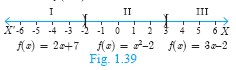
If the function f: R⟶ R defined by
\(f(x)=\left\{\begin{array}{l} 2 x+7, x<-2 \\ x^{2}-2,-2 \leq x<3 \\ 3 x-2, x \geq 3 \end{array}\right.\)
(i) f( 4)
(ii) f( -2)
(iii) f(4) + 2f(1)
(iv) \(\frac { f(1)-3f(4) }{ f(-3) } \)
8.
Given the function f:x ⟶ x2- 5x + 6, evaluate
i) f( -1)
ii) f (2a)
iii) f (2)
iv) f (x - 1)
9.
Let A = {x \(\in \) W| x < 2}, B = {x \(\in \) N| 1 < x ≤ 4} and C = (3,5). Verify that
A x (B U C) = (A x B) U (A x C)
10.
Given A = {1,2,3}, B = {2,3,5}, C = {3,4} and D = {1,3,5}, check if (A ∩ C) x (B ∩ D) = (A x B) ∩ (C x D) is true?
1.
f(x) = 2x + 1,g(x) = x2 - 2
f o g(x) = f(g(x) = f(x2 - 2) = 2(x2- 2) + 1 = 2x2 - 3
g o f(x) = g(f(x) = g(2x + 1) = (2x + 1)2-2 = 4 = x2 + 4x - 1
Thus f o g = 2x2 - 3,g o f = 4x2 + 4x-1 .From the above, we see that f o g ≠ g o f.
2.
Given
A = {1,2,3,4,5,6,7}
B = {2,3,5,7}
C = {2}
A x ( B - C) = (A x B) - (A x C)
B - C = {2,3,5,7} - {2}
= {3,5,7}
A x (B-C) = {1,2,3,4,5,6,7} x {3.5.7}
={(1,3),(1,5),(1,7),(2,3),(2,5),(2,7) (3,3),(3,5),(3,7),(4,3),(4,5),(4,7) (5,7),(5,3),(5,5) (6,3),(6,5),(6,7),(7,3),(7,5),(7,7)} ....(1)
A x B = {1,2,3,4,5,6,7} x {2,3,5,7}
= {(1,2),(1,3),(1,5),(1,7),(2,2),(2,3),(2,5),(2,7) (3,2),(3,3),(3,5),(3,7),(4,2),(4,3),(4,5),(4,7) (5,2),(5,3),(5,5),(5,7),(6,2),(6,3),(6,5),(6,7) (7,2),(7,3),(7,5),(7,7)}
A x C = {1,2,3,4,5,6,7} x {2}
= {(1,2),(2,2),(3,2),(4,2),(5,2)(6,2),(7,2)}
(A x B) - (A x C) = {(1,3),(1,5),(1,7),(2,3) (2,5),(2,7),(3,3),(3,5) (3,7),(4,3),(4,5),(4,7), (5,3),(5,5),(5,7),(6,3) (6,5),(6,7),(7,3),(7,5),(7,7)} ..(2)
From (1) and (2), it is clear that
A x ( B - C) = (A x B) - (A x C)
Hence verified
3.
(A U B) x C = (A x C) U (B x C)
A = {0,1} , B = {2,3,4} , C = {3,5}
\(A\cup B\) = {0,1,2,3,4}
\((A\cup B)\times C\) = {0,1,2,3,4} x {3,5}
= {(0,3),(0,5),(1,3),(1,5),(2,3),(2,5),(3,3),(3,5),(4,3),(4,5)} ...(1)
A x C = {0,1} x {3,5}
= {(0,3),(0,5),(1,3),(1,5)}
B x C = {2,3,4} x {3,5}
= {(2,3),(2,5),(3,3),(3,5),(4,3),(4,5)}
\((A\times C)\cup (B\times C)\) = {(0,3),(0,5),(1,3),(1,5),(2,3),(2,5),(3,3),(3,5),(4,3),(4,5)} .....(2)
From (1) and (2), it is clear that
(A U B) x C = (A x C) U (B x C)
Hence verified.
4.
f(x) = 6x + 8 , \(g(x)=\frac { x-2 }{ 3 } \)
(i) \(g\left(\frac{1}{2}\right)=\frac{\frac{1}{2}-2}{3}=\frac{1-4}{2 \times 3}=-\frac{3}{6}=-\frac{1}{2}
\)
\(\therefore \ g g\left(\frac{1}{2}\right)=g\left[g\left(\frac{1}{2}\right)\right]
\)
\(=g\left(-\frac{1}{2}\right)=\frac{-\frac{1}{2}-2}{3}=-\frac{1-4}{2 \times 3}=-\frac{5}{6}
\)
(ii) gf (x) = g [f (x)] = g [6x + 8]
\(=\frac{6 x+8-2}{3}=\frac{6 x+6}{3}
\)
\(=\frac{6(x+1)}{3}=2(x+1)
\)
5.
\(f(x)=\frac { x-1 }{ x+1 } ,x\neq 0\)
\(f(f(x))=f\left( \frac { x-1 }{ x+1 } \right) =\frac { \left( \frac { x-1 }{ x+1 } \right) -1 }{ \left( \frac { x-1 }{ x+1 } \right) +1 } \)
\(=\frac{\frac{\not x-1-x-1}{(\not x+1)}}{\frac{\not x-1+x+1}{(\not x+1)}}=\frac{-2}{2 x}=\frac{-1}{x}\)
Hence it is proved.
6.
A = {1, 2),B = {1, 2, 3, 4}, C = {5, 6},D = {5, 6, 7, 8}
A x C = {1, 2} x {5, 6}
\(\mathrm{A} \times \mathrm{C}=\{(1,5),(1,6),(2,5),(2,6)\}\)
B x D = { 1, 2, 3, 4} x { 5, 6, 7, 8}
\(\begin{array}{r} \mathrm{B} \times \mathrm{D}=\{({1,5}),(1,6),(1,7),(1,8) ({2,5}),(2,6),(2,7),(2,8) (3,5),(3,6),(3,7),(3,8) (4,5),(4,6),(4,7),(4,8)\} \end{array}\)
(A x C) is a subset of (B x D)
7.
The function f is defined by three values in intervals I, II, III as shown by the side.
For a given value of x = a, find out the interval at which the point a is located, there after find
f(a) using the particular value defined in that interval.
(i) First, we see that, x = 4 lie in the third interval.
Therefore, f(x) = 3x - 2; f(4) = 3(4) = 10
(ii) x = -2 lies in the second interval
Therefore, f(x) = x2 - 2; f(-2) = (-2)2 - 2 = 2
(iii) From (i), f(4) =10.
To find f(1) first we see that x = 1 lies in the second interval.
Therefore, f(x) = x2-2 ⇒ f(1) = 12 - 2 = -1
So, f(4) + 2f(1) = 10 + 2(-1) = 8
(iv) We know that f(1) = -1 and f(4) = 10
For finding f(-3), we see that x = −3, lies in the first interval.
Therefore, f(x) = 2x + 7; thus, f(-3) = 2(-3) + 7 = 1
Hence, \(\frac { f(1)-3f(4) }{ f(-3) } =\frac { -2-3(10) }{ 1 } \) = - 31
8.
Given the function f: x ⟶ x2 - 5x + 6.
i) f(-1) = (-1)2 - 5(-1) + 6 = 1 + 5 + 6 = 12
ii) f(2a) = (2a)2 - 5(2a) + 6 = 4a2 - 10a + 6
iii) f(2) = 22 - 5(2) + 6 = 4 - 10 + 6 = 0
iv) f (x - 1)2 - 5(x - 1) + 6
= x2- 2x + 1 - 5x + 5 + 6
= x2-7x + 12
9.
Given A = {x \(\in \) W| x < 2} A = {0,1}
B = {x \(\in \) N| 1 < x ≤ 4} B = {2,3,4}
C = {3,5}
A x (B U C) = (A x B) U (A x C)
\(B\cup C\) = {2,3,4,5}
A x (B U C) = {0,1} x {2,3,4,5}
= {{0,2},(0,3),(0,4),(0,5),(1,2),(1,3),(1,4),(1,5)} ...(1)
A x B = {0,1} x {2,3,4}
= {(0,2),(0,3),(0,4),(1,2),(1,3),(1,4)}
A x C = {0,1} x {3,5}
= {{0,3},(0,5),(1,3),(1,5)}
\((A\times B)\cup (A\cup C)\) = {(0,2),(0,3),(0,4),(0,5),(1,2),(1,3),(1,4),(1,5)} ...(2)
From (1) and (2),it is clear that
\(A\times (B\cup C)=(A\times B)\cup (A\times C)\)
Hence verified
10.
Given: A = {1,2,3} , B = {2,3,5} , C = {3,4} ,D = {1,3,5}
\(A\cap C\) = {3}
\(B\cap D\) = {3,5}
\((A\cap C)\times(B\cap D)=\{ 3\} \times \{ 3,5\} \)
= {(3,3),(3,5)} ..(1)
A x B = {(1,2),(1,3),(1,5),(2,2),(2,3),(2,5),(3,2),(3,3),(3,5)}
C x D = {(3,1),(3,3),(3,5),(4,1),(4,3),(4,5)}
\((A\times B)\cap (C\times D)\) = {(3,3),(3,5)} ....(2)
From (1) and (2),it is clear that
(A ∩ C) x (B ∩ D) = (A x B) ∩ (C x D)
Hence it is true.

10th Standard Syllabus & Materials
10th Standard
TN 10th English Prose - 2 - The Night the Ghost Got in Important Questions And Answers Study Material - QB365 Set A
NEW10th Standard
TN 10th English Supplementary - 1 - The Tempest Important Questions And Answers Study Material - QB365 Set A
NEW10th Standard
TN 10th English Poem - 1 - Life Important Questions And Answers Study Material - QB365 Set A
NEW10th Standard
TN 10th English Prose - 1 - His First Flight Important Questions And Answers Study Material - QB365 Set A



Tamilnadu Stateboard 10th Standard Subjects
Tamilnadu Stateboard Standards