 100% FREE ACCESS
11th Standard CBSE Syllabus & Materials
11th Standard CBSE
CBSE 11th Economics PART-A - Presentation of Data - New Sample Question Papers Study Material - QB365 Set A
NEW11th Standard CBSE
CBSE 11th Economics PART-A - Organisation of Data - New Sample Question Papers Study Material - QB365 Set A
NEW11th Standard CBSE
CBSE 11th Economics PART-A - Collection of Data - New Sample Question Papers Study Material - QB365 Set A
NEW11th Standard CBSE
CBSE 11th Economics PART-A - Introduction to Economics and Statistics - New Sample Question Papers Study Material - QB365 Set A
NEW11th Standard CBSE
CBSE 11th Business Studies International Trade Sample Question Papers Study Material - QB365 Set A
NEW11th Standard CBSE
CBSE 11th Business Studies Evolution and Fundamentals of Business Sample Question Papers Study Material - QB365 Set A
Published on: 21/10/2025
Download CBSE Class 11th Standard CBSE Biology question papers, sample papers, important questions, and previous year solved papers in PDF format. Get free study materials, NCERT solutions, and exam preparation resources for Class 11th Standard CBSE Biology
Questions + Answers key
Take MCQ Biology Test
1.
Explain the nature of bonds linking monomers in a polymer.
2.
What are main essential elements and what is their role in plants?
3.
Calcium plays a very important role in the formation of bones. Write about the role of endocrine glands and hormones responsible for maintaining calcium homoeostasis.
4.
The glomerular filtrate in the loop of Henle gets concentrated in the descending and then gets diluted in the ascending limbs.Explain
5.
Six turns of Calvin cycle are required to generate one mole of glucose. Explain.
6.
The diagram shows some of the structures present in an animal cell.
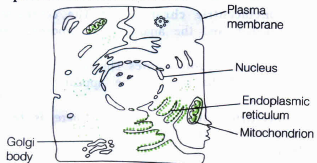
Which of these structures is responsible for
(i) Manufacture of lipids and steroids
(ii) Release of energy
(iii) Manufacture of hormones and digestive enzymes
(iv) Production of spindle fibres in cell division
(v) Endo and exocytosis?
7.
Describe the various types of placentations found in flowering plants.
8.
Write an account of general features of roundworms.
9.
Algae are known to reproduce asexually by a variety of spores under different environmental condition. Name these spores and the conditions under which they are produced.
10.
Some of the properties of tissues are not the properties of constituents of its cells. Give three examples to support the statement.
1.
Nature of bond linking monomers in a polymer
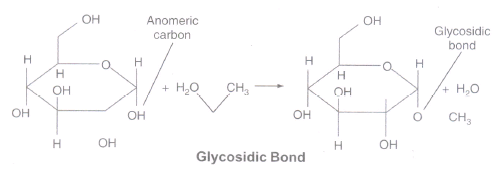
Glycosidic Bond.
A glycosidic bond is a certain type of functional group that joins a carbohydrate (sugar) molecule to another group, which may or may not be another carbohydrate.
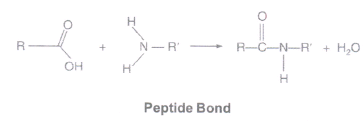
Peptide Bond. A peptide bond (amide bond) is a chemical bond formed between two molecules when the carboxyl group of one molecule reacts with the amine group of the other molecule, thereby releasing a molecule of water (H2O). This is a dehydration synthesis reaction (also known as a condensation reaction) and usually occurs between amino acids. The resulting CO - NH bond is called a peptide bond, and the resulting molecule is an amide. The four-atom functional group - C(=O) NH-is called an amide group or (in the context of proteins) a peptide group. Polypeptides and proteins are chains of amino acids held together by peptide bonds, as is the backbone of PNA. Polyamides, such as nylons and aramids, are synthetic molecules (polymers) that possess peptide bonds.
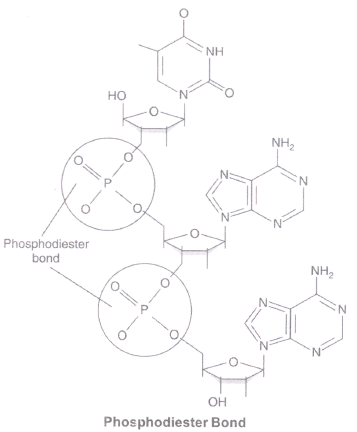
Phosphodiester Bond.
A phosphodiester bond is a group of strong covalent bonds between a phosphate group and two other molecules over two ester bonds. Phosphodiester bonds are central to all life on Earth, as they make up the backbone of the strands of DNA. In DNA and RNA, the phosphodiester bond is the linkage between the 3' carbon atom of one sugar molecule and the 5' carbon of another, deoxyribose in DNA and ribose in RNA.
2.
Macro- and Micro-nutrients and their roles
1. Nitrogen. This is the mineral element required by plants in the greatest amount. It is absorbed mainly as NO3- though some are also taken up as NO2 or NH4+. Nitrogen is required by all parts of a plant, particularly the meristematic tissues and the metabolically active cells. Nitrogen is one of the major constituents of proteins, nucleic acids, vitamins and hormones.
2. Phosphorus. Phosphorus is absorbed by the plants from soil in the form of phosphate ions (either as H2POor HPO). Phosphorus is a constituent of cell membranes, certain proteins, all nucleic acids and nucleotides, and is required for all phosphorylation reactions.
3. Potassium. It is absorbed as potassium ion (K+).In plants, this is required in more abundant quantities in the meristematic tissues, buds, leaves and root tips. Potassium helps to maintain an anion-cation balance in cells and is involved in protein synthesis, opening and closing of stomata, activation of enzymes and in the maintenance of the turgidity of cells.
4. Calcium. Plant absorbs calcium from the soil in the form of calcium ions (Ca2+). Calcium is required by meristematic and differentiating tissues. During cell division it is used in the synthesis of cell wall, particularly as calcium pectate in the middle lamella. It is also needed during the formation of mitotic spindle. It accumulates in older leaves. It is involved in the normal functioning of the cell membranes. It activates certain enzymes and plays an important role in regulating metabolic activities.
5. Magnesium. It is absorbed by plants in the form of divalent Mg2+.It activates the enzymes of respiration, photosynthesis and are involved in the synthesis of DNAand RNA.Magnesium is a constituent of the ring structure of chlorophyll and helps to maintain the ribosome structure.
6. Sulphur. Plants obtain sulphur in the form of sulphate (SO) . Sulphur is present in two amino acids - cysteine and methionine and is the main constituent of several coenzymes, vitamins (thiamine, biotin, Coenzyme A) and ferredoxin.
7. Iron. Plants obtain iron in the form of ferric ions (Fe3+).It is required in larger amounts in comparison to other micronutrients. It is an important constituent of proteins involved in the transfer of electrons like ferredoxin and cytochromes. It is reversibly oxidised from Fe2+to Fe3+during electron transfer. It activates catalase enzyme, and is essential for the formation of chlorophyll.
8. Manganese. It is absorbed in the form of manganous ions (Mn2+).It activates many enzymes involved in photosynthesis, respiration and nitrogen metabolism. The best defined function of manganese is in the splitting of water to liberate oxygen during photosynthesis.
9. Zinc. Plants obtain zinc as Zn2+ions. It activates various enzymes, especially carboxylases. It is also needed in the synthesis of auxin.
10. Copper. It is absorbed as cupric ions (Cu2+).It is essential for the overall metabolism in plants. Like iron, it is associated with certain enzymes involved in redox reactions and is reversibly oxidised from Cu' to Cu2+.
11. Boron. It is absorbed as BO or B4O. Boron is required for uptake and utilisation of Ca2+, membrane functioning, pollen germination, cell elongation, cell differentiation and carbohydrate translocation.
12. Molybdenum. Plants obtain it in the form of molybdate ions (MoO). It is a component of several enzymes, including nitrogenase and nitrate reductase both of which participate in nitrogen metabolism.
13. Chlorine. It is absorbed in the form of chloride anion (Cl]. Along with Na+ and K+,it helps in determining the solute concentration and the anioncation balance in cells. It is essential for the water-splitting reaction in photosynthesis, a reaction that leads to oxygen evolution.
3.
The endocrine glands and hormones that are responsible for maintaining calcium homeostasis, are thyroid and parathyroid glands and their associated hormones an calcitonin and Parathyroid Hormone (PTH).
(i) Parathyroid glands are the glands developed from the endoderm of the embryo The cells of parathyroid glands are of two types, i.e., chief cells and oxyphil cells. Thr chief cells of the parathyroid glands secrete parathyroid hormone (PTH).
This hormone (PTH) is involved in regulating calcium and phosphate balance betweer the blood and other tissue. It mobilises the release of calcium into the blood from bones. PTH increases calcium reabsorption by the body organs like intestine anc kidneys.
(ii) Thyroid gland is the largest endocrine gland located anterior to the thyroid cartilage o. the larynx in the neck. This gland plays a vital role in maintaining calcium homeostasis It releases thyroculcitonin hormone produced by the parafollicular cells, also called 'C cells.
This hormone is secreted when the calcium level in blood gets high. It is a 32 aminc acid peptide hormone that lowers the calcium level by suppressing release of catciurr ions from the bones. Thus, calcitonin has an action opposite to that of the parathyroic hormone on calcium homeostasis.

4.
The gradient of increasing hyperosmolarity of medullary interstitium is maintained by a counter current mechanism and the proximity between the Henle's loop and vasa recta.
This gradient is mainly caused by NaCl and urea.The transport of these substances facilitated by the special arrangement of Henle's loop and vasa recta is called the counter current mechanism.
NaCl is transported by the ascending limb of Henle's loop, which is exchanged with the descending limb of vasa recta.NaCl is returned to the medullary interstitium by the ascending part of the vasa recta.
But,contrarily, the water diffuses into the blood of ascending limb of vasa recta and is carried away into the general blood circulation.
Permeability to urea is found only in the deeper parts of thin ascending limbs of Henle's loops and collecting ducts.Urea diffuses out of the collecting ducts and enters into the thin.
5.
Calvin cycle is a series of reactions that leads to the formation of glucose. The steps involve utilisation of 2 molecules of ATP for phosphorylation and 2 of NADPH for reduction per CO2 molecule fixed. The fixation of six molecules of CO2 and six turns of the cycle are required for the synthesis of one molecule of glucose through these reactions.
Hence, for every CO2 molecule entering the Calvin cycle, 3 molecules of ATP and 2 of NADPH are required. It is probably to meet this difference in number of ATP and NADPH used in the dark reaction that the cyclic phosphorylation takes place. To make one molecule of glucose six turns of the cycle are required.
6.
Structures responsible are
(i) Smooth endoplasmic Reticulim (SER) is responsible for the manufacture of lipids and steroids.
(ii) Mitochondrion is responsible for the release of energy.
(iii) Ribosomes is responsible for the production of hormones and digestive enzymes.
(iv) Centrioles is responsible for production of spindle fibres.
(v) Plasma membrane is responsible for endo and exocytosis.
7.
The arrangement of ovules within the ovary is called placentation.
It is the following types
(i) Marginal The placenta forms a ridge along the ventral suture and ovules are borne on the ridge,
e.g., pea, bean etc
(ii) Axile The margins of the carpels fuse to form a central axis on which the ovules are attached.
e.g., Hibiscus, Citrus, etc.
(iii) Parietal The placnta develops on the ovary wall,
e.g., Cucurbita.
(iv) Basal The placenta arises from the base of the unilocular ovary and bears a single ovule,
e.g., sunflower
(v) Free-Central The ovules are borne on central axis and septa are ansent, e.g., primrose.
8.
General features of roundworms are
(i) The body is cylindrical and tapering at both ends.
(ii) No segmentation.
(iii) Bilateral symmetry
(iv) They have organ system level of organisation
(v) The anterior end does not form a distinct head
(vi) There are no locomotory appendages in roundworms
(vii) The body wall consists of firm, non-living, resistant cuticle, epidermis and muscle layer.
(viii) These are pseudocoelomates.
(ix) Hydroskeleton is present.
(x) Digestive tract is complete.Respiration occurs by body surface.
(xi) Circulatory system is undeveloped.Excretion occurs through gland cells.
(xii) Sexes are separate.Sexual dimorphism is present. Fertilisation is internal.There is no asexual reproduction.
(xiii)Development is direct.
9.
Zoospores Flagellate spores, under favourable conditions.
Aplanospores Non-flagellate, thin-walled spores under approaching unfavourable condition.
Hypnospores Thin-walled, resting spores in unfavourable condition.
Akinetes Thin-walled and thick-walled spores formed from whole cells in unfavourable conditions.
Autospores Spores which look exactly parent cell formed under favourable conditions.
10.
A living thing has multiple levels of organisation. Each lavel of organisation has its own properties, which are not found in its constituents.
Examples of three tissues supporting the statements are
(i) Cardiac Muscle Tissue : It is contractile tissue present only in heart. Cell junctions fuse the plasma membrane of cardiac muscle cells and make them stick together. When one cell receives a signal to contract. It means a single cell cannot contract, while there are some fusion points, which allow the cells to contract as a unit.
(ii) Blood : It is a fluid connective tissue. The individual components of blood, i.e., RBCs, WBCs and platelets have different properties but as a unit they make the blood, a tissue serving many functions.
(iii) Bone : It is a hard connective tissue that forms the framework of the body. The individual cells inside the bone do not have this property.

11th Standard CBSE Syllabus & Materials
11th Standard CBSE
CBSE 11th Business Studies Forms of Business Organisation Sample Question Papers Study Material - QB365 Set A
NEW11th Standard CBSE
CBSE 11th Business Studies Business, Trade and Commerce Sample Question Papers Study Material - QB365 Set A
NEW11th Standard CBSE
CBSE 11th Physics Waves Sample Question Papers Study Material - QB365 Set A
NEW11th Standard CBSE
CBSE 11th Physics Kinetic Theory Sample Question Papers Study Material - QB365 Set A

NCERT Books

Syllabus

Exam Pattern

Sample Question Papers

Previous year Question Papers

Important Notes

MCQ Practice test

NCERT Exemplers

Case study Questions

Image Based Questions

Passage based Questions

HOT Questions

Value Based Questions

Model Questions Papers
NCERT ( Book Back ) Questions

Assertion and Reason
Important Questions And Answers

CBSE 11th Standard CBSE Subjects
CBSE Standards