 100% FREE ACCESS
11th Standard CBSE Syllabus & Materials
11th Standard CBSE
CBSE 11th Economics PART-A - Presentation of Data - New Sample Question Papers Study Material - QB365 Set A
NEW11th Standard CBSE
CBSE 11th Economics PART-A - Organisation of Data - New Sample Question Papers Study Material - QB365 Set A
NEW11th Standard CBSE
CBSE 11th Economics PART-A - Collection of Data - New Sample Question Papers Study Material - QB365 Set A
NEW11th Standard CBSE
CBSE 11th Economics PART-A - Introduction to Economics and Statistics - New Sample Question Papers Study Material - QB365 Set A
NEW11th Standard CBSE
CBSE 11th Business Studies International Trade Sample Question Papers Study Material - QB365 Set A
NEW11th Standard CBSE
CBSE 11th Business Studies Evolution and Fundamentals of Business Sample Question Papers Study Material - QB365 Set A

Published on: 21/10/2025
Download CBSE Class 11th Standard CBSE Biology question papers, sample papers, important questions, and previous year solved papers in PDF format. Get free study materials, NCERT solutions, and exam preparation resources for Class 11th Standard CBSE Biology
Questions + Answers key
Take MCQ Biology Test
1.
How many molecules of ATP is generated after oxidation of 1molecule of glucose during cellular respiration?
2.
Name the hormones involved in photoperiodism.
3.
Identify and complete the equations given below.
\((i)\quad { 2NH }_{ 3 }+3O_{ 2 }\overset { ? }{ \longrightarrow } { 2NO }_{ 2 }^{ - }+{ 2H }^{ + }+2H_{ 2 }O\)
\((ii) \begin{matrix} ? \\ - \end{matrix}+O_{ 2 }\overset { Nitrobacter }{ \longrightarrow } { 2NO }_{ 3 }^{ - }\)
4.
Can there be DNA replication without cell division?
5.
What does'S' refer to, in 70 Sand 80 S ribosomes?
6.
Justify the name pseudo stratified epithelium
7.
Give two examples of lateral meristem in plants.
8.
Fill in the following blanks in the table by giving correct information.
| Family | Flower | Androecium | Gynoecium | Floral formula |
| Fabaceae | (i) Zygomorphic | (ii)..................... | (iii) Monocarpellary | (iv).................. |
| Solanaceae | (v)..................... | (vi)Polyandrous | (vii).................. | Ebr\(\oplus { K }_{ (5) }{ C }_{ (5) }{ A }_{ (5) }{ G }_{ (2) }\) |
| Liliaceae | (ix) Actinomorphic | (x) Epiphyllus | (xi)..................... | (xii) Br or Ebr \(\oplus \)3+3\(3+3A_{ 3+3 }g(3)\) |
9.
Given below are types of cells present in some animals each one is specialised to perform a single function.
(a) choanocytes
(b) interstitial cells
(c) gastrodermal cells
(d) nematocytes
10.
In which virus two single strands RNA are present? What is the role of reverse transcriptase?
11.
Why are living organisms classified?
12.
How does the nervous system control the activities of gastro-intestinal tract?
13.
How does meiosis facilitate creation of off springs, with distinct characters?
14.
During a college tour; while travelling at a higher altitude of maintains, Vijay complains of dizziness and vomiting sensation. The guide took him to the doctor. The doctor after diagnosing him gave some medicines and explained that it happened due to the change In air pressure, as we go towards the higher altitude,
(i) What is the cause of Vijay's sickness?
(ii) Which of the sensory organ get disturbed during the journey?
(iii) Name the part of the ear that maintains the air pressure.
(iv) What values did the guide possess?
15.
Briefly, describe water potential. what are at the factors affecting it?
16.
Justify the statement Euglena is a taxonomic puzzle.
17.
Describe phylum Coelenterata. Give suitable examples.
18.
Distinguish between
(a) IRV and ERV
(b) Inspiratory capacity and Expiratory capacity.
(c) Vital capacity and Total lung capacity.
19.
It is an old saying that monkeys are the forefathers of human. Describe in detail in support of this saying.
20.
Define and understand the following terms:
(i) Phylum
(ii) Class
(iii) Family
(iv) Order
(v) Genus
21.
RuBisCO is an enzyme that acts both as a carboxylase and oxygenase. Why do you think RuBisCO carries out more carboxylation in C4 plants?
22.
Observe the given figure and answer the following questions.
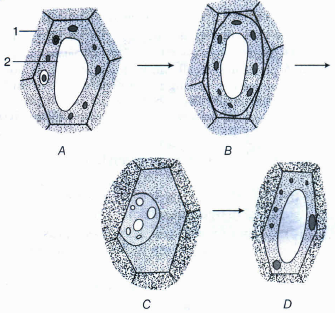
(i) State the nature of the solution marked (1).
(ii) What process has been depicted in figures C to D?
(iii) What will be present in the space marked as (2)?
(iv) In which figures turgor pressure will be zero?
(v) In which figures wall pressure will be positive?
23.
What are the functions of polysaccharides?
1.
Oxidation of one molecule of glucose molecule during cellular respiration generates 38 ATP molecules - 2 from glycolysis, 2 from Krebs cycle, and 34 from the electron transport system. Therefore, two glucose molecules can generate 76 ATP molecules.
2.
Florigen is the hormone involved in photoperiodism.It's chemical nature is not yet established. It induces flowering in plants.
3.
(i) Nitrosomonas
(ii) \({ 2NO }_{ 2 }^{ - }\)
4.
Yes, DNA replication takes place during the synthetic stage of interphase in the cell cycle. It is totally independent of cell division. After G2 -phase a cell may or may not enter into the M-phase.
There can be DNA replication without cell division. During cell division, the parent cell gets divided into two daughter cells. However, if there is a repeated replication of DNA without any cell division, then this DNA will keep accumulating inside the cell. This would increase the volume of the cell nucleus, thereby causing cell expansion. An example of DNA duplication without cell division is commonly observed in the salivary glands of Drosophila. The chromosome undergoing repeated DNA duplication is known as polytene chromosome.
5.
'S' or Svedberg unit, refers to the sedimentation coefficient.
6.
This epithelium is made up of a single layer of columnar cells but it appears as two layered . Hence it is named pseudo stratified epithelium
7.
Fascicular combium and phellogen ( cork cambium).
8.
(ii) Polyandrrous
(iii)Monocarpellary
(v) Actinomorphic
(vii) Bicarpellary
(xi) Tricarpellary
9.
Interstitial cells are reserve cells in coelenterates.They are also called as totipotent cells and can be converted into any type of cells or into a full of organism.
10.
HIV has two single RNA strands in its nucleoid. Reverse transcriptase enzyme catalyses the formation of DNA from RNA. It is found in some RNA viruses called retroviruses, e.g., HIV
11.
Living organisms are classified because
(i) there are millions of organisms on the earth, which need a proper system of classification for their easy identification and methodical studies.
(ii) A number of new organisms are discovered each year. They require a particular system to be identified and to find out their correct position in a group.
12.
The sight, smell and/or presence of food in the oral cavity can stimulate the secretion of saliva. Gastric and intestinal secretions are also stimulated by similar neural signals. Muscular activities of alimentary canal is coordinated by both local and CNS neural mechanisms. Hormonal control of secretion of digestive enzymes is carried out by local hormones.
13.
Meiosis happens during gametogenesis and as a result gametes have half the number of chromosomes. During fertilization, when gametes fuse together two different sets of chromosomes make a new set. This results in an offspring, who has distinct characters, compared to parents.
14.
(i) The cause of Vijay's sickness is the change of altitude in which there is change in the physiology of the body.
(ii) Internal ear gets affected which control balancing of body
(iii) Eustachian tube maintains the air pressure in the ear.
(iv) The guide is a very sensible person and is caring too.
15.
Water potential is the potential energy of water relative to pure free water (e.g., deionised water). It quantifies the tendency of water to move from one area to another due to osmosis, gravity, mechanical pressure or matrix effects including surface tension. Water potential is measured in units of pressure and is commonly represented by the Greek letter \(\Psi \)(psi). This concept has proved useful especially in understanding the water movement within plants, animals and soil.
Water potential of a cell is affected by both solute and pressure potential. The relationship between them is as follows
\({ \Psi }_{ w }={ \Psi }_{ s }+{ \Psi }_{ p }\)
16.
Euglena is a taxonomic puzzle since, it shows both plant and animal characters. Absence of cell wall is an animal feature and presence of chloroplast is a plant character of Euglena. It have mixotrophic nutrition. In the presence of sunlight it can photosynthesise its food and in the absence of sunlight, it behaves like a hetrerotroph by predating on other smaller organisms.
17.
Phylum - Coelenterata (Cnidaria)
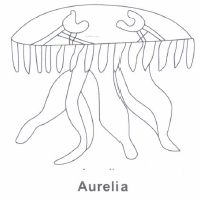
Habit and Habitat. They are aquatic, mostly marine, sessile or free-swimming, radially symmetrical animals. The name cnidaria is derived from the cnidoblasts or cnidocytes (which contain the stinging capsules or nematocytes) present on the tentacles and the body. Cnidoblasts are used for anchorage, defense and for the capture of prey.
Key Structural Features. Cnidarians exhibit tissue level of organisation and are diploblastic. They have a central gastro-vascular cavity with a single opening, hypostome. Digestion is extracellular and intracellular. Some of the cnidarians, e.g., corals have a skeleton composed of calcium carbonate.
Basic Body Forms. Cnidarians exhibit two basic body forms called polyp and medusa. Polyp is a sessile and cylindrical form like Hydra, Adamsia, etc. whereas,
medussa is umbrella-shaped and free-swimming like Aurelia or jelly fish. Those cnidarians which exist in both forms exhibit alternation of generation
(Metagenesis), i.e., polyps produce medusae asexually and medusae form the polyps sexually (e.g., Obelia).
Examples: Physalia (Portuguese man-of-war), Adamsia (Sea anemone), Pennatula (Sea-pen), Gorgonia (Sea-fan) and Meandrina (Brain coral).
18.
Part (a): IRV vs ERV
| Inspiratory Reserve Volume(IRV) | Expiratory Reserve Volume (ERV) |
| 1. The maximum volume of air that can be inhaled after normal inspiration is called inspiratory reserve volume. | 1. The maximum volume of air that can be forcefully exhaled after normal expiration is called expiratory reserve volume. |
| 2. The IRV of the human lungs is about 2500 - 3500 mL. | 2. The ERV of the human lungs is about 1000-1100 mL. |
Part (b): Inspiratory Capacity vs Expiratory Capacity
| Inspiratory capacity (IC) | Expiratory capacity (EC) |
| 1. It is the volume air that can be inhaled after normal expiration. | 1. It is the volume of air that can be exhaled after a normal inspiration. |
| 2. It includes tidal volume and inspiratory reserve volume | 2. It includes the tidal volume along with the expiratory reserve volume |
| 3. IC = TV + IRV | 3. EC = TV + ERV |
Part (c): Vital capacity vs Total lung capacity
| Vital capacity (VC) | Total lung capacity (TLC) |
| 1. It is the maximum volume of air that can be exhaled after maximum inspiration. | 1. It is the maximum volume of air in the lungs after maximum inspiration. |
| 2. IC + ERV = VC = 4000 mL in humans. | 2. TLC = IC + ERV + RV = 5000-6000 mL in humans. |
19.
Similarities between monkeys and man
i) Forelimbs are used for many purposes other than walking.
ii) Stereoscopic vision is well developed.
iii) Larger brain size compared to other mammals.
iv) Complex social life, involving interdependency among members.
v) Physical traits of male and female are remarkably different.
vi) The society can be patriarchal or matriarchal.
vii) Neonate takes longer time to develop leading to a longer lifespan.
viii) Presence of menstrual cycle in primates.
Differences between monkeys and man
i) Complete upright walking on hind limbs, which frees forelimbs for other usage.
ii) Ability to communicate using language.
iii) Thumbs can be brought opposite to other digits, enabling man to handle tools.
iv) More developed brain
Based on similarities it is evident that monkeys and human are closely related. On the other hand certain advanced properties of human indicate towards a more evolved species. It is clear that monkeys are primitive compared to humans but they are closely related. So it is often said that monkeys are the forefathers of human.
20.
(i) Phylum:
Phylum comes next to Kingdom in the taxonomical hierarchy. All broad characteristics of an animal or plant are defined in a phylum. For example, all chordates have a notochord and gill at some stage of life cycle. Similarly, all arthopods have jointed legs made of chitin.
(ii) Class:
A class includes related orders. Class defines more detailed characters other than broad architecture. For example, all mammals have mammary glands to secrete milk, have hairy body. All birds or aves have pneumatic bones to assist in flying. The common character among them is the presence of notochord thereby making them members of the same phylum.
(iii) Family:
(i) Family contains a group of related genera with less number of similarities as compared to genus and species.
(ii) All the genera of a family have some common or correlated features.
(iii) Let us take example of dog and fox. They are members of the same family
(iv) Order:
Order further zeroes down on characteristics and includes related genus. For example, humans and monkeys belong to the order Primates. Both humans and monkeys can use their hands to manipulate objects and can walk on their hind legs.
(v) Genus:
It comprises a group of related species which has more characters in common in comparison to species of other genera. We can say that genera are aggregates of closely related species. For example, potato, tomato and brinjal are three different species but all belong to the genus Solanum. Lion (Panthera leo), leopard (P. pardus) and tiger (P. tigris) with several common features, are all species of the genus Panthera. This genus differs from another genus Felis which includes cats.
21.
RuBisCO has a much greater affinity for CO2 than for O2 under normal conditions.It is the relative concentration of O2 and CO2 that determines which of the two will bind to the enzyme.
In C3-plants some O2 does bind to RuBisCo and hence, CO2 fixation is decreased.Here the RuBP instead of being converted to 2 molecules of PGA binds with O2 to form one molecule and phosphoglycolate in a pathway called photorespiration.In the photorespiratory pathway, there is neither synthesis of sugars, nor of ATP, rather it results in the release of CO2 with the utilization of ATP. In the photorespiratory pathway, there is no synthesis of ATP or NADPH. Therefore, photorespiration is a wasteful process.
In C,•plants, photorespiration does not occur. This is because they have a mechanism that increases the concentration of CO2 at the enzyme site. This takes place when the C, acid frorn the mesophyll is brcoe down in the bundle cells to release CO2this increasing the intracellular concentration ofCO2 turn, thís ensures that the RuBisCO functions carboxylase minimising the oxygenase activity
22.
(i) The solution marked as (1) will be hypertonic (more concentrated) due to which cell shrinks.
(ii) From C to D, figure is showing the process of deplasmolysis as shrinked cell has again regained its original shape.
(iii) In space marked as (2) hypotonic solution and water is present.
(iv) Turgor pressure will be zero in figure Band Cbecause cell is in a flaccid condition.
(v) Wall pressure will be positive in- figure A and D because in these figure cell wall is exerting equal and opposite pressure against the expanding protoplasm.
23.
The function of polysaccharides are
(i) Starch and glycogen are the major storage food of organic world.
(ii) On hydrolysis, storage carbohydrates provide both energy and carbon chains.
(iii) Chitin is the structural carbohydrate of fungal walls and exoskeleton of arthropods. (insects).
(iv) Cellulose is the structural substance of cell walls in most of the plants.
(v) Cellulose is economically important in the production of furniture, shelter, fuel, paper, textiles, ropes, rayon, cellophane, plastics, etc.

11th Standard CBSE Syllabus & Materials
11th Standard CBSE
CBSE 11th Business Studies Forms of Business Organisation Sample Question Papers Study Material - QB365 Set A
NEW11th Standard CBSE
CBSE 11th Business Studies Business, Trade and Commerce Sample Question Papers Study Material - QB365 Set A
NEW11th Standard CBSE
CBSE 11th Physics Waves Sample Question Papers Study Material - QB365 Set A
NEW11th Standard CBSE
CBSE 11th Physics Kinetic Theory Sample Question Papers Study Material - QB365 Set A



NCERT Books

Syllabus

Exam Pattern

Sample Question Papers

Previous year Question Papers

Important Notes

MCQ Practice test

NCERT Exemplers

Case study Questions

Image Based Questions

Passage based Questions

HOT Questions

Value Based Questions

Model Questions Papers
NCERT ( Book Back ) Questions

Assertion and Reason
Important Questions And Answers

CBSE 11th Standard CBSE Subjects
CBSE Standards