
 100% FREE ACCESS
11th Standard CBSE Syllabus & Materials
11th Standard CBSE
CBSE 11th Economics PART-A - Presentation of Data - New Sample Question Papers Study Material - QB365 Set A
NEW11th Standard CBSE
CBSE 11th Economics PART-A - Organisation of Data - New Sample Question Papers Study Material - QB365 Set A
NEW11th Standard CBSE
CBSE 11th Economics PART-A - Collection of Data - New Sample Question Papers Study Material - QB365 Set A
NEW11th Standard CBSE
CBSE 11th Economics PART-A - Introduction to Economics and Statistics - New Sample Question Papers Study Material - QB365 Set A
NEW11th Standard CBSE
CBSE 11th Business Studies International Trade Sample Question Papers Study Material - QB365 Set A
NEW11th Standard CBSE
CBSE 11th Business Studies Evolution and Fundamentals of Business Sample Question Papers Study Material - QB365 Set A

Published on: 21/10/2025
Download CBSE Class 11th Standard CBSE Chemistry question papers, sample papers, important questions, and previous year solved papers in PDF format. Get free study materials, NCERT solutions, and exam preparation resources for Class 11th Standard CBSE Chemistry
Questions + Answers key
Take MCQ Chemistry Test
1.
Convert:
(i) Ethylene to Nitrobenzene.
(ii) Write short note on Markovnikov's Rule.
2.
Give reasons:
(i) IE1 of sodium is lower than that of magnesium whereas IE2 of sodium is higher than that of magnesium.
(ii) Noble gases have the positive value of electron gain enthalpy.
3.
How would you justify the presence of 18 elements in the 5th period of the Periodic Table?
4.
Calculate the molarity of NaOH in the solution prepared by dissolving its 4 g in enough water to form 250ml. of the solution.
5.
What effect does branching of an alkane chain has on its boiling point?
6.
Express the following in the scientific notation:
(i) 0.0048
(ii) 234,000
(iii) 8008
(iv) 500.0
(v) 6.0012
7.
What are the various factors due to which the ionization enthalpy of the main group elements tends to decrease down a group?
8.
Which important property did Mendeleev use to classify the elements in his periodic table and did he stick to that?
9.
Calculate the percentage of N in NH3 molecule.
10.
(i) Explain the following reactions with suitable examples:
(a) Wurtz reaction
(b) Fittig reaction
(i) What happens when isobutyl chloride is reacted with alcoholic KOH?
(ii) Give one chemical test to distinguish between ethene and ethyne.
11.
What is the basic difference between the terms electron gain enthalpy and electronegativity?
12.
Dinitrogen and dihydrogen react with each other to produce ammonia according to the following chemical equation: N2 (g) + H2 (g) ⟶ 2NH3 (g)
(i) Calculate the mass of ammonia produced if 2.00 × 10³ g dinitrogen reacts with 1.00 × 10³ g of dihydrogen.
(ii) Will any of the two reactants remain unreacted?
(iii) If yes, which one and what would be its mass?
13.
Anything that influences the valence electrons will affect the chemistry of the element. Which one of the following factors does not affect the valence shell?
Valence principal quantum number (n)
Nuclear charge (Z)
Nuclear mass
Number of core electrons
14.
The aromatic compound among the following is ______.


All of these
15.
Which of the following statements is incorrect?
Mendeleev's arranged elements in horizontal rows and vertical columns
Mendeleev's arranged elements in order of their increasing atomic number
Mendeleev's system of classifying elements was more elaborate than that of Lother Meyer
None of the above
16.
The concentration of a solution or the amount of substance present in its given volume can be expressed in which of the following ways?
Mass per cent or weight per cent (w/w%)
Mole fraction or molarity
Molality
All of the above
17.
Which of the following statements is correct about the reaction given below?
\({ }_{4 \mathrm{Fe}}(s)+30_{2}(g) \longrightarrow 2 \mathrm{Fe}_{2} \mathrm{O}_{3}(g)\)
Total mass of iron and oxygen in reactants = total mass of iron and oxygen in product therefore it follows law of conservation of mass.
Total mass of reactants = total mass of product, therefore, law of multiple proportions is followed
Amount of Fe2O3 can be increased by taking anyone of the reactants (iron or oxygen) in excess
Amount of Fe2O3 produced will decrease if the amount of anyone of the reactants (iron or oxygen) is taken in excess.
18.
The peroxide effect in anti-Markovnikov addition involves ______.
The heterolytic fission of the double bond
The homolytic fission of the double bond
a free radical mechanism
an ionic mechanism
1.

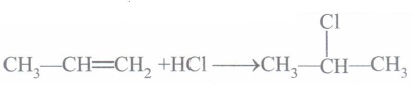
(ii) Markovnikov's Rule: When a polar compound is a unsymmetrical alkene or alkyne, negative part goes to least substituted carbon e.g.,
2.
(i) The effective nuclear charge of magnesium is higher than that of sodium. For these reasons, the energy required to remove an electron from magnesium is more than the energy required in sodium. Hence, the first ionization enthalpy of sodium is lower than that of magnesium. However, the second ionization enthalpy of sodium is higher than that of magnesium. This is because after losing an electron, sodium attains the stable noble gas configuration. On the other hand, magnesium, after losing an electron still has one electron.
(ii) Because of stable configuration.
3.
When n = 5, l = 0, 1, 2, 3. The order in which the energy of the available orbitals 4d, 5s and 5p increases is 5s < 4d < 5p. The total number of orbitals available are 9. The maximum number of electrons that can be accommodated is 18; and therefore 18 elements are there in the 5th period.
4.
Since molarity (M)
\(=\frac {\text{ number of moles of solute} }{ \text{volume of solution in litres } } \)
\(=\frac { \text{ Mass of NaOH Molar mass of NaOH } }{ 0.250L }\)
\(=\frac { 4g/40g }{ 0.250L } =\frac { 0.1mol }{ 0.250l } \)
= 0.4 mol L-1 = 0.4 M
Note that molarity of a solution depends upon temperature because volume of a solution is temperature dependent.
5.
Boiling points of alkanes
1. The boiling points of alkanes rise as the number of carbons increases.
2. Since nonane has a longer carbon chain than octane, it will have a higher boiling point.
Effect of branching on the boiling point of alkane
1. As an alkane chain branch, the surface area of the molecule decreases.
2. The intermolecular force reduces as a result of this.
3. At a lower temperature, the forces can be readily overcome.
4. Therefore, as the branching increases, the boiling point of an alkane chain decreases.
6.
(i) 0.0048 = 4.8× 10⁻³
(ii) 234, 000 = 2.34 ×10⁵
(iii) 8008 = 8.008 ×10³
(iv) 500.0 = 5.000 × 10²
(v) 6.0012 = 6.0012
7.
The ionisation enthalpy of the main group elements decreases regularly on moving down the group due to the following two factors.
(i) Atomic size On moving down the group,atomic size increases due to the addition of new higher energy shell.As a result of this, forces of attraction of nucleus for valence electrons decrease and ionisation enthalpy also decreases.
(ii) Screening effect On moving down the group, screening effect or shielding effect increases, so ionisation enthalpy decreases (because forces of attraction between nucleus and electron secreases).
8.
Mendeleev used atomic weight as the basis of classification of elements in the periodic table. He arranged 63 elements known at that time in the periodic table on the basis of the order of their increasing atomic weight. At some places he ignored the increasing order of atomic weights where the elements having similar properties are placed together.
9.
Molar mass of NH3 = 14 + 1 x 3 = 17 g mol-1
Percentage of N \( = \frac{\text{mass of Nin }NH_3} {\text{molar mass of } NH_3} × 100\)
\(=\frac{14}{17}×100\)
= 82.35 %
10.
(i) (a) Wurtz reaction: When two moles of alkyl halide react with Na metal in presence of dry ether, higher alkanes are formed.

(b) Fittig reaction:


Nucleophilic elimination reaction will take place and 2-methyl propene will be formed.
(iii) Add Tollen's reagent. Ethene will not react. Ethyne will give white ppt. of silver acetylide.
11.
Electronegativity:
1. The tendency of an atom in a molecule to attract the shared pair of electrons towards itself is known as electronegativity.
2. There is no specific unit for electronegativity. In the modern periodic table:
3. In the modern periodic table: as we move left to right, across a period the nuclear charge increases, atomic size decreases, and electronegativity value increases.
4. As we move down the group there is an increase in the atomic number also nuclear charge and a decrease in the electronegativity value.
5. In general, metal shows a lower electronegativity value compared to on-metals.
| Electronegativity: | Electron gain enthalpy |
| 1. An atom in a molecule tends to attract the shared pair of electrons towards itself known as electronegativity. | 1. Electron gain enthalpy is defined as the amount of energy released when an electron is added to an isolated gaseous atom. |
| 2. It is the property of a bonded atom. | 2. It is the property of an isolated atom. |
| 3. It has no unit. | 3. Its unit is KJ/ mol. |
| 4. The values of electronegativity cannot be determined experimentally. | 4. An element has a constant value of the electron gain enthalpy that can be calculated experimentally. |
12.
Balance the equation
Balancing the given chemical equation,
N2(g)+3H2(g)→2NH3(g)
Given amount of N2=2.00×10³g=2000g of N2
Given amount of H2=1.00×10³g=1000g of H2
Amount of H2 required
From the equation, 1 mol (28g) of N2 reacts with 3 mol(6g) of H2 to give 2 mol (34g) of NH2
Mass of H2 that means with 2000 g of \(\frac { 6 }{ 28 } \times2000 \)=428.6g of H2
Here, N2 is consumed completely, hence it is the limiting reagent.
Hence, some amount of H2 will remain unreacted.
Amount of NH3 produced
Now, 28g of N2 produces 34g of NH3
Hence, mass of NH3 produced by 2000g of N2= \(\frac { 34 }{ 28 } \) ×2000g NH3
=2428.57g NH3
Final Answer: So the mass of ammonia produced is 2428.57g
(ii) Here, N2 is the limiting reagent and H2 is the excess reagent. Hence, H2 will remain unreacted.
(iii) Mass of dihydrogen left unreacted =(1×10³−428.6)g = 571.4g
13.
(c)
Nuclear mass
14.
(d)
All of these
15.
(b)
Mendeleev's arranged elements in order of their increasing atomic number
16.
(d)
All of the above
17.
(a)
Total mass of iron and oxygen in reactants = total mass of iron and oxygen in product therefore it follows law of conservation of mass.
18.
(c)
a free radical mechanism

11th Standard CBSE Syllabus & Materials
11th Standard CBSE
CBSE 11th Business Studies Forms of Business Organisation Sample Question Papers Study Material - QB365 Set A
NEW11th Standard CBSE
CBSE 11th Business Studies Business, Trade and Commerce Sample Question Papers Study Material - QB365 Set A
NEW11th Standard CBSE
CBSE 11th Physics Waves Sample Question Papers Study Material - QB365 Set A
NEW11th Standard CBSE
CBSE 11th Physics Kinetic Theory Sample Question Papers Study Material - QB365 Set A



NCERT Books

Syllabus

Exam Pattern

Sample Question Papers

Previous year Question Papers

Important Notes

MCQ Practice test

NCERT Exemplers

Case study Questions

Image Based Questions

Passage based Questions

HOT Questions

Value Based Questions

Model Questions Papers
NCERT ( Book Back ) Questions

Assertion and Reason
Important Questions And Answers

CBSE 11th Standard CBSE Subjects
CBSE Standards