 100% FREE ACCESS
11th Standard CBSE Syllabus & Materials
11th Standard CBSE
CBSE 11th Economics PART-A - Presentation of Data - New Sample Question Papers Study Material - QB365 Set A
NEW11th Standard CBSE
CBSE 11th Economics PART-A - Organisation of Data - New Sample Question Papers Study Material - QB365 Set A
NEW11th Standard CBSE
CBSE 11th Economics PART-A - Collection of Data - New Sample Question Papers Study Material - QB365 Set A
NEW11th Standard CBSE
CBSE 11th Economics PART-A - Introduction to Economics and Statistics - New Sample Question Papers Study Material - QB365 Set A
NEW11th Standard CBSE
CBSE 11th Business Studies International Trade Sample Question Papers Study Material - QB365 Set A
NEW11th Standard CBSE
CBSE 11th Business Studies Evolution and Fundamentals of Business Sample Question Papers Study Material - QB365 Set A
Published on: 21/10/2025
Download CBSE Class 11th Standard CBSE Chemistry question papers, sample papers, important questions, and previous year solved papers in PDF format. Get free study materials, NCERT solutions, and exam preparation resources for Class 11th Standard CBSE Chemistry
Questions + Answers key
Take MCQ Chemistry Test
1.
Write structures for each of the following compounds. Why are the given names incorrect? Write correct IUPAC names.
(i) 2-Ethylpentane
(ii) 5-Ethyl – 3-methylheptane
2.
Write structural formulas of the following compounds :
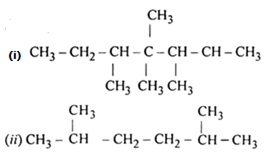
(i) 3, 4, 4, 5–Tetramethylheptane
(ii) 2,5-Dimethyhexane
3.
Write IUPAC names of the following compounds :
(i) (CH3)3CCH2C(CH3)3
(ii) (CH3)2C(C2H5)2
(iii) tetra - tert-butylmethane
4.
An alkene ‘A’ contains three C – C, eight C – H σ bonds and one C – C π bond. ‘A’ on ozonolysis gives two moles of an aldehyde of molar mass 44 u. Write IUPAC name of ‘A’.
5.
For the following compounds, write structural formulas and IUPAC names for all possible isomers having the number of double or triple bond as indicated :
(a) C4H8 (one double bond)
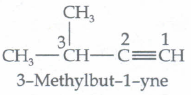
(b) C5H8 (one triple bond)
6.
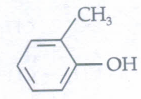
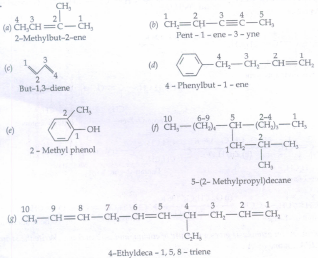
Write IUPAC names of the following compounds:
(a) CH3CH = C(CH3)2
(b) CH2 = CH-C\(\equiv \)C-CH3
(c)

(d)

(e)
(f) \(CH_{ 3 }({ CH }_{ 2 })\underset { \overset { | }{ { CH }_{ 2 }-CH(CH_{ 3 } } )_{ 2 } }{ CH } (CH_{ 2 })_{ 3 }{ CH }_{ 3 }\)
(g) \({ CH }_{ 3 }-CH=CH-{ CH }_{ 2 }-CH=CH-\underset { \overset { | }{ { C }_{ 2 }{ H }_{ 5 } } }{ CH } -{ CH }_{ 2 }-CH={ CH }_{ 2 }\)
7.
How do you account for the formation of ethane during chlorination of methane ?
8.
Draw the cis and trans structures of hex-2-ene. Which isomer will have higher b.p. and why?
9.


1.
(i)
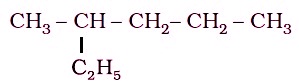
Longest chain is of six carbon atoms and not that of five. Hence, correct name is 3-Methylhexane.
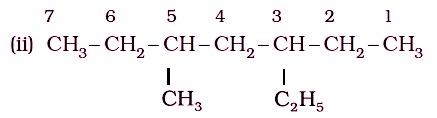
Numbering is to be started from the end which gives lower number to ethyl group. Hence, correct name is 3-ethyl-5- methylheptane.
2.
3.
(i) 2, 2, 4, 4-Tetramethylpentane
(ii) 3, 3-Dimethylpentane
(iii) 3,3-Di-tert-butyl -2, 2, 4, 4 - tetramethylpentane
4.
(i) An aldehyde with molar mass of 44 u is ethanal, CH3CH = O
(ii) Write two moles of ethanal side by side with their oxygen atoms pointing towards each other.
CH3CH = O O = CHCH3
Ethanal Ethanal
(ii) Remove the oxygen atoms and join them by a double bond, the structure of alkene 'A' is
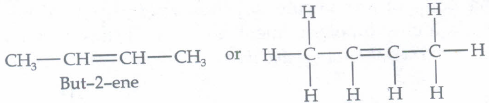
As required, but-2-ene has three C-C, eight C-H \(\sigma \)-bonds and one C-C \(\pi\)-bond.
5.
(a) Isomers of C4H8 having one double bond are:
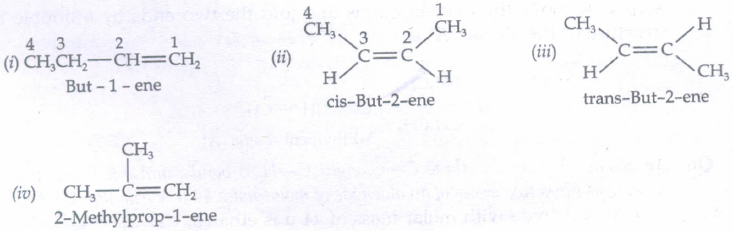
(b) (i) \({ CH }_{ 3 }{ CH }_{ 2 }{ CH }_{ 2 }\overset { 2 }{ C } \equiv \overset { 1 }{ C } H\)
Pent-1-yne
(ii) \({ CH }_{ 3 }{ CH }_{ 2 }-C\equiv \overset { 2 }{ C } -\overset { 1 }{ C } { H }_{ 3 }\)
Pent-2-yne
(iii)
6.
7.
Chlorination of methane is a free radical reaction which occurs by the following mechanism:
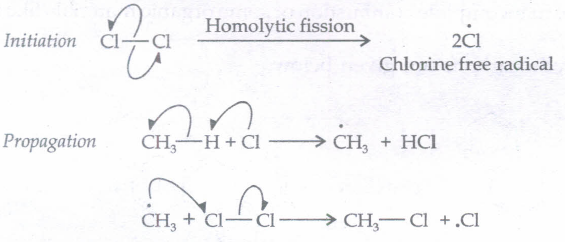 .........(i)
Termination \({ \overset .{ CH } }_{ 3 }+{ .CH }_{ 3 }\rightarrow { CH }_{ 3 }-{ CH }_{ 3 }\) .....(ii)
Ethane
\(\overset .{ C } H_{ 3 }+\overset .{ C } I\rightarrow { CH }_{ 3 }-CI\)
\(\overset { . }{ C } I+\overset { . }{ C } I\rightarrow CI-CI\) ..(iii)
From the above mechanism, it is evident that during propagation step, \(\overset { . }{ C } H_{ 3 }\)free radicals are produced which may undergo three reactions, i.e., (i) - (iii). In the chain termination step, the two CH3 free radicals combine together to form ethane (CH3-CH3) molecule.
8.
The structures of cis- and trans-isomer of hex-2-ene are:
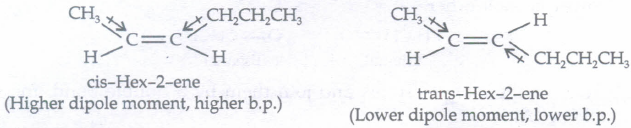
The boiling point of a molecule depends upon dipole-dipole interactions. Since cis-isomer has higher dipole moment, therefore, it has higher boiling point.
9.
11th Standard CBSE Syllabus & Materials
11th Standard CBSE
CBSE 11th Business Studies Forms of Business Organisation Sample Question Papers Study Material - QB365 Set A
NEW11th Standard CBSE
CBSE 11th Business Studies Business, Trade and Commerce Sample Question Papers Study Material - QB365 Set A
NEW11th Standard CBSE
CBSE 11th Physics Waves Sample Question Papers Study Material - QB365 Set A
NEW11th Standard CBSE
CBSE 11th Physics Kinetic Theory Sample Question Papers Study Material - QB365 Set A

NCERT Books

Syllabus

Exam Pattern

Sample Question Papers

Previous year Question Papers

Important Notes

MCQ Practice test

NCERT Exemplers

Case study Questions

Image Based Questions

Passage based Questions

HOT Questions

Value Based Questions

Model Questions Papers
NCERT ( Book Back ) Questions

Assertion and Reason
Important Questions And Answers

CBSE 11th Standard CBSE Subjects
CBSE Standards