 100% FREE ACCESS
11th Standard CBSE Syllabus & Materials
11th Standard CBSE
CBSE 11th Economics PART-A - Presentation of Data - New Sample Question Papers Study Material - QB365 Set A
NEW11th Standard CBSE
CBSE 11th Economics PART-A - Organisation of Data - New Sample Question Papers Study Material - QB365 Set A
NEW11th Standard CBSE
CBSE 11th Economics PART-A - Collection of Data - New Sample Question Papers Study Material - QB365 Set A
NEW11th Standard CBSE
CBSE 11th Economics PART-A - Introduction to Economics and Statistics - New Sample Question Papers Study Material - QB365 Set A
NEW11th Standard CBSE
CBSE 11th Business Studies International Trade Sample Question Papers Study Material - QB365 Set A
NEW11th Standard CBSE
CBSE 11th Business Studies Evolution and Fundamentals of Business Sample Question Papers Study Material - QB365 Set A

Published on: 21/10/2025
Download CBSE Class 11th Standard CBSE Chemistry question papers, sample papers, important questions, and previous year solved papers in PDF format. Get free study materials, NCERT solutions, and exam preparation resources for Class 11th Standard CBSE Chemistry
Questions + Answers key
Take MCQ Chemistry Test
1.
Arrange the following in order of increasing O.N of iodine: I2, HI, HIO2, KIO3, ICI
2.
Calculate the de Broglie wavelength of an electron moving with 1% of the speed of light?
3.
Give condensed and bond line structural formulas and identify the functional group(s) present, if any, for :
(a) 2,2,4-Trimethylpentane
(b) 2-Hydroxy-1,2,3-propanetricarboxylic acid
(c) Hexanedial
4.
At 1127 K and 1 atm pressure, a gaseous mixture of CO and CO 2, in carbon has 90.55% CO by mass \(C(S)+C{ O }_{ 2 }(g)\rightleftharpoons 2CO(g)\)
Calculate Kc for this reaction at the above temperature.
5.
The molar heat of formation of NH4NO3 (s) is -367.54 kJ and those of N2 O(g) and H2O(i) are + 81.46 kJ and -258.78 kJ respectively at 25oC and 1.0 atmospheric pressure. Calculate \(\Delta \)H and \(\Delta \)U for the reaction.
6.
Consider the following species : N3–, O2–, F– , Na+, Mg2+ and Al3+
(a) What is common in them?
(b) Arrange them in the order of increasing ionic radii.
7.
A Welding fuel gas contains carbon and hydrogen only. Buring a small sample of it in oxygen gives 3.38g carbon dioxide, 0.690 g of water and no other products. A volume 10.0 L (measured at STP) of this welding gas is found to weigh 11.6 g.
(a) Calculate. Molar mass of the gas.
(b) Calculate. molecular formula.
8.
What do you understand by catenation.
9.
What is PAN stands for?
10.
Explain the principle of paper chromatography.
11.
What are degenerate orbitals?
12.
Does the oxidation number of an element in any molecule or any polyatomic ion represent the actual charge on it?
13.
What do you understand by bond pairs and lone pairs of electrons? Illustrate by giving one exmaple of each type.
14.
Why is the energy of \({ \pi 2p }_{ x }\) and \({ { \pi 2p } }_{ y }\) molecular orbital lower than \({ \sigma 2p }_{ z }\) molecular orbital in \({ N }_{ 2 }\) molecule?
15.
Neutrons can be found in all atomic nuclei except in one case. Which is this atomic nucleus and what does it consist of ?
16.
Why do hydrides and halides of Be polymerise?
17.
Why are potassium and caesium,rather than lithium used in photioelectric cells?
18.
Why are the gases helium and hydrogen not liquefied at room temperature by applying very high pressure?
19.
Pressure versus volume graph for a real gas and an ideal gas are shown in figure. Answer the following questions on the basis of the graph.
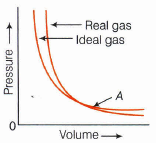
Interpret the behaviour of real gas with respect to ideal gas at high pressure.
20.
A catalyst will increase the rate of a chemical reaction by ______.
shifting the equilibrium to the right
shifting the equilibrium to the left
lowering the activation energy
increasing the activation energy
21.
The average kinetic energy of the gas molecule is
inversely proportional to its absolute temperature
directly proportional to its absolute temperature
equal to the square of its absolute temperature
All of the above
22.
Which of the following is a purely acidic oxide?
Si02
Sn02
PbO
Mn02
23.
The pollutant released in Bhopal gas tragedy was
Ammonia
Mustard gas
Nitrous oxide
Methyl isocyanate
24.
sp3, sp2 and sp hybridized carbon atom, the p character is maximum in:______.
sp3
sp2
sp
all of the above have same p-character
25.
A co-ordinate bond is formed by ______.
sharing of electrons contributed by both the atoms
complete transfer of electrons
sharing of electrons contributed by one atom only
none of these
26.
Hydrogen is obtained as a by-product in the
electrolysis of water
manufacture of caustic soda
Bosch process
Lane process
27.
Water may be softened using
sodium aluminium silicate
Graham's salt
an ion exchange resin
trisodium phosphate
28.
The highest ionization energy is exhibited by _____.
halogens
alkaline earth metals
transition metals
noble gases
29.
The enthalpies of all elements in their standard states are: _______.
unity
zero
<0
different for each element
1.
The increasing order is
HI < I2 < ICI < HIO2 < KIO3
2.
According to de Broglie equation,\(\lambda =\frac { h }{ mv } \)
Mass of electron = 9.1 x 10⁻³¹ kg; Planck's constant = 6.626 x 10⁻³⁴ kgm2s-1
Velocity of electron = 1% of speed of light = 3.0 x 108 x 0.01 = 3 x 10⁶ me-1
Wavelength of electron (\(\lambda \)) =\(\frac { h }{ mv } =\frac { (6.626x10^{ -34 }kgm^{ 2 }s^{ -1 }) }{ (9.1x10^{ -31 }kg)x(3x10^{ 6 }ms^{ -1 }) } \)
= 2.43 x 10⁻¹⁰ m.
3.
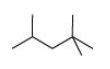
(a) 2, 2, 4-trimethylpentane
Condensed formula: (CH3)2CHCH2C (CH3)3
Bond line formula:
(b) 2-hydroxy-1, 2, 3-propanetricarboxylic acid
Condensed Formula: (COOH)CH2C(OH) (COOH)CH2(COOH)
Bond line formula:
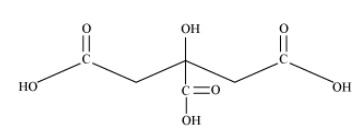
The functional groups present in the given compound are carboxylic acid (-COOH) and alcoholic (-OH) groups.
(c) Hexanedial Condensed Formula: (CHO) (CH2)4 (CHO)
Bond line Formula:

The functional group present in the given compound is aldehyde (-CHO).
4.
Let the total mass of the gaseous mixture = 100 g.
Mass of CO = 90.55 g
And, mass of CO2= (100 – 90.55) = 9.45 g
Now, the number of moles of CO, nCO\(=\frac{90.55}{28}\)=3.234mol
Number of moles of CO2,nCO2\(=\frac{9.45}{44}\)=0.215mol
The partial pressure of CO,
pCO=nCOnCO+nCO2×ptotal
\(= \frac{3.234}{3.234+0.215}×1 \)= 0.938 atm
Partial pressure of CO2,
pCO2 = nCO2nCO+nCO2×ptotal
\(=\frac{ 0.215}{3.234+0.215}×1\)=0.062atm
Kp=P2COPCO2 = (0.938)20.062=14.19
For the given reaction,
Δng= 2 –1 = 1
We know that,
KP=KC(RT)Δn
14.19= KC(0.082×1127)1
\(KC=\frac{14.19}{0.082×1127}\)
= 0.153
5.
\(\mathrm{NH}_4 \mathrm{NO}_3(s) \longrightarrow \mathrm{N}_2 \mathrm{O}(g)+2 \mathrm{H}_2 \mathrm{O}(l) \)
\( \Delta H_{\text {Reaction }}=\Delta H_{\text {Products }}-\Delta H_{\text {Reactants }} \)
\( =\Delta H_{\mathrm{N}_2 \mathrm{O}}+2 \times \Delta H_{\mathrm{H}_2 \mathrm{O}}-\Delta \mathrm{H}_{\mathrm{NH}_4 \mathrm{NO}_3} \)
\( =81.46+2(-285.8)-(-367.57) \)
\( \Delta H=-122.560 \mathrm{~kJ} \)
\( \Delta H=\Delta E+\Delta n R T \)
\( -122560=\Delta E+1 \times 8.314 \times 298 \)
\( \Delta E=-125037 \mathrm{~J} \)
\(=-125.037 \mathrm{~kJ}\)
6.
(a) All the given species have a same number of electrons \(({ 10e }^{ 1 })\)Therefore, all are isoelectronic species.
(b) The ionic radii of isoelectronic species decreases with increase in atomic number (as magnitude of the nuclear charge increase with increase in atomic number)
Therefore, their ionic radii increase in the order.\(\underset { z=13 }{ { Al }^{ 3+ } } <\underset { 12 }{ { Mg }^{ 2+ } } <\underset { 11 }{ { Na }^{ + } } <\underset { 9 }{ { F }^{ - } } <\underset { 8 }{ { O }^{ 2 } } <\underset { 7 }{ { N }^{ 3- } } \)
7.
(a) Calculation for molar of the gas
10.0 L of the given gas at STP weigh = 11.6 g
\(\therefore \) 22.4 L of the given gas at STP will weigh
\(\frac { 11.6\times 22.4 }{ 10 } =25.984\quad g\)
Molar mass = 25.984 = 26 \({ mol }^{ -1 }\)
(b) Empirical formula mass (CH) = 12 + 1 = 13
\(\therefore \) \(n=\frac { molecular \ mass }{ empirical \ formula \ mass } =\frac { 26 }{ 13 } =2\)
Hence, molecular formula
\(=n\times CH=2\times CH={ C }_{ 2 }{ H }_{ 2 }\)
8.
Catenation: The property to form chains or rings not only with single bonds but also with multiple bonds with itself is called catenation.
For example, carbon forms chains with (C - C) single bonds and also with multiple bonds (C = C or C \(\equiv \) C).
9.
It is peroxyacetyl nitrate.
10.
This is the simplest form of chromatography. Here a strip of paper acts as an adsorbent. It is based on the principle which is partly adsorption. The paper is made of cellulose fibres with molecules of water adsorbed on them. This acts as stationary phase. The mobile phase is the mixture of the components to be identified prepared in a suitable solvent.
11.
Orbitals having same energy belonging to the same subshell.
12.
No, the oxidation number of an element in any species is an apparent charge on the atom which it appears to have acquired when all other atoms in the species are removed as ions.
13.
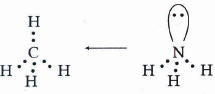
Covalent bond is formed by mutual sharing of electrons. The shared pair of electrons present between the bonded atoms are called bond pairs of electrons and unshared pair (non-bonding) electrons are called the lone pairs of electrons. e.g., ammonia, NH3 contains 3 bond pairs and 1 lone pair of electrons, whereas CH4 contains only 4 bond pairs.
14.
This is because of intermixing of 2s and 2pz orbitals because of their close proximity. Due to intermixing, \({ \sigma 2p }_{ z }\) molecular orbital becomes higher in energy than \({ \pi 2p }_{ x }\) and \({ { \pi 2p } }_{ y }\) molecular orbitals.
15.
In case of hydrogen atom, there is no neutron. It consists of only one proton
16.
()
Since BeH2 and BeCl2 have only four electrons in the valence shell, therefore, they are electron deficient molecules.
To make up their electron deficiency, each Be atom forms four, three - center two-electron bonds or banana bonds. Thus, it is due to electron deficiency that BeH2 and BeCl2 have polymeric structures.
17.
()
Metals having very high tendency to lose electroms are used in photoelectric cells.Lower the ionisation energy,higher is the tendency to lose electrons.
Potassium and caesium have much lower ionisation enthalpy than that of lithium.Therefore,these metals on exposure to light emit electrons easily but lithium does not.That's why K and Cs rather than Li are used in photoelectric cells.
18.
()
Because their critical temperature is lower than room temperature. (Gases cannot be liquefied above the critical temperature by applying even very high pressure.)
19.
At high pressure, the real gas shows large deviations from ideal behaviour as the curves are far apart.
20.
(c)
lowering the activation energy
21.
(b)
directly proportional to its absolute temperature
22.
(a)
Si02
23.
(d)
Methyl isocyanate
24.
(a)
sp3
25.
(c)
sharing of electrons contributed by one atom only
26.
(b)
manufacture of caustic soda
27.
(c)
an ion exchange resin
28.
(b)
alkaline earth metals
29.
(b)
zero

11th Standard CBSE Syllabus & Materials
11th Standard CBSE
CBSE 11th Business Studies Forms of Business Organisation Sample Question Papers Study Material - QB365 Set A
NEW11th Standard CBSE
CBSE 11th Business Studies Business, Trade and Commerce Sample Question Papers Study Material - QB365 Set A
NEW11th Standard CBSE
CBSE 11th Physics Waves Sample Question Papers Study Material - QB365 Set A
NEW11th Standard CBSE
CBSE 11th Physics Kinetic Theory Sample Question Papers Study Material - QB365 Set A



NCERT Books

Syllabus

Exam Pattern

Sample Question Papers

Previous year Question Papers

Important Notes

MCQ Practice test

NCERT Exemplers

Case study Questions

Image Based Questions

Passage based Questions

HOT Questions

Value Based Questions

Model Questions Papers
NCERT ( Book Back ) Questions

Assertion and Reason
Important Questions And Answers

CBSE 11th Standard CBSE Subjects
CBSE Standards