 100% FREE ACCESS
11th Standard CBSE Syllabus & Materials
11th Standard CBSE
CBSE 11th Economics PART-A - Presentation of Data - New Sample Question Papers Study Material - QB365 Set A
NEW11th Standard CBSE
CBSE 11th Economics PART-A - Organisation of Data - New Sample Question Papers Study Material - QB365 Set A
NEW11th Standard CBSE
CBSE 11th Economics PART-A - Collection of Data - New Sample Question Papers Study Material - QB365 Set A
NEW11th Standard CBSE
CBSE 11th Economics PART-A - Introduction to Economics and Statistics - New Sample Question Papers Study Material - QB365 Set A
NEW11th Standard CBSE
CBSE 11th Business Studies International Trade Sample Question Papers Study Material - QB365 Set A
NEW11th Standard CBSE
CBSE 11th Business Studies Evolution and Fundamentals of Business Sample Question Papers Study Material - QB365 Set A

Published on: 21/10/2025
Download CBSE Class 11th Standard CBSE Chemistry question papers, sample papers, important questions, and previous year solved papers in PDF format. Get free study materials, NCERT solutions, and exam preparation resources for Class 11th Standard CBSE Chemistry
Questions + Answers key
Take MCQ Chemistry Test
1.
What is the suitable adsorbent in the process of column chromatography?
2.
Why is nitric acid added to sodium extract before adding silver nitrate for testing halogens?
3.
Give reason for the following statements
(a) Halogens act as good oxidising agents.
(b) Electron gain enthalpy of noble gases is almost zero.
4.
Why do elements in the same group have similar physical and chemical properties?
5.
Caluculate the mass percentage of C in C2H4.
6.
Convert the following into basic units:
(i) 28.7 pm
(ii) 15.15 pm
(iii) 25365 mg
7.
(i) Give one example of position isomerism.
(ii) What are electrophiles? Give one example of electrophilic substitution reaction.
(iii) Write the chemistry of Lassaigne's test for qualitative analysis of nitrogen.
8.
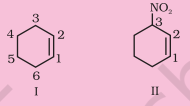
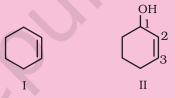
Derive the structure of (i) 2-Chlorohexane, (ii) Pent-4-en-2-ol, (iii) 3- Nitrocyclohexene, (iv) Cyclohex-2-en-1-ol, (v) 6-Hydroxyheptanal.
9.
Discuss the factors that influence the magnitude of ionization enthalpy. What are the general trends of variation of ionization enthalpy in the periodic table? Explain.
10.
In a reaction A + B2 → AB2 Identify the limiting reagent, if any, in the following reaction mixtures.
(i) 300 atoms of A + 200 molecules of B
(ii) 2 mol A + 3 mol B
(iii) 100 atoms of A + 100 molecules of B
(iv) 5 mol A + 2.5 mol B
(v) 2.5 mol A + 5 mol B
11.
The first ionisation enthalpy of magnesium is higher than that of sodium. On the other hand, the second ionisation enthalpy of sodium is very much higher than that of magnesium. Explain.
12.
Arrange the following
\(C{ H }_{ 3 }{ CH }_{ 2 }^{ + },{ C }_{ 6 }{ H }_{ 5 }{ CH }_{ 2 }^{ + },(C{ H }_{ 3 })_{ 3 }{ C }^{ + },C{ H }_{ 2 }=C{ H }{ CH }_{ 2 }^{ + }\) in order of decreasing stability.
13.
In three moles of ethane (C2H6), calculate the following:
(i) Number of moles of carbon atoms.
(ii) Number of moles of hydrogen atoms.
(iii) Number of molecules of ethane.
14.
Considering the elements F, Cl, O and N, the correct order of their chemical reactivity in terms of oxidizing property is :
F > Cl > O > N
F > O > Cl > N
Cl > F > O > N
O > F > N > Cl
15.
Which of the following is the correct IUPAC name?
3-ethyl-4, 4-dimethylheptane
4, 4-dimethyl-3-ethylheptane
S-ethyl-4, 4-dimethylheptane
4, 4-bis(methyl)-3-ethylheptane
16.
Consider the isoelectronic species, Na+.Mg2+, F- and O2-. The correct order of increasing length of their radii is ______.
\(\mathrm{F}^{-}<\mathrm{O}^{2-}<\mathrm{Mg}^{2+}<\mathrm{Na}^{+}\)
\(\mathrm{Mg}^{2+}<\mathrm{Na}^{+}<\mathrm{F}^{-}<\mathrm{O}^{2-}\)
\(\mathrm{O}^{2-}<\mathrm{F}^{-}<\mathrm{Na}^{+}<\mathrm{Mg}^{2+}\)
\(\mathrm{O}^{2-}<\mathrm{F}^{-}<\mathrm{Mg}^{2+}<\mathrm{Na}^{+}\)
17.
Which of the following statements is/are correct regarding significant figures?
All non-zero digits are significant
Significant figures are meaningful digits which are known with certainty
Significant figures are meaningful digits which are known with certainty
All of the above
18.
The empirical formula and molecular mass of a compound are CH2O and 180 g respectively. What will be the molecular formula of the compound?
C9H18O9
CH2O
C6H12O6
C2H4O2
19.
The best and latest technique for isolation, purification and separation of organic compounds is _______.
Crystallisation
Distillation
Sublimation
Chromatography.
1.
Al2O3 (alumina) is most suitable adsorbent for column chromatography.
2.
sodium extract is boiled with nitric acid to decompose NaCN and Na2S if present.
\(\mathrm{NaCN}+\mathrm{HNO}_{3} \longrightarrow \mathrm{NaNO}_{3}+\mathrm{HCN} \uparrow\)
\(\mathrm{Na}_{2} \mathrm{~S}+2 \mathrm{HNO}_{3} \longrightarrow 2 \mathrm{NaNO}_{3}+\mathrm{H}_{2} \mathrm{~S} \uparrow\)
If cyanide and sulphide are not removed, they will react with AgNO3 and hence, will interfere with the silver nitrate test for halogens
\(\mathrm{NaCN}+\mathrm{AgNO}_{3} \longrightarrow \underset{\text { White ppt }}{\mathrm{AgCN}}+\mathrm{NaNO}_{3}\)
\(\mathrm{Na}_{2} \mathrm{~S}+2 \mathrm{AgNO}_{3} \longrightarrow \underset{\text { Black } \mathrm{ppt}}{\mathrm{Ag}_{2} \mathrm{~S}}+2 \mathrm{NaNO}_{3}\)
3.
(a) Due to highly negative electron gain enthalpy they act as good oxidising agents as they can gain electrons easily.
(b) Electronic configuration of noble gases is such that all subshells are completely filled. Hence, their electron gain enthalpy is almost zero.
4.
Same group elements have similar valence shell electronic configuration. Therefore, have similar physical and chemical properties.
5.
The compound is \(\mathrm{C}_2 \mathrm{H}_4\).
The atomic mass of C is 12 grams and the atomic mass of hydrogen is 1 gram.
Hence the molecular mass of ethene is \(2 \times 12+1 \times 4=28\) grams.
The amount of C is \(12 \times 2=24\) grams.
Hence mass percentage of carbon in ethene can be given as follows-
\( \frac{24}{28} \times 100 =85.71 \%\)
6.
(i) The basic units for length is meter (m), for time is second(s) and for mass is kilogram (kg).
\(28.7pm\times \frac { { 10 }^{ -12 }m }{ 1pm } =28.7\times { 10 }^{ -11 }m\)
(ii) The basic units for length is meter (m), for time is second(s) and for mass is kilogram (kg)
\(15.15\mu s\frac { { 10 }^{ -12 }s }{ 1\mu s } =1.515\times { 10 }^{ -5 }s\)
(iii) The basic units for length is meter (m), for time is second(s) and for mass is kilogram (kg).
\(25365mg\times \frac { 1g }{ 1000mg } \times \frac { 1kg }{ 1000g } =2.5365\times { 10 }^{ -2 }kg\)
7.
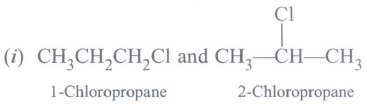
(ii) Those species which are positively charged or electron deficient are called electrophiles.
\(\text { e.g. } \mathrm{H}^{+}, \mathrm{AlCl}_{3}, \mathrm{Cl}^{+}\)
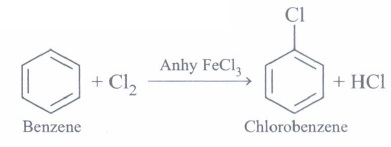
(iii) Fuse the organic compound with sodium metal. Sodium reacts with 'C' and 'N' present in organic compound to form NaCN.
\(\mathrm{Na}+\mathrm{C}+\mathrm{N} \longrightarrow \mathrm{NaCN}\)
Add FeSO4 to L.E. (Lassaigne's extract)
\(6 \mathrm{NaCN}+\mathrm{FeSO}_{4} \longrightarrow \mathrm{Na}_{4}\left[\mathrm{Fe}(\mathrm{CN})_{6}\right]+\mathrm{Na}_{2} \mathrm{SO}_{4}\)
Dilute H2SO4 is added to convert Fe2+ to Fe3+ and blue colour is formed due to formation of ferric ferrocyanide.
\(4 \mathrm{Fe}^{3+}+3 \mathrm{Na}_{4}\left[\mathrm{Fe}(\mathrm{CN})_{6}\right]\begin{aligned}
&\longrightarrow \mathrm{Fe}_{4}\left[\mathrm{Fe}(\mathrm{CN})_{6}\right]_{3}+12 \mathrm{Na}^{+}\\
&\text { Blue colouration }
\end{aligned}\)
8.
(i) ‘hexane’ indicates the presence of 6 carbon atoms in the chain. The functional group chloro is present at carbon 2. Hence, the structure of the compound is CH3CH2CH2CH2CH(Cl)CH3.
(ii) ‘pent’ indicates that parent hydrocarbon contains 5 carbon atoms in the chain. ‘en’ and ‘ol’ correspond to the functional groups C=C and -OH at carbon atoms 4 and 2 respectively. Thus, the structure is CH2 = CHCH2CH (OH)CH3
(iii) Six membered ring containing a carbon-carbon double bond is implied by cyclohexene, which is numbered as shown in (I). The prefix 3-nitro means that a nitro group is present on C-3. Thus, complete structural formula of the compound is (II). Double bond is suffixed functional group whereas NO2 is prefixed functional group therefore double bond gets preference over –NO2 group:
(iv) ‘1-ol’ means that a -OH group is present at C-1. OH is suffixed functional group and gets preference over C=C bond. Thus the structure is as shown in (II):
(v) ‘heptanal’ indicates the compound to be an aldehyde containing 7 carbon atoms in the parent chain. The ‘6-hydroxy’ indicates that -OH group is present at carbon 6. Thus, the structural formula of the compound is:CH3CH(OH)CH2CH2CH2CH2CHO. Carbon atom of –CHO group is included while numbering the carbon chain.
9.
Factors affecting Ionization enthalpy.
(i) Atomic size. With the increase in atomic size, the number of electron shells increases and thus the force of attraction between the electrons and the nucleus decreases. Therefore the ionization enthalpy decreases.
(ii) Nuclear charge. As the nuclear charge increases the attraction for the electron also increases that's why ionization enthalpy increases.
(iii) Screening or shielding effect. In a multi-electron atom, the electron present in the inner shells shield the electrons in the valence shell as a result these electrons experience less attraction from the nucleus. This leads to lesser ionization enthalpy.
Variation along a period. On moving from left to right in a period the nuclear charge increases and the atomic size decreases as a result ionization enthalpies are expected to increase.
Variation within a group. On moving down the group as the atomic size of the elements increases that's why ionization enthalpy decreases down the group
10.
A limiting reagent determines the extent of a reaction. It is the reactant which is the first to get consumed during a reaction, thereby causing the reaction to stop and limiting the amount of products formed.
(i) According to the given reaction, 1 atom of A reacts with 1 molecule of B. Thus, 200 molecules of B will react with 200 atoms of A, thereby leaving 100 atoms of A unused. Hence, B is the limiting reagent.
(ii) According to the reaction, 1 mol of A reacts with 1 mol of B. Thus, 2 mol of A will react with only 2 mol of B. As a result, 1 mol of B will not be consumed. Hence, A is the limiting reagent.
(iii) According to the given reaction, 1 atom of A combines with 1 molecule of B. Thus, all 100 atoms of A will combine with all 100 molecules of B. Hence, the mixture is stoichiometric where no limiting reagent is present.
(iv) 1 mol of atom A combines with 1 mol of molecule B. Thus, 2.5 mol of B will combine with only 2.5 mol of A. As a result, 2.5 mol of A will be left as such. Hence, B is the limiting reagent.
(v) According to the reaction, 1 mol of atom A combines with 1 mol of molecule B. Thus, 2.5 mol of A will combine with only 2.5 mol of B and the remaining 2.5 mol of B will be left as such. Hence, A is the limiting reagent.
11.
The Ist ionisation enthalpy of magnesium is higher than that of Na due to higher nuclear charge and slightly smaller atomic radius of Mg than Na. After the loss of first electron, Na + formed has the electronic configuration of neon (2, 8). The higher stability of the completely filled noble gas configuration leads to very high second ionisation enthalpy for sodium. On the other hand, Mg+ formed after losing first electron still has one more electron in its outermost (3s) orbital. As a result, the second ionisation enthalpy of magnesium is much smaller than that of sodium.
12.
\((C{ H }_{ 3 })_{ 3 }{ C }^{ + }>{ C }_{ 6 }{ H }_{ 5 }{ CH }_{ 2 }^{ + }>C{ H }_{ 2 }=C{ H }{ CH }_{ 2 }^{ + }>C{ H }_{ 3 }{ CH }_{ 2 }^{ + }\)
13.
(i) 1 mole of C2H6 contains 2 moles of carbon atoms.
 Number of moles of carbon atoms in 3 moles of C2H6
= 2 × 3 = 6
(ii) 1 mole of C2H6 contains 6 moles of hydrogen atoms.
Number of moles of carbon atoms in 3 moles of C2H6
= 3 × 6 = 18
(iii) 1 mole of C2H6 contains 6.023 × 10²³ molecules of ethane.
Number of molecules in 3 moles of C2H6
= 3 × 6.023 × 1023 = 18.069 × 10²³
14.
Within a period, the oxidising character increases from left to right. Therefore, among F, 0 and N, oxidising power decreases in the order: F > 0 > N. However, within a group, oxidising power decreases from top to bottom. Thus, F is a stronger oxidising agent than Cl. Further because 0 is more electronegative than Cl, therefore, 0 is a stronger oxidising agent than Cl. Thus, overall decreasing order of oxidising power is: F > 0 > Cl > N, i.e., option (b) is correct.
15.
(a)
3-ethyl-4, 4-dimethylheptane
16.
(d)
\(\mathrm{O}^{2-}<\mathrm{F}^{-}<\mathrm{Mg}^{2+}<\mathrm{Na}^{+}\)
17.
(d)
All of the above
18.
(c)
C6H12O6
19.
(d)
Chromatography.

11th Standard CBSE Syllabus & Materials
11th Standard CBSE
CBSE 11th Business Studies Forms of Business Organisation Sample Question Papers Study Material - QB365 Set A
NEW11th Standard CBSE
CBSE 11th Business Studies Business, Trade and Commerce Sample Question Papers Study Material - QB365 Set A
NEW11th Standard CBSE
CBSE 11th Physics Waves Sample Question Papers Study Material - QB365 Set A
NEW11th Standard CBSE
CBSE 11th Physics Kinetic Theory Sample Question Papers Study Material - QB365 Set A



NCERT Books

Syllabus

Exam Pattern

Sample Question Papers

Previous year Question Papers

Important Notes

MCQ Practice test

NCERT Exemplers

Case study Questions

Image Based Questions

Passage based Questions

HOT Questions

Value Based Questions

Model Questions Papers
NCERT ( Book Back ) Questions

Assertion and Reason
Important Questions And Answers

CBSE 11th Standard CBSE Subjects
CBSE Standards