100% FREE ACCESS
11th Standard CBSE Syllabus & Materials
11th Standard CBSE
CBSE 11th Economics PART-A - Presentation of Data - New Sample Question Papers Study Material - QB365 Set A
NEW11th Standard CBSE
CBSE 11th Economics PART-A - Organisation of Data - New Sample Question Papers Study Material - QB365 Set A
NEW11th Standard CBSE
CBSE 11th Economics PART-A - Collection of Data - New Sample Question Papers Study Material - QB365 Set A
NEW11th Standard CBSE
CBSE 11th Economics PART-A - Introduction to Economics and Statistics - New Sample Question Papers Study Material - QB365 Set A
NEW11th Standard CBSE
CBSE 11th Business Studies International Trade Sample Question Papers Study Material - QB365 Set A
NEW11th Standard CBSE
CBSE 11th Business Studies Evolution and Fundamentals of Business Sample Question Papers Study Material - QB365 Set A

Published on: 21/10/2025
Download CBSE Class 11th Standard CBSE Chemistry question papers, sample papers, important questions, and previous year solved papers in PDF format. Get free study materials, NCERT solutions, and exam preparation resources for Class 11th Standard CBSE Chemistry
Questions + Answers key
Take MCQ Chemistry Test
1.
What is meant by E.M.F of cell? How is it measured?
2.
Balance the following equation:
\(\mathrm{Zn}(s)+\mathrm{NO}_{3}^{-}(a q) \rightarrow \mathrm{Zn}^{2+}(a q)+\mathrm{NH}_{4}^{+}(a q)+\mathbf{H}^{+} \text {(Acidic medium) }\)
3.
What are the two longest wavelength lines (in manometers) in the Lyman series of hydrogen spectrum?
4.
The kinetic energy of an electron is 4.55 x 10⁻²⁵ J. The mass of electron 9.1 x 10⁻¹ kg. Calculate velocity, momentum and the wavelength of the electron?
5.
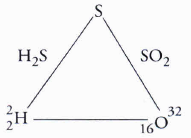
The element H and O combine separately with the third element S to form H2S and SO2 respectively, then show that they combine directly with each other to from H2O.
6.
The mass of a liter of oxygen at standard conditions of temperature and pressure is 1.43g and that of a liter of \({ SO }_{ 2 }\)is 2.857 g. What is the mass in gram of a single molecule of each gas?
7.
Fe decomposes steam while Cu does not, why?
8.
Write electronic configuration of Ni2+ (Atomic number of Ni = 28)
9.
What is the most important application of de Broglie concept?
10.
Why air is not always regarded as homogeneous mixture?
11.
Calculate the oxidation number of phosphorus in the following species.
\({ HPO }_{ 3 }^{ 2- }\)
12.
In a reaction, \(A+{ B }_{ 2 }\rightarrow { AB }_{ 2 }\) identify the limiting reagent if any in the following reaction mixtures.
5 moles of A + 2.5 moles of B.
13.
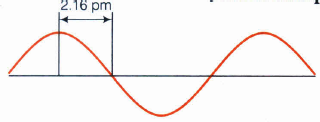
A hypothetical electromagnetic wave is shown is figure. Find out the wavelength of the radiation.
14.
Gastric juice contains \(3\times { 10 }^{ 23 }g\) of HCl per millilitre. If a person about 2.5L of gastric juice per day, how many antacid tablets each containing 0.4 g of AI(OH)3 are needed to neutralise all the HCI produced in one day?
15.
1 g of M2CO3 on treatment with excess HCl produces 0.01186 moles of CO2. The molar mass of M2CO3 in g mol-1 is _______.
1186
84.3
118.6
11.86
16.
Which of the following is wrong statement?
The uncertainty principle is \(\Delta x . \Delta v \geq \frac{h}{4 \pi} \text { . }\)
Half filled and fully filled orbitals have greater stability due to greater exchange energy, greater symmetry and more balanced arrangement
The energy of 2s orbital is less than the energy of 2p-orbitals in case of hydrogen like atoms.
de Broglie wavelength, \(\lambda=\frac{h}{2 \pi} .\)
17.
The given reactions such as
\(I. \mathrm{Zn}+2 \mathrm{HCl} \longrightarrow \mathrm{ZnCl}_{2}+\mathrm{H}_{2} \)
\(II. \mathrm{Fe}+2 \mathrm{HCl} \longrightarrow \mathrm{FeCl}_{2}+\mathrm{H}_{2}\) are represented as ______.
displacement of zinc and iron metals
displacement of only zinc metals
displacement of only iron metals
displacement of hydrogen
18.
The reaction, 2H2 \(0(l) \stackrel{\Delta}{\longrightarrow} 2 \mathrm{H}_{2}(g)+0_{2}(g)\) is anexample of ______.
addition reaction
decomposition reaction
displacement reaction
None of these
19.
Identify disproportionation reaction
\( \mathrm{CH}_{4}+2 \mathrm{O}_{2} \longrightarrow \mathrm{CO}_{2}+2 \mathrm{H}_{2} \mathrm{O} \)
\(\mathrm{CH}_{4}+4 \mathrm{Cl}_{2} \longrightarrow \mathrm{CCl}_{4}+4 \mathrm{HCl}\)
\(2 \mathrm{~F}_{2}+2 \mathrm{OH}^{-} \longrightarrow 2 \mathrm{~F}^{-}+\mathrm{OF}_{2}+\mathrm{H}_{2} \mathrm{O} \)
\(2 \mathrm{NO}_{2}+2 \mathrm{OH}^{-} \longrightarrow \mathrm{NO}_{2}^{-}+\mathrm{NO}_{3}^{-}+\mathrm{H}_{2} \mathrm{O} \)
20.
In the given reaction, 2Na + S \(\rightarrow\) 7 Na2S, sulphur is ______.
oxidised
reduced
reducing agent
None of these
21.
The pair of ions having same electronic configuration is _____
\(\mathrm{Cr}^{3+}, \mathrm{Fe}^{3+}\)
\(\mathrm{Fe}^{3+}, \mathrm{Mn}^{2+}+\)
\(\mathrm{Fe}^{3+}, \mathrm{Co}^{3+}\)
\(\mathrm{Sc}^{3+}, \mathrm{Cr}^{3+}\)
22.
A solution is prepared by adding 2 g of a substance A to 18 g of water. Calculate the mass per cent of the solute.
8%
9%
10%
11%
23.
Which of the following statements about a compound is incorrect?
A molecule of a compound has atoms of different elements
A compound cannot be separated into its constituent elements by physical methods of separation
A compound retains the physical properties of its constituent elements
The ratio of atoms of different elements in a compound is fIxed
24.
de Broglie equation is _______.
\(\lambda =\frac { h }{ mv } \)
\(\lambda =\frac { hv }{ m } \)
\(\lambda =\frac { mv }{ h } \)
\(\lambda =hmv\)
25.
Assertion : Volume of a gas is inversely proportional to the number of moles of gas.
Reason : The ratio by volume of gaseous reactants and products is in agreement with their mole ratio.
Codes:
(a) Assertion is correct, reason is correct; reason is a correct explanation for assertion.
(b) Assertion is correct, reason is correct; reason is not a correct explanation for assertion
(c) Assertion is correct, reason is incorrect
(d) Assertion is incorrect, reason is correct.
26.
27.
28.
1.
It is equal to maximum potential difference when no current is drawn from the cell.
2.
\(\begin{gathered} \mathrm{Zn}(s)+\mathrm{NO}_{3}^{-}(a q) \longrightarrow \mathrm{Zn}^{2+}(a q)+\mathrm{NH}_{4}^{+}(a q)+\mathrm{H}^{+} \text {(Acidic medium) } \\ {\left[\mathrm{Zn} \longrightarrow \mathrm{Zn}^{2+}+2 \mathrm{e}^{-} \ldots(i)\right] \times 4} \\ 10 \mathrm{H}^{+}+8 \mathrm{e}^{-}+\mathrm{NO}_{3}^{-}(a q) \longrightarrow \mathrm{NH}_{4}^{+}(a q)+3 \mathrm{H}_{2} \mathrm{O} \ldots(\mathrm{ii}) \\ +5 \quad-3 \\ \hline 4 \mathrm{Zn}+10 \mathrm{H}^{+}+\mathrm{NO}_{3}^{-} \longrightarrow 4 \mathrm{Zn}^{2+}+\mathrm{NH}_{4}^{+}+3 \mathrm{H}_{2} \mathrm{O} \\ \hline \end{gathered}\)
3.
According to Rydberg-Balmer equation.
\(\frac { 1 }{ \lambda } =R\left[ \frac { 1 }{ n^{ 2 }_{ 1 } } -\frac { 1 }{ n^{ 2 }_{ 2 } } \right] =R\left[ \frac { 1 }{ 1^{ 2 } } -\frac { 1 }{ n^{ 2 }_{ 2 } } \right] \)
The wavelength (\(\lambda \))will be the longest when n2 is the smallest i.e., n2 = 2 and 3 for two longest wavelength lines.
For n2 = 2 : \(\frac { 1 }{ \lambda } \)= (1.097 x 10⁻² nm-1)\(\left[ \frac { 1 }{ 1^{ 2 } } -\frac { 1 }{ 2^{ 2 } } \right] \)
= (1.097 x 10⁻² nm-1) x 4 = 8.228 x 10⁻³ nm-1 or \(\lambda \).= 121.54 nm
For n2 = 3 : \(\frac { 1 }{ \lambda } \)= (1 097 x 10-2 nm-1)\(\left[ \frac { 1 }{ 1^{ 2 } } -\frac { 1 }{ 3^{ 2 } } \right] \)
= (1.097 x 10⁻² nm-1) x (8/9) = 9.75 x 10⁻³ nm-1 ; \(\lambda \).= 102.56 nm
4.
Step I. Calculation of the velocity of electron
Kinetic energy = 1/2 mv2 = 4.55 x 10⁻²⁵J = 4.55 x 10⁻²⁵ kg m2 S-2
or v2 = \(\frac { 2\times KE }{ m } =\frac { 2\times (4.55\times10^{ -25 }kgm^{ 2 }s^{ -2 }) }{ (3x10^{ 6 }ms^{ -1 }) } \)=106 m2 S-2
or Velocity (v) = (106 m2 S-2 )1/2 = 103 ms-1
Step II. Calculation of the momentum of the electron Momentum of electron = mv = (9.1 x 10⁻³¹ kg) x (103m s-l) = 9.1 x 10⁻²⁸ kg m-1
Step III. Calculation of the wavelength of the electron According to de Broglie equation:
\(\lambda \frac { h }{ mv } =\frac { (6.626\times10^{ -34 }kgm^{ 2 }s^{ -1 }) }{ (9.1x10^{ -31 }kg)\times (10^{ 3 }ms^{ -l }) } \)
= 0.728 x 10⁻⁶m = 7.28 x 10⁻⁷ m
5.
As shown in figure, the masses of H and O which combine with the fixed mass of S, i.e. 32 parts are 2 and 32 i.e. they are in the ration 2: 32 or 1:16. When H and O combine directly to form H2O, the ratio of their combining, masses are 2:16 or 1:8.
combine directly to form H2O, the ratio of their combining, masses are 2:16 or 1:8.
These ratio are related to each other as \(\frac { 1 }{ 16 } :\frac { 1 }{ 8 } =1:2\)
i.e. they are simple multiple of each other.
6.
mass of \({ O }_{ 2\\ }\)molecule = \(=5.32\times { 10 }^{ -23 }g\) ;
mass of \({ SO }_{ 2 }\) molecule \(=1.06\times { 10 }^{ -22 }g\)
7.
Fe is more reactive than hydrogen, it has lower reduction potential than hydrogen whereas Cu has higher reduction potential than hydrogen, copper cannot displace hydrogen from steam because it is less reactive than hydrogen.
8.
1s22s22p63s23p64s03d8. [∴ Electrons are removed from 4s orbital first, then from 3d].
9.
In the construction of electron microscope used for the measurement of objects of very small size.
10.
This is due to the presence of dust particles.
11.
Suppose that the oxidation number of P in \({ HPO }_{ 3 }^{ 2- }\) be x.
Theb, 1 + x + 3 (-2) = -2
or x + 1 - 6 = -2 or x = +3
12.
The given equation shows that 1 mole of A reacts with 1 mole of \({ B }_{ 2 }\) and 1 atom of A reacts with 1 molecule of \({ B }_{ 2 }\).
2.5 moles of B will react with 2.5 moles of A, hence Bb is the limiting reagent.
13.
Wavelength is the distance between two successive crests or two successive troughs of a wave.
There, \(\lambda =4\times 2.16pm=8.64 \ pm \)
14.
HCI is neutralised by AI(OH)3 by equation,
\(Al{ (OH) }_{ 3 }+3HCl\longrightarrow AlC{ l }_{ 3 }+3{ H }_{ 2 }O\)
HCI produced from 2.5 L of gastric juice
\(=3\times { 10 }^{ -3 }\times { 10 }^{ 3 }\times 2.5\)
109.5g HCl is neutralised by Al(OH)3 = 78 g
7.5 g HCl is neutralised by Al(OH)3\(=\frac { 78 }{ 109.5 } \times 7.5\quad 3g\)
Number of tablets required \(=\frac { 5.342 }{ 0.4 } =13.35=14\) tablets
15.
(b)
84.3
16.
(c)
The energy of 2s orbital is less than the energy of 2p-orbitals in case of hydrogen like atoms.
17.
(d)
displacement of hydrogen
18.
(b)
decomposition reaction
19.
(d)
\(2 \mathrm{NO}_{2}+2 \mathrm{OH}^{-} \longrightarrow \mathrm{NO}_{2}^{-}+\mathrm{NO}_{3}^{-}+\mathrm{H}_{2} \mathrm{O} \)
20.
(b)
reduced
21.
(b)
\(\mathrm{Fe}^{3+}, \mathrm{Mn}^{2+}+\)
22.
(c)
10%
23.
(c)
A compound retains the physical properties of its constituent elements
24.
(a)
\(\lambda =\frac { h }{ mv } \)
25.
(d) Assertion is incorrect, reason is correct.
26.
27.
28.

11th Standard CBSE Syllabus & Materials
11th Standard CBSE
CBSE 11th Business Studies Forms of Business Organisation Sample Question Papers Study Material - QB365 Set A
NEW11th Standard CBSE
CBSE 11th Business Studies Business, Trade and Commerce Sample Question Papers Study Material - QB365 Set A
NEW11th Standard CBSE
CBSE 11th Physics Waves Sample Question Papers Study Material - QB365 Set A
NEW11th Standard CBSE
CBSE 11th Physics Kinetic Theory Sample Question Papers Study Material - QB365 Set A



NCERT Books

Syllabus

Exam Pattern

Sample Question Papers

Previous year Question Papers

Important Notes

MCQ Practice test

NCERT Exemplers

Case study Questions

Image Based Questions

Passage based Questions

HOT Questions

Value Based Questions

Model Questions Papers
NCERT ( Book Back ) Questions

Assertion and Reason
Important Questions And Answers

CBSE 11th Standard CBSE Subjects
CBSE Standards