
 100% FREE ACCESS
11th Standard CBSE Syllabus & Materials
11th Standard CBSE
CBSE 11th Economics PART-A - Presentation of Data - New Sample Question Papers Study Material - QB365 Set A
NEW11th Standard CBSE
CBSE 11th Economics PART-A - Organisation of Data - New Sample Question Papers Study Material - QB365 Set A
NEW11th Standard CBSE
CBSE 11th Economics PART-A - Collection of Data - New Sample Question Papers Study Material - QB365 Set A
NEW11th Standard CBSE
CBSE 11th Economics PART-A - Introduction to Economics and Statistics - New Sample Question Papers Study Material - QB365 Set A
NEW11th Standard CBSE
CBSE 11th Business Studies International Trade Sample Question Papers Study Material - QB365 Set A
NEW11th Standard CBSE
CBSE 11th Business Studies Evolution and Fundamentals of Business Sample Question Papers Study Material - QB365 Set A

Published on: 21/10/2025
Download CBSE Class 11th Standard CBSE Computer Science question papers, sample papers, important questions, and previous year solved papers in PDF format. Get free study materials, NCERT solutions, and exam preparation resources for Class 11th Standard CBSE Computer Science
Questions + Answers key
Take MCQ Computer Science Test
1.
What is microprocessor ? Name its various components.
2.
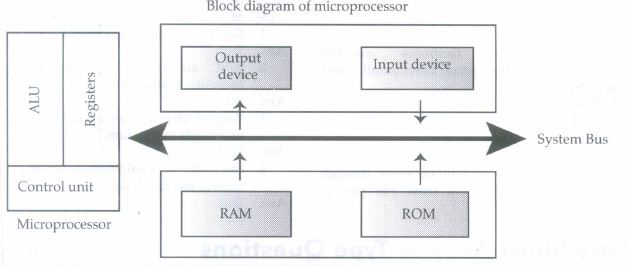
Draw the block diagram of microprocessor.
3.
Define computer. Give it's characteristics
4.
Explain what is a computer and write its characteristics
5.
Explain Primary Memory Unit
6.
What are the features of Python?
7.
Differentiate between SRAM and DRAM.
8.
Explain Cache Memory.
9.
Pen drives are universal. Explain
10.
Explain Computer memory.
11.
Explain four characteristics of computer
12.
13.
14.
15.
16.
17.
18.
19.
20.
21.
22.
23.
24.
25.
26.
27.
28.
29.
The_____operator is used to find out if division of two number yields any remainder
/
+
%
//
30.
If the value of a = 20 and b = 20, then a+ =b will assign____to a
40
30
20
10
31.
The_____data type allows only True/False value
bool
boolean
Boolean
None
32.
Choose the correct syntax for printing values in the same line
print(a,b)
print(a, end=" ",b)
print (a,end="$",b)
print(a)print(b)
33.
What do you mean by 'immutable'?
34.
What will be the output of following statements when inputs are a=30, b=20, c=30?
print(a<b)
print(b< =c)
print(a<b<=c)
35.
Find the output of the following:
a=4.5
b=2
print (a//b)
36.
Write the value justification:
(i) 2*(3+4)
(ii) 2*3+4
(iii) 2+3*4
37.
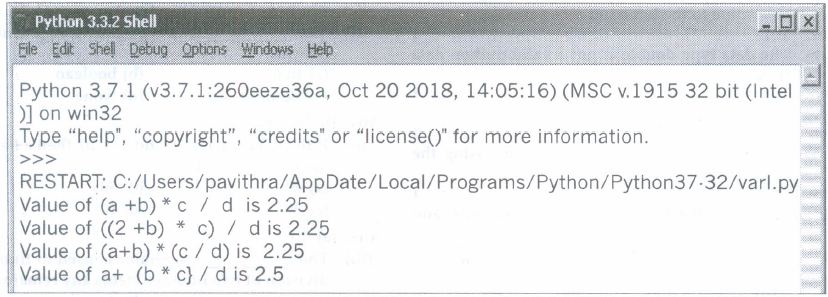
What will be the output of the following Python code?
a=1
b=2
c=3
d=4
e=0
e = (a + b) * c / d #( 3 * 3 /4) = 9/4
print("Value of (a + b) * c / d is ", e)
f = ((a + b) * c) / d # (3 * 3 ) / 4 = 9/4
print("Value of ((a + b) * c) / d is ", f)
g = (a + b) * (c / d); # (3) * (3/4) = 0
print("Value of (a + b) * (c / d) is ", g)
h=a+(b*c)/d; # 1+(2*3)/4=1+6/4=10/4
print ("Value of a + (b * c) / d is ", h)
38.
What are the different number datatypes in Python?
39.
What are data types? What are Python's data type?
40.
Which of the following variable names are invalid? Justify.
(a) try
(c) abc@d
(b) 123Hello
(d) sum
41.
Write a note on multiple assignments in Python?
42.
What are the rules for identifier names?
43.
44.
45.
46.
1.
A microprocessor is a computer processor that incorporates the functions of a CPU on a single integrated circuit (IC).
Components of Microprocessor:
1. CPU
2. I/O units
3. Register
4. Cache
2.
3.
A computer is an electronic device which can perform various operations accurately and fast. For example data processing, huge calculations etc.
Characteristics of computer:
(i) Speed: It speed is very fast.Amodern computer can execute millions of instructions in one second.
(ii) Accuracy: A computer can give accurate results up to 20 to 30 places of decimal.
(iii) High storage capacity: A computer can store large amount of data in very small space.
(iv) Versatility: A computer can do different types of tasks like data processing, graphics, audio and visual effects.
(v) Repetitive: A computer makes no mistake in repeating anything as many times
4.
A computer is an electronic device which can perform various operations accurately and fast. For example data processing, huge calculations etc.
Characteristics of computer:
(i) Speed: It speed is very fast.A modern computer can execute millions of instructions in one second.
(ii) Accuracy: A computer can give accurate results up to 20 to 30 places of decimal.
(iii) High storage capacity: A computer can store large amount of data in very small space.
(iv) Versatility: A computer can do different types of tasks like data processing, graphics, audio and visual effects.
(v) Repetitive: A computer makes no mistake in repeating anything as many times
5.
Memory Unit stores the data, instructions, intermediate results and output temporarily, during the processing of data. This memory is also called the main memory of primary memory of the computer. The input data that is to be processed is brought into the main memory before processing.
6.
Python's features include -
i) Easy-to-Iearn - Python has few keywords, simple structure, and a clearly defined syntax. This allows the student to pick up the language quickly.
ii)Easy-to-read - Python code is more clearly defined and visible to the eyes.
iii) Easy-to-maintain - Python-s source code is fairlyeasy-to-maintain.
iv) A broad standard library - Python-s bulk of the library is very portable and cross-platform compatible on UNIX,Windows, and Macintosh.
v) Interactive Mode -:- Python has support for an interactive mode which allows interactive testing and debugging of snippets of code.
vi) Portable - Python can run on a wide variety of hardware platforms and has the same interface on all platforms.
vii)Extendable - You can add low-level modules to the Python interpreter. These modules enable programmers to add to or customize their tools to be more efficient.
viii) Databases - Python provides interfaces to all major commercial databases.
ix) GUI Programming - Python supports GUI applications that can be created and ported to many system calls, libraries and windows systems, such as Windows MFC, Macintosh, and the XWindow system of Unix.
x) Scalable - Python provides a better structure and support for large programs than shell scripting.
7.
| DRAM | SRAM |
| (i) A DRAM cell consists of only one transistor and one capacitor. |
A SRAM consists of internal flip-flops |
| (ii) It has large number of cells packed within the chip. |
The number of cells on a SRAM chip is less. |
| (iii) It needs to be refreshed (about thousand times in a second) to retain the stored data |
It retains data as long as the power is supplied to thousand i.e. there is no need to refresh it. |
| (iv) DRAMs areused in primary storage sections of most computers. |
SRAMs are used is spe- cialized applications. |
8.
A CPU cache is a memory used by the Central Processing Unit (CPU) of a computer to reduce the average time to access data from the main memory. The cache is a smaller and faster memory which stores copies of the data from frequently used main memory locations. Most CPUs have different independent caches, including instructions and data caches, where the data cache is usually organized as a hierarchy of more cache levels (L1, L2, etc.)
When the processor needs to read from or write to a location in main memory, it first checks whether a copy of that data reside in the cache. If so, the processor immediately reads from or writes to the cache, which is much faster than reading from or writing to main memory.
Most modern desktop and server CPUs have at least three independent caches : an instruction cache to seed up executable instruction fetch, a data cache to speed up data fetch and store, and a translation look aside buffer (TLB)used to speed up virtual - to physical address translation for both executable instructions and data. The data cache is usually organized as a hierarchy of more cache level 1.
9.
The design of a pen drive makes it easy to fit almost anywhere. They can store a large amount of information, sometimes as large as 32 Gigabytes. Almost all computers that are designed today have a USB port that allows for extra drives to be attached to access other information on other computer hardware accessories.
10.
Computer memory are internal storage areas in the computer used to either temporarily or permanently store data or instructions to be processed. There are four basic types of computer memory. Cache Memory, RAM, Virtual Memory and Hard Drives. With modern CPU's running at speeds of 1 gigahertz or higher, it is hard for computer memory to keep up with the extreme amount of data being processed. Computer engineers fixed the problem by "tiring" memory. By using this tiring effect, engineers use a small amount of more expensive memory and a large amount of low cost memory.
11.
Speed, accuracy, diligence, storage capability and versatility are some of the key characteristic of a computer. A brief overview of these characteristics are:
(i) Speed: The computer can process data very fast, with the rate of millions of instructions per second. Some calculations that would have taken hours and days to complete otherwise, can be completed in a few seconds using() the computer.
(ii) Accuracy: Computer provides a high degree of accuracy. For example : the computer can accurately give the result of division of any two numbers up to 30 decimal places.
(iii) Diligence : When used for a longer period of time, the computer does not get tired or fatigued. It can perform long and complex calculations with the same speed and accuracy from the start till the end.
(iv) Storage Capability: Large volumes of data and information can be stored in the computer and also retrieved whenever required. A limited amount of data can be stored temporarily in the primary memory. Secondary storage devices like DVD and compact disk can store a large amount of data permanently.
12.
(c)
13.
(d)
14.
(c)
15.
(a)
16.
(b)
17.
(b)
18.
(a)
19.
(b)
20.
(a)
21.
(a)
22.
(c)
23.
(b)
24.
(c)
25.
(d)
26.
(d)
27.
(c)
28.
(c)
29.
(c)
%
30.
(a)
40
31.
(b)
boolean
32.
(b)
print(a, end=" ",b)
33.
Immutable means unchangeable. In Python, immutable types are those whose values cannot be changed in place. Whenever one assigns a new value to a variable referring to immutable type, variable's reference is changed and the previous value is left unchanged.
34.
False
True
False
35.
2.0
36.
(i) 14
(ii) 10
(ii) 14
37.
38.
The various number types are Integers, Floating point, Boolean, complex numbers
39.
To represent real-life da ta programming languages offer ways to handle them. These are called data types.
Python's datatypes are:
(i) Numbers
(ii) String
(iii) List
(iv) Tuple
(v) Dictionary
40.
(a) try - It's a keyword and can't be used as a variable name
(b) 123Hello - Variable names can't start with a digit
(c) abc@d - Special characters aren't allowed in variable names.
41.
Assigning same value to multiple variables:
We can assign same value to multiple variables:
Example: a=b=c=10
Assigning Multiple values to multiple variables:
Wecan assign multiple values to multiple variables in single statement e.g. X, Y,Z=10, 20, 30 It will assign the values order wise, i.e. first variable is given first value, second variable the second value and so on.
42.
An identifier starts with a letter A to Z or a to z or an underscore (_) followed by zero or more letters, underscores and digits (0 to 9).
Python does not allow punctuation characters such as @, $, and % within identifiers. Python is a case sensitive programming language. Thus, Count and count are two different identifiers in Python.
43.
44.
45.
46.

11th Standard CBSE Syllabus & Materials
11th Standard CBSE
CBSE 11th Business Studies Forms of Business Organisation Sample Question Papers Study Material - QB365 Set A
NEW11th Standard CBSE
CBSE 11th Business Studies Business, Trade and Commerce Sample Question Papers Study Material - QB365 Set A
NEW11th Standard CBSE
CBSE 11th Physics Waves Sample Question Papers Study Material - QB365 Set A
NEW11th Standard CBSE
CBSE 11th Physics Kinetic Theory Sample Question Papers Study Material - QB365 Set A



NCERT Books

Syllabus

Exam Pattern

Sample Question Papers

Previous year Question Papers

Important Notes

MCQ Practice test

NCERT Exemplers

Case study Questions

Image Based Questions

Passage based Questions

HOT Questions

Value Based Questions

Model Questions Papers
NCERT ( Book Back ) Questions

Assertion and Reason
Important Questions And Answers

CBSE 11th Standard CBSE Subjects
CBSE Standards