
 100% FREE ACCESS
11th Standard CBSE Syllabus & Materials
11th Standard CBSE
CBSE 11th Economics PART-A - Presentation of Data - New Sample Question Papers Study Material - QB365 Set A
NEW11th Standard CBSE
CBSE 11th Economics PART-A - Organisation of Data - New Sample Question Papers Study Material - QB365 Set A
NEW11th Standard CBSE
CBSE 11th Economics PART-A - Collection of Data - New Sample Question Papers Study Material - QB365 Set A
NEW11th Standard CBSE
CBSE 11th Economics PART-A - Introduction to Economics and Statistics - New Sample Question Papers Study Material - QB365 Set A
NEW11th Standard CBSE
CBSE 11th Business Studies International Trade Sample Question Papers Study Material - QB365 Set A
NEW11th Standard CBSE
CBSE 11th Business Studies Evolution and Fundamentals of Business Sample Question Papers Study Material - QB365 Set A

Published on: 21/10/2025
Download CBSE Class 11th Standard CBSE undefined question papers, sample papers, important questions, and previous year solved papers in PDF format. Get free study materials, NCERT solutions, and exam preparation resources for Class 11th Standard CBSE undefined
Questions + Answers key
Take MCQ Biology Test
1.
Discuss the central problems of an economy
2.
Define microeconomics.
3.
What is meant by central problem of an economy?
4.
What is meant by economising of resources?
5.
What is a production possibility frontier?
6.
Explain three factors that lead to an economic problem
7.
Why does problem of choice arise?
8.
Giving reason comment on the shape of Production Possibilities curve based on the following schedule.
| Goods X (units) | Goods Y (Units) |
|---|---|
| 0 | 30 |
| 1 | 27 |
| 2 | 21 |
| 3 | 12 |
| 4 | 0 |
9.
What is likely to be the impact of 'Make in India' appeal to the foreign investors by the Prime Minister of India, on the production possibilities frontiers of India? Explain.
10.
Why is production possibility curve also called opportunity cost curve?
11.
Define Production Possibility Curve and state its properties.
12.
State the central problems of an economy.
13.
Distinguish between microeconomics and macroeconomics.
14.
Discuss the subject matter of economics.
15.
Which of the following is an assumption of Production Possibility Frontier?
Resources are not fully employed.
Resources are not equally efficient for production of the two goods.
Resources are not efficiently employed
Resources available are not fixed.
16.
Labour intensive technique is chosen in a
Labour surplus economy
Capital surplus economy
Developed economy.
Developing economy.
17.
If the PPF is linear, i.e., a straight line, which one of the following statements is true?
As the production of a good increases , the opportunity cost of that good rises.
(b) As the production of a good increases , the opportunity cost of that good falls
Opportunity costs are constant
The economy is not at full employment when operating on the PPF.
18.
An economy achieves "productive efficiency" when:
Resources are employed in their most highly valued uses.
The best resources are employed.
The total number of produced goods is the greatest.
Goods and services are produced at least cost and no resources are wasted
19.
The central problem in economics is that of
Comparing the success of command versus market economies
Guaranteeing that production occurs in the most efficient manner.
Guaranteeing a minimum level of income for every citizen.
Allocating scarce resources in such a manner that society's unlimited needs or wants are satisfied in the best possible manner.
1.
The three central problems of an economyare:
(i) What to produce?
(a) What to produce refers to a problem in which decision regarding which goods and services should be produced is to be taken.
(b) Since its resources are limited, every economy has to decide what commodities are to be produced and in what quantities.
(c) The guiding principle for an economy here is to allocate resources in such a way that gives maximum aggregate utility to the society.
(ii) How to produce?
(a) How to produce refers to a problem in which decision regarding which technique of production should be used is made.
(b) Goods and services can be produced in two ways: by using labour intensive techniques, and by using capital-intensive techniques
(c) The guiding principle for an economy in such a case has to decide about the techniques of production on the basis of cost of production. Those techniques of production should be used which lead to the least possible cost per unit of commodity or service.
(iii) For whom to produce?
(a) For whom to produce refers to a problem in which decision regarding which category of people are going to consume a good, i.e., economically poor or rich.
(b) As we know, goods and services are produced for those who can purchase them or have the capacity to buy them.
(c) Capacity to buy depends upon how income is distributed among the factors of production. The higher the income, the higher will be the capacity to buy and vice versa. So, this is a problem of distribution.
(d) The guiding principle is that the economy must see here that important and urgent wants of its citizens are being satisfied for the maximum possible extent or not.
2.
()
Microeconomics studies the behaviour of individual economic units of an economy, like households, firms, individual consumers and producers etc.
3.
()
The problem of making a choice among alternative uses of resources is known as basic or central problem of an economy
4.
()
Economising of resources means that resources are to be used in such a manner that maximum output is realised per unit of input. It also means optimum utilisation of resources.
5.
()
Production possibility frontier is a curve which depicts all the possible combinations of two goods which can be produced with given resources and technology in an economy.
6.
Economic problem arises because of scarcity of resources in relation to demand for them.
(i) Wants are unlimited:
(a) This is a basic fact of human life. Human wants are unlimited.
(b) They are not only unlimited but also grow and multiply very fast.
(ii) Resources are limited:
(a) The resources to produce goods and services to satisfy human wants are available in limited quantities. Land, labour, capital and entrepreneurship are the basic scarce resources.
(b) These resources are available in limited quantities in every economy, big or small, developed or underdeveloped, rich or poor. Some economies may have more of one or two resources but not all the resources.
(c) For example, Indian economy has relatively more labour but less capital and land. The U.S. economy has relatively more land but less labour. No economy in the world is comfortable in all the resources.
(iii) Resources have alternative uses:
(a) Generally a resource has many alternative uses.
(b) A worker can be employed in a factory, in a school, in a government office, self employed and so on.
(c) Like this, nearly all resources have alternative uses. But the problem is that which resource should be put to which use.
7.
Economic problem arises because of scarcity of resources in relation to demand for them.
(i) Wants are unlimited:
(a) This is a basic fact of human life. Human wants are unlimited.
(b) They are not only unlimited but also grow and multiply very fast.
(ii) Resources are limited:
(a) The resources to produce goods and services to satisfy human wants are available in limited quantities. Land, labour, capital and entrepreneurship are the basic scarce resources.
(b) These resources are available in limited quantities in every economy, big or small, developed or underdeveloped, rich or poor. Some economies may have more of one or two resources but not all the resources.
(c) For example, Indian economy has relatively more labour but less capital and land. The U.S. economy has relatively more land but less labour. No economy in the world is comfortable in all the resources.
(iii) Resources have alternative uses:
(a) Generally a resource has many alternative uses.
(b) A worker can be employed in a factory, in a school, in a government office, self employed and so on.
(c) Like this, nearly all resources have alternative uses. But the problem is that which resource should be put to which use.
8.
| Goods X (units) | Goods Y(units) | Marginal opportunity cost of X (in terms of Y) \(\frac { \triangle Y }{ \triangle X } \) |
|---|---|---|
| 0 | 30 | ____ |
| 1 | 27 | 3 |
| 2 | 21 | 6 |
| 3 | 12 | 9 |
| 4 | 0 | 12 |
The Production Possibility Curve is downward sloping concave because of increasing marginal opportunity cost.
9.
(i) The production possibility frontier of India shifts rightward because of 'Make in India' appeal.
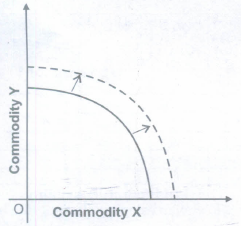
(ii) It is so because it attracts foreign companies or investors to set up factories in India and invest in country's infrastructure.
(iii) It leads to huge capital inflow shifting the production possibility curve rightward as shown in the figure.
10.
(i) Production possibility curve is a curve which depicts all possible combinations of two goods which can be produced with given resources and technology in an economy.
(ii) PPC is also called opportunity cost curve because each and every point on PPC measures the opportunity cost of one commodity in terms of sacrificing other commodity.
(iii) The rate of this sacrificed commodity is called the Marginal Opportunity Cost of the expanding good.
11.
Production possibility curve is a curve which depicts all possible combinations of two goods which can be produced with given resources and technology in an economy.
Properties of Production Possibility Curve
(i) PPC is downward sloping: The downward slope of PPC means if the country wants to produce more of one good, it has to produce less quantity of the other goods.
(ii) PPC is concave to the point of origin:
Concave shape of PPC implies that the slope of PPC increases. Slope of PPC is defined as the quantity of goods Y given up in exchange for additional unit of goods X.
[Slope of Production Possibility Curve]
\(=\frac { \triangle Y }{ \triangle X } =\frac { Amount\ of\ Goods\ Y\ lost }{ Amount\ of\ Good\ X\ gained } \)
[Slope of PPC] = MRT = [Marginal Opportunity Cost]
12.
The central problems of an economy are:
(i) What to produce and in what quantity?
(ii) How to produce?
(iii) For whom to produce?
13.
| Microeconomics | Basis | Macroeconomics |
|---|---|---|
| Microeconomics studies the behaviour of individual economic units of an economy, like households, firms, individual consumers and producers etc. | Degree of Aggregation | Macroeconomics is that part of economic theory which studies the economy as a whole, such as national income, aggregate employment, general price level, aggregate consumption, aggregate investment, etc |
| The objective of macroeconomics is to study the principles, problems, policies concerning the optimum utilisation of resources. | Objective | Its objective is to study the problems, policies and principles relating to the full employment of resources. |
| In this, laws are based on the assumption of other things being constant (ceteris paribus). It means that we show effect of only one change by keeping other factor constant. This method of study is called partial equilibrium analysis. | Method of study |
In this, laws are formulated so that mutual interdependence between different economic variables such as total savings total employment could be studied easily. This method of study is called general equilibrium analysis. |
| Its main instruments are demand and supply. | Instrument | Its main instruments are aggregate demand and aggregate supply |
| It is also called 'Price Theory' | Alternative Name | It is also called the 'Income Theory' or 'Employment Theory'. |
14.
(i) The subject matter of economics includes microeconomics and macroeconomics.
(ii) Microeconomics, studies the behaviour of individual economic units of an economy like households, firms, individual consumers and producers etc. It does not study the economy as a whole.
(iii) Macroeconomics is the part of economic theory that studies the economy as a whole, such as national income, aggregate employment, general price level, aggregate consumption, aggregate investment, etc.
15.
(b)
Resources are not equally efficient for production of the two goods.
16.
(a)
Labour surplus economy
17.
(c)
Opportunity costs are constant
18.
(d)
Goods and services are produced at least cost and no resources are wasted
19.
(d)
Allocating scarce resources in such a manner that society's unlimited needs or wants are satisfied in the best possible manner.

11th Standard CBSE Syllabus & Materials
11th Standard CBSE
CBSE 11th Business Studies Forms of Business Organisation Sample Question Papers Study Material - QB365 Set A
NEW11th Standard CBSE
CBSE 11th Business Studies Business, Trade and Commerce Sample Question Papers Study Material - QB365 Set A
NEW11th Standard CBSE
CBSE 11th Physics Waves Sample Question Papers Study Material - QB365 Set A
NEW11th Standard CBSE
CBSE 11th Physics Kinetic Theory Sample Question Papers Study Material - QB365 Set A



NCERT Books

Syllabus

Exam Pattern

Sample Question Papers

Previous year Question Papers

Important Notes

MCQ Practice test

NCERT Exemplers

Case study Questions

Image Based Questions

Passage based Questions

HOT Questions

Value Based Questions

Model Questions Papers
NCERT ( Book Back ) Questions

Assertion and Reason
Important Questions And Answers

CBSE 11th Standard CBSE Subjects
CBSE Standards