 100% FREE ACCESS
11th Standard CBSE Syllabus & Materials
11th Standard CBSE
CBSE 11th Economics PART-A - Presentation of Data - New Sample Question Papers Study Material - QB365 Set A
NEW11th Standard CBSE
CBSE 11th Economics PART-A - Organisation of Data - New Sample Question Papers Study Material - QB365 Set A
NEW11th Standard CBSE
CBSE 11th Economics PART-A - Collection of Data - New Sample Question Papers Study Material - QB365 Set A
NEW11th Standard CBSE
CBSE 11th Economics PART-A - Introduction to Economics and Statistics - New Sample Question Papers Study Material - QB365 Set A
NEW11th Standard CBSE
CBSE 11th Business Studies International Trade Sample Question Papers Study Material - QB365 Set A
NEW11th Standard CBSE
CBSE 11th Business Studies Evolution and Fundamentals of Business Sample Question Papers Study Material - QB365 Set A

Published on: 21/10/2025
Download CBSE Class 11th Standard CBSE Mathematics question papers, sample papers, important questions, and previous year solved papers in PDF format. Get free study materials, NCERT solutions, and exam preparation resources for Class 11th Standard CBSE Mathematics
Questions + Answers key
Take MCQ Mathematics Test
1.
Expand the following expressions by using binomial theorem:
\(\left( ax-\frac { b }{ x } \right) ^{ 6 }\)
2.
Find the derivative of \(\frac{sin x-x cos x}{x sinx+cos x}\) w.r.t.x.
3.
In a group of 1200 people, there are 800 people who can speak Hindi and 480 people who can Speak spanish. How many can speak Hindi only? How many can speak Spanish only? How many can speak both Hindi and Spanish?
4.
A solution of 9% acid is to be diluted by adding 3%acid solution to it. The resulting mixture is to be more than 5%but less than 7% acid. If there is 460 litres of the 9% solution, how many litres of 3%solution will have to be added?
5.
Find the equation of the circle with, centre (-2,3) and radius 4.
6.
Find x, if \({1\over 7!}+{1\over 8!}={x\over 9!}\)
7.
What is the probability that a randomly chosen two-digit positive integer is multiple of 3?
8.
Find the derivative of the following functions.
\(\frac { a }{ x^{ 4 } } -\frac { b }{ { x }^{ 2 } } +cosx\)
9.
Find the centroid of a triangle, the mid-point of whose sides are D(1, 2, -3), E (3, 0, 1) and F(-1, 1, -4).
10.
In each of the following questions, find the coordinates of the focus, axis of the parabola, the equation of the directrix and the length of the latusrectum .x2 = -9y
11.
Reduce the equation \(\sqrt { 3x } + y=4\) into normal form and hence find the values of p and a.
12.
If \(^{n-1}{C}{_{r}}\) : \( ^{n}{C}{_{r}}\) : \(^{n+1}{C}{_{r}} \)= 6:9:13, then find the values of n and r
13.
How many 2 digit even numbers can be formed from the digits 1, 2, 3, 4, 5 if the digits can be repeated?
14.
Solve the inequalities : 2(2x + 3) -10< 6 (x - 2) for real x.
15.
Simplify the following
in + in+1 +in+2 +in+3
16.
Find the conjugate of the complex number \(\frac { 1-i }{ 1+i }\)
17.
Prove that
\(cos\frac { \pi }{ 8 } +cos\frac { 3\pi }{ 8 } +cos\frac { 5\pi }{ 8 } +cos\frac { 7\pi }{ 8 } =0.\)
18.
Show that
\(cos\left( \frac { \pi }{ 4 } -\theta \right) cos\left( \frac { \pi }{ 4 } -\phi \right) -sin\left( \frac { \pi }{ 4 } -\theta \right) sin\left( \frac { \pi }{ 4 } -\phi \right) =sin\left( \theta +\phi \right) .\)
19.
Determine the domain and range of the relation R, where R = {(x-2,\({ x }^{ 2 }\)) : x is a prime number less than 15}
20.
Write the following as intervals.
{x : x \(\in\) R, 0 \(\le\) x < 7}
21.
Prove by mathematical induction that \({ 1 }^{ 3 }+{ 2 }^{ 3 }+{ 3 }^{ 3 }+...+{ n }^{ 3 }=\left[ \frac { n(n+1) }{ 2 } \right] ^{ 2 }\), for all \(n\varepsilon N\)
22.
Prove that: \({cos 6\theta +6cos 4\theta+15cos 2\theta+10\over cos5\theta+5cos 3\theta+10cos\theta}=2cos \theta\)
23.
A man running a race leave no space course notes that the sum of the distances from the two flag posts from him is always 10m and the distance between the flag posts is 8 m. Find the equation of the posts traced by the man.
24.
Find the equations of the medians of a triangle formed by the lines x + y - 6 = 0, x - 3y - 2 = 0 and 5x - 3y + 2 = 0.
25.
Find the modulus and argument of the complex number \(\frac{1+2i}{1-3i}\) and convert it into polar form.
26.
Solve the inequalities graphically 3x+2y\(\le\)150, x+4y\(\le\)80, x\(\le\)15, y\(\ge\)0,x\(\ge\)0
27.
The domain of the function \(f(x)=\sqrt{x-1}+\sqrt{3-x}\) is ______.
(1,\(\infty\))
(\(\infty\),5)
(1, 3)
[1, 3]
28.
If x = r sin\(\alpha\) cos \(\beta\), y = r sin\(\alpha\) sin \(\beta\)and z = r cos\(\alpha\), then X2 + y2 + Z2 is independent of ______.
\(\alpha , \beta\)
\(\gamma , \alpha\)
\(\gamma , \beta\)
none of these
29.
If A = {x : x is a multiple of 3} and B = {x : x is a multiple of 5} then A - B is _____.
\(A\cap B\)
\(A-\bar B\)
\(\bar A\cap\bar B\)
\(\overline {A\cap B}\)
30.
The sum of the square of (n - 1) natural numbers is ______.
\(\frac{n(n+1)(2n+1)}{6}\)
\(\frac{n(n-1)(2n-1)}{6}\)
\(\frac{(n+1)(n-1)(n-2)}{6}\)
None
31.
The difference between the lengths of the major axis and the latus rectum of an ellipse is ______.
\({ 2ae }^{ 2 }\)
\(ae\)
\(3ae\)
\(ae^{ 2 }\)
32.
The circle x2+y2+2gx+2fy+c = 0 does not intersect x − axis if ______.
\(g^{ 2 }>c\)
\(g^{ 2 }
\(g^{ 2 }>2c\)
\(g^{ 2 }<2c\)
33.
If in the expansion of (1 +x)n, the coefficients of fifth, sixth and seventh terms are inA.P. then n is equal to _____.
5,7
7,16
7,14
8,15
34.
If 40Cr+2 = 40Cr-2 then r is equal to ______.
20
18
14
28
35.
If p be the length of the perpendicular from the origin to the line \({x\over a}+{y\over b}=1\) then ______.
\({1\over p^2}=a^2 + b^2\)
\({1\over p^2}={1\over a^2} +{1\over b^2}\)
p2 = a2 + b2
none of these
36.
Sum of n terms of ,the series \(\sqrt { 2 } +\sqrt { 8 } +\sqrt { 18 } +\sqrt { 32 } +\)..... is ______.
\(\left[ \frac { n(n+1) }{ 2 } \right] ^{ 2 }\)
n2 (n+3)
\(\frac { n(n+1) }{ \sqrt { 2 } } \)
2
1.
a6x6 - 6a5x4b + 15a4x2b2 - 20a3b3 + \(\frac { { 15 a }^{ 2 }{ b }^{ 4 } }{ { x }^{ 4 } } -6\frac { { ab }^{ 5 } }{ { x }^{ 4 } } +\frac { { b }^{ 6 } }{ { x }^{ 6 } } \)
2.
\(\frac{x^{2}}{(x sinx+cos x)^{2}}\)
3.
20,400,80
4.
More than 230 litres but less than 920 litres]
5.
Here h = -2, k = 3 and r = 4
The equation of circle is
(x - h)2 + (y - k)2 = r2
∴ (x + 2)2 + (y - 3)2 = (4)2
⇒ x2 + 4 + 4x + y2 + 9 - 6y = 16
⇒ x2 + y2 + 4x - 6y - 3 = 0
which is required equation of circle.
6.
\({1\over 7!}+{1\over 8!}={x\over 9!}\)
⇒ \({1\over 7!}+{1\over 8\times7!}={x\over 9\times8\times7!}\)
⇒ \({1\over 7!}\left[1+{1\over8}\right]={1\over 7!}\left[x\over 9\times8\right]\)
⇒ \({9\over 8}={x\over 9\times8}\)
⇒ x=81
7.
\(\frac { 1 }{ 3 } \)
8.
\(-\frac { 4a }{ { x }^{ 5 } } +\frac { 2b }{ { x }^{ 3 } } -sinx\)
9.
The centroid of a triangle is equal to the centroid of the triangle formed by mid-points of its sides.
(1, 1, -2)
10.
Given, equation of parabola is .x2 = -9y, which is of the form .x2 = -4ay i.e focus lies on the negative direction of Y-axis
Here, 4a=9
\(\Rightarrow\) a =\(\frac{9}{4}\)
\(\therefore\) Focus = (0, -a) =\(\left( 0,-\frac { 9 }{ 4 } \right) \)
Axis = Y-axis
Directrix, y = a \(\Rightarrow\) y =\(\frac{9}{4}\) and length of latusrectum = 4a =9
11.
On dividing both sides of given equation by
\(\sqrt { (\sqrt { 3 } )^{ 2 }+(1)^{ 2 } } \) we get
\(x.\left( \frac { \sqrt { 3 } }{ 2 } \right) +y.\left( \frac { 1 }{ 2 } \right) =2\)
\(xcos30^{ \circ }+ysin30^{ 0 }=2\)
\(\alpha =30^{ \circ }\quad p=2\quad units\)
12.
We have ,\(\frac{^{n-1}{C}{_{r}} } { ^{n}{C}{_{r}}}\) = \(\frac {6}{9}\)
\(\Rightarrow\) \(\frac { \frac { (n-1)! }{r!(n-1-r)! } }{ \frac { n! }{ r!(n-r)! } }\) =\(\frac {2}{3}\)
\(\Rightarrow\) \(\frac { (n-1)! }{(n-(r+1))!} \times \frac {(n-r)!}{n!}\) = \(\frac {2}{3}\)
\(\Rightarrow\) \(\frac { (n-1)! }{r!(r+1))!} \times \frac {(n-r)(n-(r=1))!}{n(n-1)!}\) =\(\frac {2}{3}\)
\(\Rightarrow\) \(\frac {n-r}{n}\)= \(\frac {2}{3}\)
\(\Rightarrow\)3n - 3r = 2n
\(\Rightarrow\)n - 3r = 0 ......(i)
Also we have \( \frac{^{n}{C}{_{r}}}{^{n+1}{C}{_{r}}}\) = \(\frac{9}{13}\)
\(\Rightarrow\) \(\frac{n!}{r!(n-r)!} \times \frac{r!(n+1-r)!}{(n+1)}\) = \(\frac{9}{13}\)
\(\Rightarrow\)\(\frac{n!}{ (n-r)!} \times \frac{n-(r-1)! }{(n+1)n!}\) = \(\frac{9}{13}\)
\(\Rightarrow\)\(\frac {(n-(r-1))(n-r)!}{(n-r!)(n+1)}\) = \(\frac{9}{13}\)
\(\Rightarrow\) \(\frac{n-r+1}{n+1} \) = \(\frac{9}{13}\)
\(\Rightarrow\)13n - 13r + 13 = 9n + 9
\(\Rightarrow\) 4n - 13r = -4 .....(ii)
On solving Eqs.(i) and (ii), we get
n = 12 and r = 4
13.
There will be as many ways as there are ways of filling 2 vacant places  in succession by the five given digits. Here, in this case, we start filling in unit’s place, because the options for this place are 2 and 4 only and this can be done in 2 ways; following which the ten’s place can be filled by any of the 5 digits in 5 different ways as the digits can be repeated. Therefore, by the multiplication principle, the required number of two digits even numbers is 2 × 5, i.e., 10.
14.
2(2x+3)−10<6(x−2)
⇒4x+6−10<6x−12
⇒4x−4<6x−12
⇒−4+12<6x−4x
⇒8<2x
⇒4
Hence, the solution set of the given inequality is (4, \(\infty \))
15.
0
16.
\(z=\frac { 1-i }{ 1+i } x \frac { 1-i }{ 1-i } =\frac { 1-1-2i }{ 1+1 } =-i\) = i
17.
LHS= \(cos\frac { \pi }{ 8 } +cos\frac { 3\pi }{ 8 } +cos\frac { 5\pi }{ 8 } +cos\frac { 7\pi }{ 8 } \)
\(=cos\frac { \pi }{ 8 } +cos\frac { 3\pi }{ 8 } +cos\left( \pi -\frac { 3\pi }{ 8 } \right) +cos\left( \pi -\frac { \pi }{ 8 } \right)\)
\( \\ =cos\frac { \pi }{ 8 } +cos\frac { 3\pi }{ 8 } -cos\frac { 3\pi }{ 8 } -cos\frac { \pi }{ 8 } \quad [\because cos(\pi -\theta )=-cos\theta ]\)
\(=0\)=RHS.
Hence proved.
18.
Use the formula of cos (A+B).
19.
Given, R = {(x-2,\({ x }^{ 2 }\)) : x is a prime number less than 15}
\(\therefore \) R = {(0,4),(1,9),(3,25),(5,49),(9,121),(11,169)}
Domain(R) = {0,1,3,5,9,11}
Range(R) = {4,9,25,49,121,169}
20.
{x : x \(\in\) R, 0 \(\le\) x < 7} is the set that contain 0 but not 7. So, it can be represented as an interval whose first end is closed and the other end is open.
So, the interval is [0,7).
21.
Step I Let P(n) be the given statement,
i.e. P(n): \({ 1 }^{ 3 }+{ 2 }^{ 3 }+{ 3 }^{ 3 }+...+{ n }^{ 3 }=\left[ \frac { n(n+1) }{ 2 } \right] ^{ 2 }\)
Step II For n=1, we have, LHS=13=1
and RHS= \(\left[ \frac { 1(1+1) }{ 2 } \right] ^{ 3 }=\left( \frac { 1.2 }{ 2 } \right) ^{ 3 }=1\)
LHS=RHS; P(1) is true
Step III Let us assume that P(n) is true for n=k. Then we have
P(k): \({ 1 }^{ 3 }+{ 2 }^{ 3 }+{ 3 }^{ 3 }+.....+{ k }^{ 3 }=\left[ \frac { k(k+1) }{ 2 } \right] ^{ 2 }...(i)\)
Step IV Now, we shall prove the statement for n=k+1 For this we have to show
13+23+33+.....+k3+(k+1)3
=\(\left[ \frac { (k+1)(k+1+1) }{ 2 } \right] ^{ 2 }\)
Now, LHS=13+23+33+.....+k3+(k+1)3
= \(\left[ \frac { k(k+1) }{ 2 } \right] ^{ 2 }+(k+1)^{ 3 }\) [from Eq.(i)]
\(=(k+1)^{ 2 }\left[ \frac { k^{ 2 } }{ 4 } +(k+1) \right] \)
\(\\ =(k+1)^{ 2 }\left[ \frac { k^{ 2 }+4(k+1) }{ 4 } \right] =\frac { (k+1)^{ 2 }\left[ k^{ 2 }+4k+4 \right] }{ 4 } \)
\(=\frac { (k+1)^{ 2 }(k+2)^{ 2 } }{ 4 } =RHS\)
So, P(k+1) is true, whenever P(k) is true. Hence, by principle of mathematical induction, P(n) is true for all \(n\in N\)
22.
cos 6\(\theta\) + 6 cos 4\(\theta\) + 15 cos 2\(\theta\) + 10
= (cos 6\(\theta\) + cos 4\(\theta\)) + (5 cos 4\(\theta\) + 5 cos 2\(\theta\)) + (10 cos 2\(\theta\) + 10)
= (cos 6\(\theta\) + cos 4\(\theta\)) + 5 (cos 4\(\theta\) + cos 2\(\theta\)) + 10 (cos 2\(\theta\)+ 1)
= 2cos 5\(\theta\) cos \(\theta\) + 5 x 2 cos 3\(\theta\) cos \(\theta\)+ 10 x 2 cos \(\theta\) cos \(\theta\)
= 2cos \(\theta\) [cos5\(\theta\) + 5 cos 3\(\theta\) + 10 cos \(\theta\)]
\(\therefore {cos \theta + 6 cos 4 \theta + 15 cos 2 \theta + 10 \over
cos 5 \theta + 5 cos 3 \theta + 10 cos \theta}=2cos \theta\)
23.
Let F1 and F2 be two points where the flag parts are fixed on the ground. The origin O is the mid point of F1F2
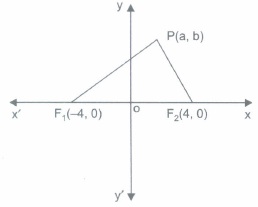
∴ OF1=OF2=\(\frac { 1 }{ 2 } \)F1F2=\(\frac { 1 }{ 2 } \) x 8 =4m
∴ Coordinates of F; are (-4, 0) and F2 are (4, 0)
Let P(α, β) be any point on the track.
∴ PF1+PF2 = 0
∴ \(\sqrt { (\alpha +4)^{ 2 }+(\beta -0)^{ 2 } } +\sqrt { (\alpha -4)^{ 2 }+(\beta -0)^{ 2 } } \)
=10
⇒ \(\sqrt { \alpha ^{ 2 }+16+8\alpha +{ \beta }^{ 2 } } \)
=10-\(\sqrt { { \alpha }^{ 2 }+16-8\alpha +{ \beta }^{ 2 } } \)
Squaring both sides, we have
\(\\ { \alpha }^{ 2 }+{ \beta }^{ 2 }+8\alpha +16=100+{ \alpha }^{ 2 }+{ \beta }^{ 2 }-8\alpha \)+16
=-20\(\sqrt { { \alpha }^{ 2 }+{ \beta }^{ 2 }-8d+16 } \)
⇒ 16\(\alpha \)-100=-20\(\sqrt { { \alpha }^{ 2 }+{ \beta }^{ 2 }-8d+16 } \)
Squaring both sides again, we have
(16\(\alpha \)-100)2=(-20\(\sqrt { { (\alpha }^{ 2 }+{ \beta }^{ 2 }-8d+16)^{ 2 } } \)
⇒ 256\(\alpha \)2+1000-3200\(\alpha \) = 400(\(\alpha \)2+\(\beta \)2+8\(\alpha \)+16)
⇒ 256\(\alpha \)2+10000-3200\(\alpha \)=400\(\alpha \)2+400\(\beta \)2-3200\(\alpha \)+6400
⇒ 144\(\alpha \)2+400\(\beta \)2=3600
⇒ \(\frac { 144\alpha ^{ 2 } }{ 3600 } +\frac { 400{ \beta }^{ 2 } }{ 3600 } \)=1 ⇒ \(\frac { { \alpha }^{ 2 } }{ 25 } +\frac { { \beta }^{ 2 } }{ 9 } \)=1
Thus required equation of locus of point P is
\(\frac { { x }^{ 2 } }{ 25 } +\frac { { y }^{ 2 } }{ 9 } \)=1
24.
The equations of lines AB, BC and AC are
x + y - 6 = 0 ...(i)
x - 3y - 2 = 0 ...(ii)
5x- 3y + 2 = 0 ...(iii)
On solving the equation (i) and (ii), we have coordinates of point B (5,1).
On solving the equation (ii) and (iii), we have coordinates of point C (-1, -1).
On solving the equation (iii) and (i), we have coordinates of point A (2, 4).
Let D, E, F are mid points of BC, AC and AB respectively.
Coordinates of D are \(\left({5-1\over 2},{1-1\over 2}\right)\ i.e.(2,0)\)
Coordinates of E are \(\left({2-1\over 2},{4-1\over 2}\right)\ i.e.\left({1\over 2},{3\over 2}\right)\)
Coordinates of D are \(\left({2+5\over 2},{4+1\over 2}\right)\ i.e.\left({7\over 2},{5\over 2}\right)\)
Equation of median AD is
\(y-4={(0-4)\over (2-2)}(y-2)\)
⇒ x - 2 = 0
Equation of median BE is
\(y-1={\left({3\over2}-1\right)\over \left({1\over2}-5\right)}(x-5)\)
\(⇒\ y-1={{1\over 2}\over -{9\over 2}}(x-5)\)
⇒ 9y - 9 = -x + 5
⇒ x + 9y - 14 = 0
Equation of CF is
\(y+1={\left({5\over 2}+1\right)\over \left({7\over 2}+5\right)}(x+1)\)
\(⇒\ y+1={{7\over 2}\over {9\over 2}}(x+1)\)
\(⇒\ y+1={7\over 9}(x+1)\)
⇒ 9y + 9 = 7x + 7 ⇒ 7x - 9y - 2 = 0
Thus equations of medians are x - 2 = 0, x + 9y - 14 = 0 and 7x - 9y - 2 = O.
25.
Let \(z=\frac{1+2i}{1-3i}\)
\(=\frac{1+2i}{1-3i}\times\frac{1+3i}{1+3i}=\frac{1+5i+6i^2}{1-9i^2}\)
\(=\frac{-5+5i}{10}=-\frac{1}{2}+\frac{1}{2}i\)
= r (cos \(\theta\) + i sin \(\theta\))
\(\Rightarrow r\ cos\theta=-\frac{1}{2}\ and\ r\ sin\theta=\frac{1}{2}\)...... (i)
Squaring both sides of (i) and adding
\(r^2(cos^2\theta+sin^2\theta)=\frac{1}{4}+\frac{1}{4}\)
\(\Rightarrow r^2=\frac{1}{2}\Rightarrow r=\frac{1}{\sqrt 2}\)
\(\therefore\frac{1}{\sqrt 2}\ cos\theta=-\frac{1}{2}\ and\frac{1}{\sqrt 2}\ sin\theta=\frac{1}{2}\)
\(\Rightarrow\ cos\theta=-\frac{1}{\sqrt 2}\ and\ sin\theta=\frac{1}{\sqrt 2}\)
Since sin \(\theta\) is positive and cos \(\theta\) is negative.
\(\therefore\) \(\theta\) lies in second quadrant.
\(\theta=(\pi-\frac{\pi}{4})=\frac{3\pi}{4}\)
Thus polar form of z is \(\frac{1}{\sqrt 2}(cos\frac{3\pi}{4}+isin\frac{3\pi}{4}).\)
26.
The given inequality is 3x + 2y \(\le\)150.
Draw the graph of the line 3x + 2y = 150.
Table of values satisfying the equation 3x + 2y = 150
| x | 30 | 40 |
| y | 30 | 15 |
Putting (0,0) in the given inequation, we have 3 x 0 + 2 x 0 \(\le\)150 \(\Rightarrow\) 0 \(\le\)150, which is true.
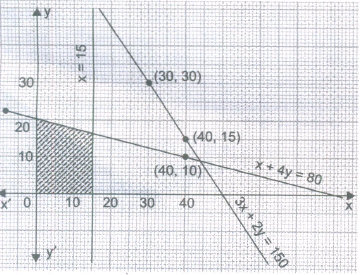
\(\therefore\) Half plane of 3x + 2y \(\le\)150 is towards origin.
Also the given inequality is x + 4y \(\le\) 80.
Draw the graph of the line x + 4y = 80.
Table of values satisfying the equation x + 4y = 80
| x | 0 | 40 |
| y | 20 | 10 |
Putting (0, 0) in the given inequation, we have o + 4 x 0 \(\le\) 80 \(\Rightarrow\) 0 \(\le\) 80, which is true.
\(\therefore\) Half plane of x + 4y \(\le\) 80 is towards origin.
The given inequality is x \(\le\)15.
Draw the graph of the line x = 15.
Putting (0, 0) in the given inequation, we have 0 \(\le\)15 which is true
\(\therefore\) Half plane of x \(\le\)15 is towards origin.
27.
(d)
[1, 3]
28.
(a)
\(\alpha , \beta\)
29.
(b)
\(A-\bar B\)
30.
(b)
\(\frac{n(n-1)(2n-1)}{6}\)
31.
(a)
\({ 2ae }^{ 2 }\)
32.
(a)
\(g^{ 2 }>c\)
33.
(b)
7,16
34.
(a)
20
35.
(b)
\({1\over p^2}={1\over a^2} +{1\over b^2}\)
36.
(c)
\(\frac { n(n+1) }{ \sqrt { 2 } } \)

11th Standard CBSE Syllabus & Materials
11th Standard CBSE
CBSE 11th Business Studies Forms of Business Organisation Sample Question Papers Study Material - QB365 Set A
NEW11th Standard CBSE
CBSE 11th Business Studies Business, Trade and Commerce Sample Question Papers Study Material - QB365 Set A
NEW11th Standard CBSE
CBSE 11th Physics Waves Sample Question Papers Study Material - QB365 Set A
NEW11th Standard CBSE
CBSE 11th Physics Kinetic Theory Sample Question Papers Study Material - QB365 Set A



NCERT Books

Syllabus

Exam Pattern

Sample Question Papers

Previous year Question Papers

Important Notes

MCQ Practice test

NCERT Exemplers

Case study Questions

Image Based Questions

Passage based Questions

HOT Questions

Value Based Questions

Model Questions Papers
NCERT ( Book Back ) Questions

Assertion and Reason
Important Questions And Answers

CBSE 11th Standard CBSE Subjects
CBSE Standards