
 100% FREE ACCESS
11th Standard CBSE Syllabus & Materials
11th Standard CBSE
CBSE 11th Economics PART-A - Presentation of Data - New Sample Question Papers Study Material - QB365 Set A
NEW11th Standard CBSE
CBSE 11th Economics PART-A - Organisation of Data - New Sample Question Papers Study Material - QB365 Set A
NEW11th Standard CBSE
CBSE 11th Economics PART-A - Collection of Data - New Sample Question Papers Study Material - QB365 Set A
NEW11th Standard CBSE
CBSE 11th Economics PART-A - Introduction to Economics and Statistics - New Sample Question Papers Study Material - QB365 Set A
NEW11th Standard CBSE
CBSE 11th Business Studies International Trade Sample Question Papers Study Material - QB365 Set A
NEW11th Standard CBSE
CBSE 11th Business Studies Evolution and Fundamentals of Business Sample Question Papers Study Material - QB365 Set A

Published on: 21/10/2025
Download CBSE Class 11th Standard CBSE Mathematics question papers, sample papers, important questions, and previous year solved papers in PDF format. Get free study materials, NCERT solutions, and exam preparation resources for Class 11th Standard CBSE Mathematics
Questions + Answers key
Take MCQ Mathematics Test
1.
Find sin\({x\over2},cos{x\over2} and \ tan {x\over2}\) in each of the following: sin x =\({1\over4}\),x in quadrant II.
2.
Find the equation of the line passing through the point of intersection of the lines 4x + 7y - 3 = 0 and 2x - 3y + 1 = 0 that has equal intercepts on the axis.
3.
Solve the inequalities graphically x +2y\(\le\)10,x+y\(\ge\)1,x-y\(\le\)0,x\(\ge\)0,y\(\ge\)0
4.
Find the mean deviation about the median for the data :
36, 72, 46, 42, 60, 45, 53, 46, 51, 49
5.
f f(x) =x2 find \(f(1.1)-f(1)\over (1.1-1)\).
6.
Given the set A = {1, 3, 5}, B = {2, 4, 6} and C = {0, 2, 4, 6, 8}, which of the following may be considered as universal set(s) for all the three sets A, B, and C?
(i) {0, 1, 2, 3, 4, 5, 6}
(ii) ф
(iii) {0, 1, 2, 3, 4, 5, 6, 7, 8, 9, 10}
(iv) {1,2, 3, 4, 5, 6, 7, 8}
7.
Check the validity of the statements given below by the method given against it
(i) p: The sum of an irrational number and a rational number is irrational (by contradiction method)
(ii) q: If n is a real number with n > 3, then n2 > 9 (by contradiction method)
8.
Prove the following by using the principle of mathematical induction for all n ∊ N:1+2+3+... +\(n<\frac { 1 }{ 8 } (2n+1)^{ 2 }\)
9.
Find the derivative of \(\frac { ax+b }{ cx+d } \) (it is to be understood that a, b, c, d, p, q, rand s are fixed non-zero constants and m and n are integers)
10.
Find the general solution for each of the following equations:
sin x + sin 3x + sin 5x = 0
1.
Here sin x = =\({1\over4}\),x in quadrant II.
\(\therefore \ cos^2 x=1-sin^2 x\)
\(\Rightarrow\) cos2x= 1- \(({1\over4})^2=1-{1\over16}={15\over16}\)
\(\therefore cos x=\pm {\sqrt{15}\over4}\)
But x lies in second quadrant.
\(\therefore cos x=- {\sqrt{15}\over4}\)
Also \({x\over2}\)
So \({x\over2}\) lies in first quadrant.
\(\therefore \) sin\(x\over2\) ,cos\(x\over2\)and tan\(x\over2\)are all positive.
Now cos\({x\over2}={\sqrt{1+cos \ x\over 2}}=\sqrt{1+{\sqrt{15}\over4}\over2}\)
\(=\sqrt{4-\sqrt{15}\over 8}={\sqrt{8-2\sqrt{15}\over4}}\)
sin\({x\over2}={\sqrt{1-cos \ x\over 2}}=\sqrt{1+{\sqrt{15}\over4}\over2}\)
\(=\sqrt{4+\sqrt{15}\over 8}={\sqrt{8+2\sqrt{15}\over4}}\)
tan\(x\over2\) \(={sin {x\over2}\over cos {x\over2}}={{\sqrt{8+2\sqrt{15}}\over4}\over{\sqrt{8-2\sqrt{15}}\over4}}\)
\(={\sqrt{4+\sqrt{15}}\over\sqrt{4-\sqrt{15}}}\times {\sqrt{4+\sqrt{15}}\over\sqrt{4+\sqrt{15}}}\)
\(={{4+\sqrt{15}}\over\sqrt{16-16}}=4+\sqrt{15}\)
2.
The equation of given lines are
4x + 7y - 3 = 0 and 2x - 3y + 1 = O.
Now the equation of any line through intersection of these lines is
4x + 7y - 3 + k (2x - 3y + 1) = 0....(i)
\(\Rightarrow\) (4 + 2k)x + (7 - 3k)y = 3 - k
\(\Rightarrow\) \(\frac{(4+2k)x}{3-k}+\frac{(7-3k)y}{3-k}=1\)
\(\Rightarrow\) \(\frac{x}{\frac{3-k}{4+2k}}+\frac{y}{\frac{3-k}{7-3k}}=1\)
It is given that \(\frac{3-k}{4+2k}=\frac{3-k}{7-3k}\)
\(\Rightarrow\) \((3-k)[\frac{1}{4+2k}-\frac{1}{7-3k}]=0\)
\(\Rightarrow\) 3 - k = 0
or \(\frac{1}{4+2k}-\frac{1}{7-3k}=0\Rightarrow 3=k\)
or 7 - 3k - 4 - 2k = 0
\(\Rightarrow\) k = 3 or -5k = -3
\(\Rightarrow\) k = 3 or \(k=\frac{3}{5}\)
Putting k = 3 in (i), we have
4x + 7y - 3 + 3(2x - 3y + 1) = 0
\(\Rightarrow\) 4x + 7y - 3 + 6x - 9y + 3 = 0
\(\Rightarrow\) 10x - 2y = 0 \(\Rightarrow\) 5x - y = 0
Putting \(k=\frac{3}{5}\) in equ (i), we have
4x + 7y - 3 + 3(2x - 3y + 1) = 0
\(\Rightarrow\) 20x + 35y - 15 + 6x - 9y + 3 = 0
\(\Rightarrow\) 13x + 13y - 6 = 0.
3.
The given inequality is x + 2y \(\le\)10.
Draw the graph of the line x + 2y = 10.
Table of values satisfying the equation x+ 2y = 10
| x | 2 | 4 |
| y | 4 | 3 |
Putting (0, 0) in the given inequation, we have 0 + 2 x 0 \(\le\) 10 \(\Rightarrow\) 0 \(\le\) 10, which is true
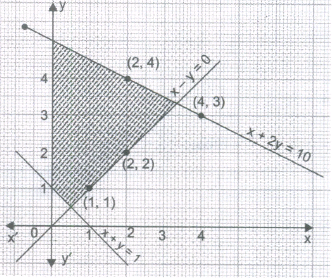
\(\therefore\) Half plane ofx + 2y \(\le\)10is towards origin.
Also the given inequality is x + y \(\ge\) 1.
Draw the graph of the line x + y = 1.
Table of values satisfying the equation x +y = 1
| x | 0 | 1 |
| y | 1 | 0 |
Putting (0, 0) in the given inequation, we have 0+ 0 \(\ge\) 1\(\Rightarrow\) 0 \(\ge\) 1, which is false.
\(\therefore\) Half plane of x+ y \(\ge\) 1is away from origin.
Also the given inequality is x - y \(\le\) O.
Draw the graph of the line x - y = O.
Table of values satisfying the equation x-y =0
| x | 1 | 2 |
| y | 1 | 2 |
Putting (2, 0) in the given inequation, we have
2 - 0 \(\le\) 0 \(\Rightarrow\) 2 \(\le\) 0 which is false.
\(\therefore\) Half plane ofx - y \(\le\) 0 is away from origin.
4.
Arrange the data in ascending order, we have
36,42,45,46,46,49,51,53,60,72
Here n = 10 (which is even)
So median is average of 5th and 6th observation
∴ Median=\(\frac{46+49}{2}=\frac{95}{2}=47.5\)
| xi | |xi-M| |
| 36 | 11.5 |
| 42 | 5.5 |
| 45 | 2.5 |
| 46 | 1.5 |
| 46 | 1.5 |
| 49 | 1.5 |
| 51 | 3.5 |
| 53 | 5.5 |
| 60 | 12.5 |
| 72 | 24.5 |
| Total | 70 |
M.D. about median=\(\frac { 1 }{ n } \sum _{ i=1 }^{ n }{ \left| { x }_{ i }-M \right| } \)
\(=\frac{1}{10}\times70=7\)
5.
Here f(x) = x2.
At x=1.1
f(1.1) = (1.1)2 = 1.21
f(1) = (1)2 =1
\(\therefore {f(1.1)-f(1)\over (1.1-1)}={1.21-1\over 0.1}={0.21\over 0.1}=2.1\)
6.
(i) {0,1, 2, 3, 4, 5, 6} is not a universal set for A, B, C because 8 ∈ C but 8 is not a member of {0, 1, 2, 3, 4, 5, 6}.
(ii) ф is a set which contains no element. So it is not a universal set for A, B, C.
(iii) {0,1, 2, 3, 4, 5, 6, 7, 8, 9, 10} is a universal set for A, B, C because all members of A, B, C are present in {0, 1, 2, 3, 4, 5, 6, 7, 8, 9,10}.
(iv) {1, 2, 3, 4, 5, 6, 7, 8} is not a universal set .for A, B, C because 0 ∈ C but 0 is not a member of {1, 2, 3, 4, 5, 6, 7, 8}.
7.
(i)Let us assume that p is not true.
\(\therefore \)Sum of an irrational and a rational number is not irrational.
\(\Rightarrow \)There exists an irrational number a and a rational number b such that a + b is not irrational.
\(\Rightarrow \)a + b = c (say) is a rational number.
\(\Rightarrow \)a=c-b
\(\Rightarrow \)a is rational.
But a is irrational, which is contradiction
So our supposition in wrong.
Thus p is true.
(ii) Let rand s be the statements given by
r: n is a real number with n > 3
s: n2> 9
If possible let q is not true then
\(\Rightarrow \)\(\sim \)q is true
\(\Rightarrow \)(r\(\Rightarrow \)s) is true
[\(\therefore \)q:rs]
\(\Rightarrow \)r and \(\sim \)s is true.
\(\Rightarrow \)n is a real number with n > 3 and n2 < 9
which is contradiction So our supposition is wrong.
Thus q is true.
8.
Let P(n) =1+2+3+....+\(n<\frac { 1 }{ 8 } (2n+1)^{ 2 }\)
For n =1
P(1) = \(1<\frac { 1 }{ 8 } (2\times +1+)^{ 2 }\Rightarrow 1<\frac { 9 }{ 8 } \)
∴ P(1) is true
Let p(n) be true for n = k
∴ P(k) = 1 + 2 + 3 + .....+\(k<\frac { 1 }{ 8 } (2k+1)^{ 2 }\) ..(i)
For n = k+1
P(k+1) =1+2+3+...+k+(k+1)<\(\frac { 1 }{ 8 } \) (2k+3)2
From (i) we have
1+2+3+.....+ k<\(\frac { 1 }{ 8 } \) (2k+3)2
Adding (k + 1) on both sides, we get
1+2+3+...... +k+(k+1)<\(\frac { 1 }{ 8 } \)(2k+1)2+(k+1)
1+2+3+...... +k+(k+1)<\(\frac { 1 }{ 8 } \) [4k2+4k+1+8k+8]
1+2+3+...... +k+(k+1) <\(\frac { 1 }{ 8 } \)[4k2+12k+9]
1+2+3+...... +k+(k+1)<\(\frac { 1 }{ 8 } \)(2k+3)2
\(\frac { k+1 }{ 2 } \)+[2\(\times\)1+(k+1-1)1]<\(\frac { 1 }{ 8 } \)(2k+3)2
⇒ \(\frac { (k+1)(k+2) }{ 2 } \)<\(\frac { 1 }{ 8 } \)(2k+3)2
⇒ 4(k + 1)(k+2)<4k2 + 9 + 6k
⇒ 4(k2 +3k+2)<4k2 + 9 + 6k
⇒ 4k2+12k+8<4k2+9+6k
⇒ 8 < 9
∴ P(k + 1) is true.
Thus P(k) is true ⇒ P(k + 1) is true.
Hence by principle of mathematical induction,p(n) is true for all n ∊ N.
9.
Here f(x)=\(\frac { ax+b }{ cx+d } \)
\(\therefore f(x)=\frac { d }{ dx } \left[ \frac { ax+b }{ cx+d } \right] \)
\(=\frac { (cx+d)\frac { d }{ dx } (ax+b)-(ax+b)\frac { d }{ dx } (cx+d) }{ { (cx+d) }^{ 2 } } \)
\(=\frac { (cx+d)(a)-(ax+b)(c) }{ { (cx+d) }^{ 2 } } \)
\(=\frac { acx+ad-acx-bc }{ { (cx+d) }^{ 2 } } \)
\(=\frac { ad-bc }{ { (cx+d) }^{ 2 } } \)
10.
sin x + sin 3x + sin 5x = 0
\(\Rightarrow\)(sin 5x + sin x) + sin 3x = 0
\(\Rightarrow\)2sin \(({5x+x\over 2})cos ({5x+x\over 2})+sin 3x=0\)
\(\Rightarrow\)2 sin 3x cos 2x + sin 3x = 0
\(\Rightarrow\)sin 3x (2 cos 2x + 1) = 0
\(\Rightarrow\)Either sin 3x = 0 or 2 cos 2x + 1 = 0
\(\Rightarrow\)3x = n\(\pi\) or cos 2x=\(-{1\over2}=cos {2\pi\over3},n\in Z\)
\(\Rightarrow\) \(x={n\pi\over3} or 2x=2n\pi\pm{2\pi\over3},n\in z.\)
\(\Rightarrow\) \(x={n\pi\over3} or x=n\pi\pm{\pi\over3},n\in z.\)
11th Standard CBSE Syllabus & Materials
11th Standard CBSE
CBSE 11th Business Studies Forms of Business Organisation Sample Question Papers Study Material - QB365 Set A
NEW11th Standard CBSE
CBSE 11th Business Studies Business, Trade and Commerce Sample Question Papers Study Material - QB365 Set A
NEW11th Standard CBSE
CBSE 11th Physics Waves Sample Question Papers Study Material - QB365 Set A
NEW11th Standard CBSE
CBSE 11th Physics Kinetic Theory Sample Question Papers Study Material - QB365 Set A

NCERT Books

Syllabus

Exam Pattern

Sample Question Papers

Previous year Question Papers

Important Notes

MCQ Practice test

NCERT Exemplers

Case study Questions

Image Based Questions

Passage based Questions

HOT Questions

Value Based Questions

Model Questions Papers
NCERT ( Book Back ) Questions

Assertion and Reason
Important Questions And Answers

CBSE 11th Standard CBSE Subjects
CBSE Standards