
 100% FREE ACCESS
11th Standard CBSE Syllabus & Materials
11th Standard CBSE
CBSE 11th Economics PART-A - Presentation of Data - New Sample Question Papers Study Material - QB365 Set A
NEW11th Standard CBSE
CBSE 11th Economics PART-A - Organisation of Data - New Sample Question Papers Study Material - QB365 Set A
NEW11th Standard CBSE
CBSE 11th Economics PART-A - Collection of Data - New Sample Question Papers Study Material - QB365 Set A
NEW11th Standard CBSE
CBSE 11th Economics PART-A - Introduction to Economics and Statistics - New Sample Question Papers Study Material - QB365 Set A
NEW11th Standard CBSE
CBSE 11th Business Studies International Trade Sample Question Papers Study Material - QB365 Set A
NEW11th Standard CBSE
CBSE 11th Business Studies Evolution and Fundamentals of Business Sample Question Papers Study Material - QB365 Set A

Published on: 21/10/2025
Download CBSE Class 11th Standard CBSE Mathematics question papers, sample papers, important questions, and previous year solved papers in PDF format. Get free study materials, NCERT solutions, and exam preparation resources for Class 11th Standard CBSE Mathematics
Questions + Answers key
Take MCQ Mathematics Test
1.
Evaluate:\(\underset { x\rightarrow \frac { p }{ 2 } }{ Lim } \frac { { a }^{ cotx }-{ a }^{ cosx } }{ cotx-cosx } \)
2.
The fourth term of a C.P. is 4. Find the product of its first seven terms.
3.
Find the transformed equation of the parabola y2=4ax if the origin is shifted to (-3, 2).
4.
The letters of word 'SOCIETY' are placed at random in a row. What is the probability that three vowels come together?
5.
Solve the quadratic equation 2x2 - 4x +3 =0.
6.
Determine the range and domain of the relation: R = {(x, y): y = I x + 1|, x \(\in\) Z, IxI \(\le\)3}.
7.
Find the domain and range of f (x) =\(\sqrt{x-2}\)
8.
Let P(n) be the statement "3n">n". If p(n) is true, prove that p(n+1) is true.
9.
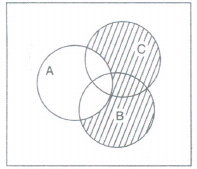
Draw the Venn diagram of the following:
A' \(\cap\) (B \(\cup\) C)
10.
A card is selected from a pack of 52 cards.
How many points are there in the sample space?
11.
An experiment consists of recording boy-girl composition of families with 2 children
What is the sample space, if we are interested in knowing whether it is a boy or girl in the order of their births?
12.
Find the standard deviation and the variance of first n natural numbers.
13.
Write the inverse of the following statements.
If you get a job, then your credentials are good.
14.
\(f: R-\{3\} \rightarrow R\) be defined by \(f(x)=\frac{x^{2}-9}{x-3}\) and \(g: R \rightarrow R\) be defined by \(g(x)=x+3\). Find whether f = g or not.
15.
Which of the following are sets? Justify your answer.
The collection of all the months of a year beginning with the letter J.
1.
\(\underset { x\rightarrow \frac { \pi }{ 2 } }{ Lim } \frac { { a }^{ cotx }-{ a }^{ cosx } }{ cotx-cosx } \)
\(=\underset { x\rightarrow \frac { \pi }{ 2 } }{ Lim } { a }^{ cosx }\left[ \frac { { a }^{ cotx }-^{ cosx }-1 }{ cotx-cosx } \right] \)
⇒Put cot x - cos x = t
\(\therefore \quad Lim\quad x\rightarrow \frac { \pi }{ 2 } \Rightarrow cot\frac { \pi }{ 2 } -cos\frac { \pi }{ 2 } =t\)
\(\therefore \quad t\rightarrow 0\Rightarrow \underset { t\rightarrow 0 }{ Lim } \frac { { a }^{ t }-1 }{ t } \Rightarrow { log }_{ e }a\)
2.
Let a be the first term and r be the common ratio of given G.P. then
a4 = 4 \(\Rightarrow\) ar3 = 4
Now product of first seven terms
= a1· a2· a3· a4· a5· a6· a7
= (a)(ar)(ar2)(ar3)(ar4)(ar5)(ar6)
= a7r2I = (ar3)7
= (4)7 [\(\therefore\) ar3 = 4]
= 16384.
3.
Origin is shifted to (-3, 2) by a translation
h = -3 and k = 2
Let (x', y') be the new coordinates of the point (x, y)
\(\therefore\) x = x' + h = x' - 3
and y = y' + k = y' + 2
Now substituting the values of x and y in the given of the parabola y2 = 4ax we get
(y' + 2)2= 4a (x'-3)
\(\Rightarrow\) y'2 + 4 + 4y' = 4ax' -12a
\(\Rightarrow\) y'2 + 4y' - 4ax' + 12a + 4 =0
\(\therefore\) the equation of the parabola in new system is y2 + 4y'-4ax+12a + 4 = 0.
4.
There are 7 letters in the word
\(\therefore \) Total events = 7!
Now there are 3 vowels in the word 'SOCIETY' when we put three vowels altogether and consider as one letter. Then favourable events = 5! x 3!
\(\text{thus required probability }=\frac { 5!\times 3! }{ 7! } =\frac { 1 }{ 7 } \)
5.
Here 2x2 - 4x + 3 = 0
Comparing the given quadratic equation with ax2 + bx + c= 0, we have a = 2, b = - 4 and c = 3
\(\therefore x=\frac{-(-4)\pm\sqrt {(-4)^2-4\times2\times3}}{2\times2}\)
\(=\frac{4\pm\sqrt {16-24}}{4}=\frac{4\pm\sqrt {-8}}{4}\)
\(=\frac{4\pm2\sqrt {2i}}{4}=\frac{2\pm\sqrt {2i}}{2}\)
Thus \(x=\frac{2+\sqrt {2i}}{2}\ and\ x=\frac{2-\sqrt {2i}}{2}.\)
6.
Domain = {-3, -2, -1,0, 1,2, 3};Range = {0,1,2,3, 4}
7.
Domain = [2,\(\infty\));Range = [0,\(\infty\))
8.
It is given that P(n) is true i.e.3n>n.
we have prove that P(n + 1) is true i.e. 3n + 1 >(n + 1)
Now 3n> n
⇒ 3·3n> 3n
⇒ 3n+1>n+2n
⇒ 3n+1>n+1 [∵ 2n> 1for all n∊N]
which shows that P(n+1) is true.
9.
10.
A card is drawn at random from a pack of 52 cards, therefore there are 52 sample points in the sample space.
11.
When the order of the birth of a girl or a boy is considered, the sample space is given by S = {GG, GB, BG, BB}
12.
The first n natural numbers are 1,2,3...,n.
\(\because\) Standard deviation,
\(SD=\sqrt { \frac { \sum _{ i=1 }^{ n }{ { x }_{ i }^{ 2 } } }{ n } -({ \frac { \sum _{ i=1 }^{ n }{ { x }_{ i } } }{ n } ) }^{ 2 } } \)
\(\therefore \ SD=\sqrt { \frac { (n(n+1)(2n+1) }{ 6n } -({ \frac { n(n+1) }{ 2n } ) }^{ 2 } } \)
\([\because \ \sum _{ i=1 }^{ n }{ { x }_{ i }^{ 2 } } =\frac { n(n+1)(2n+1) }{ 6 } and\ \sum _{ i=1 }^{ n }{ { x }_{ i } } =\frac { n(n+1) }{ 2 } ]\)
\(=\sqrt { (n+1)(\frac { 2n+1 }{ 6 } -\frac { n+1 }{ 4 } ) } \)
\(=\sqrt { (n+1)(\frac { 4n+2-3n-3 }{ 12 } ) } \)
\(=\sqrt { \frac { (n+1)(n-1) }{ 12 } } =\sqrt { \frac { { n }^{ 2 }-1 }{ 12 } } \)
\(\therefore \ Variance={ (SD) }^{ 2 }=\frac { { n }^{ 2 }-1 }{ 12 } \)
13.
The inverse of the given statement is 'If you do not get a job, then your credentials are not good'.
14.
Here, \(f(x)=\frac{x^{2}-9}{x-3}=\frac{(x-3)(x+3)}{x-3}=(x+3)\)
and \(g(x)=x+3\Rightarrow f(x)=g(x)=x+3\).
But \(f(x)\neq g(x)\) as domain of f(x) is \(R-\left\{ 3 \right\} \) and
domain of g(x) is R.
\(\Rightarrow \) Domain of \(f(x)\neq \) Domain of g(x) \(\Rightarrow \) \(f\neq g\)
15.
We are sure that members of this collection are January, June, and July. So, this collection is well-defined. Hence, it is a set.
11th Standard CBSE Syllabus & Materials
11th Standard CBSE
CBSE 11th Business Studies Forms of Business Organisation Sample Question Papers Study Material - QB365 Set A
NEW11th Standard CBSE
CBSE 11th Business Studies Business, Trade and Commerce Sample Question Papers Study Material - QB365 Set A
NEW11th Standard CBSE
CBSE 11th Physics Waves Sample Question Papers Study Material - QB365 Set A
NEW11th Standard CBSE
CBSE 11th Physics Kinetic Theory Sample Question Papers Study Material - QB365 Set A

NCERT Books

Syllabus

Exam Pattern

Sample Question Papers

Previous year Question Papers

Important Notes

MCQ Practice test

NCERT Exemplers

Case study Questions

Image Based Questions

Passage based Questions

HOT Questions

Value Based Questions

Model Questions Papers
NCERT ( Book Back ) Questions

Assertion and Reason
Important Questions And Answers

CBSE 11th Standard CBSE Subjects
CBSE Standards