
 100% FREE ACCESS
11th Standard CBSE Syllabus & Materials
11th Standard CBSE
CBSE 11th Economics PART-A - Presentation of Data - New Sample Question Papers Study Material - QB365 Set A
NEW11th Standard CBSE
CBSE 11th Economics PART-A - Organisation of Data - New Sample Question Papers Study Material - QB365 Set A
NEW11th Standard CBSE
CBSE 11th Economics PART-A - Collection of Data - New Sample Question Papers Study Material - QB365 Set A
NEW11th Standard CBSE
CBSE 11th Economics PART-A - Introduction to Economics and Statistics - New Sample Question Papers Study Material - QB365 Set A
NEW11th Standard CBSE
CBSE 11th Business Studies International Trade Sample Question Papers Study Material - QB365 Set A
NEW11th Standard CBSE
CBSE 11th Business Studies Evolution and Fundamentals of Business Sample Question Papers Study Material - QB365 Set A

Published on: 21/10/2025
Download CBSE Class 11th Standard CBSE Physics question papers, sample papers, important questions, and previous year solved papers in PDF format. Get free study materials, NCERT solutions, and exam preparation resources for Class 11th Standard CBSE Physics
Questions + Answers key
Take MCQ Physics Test
1.
Explain why a cricketer moves his hands backwards while holding a catch.
2.
Give the name of three important characteristics of a SHM.
3.
What will be the internal energy of 8g of oxygen at STP?
4.
Is reversible process possible in nature?
5.
Why a gas is cooled when it expand?
6.
The coolant used in a nuclear reactor should have high specific heat. Why?
7.
Why an ice box is constructed with a double wall?
8.
A hot liquid moves faster than a cold liquid. Why?
9.
A wire of length 2.5 m has a percentage strain of 0.012 % under a tensile force. Determine the extension in the wire.
10.
Why a body weighs more at poles and less at equator?
11.
A satellite does not need any fuel to circle around the earth.Why?
12.
Does angular momentum of a body in translatory motion is zero?
13.
The momentum of a body is doubled. What is the percentage increase in kinetic energy?
14.
A woman throws an object of mass 500 g with a speed of 25 m/s.
(i) What is the impulse imparted to the objects?
(ii) If the object hits a wall and rebounds with half the original speed, what is the change in momentum of the object ?
15.
A particle cannot accelerate if its velocity is constant, why?
16.
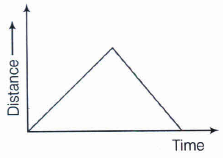
The graph between total path length and time for a particle moving along a straight line as shown in figure is not possible. Explain why?
17.
What is the condition for an object to be considered as a point object?
18.
Find the dimensional formulae of
(i) Kinetic energy and
(ii) pressure
19.
How many amu make 1 kg?
20.
If the earth did not have an atmosphere it would become intolerable cold why?
21.
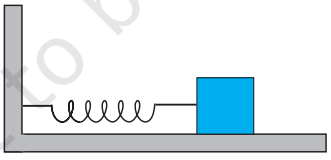
A spring having with a spring constant 1200 N m–1 is mounted on a horizontal table as shown in Fig. A mass of 3 kg is attached to the free end of the spring. The mass is then pulled sideways to a distance of 2.0 cm and released.
Determine (i) the frequency of oscillations, (ii) maximum acceleration of the mass, and (iii) the maximum speed of the mass.
22.
A guitar string is 90 cm long and has a fundamental frequency of 124 H. Where should it be pressed to produce a fundamental frequency of 180 Hz?
23.
Explain,
(i) why there is no atmosphere on moon.
(ii) there is fall in temperature with altitude
24.
Explain, why?
(i) Air pressure in a car tyres increases during driving.
(ii) The climate of a harbor town is more temperate than that of a town in a desert at the same latitude
25.
Calculate the work done for adiabatic expansion of a gas.
26.
Explain why
(a) The blood pressure in humans is greater at the feet than at the brain
(b) Atmospheric pressure at a height of about 6 km decreases to nearly half of its value at the sea level, though the height of the atmosphere is more than 100 km
(c) Hydrostatic pressure is a scalar quantity even though pressure is force divided by area.
27.
Define period of revolution.Derive an expression of the period of revolution or time period of satellite.
28.
A jet plane beginning its take off moves down the runway at a constant acceleration of 4.00 m/s2 If a speed of 70.0 m/s is required for the plane to leave the ground, how long a runwasy is required? Because the acceleration is constant , we can apply the equations of motion derived above.
29.
Find the expression for kinetic energy, potential energy and total energy of a particle executing SHM.
30.
What do you mean by orbital velocity? Find the expression for orbital velocity.
31.
Write the expressions for Cv and Cp of a gas in terms of gas constant R and constant y, where \(γ={C_P\over C_v}\)
32.
Distinguish between conduction, convection and radiation
33.
Consider the two horizontal pipes of different diameters which are connected together and the water is flowing through these two pipes. In the first pipes, the pressure is 3.0\(\times\)104N/m2 and the speed of the water flowing is 5m/s. If the diameters of the pipes are 4 cm and 6 cm, respectively, then what will be the speed and the pressure of the water in the second pipe? Density of the water is 103kg/m3 .
34.
Calculate the escape speed of a body from the solar system from following data
(i) Mass of the sun = \(2\times 10^{ 30 }kg\)
(ii) Separation of the earth from the sun = \(1.5\times 10^{ 11 }m\)
35.
According to kinetic theory of gases the r.m.s. velocity of the gas molecules is directly proportional to
\(\sqrt { T } \)
T4
T
T2
36.
A couple produces a:
pure linear motion
pure rotational motion
none of the above.
both linear and rotational motion
37.
Distance-time graph of a body at rest is
parallel to time-axis
parallel to distance-axis
inclined to time-axis
perpendicular to both axes.
38.
The displacement of an object at any instant is given by x = 30 + 20 t2, where x is in metres and t in seconds. The acceleration of the object will be
40 ms-2
50 ms-2
30 ms-2
zero
39.
Two bodies of masses m and 4 m are moving with equal linear momentum. The ratio of their kinetic energies is
1 : 4
4 : 1
1 : 1
1 : 2
40.
'Parsec' is the unit of _____.
Time
Distance
Frequency
Angular acceleration
41.
At about 4°C, a certain amount of water has maximum
energy
specific heat
density
Volume
42.
Elastic limit is equal to
Young's modulus
Modulus of rigidity
stress
strain
43.
If M is the mass of the earth and R its radius, the ratio of the gravitational acceleration and the gravitational constant is
\(\frac{R^2}{M}\)
\(\frac{M}{R^2}\)
MR2
\(\frac{M}{R}\)
44.
The mass of water rises in capillary tube of radius R is M. The mass of water that rises in tube of radius 2R is
M
M/2
2M
4M
45.
The dimension of Impulse is _______.
MLT-2
MLT-1
MLT-3
MLT
1.
The ball comes with large momentum after being hit by the batsman. When the player takes catch it causes large impulse on his palms which may hurt the cricketer. When he moves his hands backward the time of contact of ball and hand is increased so the force is reduced.
2.
Three important characteristics of an SHM are amplitude, time period (or frequency) and phase
3.
Oxygen is a diatomic gas.
Number of moles of O2 gas
\(=\frac { Atomic\ wt. }{ Molecular\ wt. } =\frac { 8 }{ 32 } \)
\(\\ =\frac { 1 }{ 4 } =0.25\)
\(\\ \therefore \ Energy\ associated\ with\ 1\ mole\ of\ oxygen\)
\(\\ U=\frac { 5 }{ 2 } RT\)
\(\\ \therefore \ Internal\ enreyg\ of\ 8g\ of\ oxygen=0.25\times \frac { 5 }{ 2 } \times 8.31\times 273=1417.9J\)
4.
A reversible process is never possible in nature because of dissipative forces and condition for a quasi-static process is not practically possible.
5.
When a gas expands, it does work on the surroundings. This work is done on the expense of internal energy and that is why its internal energy and so its temperature decreases.
6.
The purpose of a coolant is to absorb maximum heat with least rise in its own temperature. This is possible only if specific heat is high because Q = mc \(\Delta \)T. For a given value of m and Q, the rise in temperature \(\Delta \)T will be small if c is large. This will prevent different parts of the nuclear reactor from getting too hot.
7.
An ice box is made of double wall and the space in between the walls is filled with some non-conducting material to provide heat insulation, so that the loss of heat can be minimized.
8.
The viscosity of liquid decreases with the increase in temperature. Therefore, viscosity of hot liquid is less than that of cold liquid. Due to this, hot liquid moves faster than the cold liquid.
9.
Here, original length, L = 2.5 m
Strain = \(\frac { \Delta L }{ L } \) = 0.012 % = \(\frac { 0.012 }{ 100 } \)
\(\Delta L\) = Strain x L
\(\Delta L\) = extension = \(\frac { 0.012 }{ 100 } \times L\)
= \(\frac { 0.012\times 2.5 }{ 100 } \) = 3 x 10⁻⁴ m
= 0.3 mm
10.
The value of g is more at poles than at the equator. Therefore, a body weighs more at poles than at equator.
11.
The gravitation force between satellite and the earth provides the centripetal force required by the satellite to move in a circular orbit.The satellite orbits around earth at such a higher height where air friction is neglible.
12.
Angular momentum of a body is measured with respect to certain origin.
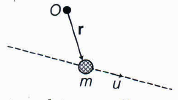
So, a body in translatory motion can have angular momentum.
It will be zero, if origin lies on the line of motion of particle.
13.
we know kinetic energy
\( K=\frac{p^2}{2 m} \)
\( K^{\prime}=\frac{p^{\prime} 2}{2 m}=\frac{(2 p)^2}{2 m}=4\left(\frac{p^2}{2 m}\right)=4 K \)
\( \frac{\Delta K}{K}=\frac{K^{\prime}-K}{K}=\frac{4 K-K}{K}=3 \)
\(\%\left(\frac{\Delta K}{K}\right)=3 \times 100=300 \%\)
14.
Given, Mass of the object (m) = 500 g = 0.5 kg
Speed of the object (v) = 25 m/s
(i) Impulse imparted to the object
= change in the momentum = mv - mu
= m ( v - u ) = 0.5 ( 25 - 0) = 12.5 N-s
(ii) Velocity of the object after rebounding = -\(\frac { 25 }{ 2 } \) m/s
v' = -12.5 m/s
\(\therefore \) Change in momentum = m ( v' - v )
= 0.5 ( - 12.5 - 25 ) = -18.75 N-s
15.
When the particle is moving with a constant velocity, there is no change in velocity with time and hence, its acceleration is zero.
16.
The graph shows that 'with the passage of time, total path length first increases and then decreases.
The path length always increases or remains constant with passage of time and it does not decrease with time as shown in figure. Thus, this graph is not possible.
17.
An object can be considered as a point object if the distance travelled by it is very large than its size.
18.
\(KE=\frac { 1 }{ 2 } mv^{ 2 }\text{ i.e.,dimensional formula of KE is} [ML^{ 2 }T^{ -2 }]\)
\(Pressure=\frac { Force }{ Area } =\frac { [MLT^{ -2 }] }{ [L^{ 2 }] } =[ML^{ -1 }T^{ -2 }]\)
19.
1 amu =1.66 x 10⁻²⁷ kg
∴ 1 kg = (1/1.66 x 10-27) amu = 0.6 x 1027 amu
20.
The lower layer of earth's atmosphere reflects infra-red radiations from earth back to the surface of the earth. So the heat radiation received by the earth from the sun during del) time are trapped by the atmosphere. Therefore, if the earth did not have atmosphere, its surface would become too cold to tolerate
21.
Here, K 1200 Nm-1; m = 3.0 kg, a = 2.0 cm = 0.02 m
(i) Frequency, \(v=\frac { 1 }{ T } =\frac { 1 }{ 2\pi } \sqrt { \frac { k }{ m } } =\frac { 1 }{ 2\times 3.14 } \sqrt { \frac { 1200 }{ 3 } } =3.2{ s }^{ -1 }\)
(ii) Acceleration, \(A={ \omega }^{ 2 }\quad y=\frac { k }{ m } y\)
Acceleration will be maximum when y is maximum i.e., y = a
∴ max. acceleration, \({ A }_{ max }=\frac { ka }{ m } =\frac { 1200\times 0.02 }{ 3 } =8{ ms }^{ -2 }\)
(iii) Max. speed of the mass will be when it is passing through mean position
\({ V }_{ max }=a\omega =a\sqrt { \frac { k }{ m } } =0.02\times \sqrt { \frac { 1200 }{ 3 } } =0.4{ ms }^{ -1 }\)
22.
The fundamental frequency of a string fixed at both ends is given by
\(v=\frac{1}{2 L} \sqrt{\frac{F}{\mu}}\)
As F and mu are fixed, \(\frac{v_1}{v_2}=\frac{L_2}{L_1}$ or , $L_2=\frac{v_1}{v_2} L_1=\frac{124 \mathrm{~Hz}}{186 \mathrm{~Hz}}(90 \mathrm{~cm})=60 \mathrm{~cm}\).
Thus, the string should be pressed at 60 cm from an end.
23.
(i) The moon has small gravitational; force and hence the escape velocity is small .As the moon is in tyhe proximity of the earth as seen from the sun, the moon has the same amount of heat per unit area as that of the earth , The air molecules have l;arge range of speeds.
Even though the rms speed of the air molecules is smaller than the escape velocity on the moon, a significant number of molecules have speed greater than escape velocity and they escape.
Now, rest of the molecules arrange the speed distribution for the equilibrium temperature. Again, a significant number of molecules escape as their speeds exceed escape sppeed. Hence, over a long time the moon has lost most of its atmosphere.
(ii) As the molecules move higher , their potential energy increases and hence kinetic energy decreases and hence temperature reduces.
At greater height, more volume is available and gas expands and hencde some cooling takes place.
24.
(i) During driving, temperature of the gas increases while its volume remains constant. So, according to Charles' law, at constant V, p \(\propto \) T. Therefore, pressure of gas increases.
(ii) This is because in a harbor town, the relative humidity is more than in a desert town. Hence, the climate of a harbour town is without extremes of hot and cold.
25.
Consider (say \(\mu \) mole) an ideal gas, which is undergoing an adiabatic expansion. Let the gas expands by an infinitesimally small volume dV, at pressure p, then the infinitesimally small work done given by
dW = pdV
The net work done from an initial volume V1 is given by
\(W=\int _{ { v }_{ 1 } }^{ { v }_{ 2 } }{ pdV } \)
For an adiabatic process, \(p{ V }^{ \gamma }=constant=K\)
\(\\ p=\frac { K }{ { V }^{ \gamma } } =K{ V }^{ -\gamma }\)
\(\\ \therefore \ W=\int _{ { v }_{ 1 } }^{ { v }_{ 2 } }{ (K{ V }^{ -\gamma })dV } =k\left[ \frac { { V }^{ -\gamma +1 } }{ -\gamma +1 } \right] _{ { v }_{ 1 } }^{ { v }_{ 2 } }\)
\(\\ =\frac { K{ V }_{ 2 }^{ -\gamma +1 }-K{ V }_{ 1 }^{ -\gamma +1 } }{ (1-\gamma ) } \)
\(\\ For\ an\ adiabatic\ process,\)
\( K={ p }_{ 1 }{ V }_{ 1 }^{ \gamma }={ p }_{ 2 }{ V }_{ 2 }^{ \gamma }\)
\(\\ \Rightarrow W=\frac { { { p }_{ 2 }{ V }_{ 2 }^{ \gamma }.{ V }_{ 2 }^{ -\gamma +1 }-{ p }_{ 1 }{ V }_{ 1 }^{ \gamma }.{ V }_{ 2 }^{ -\gamma +1 } } }{ (1-\gamma ) } \)
\(\\ =\frac { 1 }{ (1-\gamma ) } ({ p }_{ 2 }{ V }_{ 2 }-{ p }_{ 1 }{ V }_{ 1 })\)
\(\\ For\ an\ ideal\ gas,\ { p }_{ 1 }{ V }_{ 1 }=\mu R{ T }_{ 1 }\ and\ { p }_{ 2 }{ V }_{ 2 }=\mu R{ T }_{ 2 }.\ So,\ we\ have\)
\(\\ W=\frac { 1 }{ (1-\gamma ) } [\mu R{ T }_{ 2 }-\mu R{ T }_{ 1 }]=\frac { \mu R }{ (1-\gamma ) } [{ T }_{ 1 }-{ T }_{ 2 }]\)
26.
(a) The pressure of liquid column is given by \(p=h\rho g\), where h is depth, \(\rho \)i s density and g is acceleration due to gravity.
Therefore, pressure of liquid column increases with depth. The height of blood column in human body is more at feet than at the brain. Therefore, the blood pressure in humans is greater at the feet than the brain.
(b) The density of air is maximum near the surface of the earth and decreases rapidly with height. At a height of 6 km, the density of air decreases to nearly half its value at the seal level. Beyond 6km height, the density of air decreases very slowly with height.Hence, the atmospheric pressure at a height of about 6km decreases to nearly half of its value at the sea level.
(c) When force is applied on a liquid, the pressure is transmitted equally in all directions inside the liquid. Therefore, hydrostatic pressure has no fixed direction and hence, it is a scalar quantity.
27.
Period of a revolution of a satellite is the time taken by the satellite to complete one revolution round the earth. It is denoted by T.
\(\therefore T=\frac { Circumference\ of\ circular\ orbit }{ Orbital\ velocity } \)
or \(T=\frac { 2\pi r }{ { v }_{ o } } \)
or \(T=\frac { 2\pi (R+h) }{ { v }_{ o } } \quad \quad \quad \quad \quad [\therefore r=R+H]\)
or \(T=2\pi (R+h)\sqrt { \frac { R+h }{ GM } } \left[ \because \quad { v }_{ o }=\sqrt { \frac { GM }{ R+h } } \right] \)
or \(T=2\pi \sqrt { \frac { (R+h)^{ 2 } }{ GM } } \)
Also, \(T=2\pi \sqrt { \frac { (R+h)^{ 2 }(R+h) }{ GM } } \)
or \(T=2\pi \sqrt { \frac { (R+h)^{ 3 } }{ gR^{ 2 } } } \)
\(\because \quad \quad g{ R }^{ 2 }=GM\)
\(\therefore T=2\pi \sqrt { \frac { (R+h)^{ 2 } }{ gR^{ 2 } } } \)
28.
The problem here may be stated as
Find x when v = 70.0 m/s
It contains the single unknown x, as well as aand v, which are known with u = 0, vx2 = 2axx
Solving for x, we obtain
x = \( \frac{v^2}{2a} \)
= \(\frac{(70.00 m/s)^2}{2(4.00 m/s^2)}\)
= 613 m
29.
Let at any instant, the displacement of a particle executing SHM is y, mass of the particle 'm',
We know, displacement, y = a sin ωt
velocity, \(v={dy\over dt}={d\over dt}a\ sin\ ωt\)
or v= a ω cos ωt
kinetic energy = \({1\over 2}mv^2\)
\(E_k={1\over 2}m(a\ ω\ cos\ ωt)^2={1\over 2}ma^2ω^2cos^2ωt\)
or \(E_k={1\over 2}ma^2ω^2(1-sin^2ωt)\)
or \(E_k={1\over 2}ma^2ω^2(1-{y^2\over a^2})\)
or \(E_k={1\over 2}mω^2(a^2-y^2)\)
For Potential Energy:
As velocity, v = aω cos ωt
acceleration = \({d\over dt}(v)=(aω\ cos\ ωt)\)
=-aω2 sin ωt = -ω2(a sin ωt) = -ω2y
Restoring force at any instant, F = - ω2 y. m = - mω2y
The negative sign indicates that the restoring force is always directed towards the mean position. In order to maintain the particle at displacement y, a force In ω2y acting away from the mean position has to be applied on the particle. Let dW be the work done by the applied force to displace a given particle through a distance dy away from the mean position
Then, dW = mω2y dy
Let W be the total work done in increasing the displacement from O to y.
Thus, \(W=\int_0^ymω^2y dy = mω^2\int_0^yydy\)
or \(W=mω^2\left[ y^2\over 2\right]_0^4=mω^2\left({y^2\over 2}-0\right)={1\over 2}mω^2y^2\)
This work done is stored in the particle as potential
\(∴\ \ E_P={1\over 2}mω^2y^2\)
Total energy, E = Ek + Ep
\(⇒\ E={1\over 2}mω^2(a^2-y^2)+{1\over 2}mω^2y^2\)
or \(E={1\over 2}mω^2a^2-{1\over 2}mω^2y^2+{1\over 2}mω^2y^2\)
or \(E={1\over 2}mω^2a^2\)
30.
The velocity required to put a satellite into its orbit around the earth is called orbital velocity. A satellite moves around the earth in its orbit with orbital velocity
Consider a satellite of mass m revolving around the earth in an orbit of radius R + h, where R is the radius of earth and h is the height of satellite from the surface of earth.
Let vo be the orbital velocity of the satellite. The gravitational force between the satellite and the earth provides the necessary centripetal force to the satellite to move in a circular path around the earth. i.e., Gravitational force = Centripetal force
\(\frac{GMm}{(R+h)^2}=\frac{mv_0^2}{(R+h)}\Rightarrow v_0^2=\frac{GM}{(R+h)}\)
\(v_0=[\frac{GM}{(R+h)}]^{\frac{1}{2}}\)
\(\frac{GM}{R^2}=g\ or\ GM=gR^2\)
\(\therefore v_0=[\frac{gR^2}{(R+h)}]^{\frac{1}{2}}\)
If satellite is very close to the surface of earth, then (R + h) = R
Hence \(v_0=\sqrt {gR}.\)
31.
We know that Cp - Cv = R
and \({C_P\over C_v}=γ\)
From eqn. (ii) Cp = γCv and sustituting this value in (i),
We have \(⋎C_v-C_v=R⇒C_v={R\over (⋎-1)}\)
\(C_v=γ.C_v={γR\over(γ-1)}\)
32.
| S.No | Conduction | Convection | Radiation |
| 1 | It is the transfer of heat by direct physical contact | It is the transfer of heat by the motion of a fluid | It is the transfer of heat by electromagnetic waves. |
| 2 | It is due to temperature difference. Heat flows from high-temperature region to low temperature region. | It is due to difference in density. Heat flows from low destiny region to high density region | It occurs from all bodies at temperatures above 0 K |
| 3 | It occurs in solids through molecular collisions, without actual flow of matter. | It occurs in fluids by actual flow of matter | It can take place at large distances and does not heat the intervening medium |
| 4 | It is a slow process | It is also a slow process | It propagates at the speed of light. |
| 5 | It does not obey the laws of reflection and refraction | It does not obey the laws of reflection and refraction | It obeys the laws of reflection and refarction |
33.
\(According\ to\ the\ equation\ of\ continutity,\ we\ get\)
\(\\ { a }_{ 1 }{ v }_{ 1 }={ a }_{ 2 }{ v }_{ 2 }\)
\(\\ \Rightarrow \ \pi { r }_{ 1 }{ v }_{ 1 }=\pi { r }_{ 2 }{ v }_{ 2 }\)
\(\\ \therefore { v }_{ 2 }={ \left( \frac { { r }_{ 1 } }{ { r }_{ 2 } } \right) }^{ 2 }\ { v }_{ 1 }\)
\(\\ Given,\ { r }_{ 1 }=\frac { 4 }{ 2 } =2cm=2\times { 10 }^{ -2 }m\)
\({ r }_{ 2 }=\frac { 6 }{ 3 } =3cm\ =3\times { 10 }^{ -2 }m\)
\( { v }_{ 1 }=5m/s\)
\({ v }_{ 2 }={ \left( \frac { 2 }{ 3 } \right) }^{ 2 }\times 5=2.22m/s\)
\(\\ Now,\ applying\ the\ Bernoulli's\ theorem\)
\(\\ { p }_{ 1 }+\frac { 1 }{ 2 } { \rho { v } }_{ 1 }^{ 2 }={ p }_{ 2 }\frac { 1 }{ 2 } { \rho v }_{ 2 }^{ 2 }\)
\({ p }_{ 2 }={ p }_{ 1 }+\frac { 1 }{ 2 } \rho ({ { v } }_{ 1 }^{ 2 }+{ v }_{ 2 }^{ 2 })\)
\(=3.0\times { 10 }^{ 4 }+\frac { 1 }{ 2 } \times { 10 }^{ 3 }({ 5 }^{ 2 }-{ 2.22 }^{ 2 })\)
\(=3\times { 10 }^{ 4 }+\frac { 1 }{ 2 } \times { 10 }^{ 4 }+500\times 20.08\)
\( { p }_{ 2 }=4\times { 10 }^{ 4 }N/{ m }^{ 2 }\)
34.
If M be the mass of the sun and R be the distance of the earth from the sun, then escape velocity,
\({ v }_{ e }=\sqrt { \frac { 2GM }{ R } } =\sqrt { \frac { 2\times 6.67\times 10^{ -11 }\times 2\times 10^{ 30 } }{ 1.5\times { 10 }^{ 11 } } } { ms }^{ -1 }\)
\( =\sqrt { \frac { 4\times 6.67 }{ 1.5 } } \times { 10 }^{ 4 }ms^{ -1 }=4.217\times { 10 }^{ 4 }ms^{ -1 }\)
\({ v }_{ e }=42.17\ kms^{ -1 }\ [1km=1000m]\)
\(\therefore \) The escape speed for solar system is \(42.17\quad kms^{ -1 }\)
35.
(c)
T
36.
(b)
pure rotational motion
37.
(a)
parallel to time-axis
38.
(c)
30 ms-2
39.
(b)
4 : 1
40.
(b)
Distance
41.
(c)
density
42.
(c)
stress
43.
(b)
\(\frac{M}{R^2}\)
44.
(b)
M/2
45.
(b)
MLT-1

11th Standard CBSE Syllabus & Materials
11th Standard CBSE
CBSE 11th Business Studies Forms of Business Organisation Sample Question Papers Study Material - QB365 Set A
NEW11th Standard CBSE
CBSE 11th Business Studies Business, Trade and Commerce Sample Question Papers Study Material - QB365 Set A
NEW11th Standard CBSE
CBSE 11th Physics Waves Sample Question Papers Study Material - QB365 Set A
NEW11th Standard CBSE
CBSE 11th Physics Kinetic Theory Sample Question Papers Study Material - QB365 Set A



NCERT Books

Syllabus

Exam Pattern

Sample Question Papers

Previous year Question Papers

Important Notes

MCQ Practice test

NCERT Exemplers

Case study Questions

Image Based Questions

Passage based Questions

HOT Questions

Value Based Questions

Model Questions Papers
NCERT ( Book Back ) Questions

Assertion and Reason
Important Questions And Answers

CBSE 11th Standard CBSE Subjects
CBSE Standards