
 100% FREE ACCESS
11th Standard Syllabus & Materials
11th Standard
TN 11th Tamil இயற்கை வேளாண்மை,சுற்றுச்சூழல் -செய்யுள் - மனோன்மணீயம் Important Questions And Answers Study Material - QB365 Set A
NEW11th Standard
TN 11th Tamil என்னுயிர் என்பேன் -துணைப்பாடம் - இசைத்தமிழர் இருவர் Important Questions And Answers Study Material - QB365 Set A
NEW11th Standard
TN 11th Tamil மொழி கலை -செய்யுள் - ஒவ்வொரு புல்லையும் Important Questions And Answers Study Material - QB365 Set A
NEW11th Standard
TN 11th Tamil பீடு பெற நில் - இலக்கணம் - பகுபத உறுப்புகள் Important Questions And Answers Study Material - QB365 Set A
NEW11th Standard
TN 11th Tamil பீடு பெற நில் - துணைப்பாடம் - வாடிவாசல் Important Questions And Answers Study Material - QB365 Set A
NEW11th Standard
TN 11th Tamil பீடு பெற நில் - செய்யுள் - குறுந்தொகை Important Questions And Answers Study Material - QB365 Set A

Published on: 13/05/2022
QB365 provides detailed and simple solution for every Creative Questions in class 11 Biology Subject. It will helps to get more idea about question pattern in every Creative questions with solution.
latest Creative QuestionsDownload Tamil Nadu 11th Standard Biology question papers, model tests, one-mark questions, important questions, and public exam papers in PDF format. Free study materials and answer keys for TN State Board students.
Questions + Answers key
Take MCQ Biology Test1.
Explain the human respiratory system.
2.
Define the following terms and write their symptoms also.
(i) Asthma, (ii) emphysema, (iii) bronchitis, (iv) pneumonia,(v) tuberculosis (vi) Occupotionol respiratory disorders.
3.
Describe the transport of respiratory gases.
4.
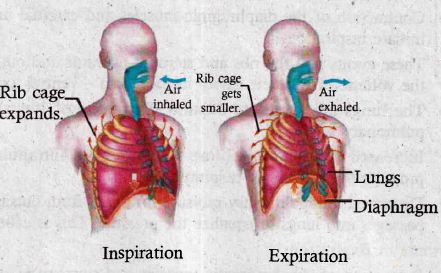
Compare the events in inspiration and expiration:
5.
1.
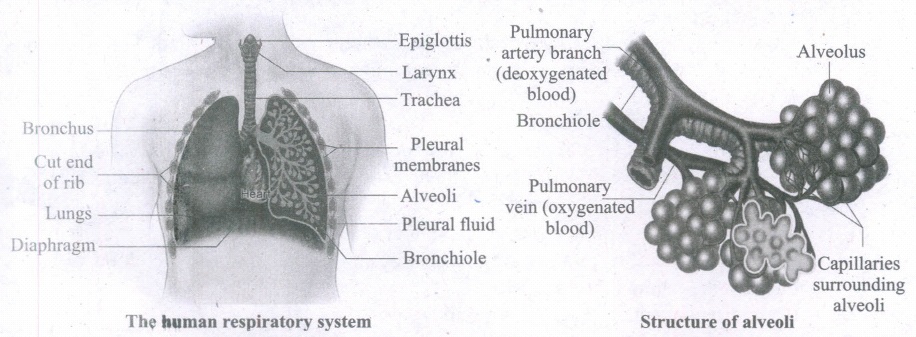
The human respiratory system constitutes the conducting zone and the respiratory zone. The conducting zone includes the external nostril, nasal cavity, pharynx, larynx, trachea, bronchi, bronchioles and the lungs which contain alveoli. The parts from the external nostrils up to the bronchioles conduct the air and hence they are called the conducting zone. This zone humidifies and warms the incoming air. The nasal cavity has fine hairs and mucus which filter dust particles in the incoming air. At the junction of the pharynx and larynx there is a flap called epiglottis. This closes the respiratory tract while swallowing thus presenting the entry of food particles into the rachea and choking. The ciliated epithelial cells of trachea, bronchi and bronchioles secrete-mucus rich in glycoprotein. Microorganism and dust particles attach in the mucus films and are carried upwards to pass down the gullet during normal swallowing. The trachea is a semi-flexible tube supported by multiple cartilaginous rings which expands upto the mid thoracic cavity. And the level of the 5th theoretic vertebra, it divides into right and left bronchi which divide into secondary and tertiary bronchi and further divide into terminal bronchioles and respiratory bronchioles. Bronchi have 'c' shaped curved Cartilage plates to ensure that the air passage does not collapse as air pressure changes during breathing. The bronchioles do not have cartilaginous rings but they have rigidity to prevent them from collapsing but are surrounded by smooth muscle which contracts or relaxes to adjust the diameter of these airways. The fine respiratory bronchioles terminate into highly vascularised thin-walled-pouch like air sacs called alveoli. It is made up of thin squamous epithelial cells, the endothelium of the alveolar capillaries and the basement substance are found in between them. The thin squamous epithelial cells of the alveoli, the endothelium of the alveolar capillaries and the basement substance found in between them. The thin squamous epithelial cells of the alveol! are composed of Type I and Type II cells. Type I cells are very thin so that gases can diffuse rapidly through them. Type II cells are thicker, synthesize and secrete a substance called Surfactant. The lungs are light spongy tissues endorsed in the thoracic cavity bound dorsally by the vertebral column and ventrally by the sternum, laterally by the ribs and on the lower side by the dome shaped diaphragm. The lungs are covered by double walled pleural membrane containing several layers of elastic connective tissues and capillaries. It encloses the pleural fluid. It reduces friction when the lungs expand and contract.
2.
(i) Asthma: It is characterized by narrowing and inflammation of bronchi andbronchioles and difficulty in breathing. Common allergens for asthma are dust, drugs, pollen grains, certain food items like fish, prawn and certain fruits etc.
(ii) Emphysema: Emphysema is chronic breathlessness caused by gradual breakdown of the thin walls of the alveoli decreasing the total surface area of a gaseous 'exchange. i.e., widening of the alveoli is called emphysema. The major cause for this disease is cigarette smoking, which reduces the respiratory surface of the alveolar walls.
(iii) Bronchitis: The bronchi when it gets inflated due to pollution smoke and cigarette smoking, causes bronchitis. The symptoms are cough, shortness of breath and sputum in the lungs.
(iv) Pneumonia: Inflammation of the lungs due to infection caused by bacteria or virus is called pneumonia. The common symptoms are sputum production, nasal congestion, shortness of breath, sore throat, etc.
(v) Tuberculosis: Tuberculosis is caused by Mycobacterium tuberculae. This infection mainly occurs in the lungs and bones. Collection of fluid between the lungs and the chest wall is the main complication of this disease.
(vi) Occupational respiratory disorders: The disorders due to one's occupation of working in industries like grinding or stone breaking, construction sites, cotton industries, etc. Dust produced affects the respiratory tracts. Long exposure can give rise to inflammation leading to fibrosis. Silicosis and asbestosis are occupational respiratory diseases resulting from inhalation of particle of silica from sand grinding and asbestos into the respiratory tract. Workers, working in such industries must wear protective masks.
3.
(i) It is a transportary/chemical/blood respiration.
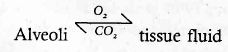
(ii) It occurs between alveoli and tissue fluid.
(iii) It mainly occurs in two steps
(A) Transport of O2
(B) Transport of CO2
(A) Transport of O2
(i) About 97% of O2 is transported by respiratory pigment haemoglobin which has more affinity with O2 to form HbO2 and poorly soluble in blood plasma.
(ii) HbO2 is formed firstly in the blood of pulmonary veins.
(iii) About 3% of O2 is transported by blood plasma under dissolved condition.
(iv) The rate at which haemoglobin binds with O2 is regulated by the pO2 (95 mm).
(v) Each haemoglobin contains four haem ions therefore four O₂ molecules are transported.
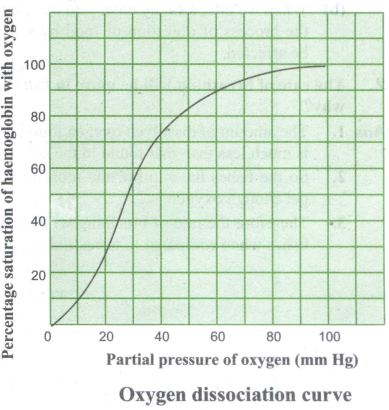
Oxygen dissociation curve
(i) In the alveoli pO2 is high (104 mm) and PCo2 is low (40 mm)
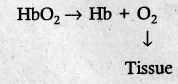
(ii) In the alveoli the temperature is low and concentration of H+ is also less. This conditions promote the formation of HbO₂ (Hb+ O₂→ HbO₂
(iii) In the tissues the pO2 is low (30 mm) and the pCO2 is high and high temperature promotes the dissociation of O2 from haemoglobin
(iv) Sigmoid (s-shaped) curve appears in oxygen dissociation curve. It is formed when % saturation of haemoglobin with O2 is plotted against pO2. This is called an oxygen haemoglobin dissociation curve.
(v) This curve appears in tissue and it is a steep slope for pO2 values between 10 and 50 mm Hg and then flattens between 70 and 100 mm Hg.
(vi) Under normal physiological state every 100 mL of oxygenated blood can deliver about 5 mL of O2 to the tissues.
(B) Transport of CO2
(i) CO2 is transported by
(a) Blood plasma: under dissolved state about 7-10% of CO2 is transported by plasma as CO2 is more soluble in blood plasma water.
(b) Bound with haemoglobin: about 20-25% of dissolved CO2 is bound and carried in the RBCs as HbCO2 (carbaminohaemoglobin).

(ii) Hb + CO2 occurs in tissues to form HbCO2
(iii) HbCO2 → Hb + CO2 occurs in alveoli of lungs
(C) As bicarbonate (HCO-3) in plasma about 70% of CO2 is transported as HCO-3 ions
(iv) The formation of HCO-3 ions is influenced by pCO2 and the degree of haemoglobin oxygenation with ferrous ions.
(v) RBCs contain a high concentration of the enzyme, carbonic anhydrase but a small quantity of this enzyme is also found in plasma of blood.
(vi) At the tissues the pCO2 is high due to catabolism and diffuses into blood to form HCO-3 and H+ ions.
(vii) The CO2 diffuses into RBCs and forms HbCO3 and into plasma water to form H2CO3 (carbonic acid).
(viii) H2CO3 is unstable and it is catalysed by carbonic anhydrase.
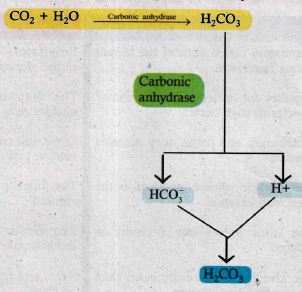
(ix) The HCO-3 moves quickly from the RBCs into plasma. From here it is transported to the lungs.
(x) At the alveolar site where pCO2 is low, the reaction is reversed leading to the formation of CO2 and H2O.
(xi) Thus CO2 trapped as HCO-3 at the tissue level is transported to the alveoli and released out as CO2.
(xii) Every 100 mL of deoxygenated blood delivers 4 mL of CO2 to the alveoli for elimination.
4.
| Inspiration | Expiration |
| Respiratory centre initiates the stimuli during inspiration \(\downarrow\) Impulses are carried to the inspiratory muscles through nerves. \(\downarrow\) Diaphragm and inspiratory muscles contract \(\downarrow\) The intrapulmonary pressure is reduced \(\downarrow\) The alveolar pressure increases than the atmospheric pressure. \(\downarrow\) Air flows into the alveoli until the alveolar pressure equalizes the atmospheric pressure and the alveoli get inflated |
Respiratory centre terminates the stimuli during expiration \(\downarrow\) The diaphragm and inspiratory muscles relax \(\downarrow\) Chest wall contracts and the thoracic volume gets reduced. \(\downarrow\) The intrapulmonary pressure is reduced. \(\downarrow\) The alveolar pressure increases than the atmospheric pressure. \(\downarrow\) Air is sent out due to the contraction of alveoli \(\downarrow\) Air flows into the alveoli until the alveolar pressure equalizes the atmospheric pressure and the alveoli get inflated |
5.


11th Standard Syllabus & Materials
11th Standard
TN 11th Tamil பீடு பெற நில் - செய்யுள் - காவடிச்சிந்து Important Questions And Answers Study Material - QB365 Set A
NEW11th Standard
TN 11th Tamil பீடு பெற நில் - உரைநடை - மலை இடப்பெயர்கள் : ஓர் ஆய்வு Important Questions And Answers Study Material - QB365 Set A
NEW11th Standard
TN 11th Tamil மாமழை போற்றுதும் - துணைப்பாடம் - யானை டாக்டர் Important Questions And Answers Study Material - QB365 Set A
NEW11th Standard
TN 11th Tamil மாமழை போற்றுதும் - செய்யுள் - ஐங்குறுநூறு Important Questions And Answers Study Material - QB365 Set A



Tamilnadu Stateboard 11th Standard Subjects

Maths

Commerce

Economics
Biology

Business Maths and Statistics

Accountancy

Computer Science

Physics

Chemistry
Maths
Biology
Economics
Physics
Chemistry

History
Business Maths and Statistics

Computer Science
Accountancy

Computer Applications
History
Computer Technology
Commerce
Computer Applications
Computer Technology

Tamil

English

French
Tamilnadu Stateboard Standards