
 100% FREE ACCESS
11th Standard Syllabus & Materials
11th Standard
TN 11th Tamil இயற்கை வேளாண்மை,சுற்றுச்சூழல் -செய்யுள் - மனோன்மணீயம் Important Questions And Answers Study Material - QB365 Set A
NEW11th Standard
TN 11th Tamil என்னுயிர் என்பேன் -துணைப்பாடம் - இசைத்தமிழர் இருவர் Important Questions And Answers Study Material - QB365 Set A
NEW11th Standard
TN 11th Tamil மொழி கலை -செய்யுள் - ஒவ்வொரு புல்லையும் Important Questions And Answers Study Material - QB365 Set A
NEW11th Standard
TN 11th Tamil பீடு பெற நில் - இலக்கணம் - பகுபத உறுப்புகள் Important Questions And Answers Study Material - QB365 Set A
NEW11th Standard
TN 11th Tamil பீடு பெற நில் - துணைப்பாடம் - வாடிவாசல் Important Questions And Answers Study Material - QB365 Set A
NEW11th Standard
TN 11th Tamil பீடு பெற நில் - செய்யுள் - குறுந்தொகை Important Questions And Answers Study Material - QB365 Set A

Published on: 13/05/2022
QB365 provides detailed and simple solution for every Book back Questions in class 11 Chemistry Subject. It will helps to get more idea about question pattern in every book back questions with solution.
latest Book back QuestionsDownload Tamil Nadu 11th Standard Chemistry question papers, model tests, one-mark questions, important questions, and public exam papers in PDF format. Free study materials and answer keys for TN State Board students.
Questions + Answers key
Take MCQ Chemistry Test1.
A sample of gas at 15°C at 1 atm. has a volume of 2.58 dm3. When the temperature is raised to 38°C at 1 atm does the volume of the gas increase? If so, calculate the final volume.
2.
When the driver of an automobile applies brake, the passengers are pushed toward the front of the car but a helium balloon is pushed toward back of the car. Upon forward acceleration the passengers are pushed toward the front of the car. Why?
3.
Suggest why there is no hydrogen (H2) in our atmosphere. Why does the moon have no atmosphere?
4.
What are ideal gases? In what way real gases differ from ideal gases.
5.
State Boyle's law.
1.
T1 = 15oC + 273 T2= 38 + 273
T1 = 288 K T2 = 311 K
V1 = 2.58 dm3 V2 = ?
(P = 1 atm constant)
\(\frac { { V }_{ 1 } }{ { T }_{ 1 } } =\frac { { V }_{ 2 } }{ { T }_{ 2 } } \)
\({ V }_{ 2 }=\left( \frac { { V }_{ 1 } }{ { T }_{ 1 } } \right) \times { T }_{ 2 }\)
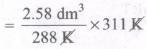
V2 = 2.78 dm3 i.e. volume increased from 2.58 dm3 to 2.78 dm3.
2.
The passenger in a moving bus falls in the forward direction, when brakes are applied suddenly is in accordance with Newton's first law of motion.
When breaks are applied, the automobile comes to rest but the passenger due to inertia of motion tend to continue to move in forward direction hence fall forward.
The movement of helium balloon in the opposite direction is due to the difference in the density of surrounding air. When the car stops suddenly, the air moves forward due to inertia of motion.
As a result the air in the front of the car is more dense that at the rear of the car creating more pressure on the front side of the balloon. This causes the balloon move towards the rear of the car where air is less dense.
The body is at rest but the car is forward motion, due to inertia the passengers are pushed toward the front of the car on forward acceleration.
3.
a) Hydrogen is the lightest gas in the atmosphere. So it rises up and other gases which are heavier like O2 & N2 come down towards the surface of the earth according to Graham's law of diffusions \(\mathrm{r} \alpha \sqrt{\frac{1}{M}}\). Hydrogen diffuses very fast. Its mean speed in greater than the escape velocity from the earth. As a consequence, H2 would have escaped from the atmosphere long time ago.
b) The acceleration due to gravity 'g' on moon surface is small. The value of escape velocity is also small. The molecules of the atmospheric gases on the moon's surface have thermal velocities greater than the escape velocity.
All the molecules have escaped. So the atmosphere is so thin.
4.
Gases which obey Boyle's Law and Charle's law or ideal gas equation PV = nRT are called ideal gases.
All gases whose behaviour is consistent with the assumption of kinetic theory of gases under all condition are called ideal gases.
| Ideal Gas | Real gas | |
|---|---|---|
| (i) | Ideal gases obey all gas laws under all conditions of temperature and pressure | Real obey gas law only at low pressures and high temperature. |
| (ii) | The volume occupied by a gas molecule is negligible when compared to the total volume of the gas. | The volume occupied by a gas molecule is not negligible when compared to the total volume of the gas. |
| (iii) | The attractive forces between the molecules are negligible | The force of attraction are not negligible at all temperatures and pressures. |
| (iv) | They obey the ideal gas equation: PV = nRT | They obey the Vander waal's equation: \(\left(P+\frac{n^{2} a}{V^{2}}\right)(V-n b)=n R T\) |
| (v) | The collision between the molecules are elastic | The collision between the molecules are not elastic |
| (vi) | No energy is involved during, the collision of the molecules of ideal gas | Collision of molecules in real gas have attractive energy |
5.
At a given temperature the volume occupied by a fixed mass of a gas is inversely proportional to its pressure.
\(V\alpha \frac { 1 }{ P }\) at constant T& n.
Mathematical form: P1V1 = P2 V2 = K

11th Standard Syllabus & Materials
11th Standard
TN 11th Tamil பீடு பெற நில் - செய்யுள் - காவடிச்சிந்து Important Questions And Answers Study Material - QB365 Set A
NEW11th Standard
TN 11th Tamil பீடு பெற நில் - உரைநடை - மலை இடப்பெயர்கள் : ஓர் ஆய்வு Important Questions And Answers Study Material - QB365 Set A
NEW11th Standard
TN 11th Tamil மாமழை போற்றுதும் - துணைப்பாடம் - யானை டாக்டர் Important Questions And Answers Study Material - QB365 Set A
NEW11th Standard
TN 11th Tamil மாமழை போற்றுதும் - செய்யுள் - ஐங்குறுநூறு Important Questions And Answers Study Material - QB365 Set A



Tamilnadu Stateboard 11th Standard Subjects

Maths

Commerce

Economics

Biology

Business Maths and Statistics

Accountancy

Computer Science

Physics
Chemistry
Maths
Biology
Economics
Physics
Chemistry

History
Business Maths and Statistics

Computer Science
Accountancy

Computer Applications
History
Computer Technology
Commerce
Computer Applications
Computer Technology

Tamil

English

French
Tamilnadu Stateboard Standards



