
 100% FREE ACCESS
11th Standard Syllabus & Materials
11th Standard
TN 11th Tamil இயற்கை வேளாண்மை,சுற்றுச்சூழல் -செய்யுள் - மனோன்மணீயம் Important Questions And Answers Study Material - QB365 Set A
NEW11th Standard
TN 11th Tamil என்னுயிர் என்பேன் -துணைப்பாடம் - இசைத்தமிழர் இருவர் Important Questions And Answers Study Material - QB365 Set A
NEW11th Standard
TN 11th Tamil மொழி கலை -செய்யுள் - ஒவ்வொரு புல்லையும் Important Questions And Answers Study Material - QB365 Set A
NEW11th Standard
TN 11th Tamil பீடு பெற நில் - இலக்கணம் - பகுபத உறுப்புகள் Important Questions And Answers Study Material - QB365 Set A
NEW11th Standard
TN 11th Tamil பீடு பெற நில் - துணைப்பாடம் - வாடிவாசல் Important Questions And Answers Study Material - QB365 Set A
NEW11th Standard
TN 11th Tamil பீடு பெற நில் - செய்யுள் - குறுந்தொகை Important Questions And Answers Study Material - QB365 Set A

Published on: 13/05/2022
QB365 provides detailed and simple solution for every book back questions in class 11 Computer Science subject.It will helps to get more idea about question pattern in every book back questions with solution.
latest Book back QuestionsDownload Tamil Nadu 11th Standard Computer Science question papers, model tests, one-mark questions, important questions, and public exam papers in PDF format. Free study materials and answer keys for TN State Board students.
Questions + Answers key
Take MCQ Computer Science Test
1.
Write a C++ Program to declare a structure book containing name and author as character array of 20 elements each and price as integer. Declare an array of book. Accept the name, author, price detail for each book. Define a user defined function to display the book details and calculate the total price. Return total price to the calling function.
2.
Write a C++ program to add two distances using the following structure definition
struct Distance{
int feet;
float inch;
}d1 , d2, sum;
3.
Explain call by value with respect to structure.
4.
How will you pass two dimensional array to a function explain with example.
5.
Write a program to accept any integer number and reverse it.
6.
What are the different forms of function return? Explain with example.
7.
Write programs to find the sum of the following series:
(a) \(x-\frac { { x }^{ 2 } }{ 2! } +\frac { { x }^{ 3 } }{ 3! } -\frac { { x }^{ 4 } }{ 4! } +\frac { { x }^{ 5 } }{ 5! } -\frac { { x }^{ 6 } }{ 6! } \)
(b) \(x+\frac { { x }^{ 2 } }{ 2 } +\frac { { x }^{ 3 } }{ 3 } +...+\frac { { x }^{ n } }{ n } \)
8.
9.
Assume a=15, b=20; What will be the result of the following operations?
(a) a&b
(b) a|b
(c) a^b
(d) a>>3
(d) (~b).
10.
Write about Binary operators used in C++.
11.
Trace the step-by-step execution of the algorithm for factorial(4).
factorial(n)
--inputs: n is an integer, n > 0
-- outputs: f = n!
f, i := 1 ,1
while i < nf
, i := f × i, i+1
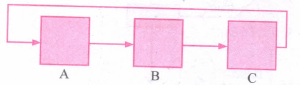
12.
13.
Observe the figure and mark all the window elements, Identify the version of the Windows Os.
14.
15.
How AND and OR can be realized using NAND and NOR gate
16.
Subtract 11010112 - 1110102
17.
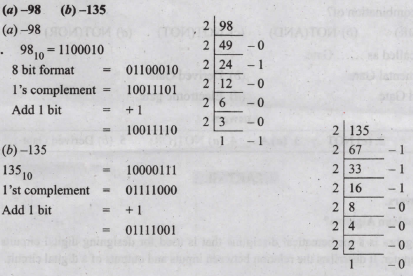
Find 1's Complement and 2's Complement for the following Decimal number.
(i) -98
(ii) -135
18.
Exchange the contents: Given two glasses marked A and B. Glass A is full of apple drink and glass B is full of grape drink. For exchanging the contents of glasses A and B, represent the state by suitable variables, and write the specification of the algorithm.
19.
Write the specification of an algorithm hypotenuse whose inputs are the lengths of the two shorter sides of a right angled triangle, and the output is the length of the third side.
20.
Discuss the various generations of computers.
21.
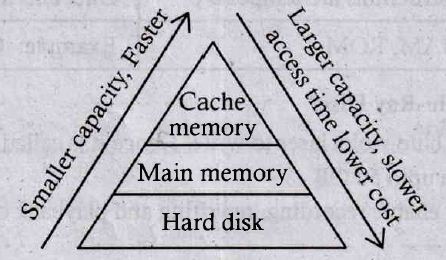
Arrange the memory devices in ascending order based on the access time.
22.
Write the procedure to convert fractional Decimal to Binary.
23.
Explain advantages and disadvantages of open source operating systems.
24.
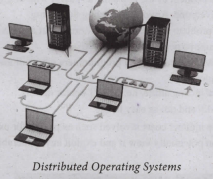
Explain the concept of a Distributed Operating System along with its advantages.
25.
1.
#inclue< iostream.h >
using namespace std;
struct book
{
char bname[20];
char author[20];
int price;
}b[10];
void input (struct book a[])
{
int i;
cout << "Enter the book details'' <
{
cout << "Enter book name"<
cin >> b[i].bname;
cout << "Enter Author name''<
cin >> b[i].author;
cout << "Enter the price of the book"<|
}
}
void display (struct book b[])
{
int i; total = 0;
for(i=0; i<9; i++)
{
cout << "Book Name < cout << "Author Name: < cout << ''Book Price: < total = total + b[i].prince < cout << ''Total price''< }
}
int main()
{
input(b);
display(b);
return 0;
}
2.
#include< iostream >
using namespace std;
struct Distance
{
int feet;
float inch;
}d1, d2, sum;
int main()
{
cout<<"Enter 1st distance:"<<endl;
cout<<"Enter feet:";
cin>>d1.feet;
cout<<"Enter inch:";
cin>>dl.inch;
cout<<"\n information for 2nd distance:"<<endl;
cout<<"Enter feet:"";
cin>>d2.feet;
cout<<"Enter inch:"
cin>>d2.inch;
sum.feet = d1.feet +d2.feet;
sum.inch-d1.inch + d2.inch;
if (sum.inch > 12)
{
++sum.feet;
sum.inch 12;
}
cout<<endl; "Sum of distance="<<sum.feet << "feet" << sum.inch<< "inches";
return 0;
}
Output:
Enter 1st distance
Enter feet: 6
Enter inch: 3.4
Enter 2nd distance
Enter feet: 5
Enter inch: 10.2
Sum of distances = 12 feet 1.6 inches
3.
Call by value:
When a structure is passed as argument to a function using call by value method, any change made to the contents of the structure variable inside the function to which it is passed do not effect the structure variable used as an argument.
Consider this example:
#include< iostream >
useing namespace std;
struct Employee
{
char name[50];
int age;
float salary;
};
void printData(Employee); //Function declaration
int main()
{
Employee p;
cout << "Enter Full name:";
cin >> p.name;
cout << "Enter age:";
cin >> p.age;
cout << "Enter salary:"; .
cin >> p.salary,
//Function call with structure variable as
an argument
PrintData(P);
return ();
}
void printData(Employee q)
{
cout << "\nDisplaying Information. " << endl;
cout << "Name:" << q.name << endl;
cout << "Age:" << q.age << endl;
cout << '' Salary: " << q.salary:
Output:
Enter Full name: Kumar
Enter age: 55
Enter salary: 34233.4
Displaying Information.
Name: Kumar
Age: 55
Salary: 34233.4
4.
In C++, arrays can be passed to a function as an argument. To pass an array to a function in C++, the function needs the array name as an arugment. Passing a two-dimensional array to a function a program to display marks of 5 students by passing one dimensional array to a function
# include< iostream >
using namespace std;
void display (in m[5]);
int main()
{
int marks [5]= {88, 76, 90, 61, 69};
display(marks);
return 0;
}
void display (int m[5])
{
cout << "\n Display Marksr:" << endl;
for(int i=0; i<5; i++)
{
cout << "Student'<
}
Output:
Display Marks:
Student 1: 88
Student 2: 76
Student 3: 90
Student 4: 61
Student 5: 69
5.
#include<iostream>
using namespace std;
int reverse (int n);
int main()
{
int n=0, result = 0;
cout<<"Enter number:"";
cin >>n;
result reverse (n);
cout<<"Reverse number is:" << result << endl;
}
int reverse (int n)
{
int temp=0, rev = 0;
while (n! =0).
{
temp=n;
rev= (rev*10) + temp;
n = n/10;
}
return rev;
}
Output:
Enter number: 1 2 3
Reverse number: 3 2 1
6.
The return statement
Returning from the function is done by using the return statement. The return statement stops execution and returns to the calling function. When a return statement is executed, the function is terminated immediately at that point. The return statement is used to return from a function. It is categorized as a jump statement because it terminates the execution of the function and transfer the control to the called statement.
Syntax:
return expression/variable;
Example: return(a+b); return(a);
return; // to terminate the function
The Returning values:
The functions that return no value is declared a void. The data type of a function is treated as int, if no data type is explicitly mentioned. For example,
For Example:
int add (int, int);
add (int, int);
In both prototypes, the return value is int, because by default the return value of a function in C++ is of type int.
Returning Non-integer values
A string can also be returned to a calling statement.
#include <iostream>
#include<string.h>
using namespace std;
char*display()
{
return ("chennai");
}
int main()
{
char s[50];
strcpy(s,display());
cout<<"\n Example:Function with Non Integer Return"<<s;
return(0);}
Output:
Example: Function with Non Integer Return Chennai
The Returning by reference
#include<iostream>
using namespace std;
int main()
{
int nl-150;
int &nlrefn1;
cout<<"\nThe Value of NI =" <<n<< "and nl Reference="<<n/ref;
n1ref++;
cout<<"\n After nl increased the Value of N1 ="<<nl;
cout<<"and nl Reference="<<ntref;
return(0);
Output:
The Value of N1 - 150 and n1 Reference - 150
After n1 increased the Value of N1 =151 and n1 Reference = 151
7.
(a) #include <iostream>
using namespace std;
#include <math.h>
#factorial function.
long int fact(int n)
{
long int f= 1;
for (int i = 1;i<n; i++)
f* = i;
return f
}
// main function
int main()
{
int x, y = 1;
float sum = 0;
cout<<"Enter the value for x:";
cin>>x;
for (int i=1;i<-6; i++)
{
sum = sum + y*((pow(x, 1))/fact(i));
y*=-1;
}
cout<<"Sum=" <<Sum<<endl;
cin.get():
return();
}
(b) #include <iostream>
using namespace std;
#include <math.h>
int main()
{
int M, L;
float sum = 0;
cout<<"Enter the value for M:";
cin>>M;
cout<<"Enter the number of terms";
cin>> L;
for (int i=1;i<=m; i++)
sum Sum + Pow(m,i)/i;
cout<<"Sum="<< Sum<<endl;
cin.get():
return 0;
}
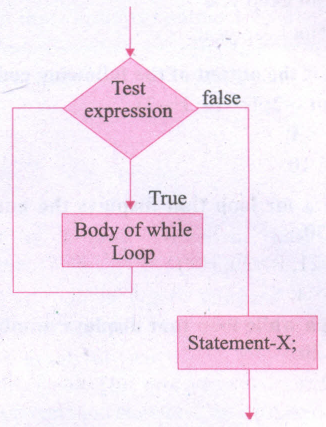
8.
9.
(a) a&b
| 10 | 1010 |
| 11 | 1111 |
| a&b | 1010 |
a&b =1010&1510=1010=1010
(b) a|b
| 10 | 1 | 0 | 1 | 0 |
| 15 | 1 | 1 | 1 | 1 |
| 10 | 15 | 1 | 1 | 1 | 1 |
a|b =10|15= 11112 =1510
(c) a^b
| 10 | 1 | 0 | 1 | 0 |
| 15 | 1 | 1 | 1 | 1 |
| 10 ^ 15 | 0 | 1 | 0 | 1 |
a^b =10^15= 01012 =1510
(d) a>>3
a=10
10/23=10/8=1
10>>3=110
(e) (~b)
| b | 1 | 1 | 1 | 1 |
| ~b | 0 | 0 | 0 | 0 |
(~b)=00002=010
10.
Binary Operators require two operands.
Arithmetic operators that perform simple arithmetic operations like addition, subtraction, multiplication, division (+,-*, %,/) etc. are binary operators which requires minimum of two operands.
Relational operators are used to determine the relationship between its operands. The relational operators (<,>,>, <=,=, !=) are applied on two operands, hence they are binary operators.
AND, OR (logical operator) both are binary operators.
Assignment operator is also a binary operator (+=, -=, *=, /=, %=)
11.
(i) f=1 i=1 f = f * i i = i+1
f = 1 x 1 = 1 i = 2
(ii) f = 1 x 2 i = 3 = 2
(iii) f = 2 × 3 i = 4 = 6
(iv) f = 6 x 4 i = 5 (loop terminates) = 24
12.
13.
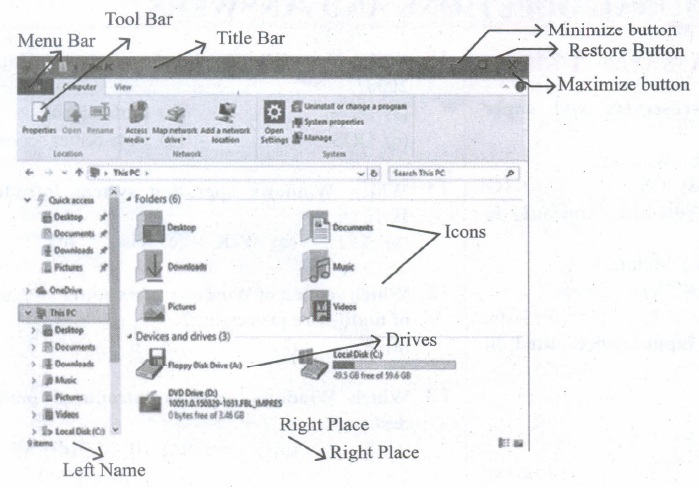
14.
 1985 1. Introduction of GUI in 16 - bit. processor
 1987 1. Supports to minimize or maximize windows.
 1992 1. Introduced the concept of multitasking.
 1995 1. Introduced Start button, the taskbar, Windows Explorer and Start menu.
 1998 1. Integration of the Web browser (Internet Explorer) with the Operating System.
 Designed to act as servers in network. 7. Windows Me
  2000 It introduced automated system diagnostics and recovery tools. 8. Windows 2000
  2000 1. Served as an Operating System for business
 2001 1. Introduced 64-bit Processor.
 2006 Updated the look and feel of Windows 11. Windows 7
  2009 Booting time was improved, introduced new user interfaces like Aero Peek, pinning programs to the taskbar, handwriting recognition etc, and Internet Explorer 8. 12. Windows 8
  2012 1. Windows 8 was faster than previous versions of Windows.
 2015 1. Start Button was added again.
15.
Bubbled AND Gate
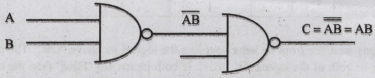
(i) Realized of and using only AND gate:
The Boolean function for AND is C=AB. The same can be realized using only NAND gates.
(ii) Realized of and using only NAND's gate:
The Boolean function for OR is C=A + B. The same can be realized using only NAND gates.
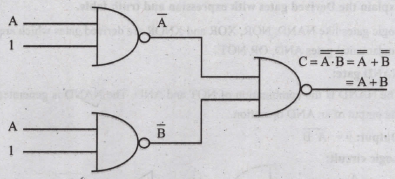
\(\mathrm{C} =\overline{\overline{\mathrm{A}} \cdot \overline{\mathrm{B}}} \)
\(=\overline{\mathrm{A}}+\overline{\mathrm{B}} \text { (By Demorgan's law) } \)
\(=\mathrm{A}+\mathrm{B} \text { (output of OR gate) }
\)
(iii) Realization of AND using NOR:
By using only the NOR gates, we can get the output equivalent to the output of AND gate.
C=A.B
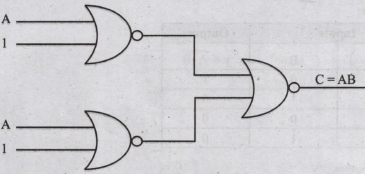
\(\mathrm{C} =\overline{\overline{\mathrm{A}} \cdot \overline{\mathrm{B}}} \)
\(=\overline{\mathrm{A}}+\overline{\mathrm{B}}\)
= AB
(iv) Realization of OR using NOR's:
By using only NOR gates we are getting the output equivalent to OR gate.

16.
11010112 - 1110102
1101011
+111010
_______
0110001
_______
11010112 - 1110102 = 01100012
17.
18.
Let the variables a, b, c represent the glass A, glass B and Glass C respectively. Variables A, B, C can store values APPLE, GRAPE or EMPTY.
Initial State:
1.-- a, b, c : = APPLE, GRAPE, EMPTY
2. C : = b
3.-- a, b, c : = APPLE, EMPTY, GRAPE
4. b : = a
5.-- a, b, c : = EMPTY, APPLE, GRAPE
6. a : = C
7.-- a, b, c : = GRAPE, APPLE, EMPTY
Final State:
Specification:
1. Exchange ()
2. -- inputs: a, b, c :- APPLE, GRAPE, EMPTY
3.--outputs: a, b, c:- GRAPE, APPLE, EMPTY
19.
1. hypotenuse (a, b)
2. -- inputs: a, b are real numbers, a > 0, b > 0
3 -- outputs: c²=a² + b² where c is real number, c > 0
20.
| Computers size was drastically reduced. S.No | Generation | Period | Main Component used | Merits/ Demerits |
| 1 | First Generation | 1942-1955 | 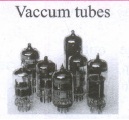 |
Big in size Consumed more power Malfunction due to overheating Machine Language was used Eg : ENIAC, EDVAC, UNIVAC |
| First Generation Computer - ENIAC, EDVAC, UNIVAC 1 ENIAC weighed about 27 tons, size 8 feet x 100 feet x 3 feet, and consumed around 150 watts of power | ||||
| 2 | Second Generation | 1955-1964 | 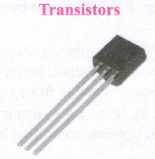 |
Smaller compared to First Generation Generated Less Heat Consumed less power compared to first-generation Punched cards were used. The first operating system was developed Batch Processing and Multiprogramming Operating System Machine language, as well as Assembly language, was used. |
| Second Generation Computers IBM 1404, IBM 1620, UNIVAC 1108 | ||||
| 3 | Third Generation | 1964-1975 | 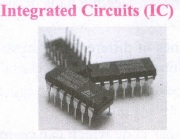 |
Computers were smaller, faster, and more reliable Consumed less power. High-Level Languages were used. |
| Third Generation Computers -IBM ·360 series, Honeywell 6000 series | ||||
| 4 | Fourth Generation | 1975-1980 | 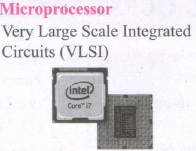 |
Smaller and Faster Microcomputer series such as IBM and APPLE was developed Portable Computers were introduced. |
| 5 | Fifth Generation | 1980-till date | 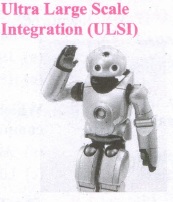 |
Parallel, Processing Superconductors Computers size was drastically reduced. Can recognize Images and Graphics Introduction of Artificial Intelligence and Expert Systems Able to solve highly complex problems including decision making and logical reasoning. |
| 6 | Sixth Generation | In future | 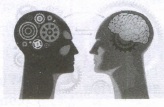 |
Parallel and Distributed computing Computers have become smarter faster and smaller Development of robotics Natural Language Processing Development of Voice Recognition Software. |
21.
A memory is just like a human brain. It is used to store data and instructions. Computer memory is the storage space in the computer, where data and instructions are stored. There are two types of accessing methods to access (read or write) the memory. They are sequential access and random access. In sequential access, the memory is accessed in an orderly manner from starting to end. But, in random access, any byte of memory can be accessed directly without navigating through previous bytes. Different memory devices are arranged according to the capacity.
22.
The method of repeated multiplication by 2 has to be used to convert such kinds of decimal fractions.
The steps involved in the method of repeated multiplication by 2.
Step 1: Multiply the decimal fraction by 2 and note the integer part. The integer part is either 0 or 1.
Step 2: Discard the integer part of the previous product. Multiply the fractional part of the previous product by 2. Repeat Step 1 until the same fraction repeats or terminates (0).
Step 3: The resulting integer part forms a sequence of 0's and 1's that become the binary equivalent of a decimal fractions.
Step 4: The final answer is to be written from first integer part obtained till the last integer part is obtained.
23.
The benefits of open source are tremendous and have gained huge popularity in the IT field in recent years. They are as follows:
1. Open source (OS) is free to use, distribute and modify.
2. Open source is independent of the company as author who originally created it.
3. It is accessible to everyone. Anyone can debug the coding.
4. It doesn't have the problem of incompatible formats that exists in proprietary software.
5. It is easy to customize as per our needs.
6. Excellent support will be provided by programmers who will assist in making solutions. Some of the disadvantages are:
7. Latest hardware are incompatible, i.e. lack of device drivers.
8. It is less user friendly and not as easy to use.
9. There may be some indirect costs involved such as paying for external support.
10. Malicious users can potentially view it and exploit any vulnerability.
24.
The data and application that are stored and processed on multiple physical locations across the world over the digital network (internet/intranet). The Distributed Operating System is used to access shared data and files that reside in any machine around the world. The user can handle the data from different locations. The users can access as if it is available on their own computer.
The advantages of distributed Operating System are as follows:
1. A user at one location can make use of all the resources available at another location over the network.
2. Many computer resources can be added easily in the network
3. Improves the interaction with the customers and clients.
4. Reduces the load on the host computer.
25.

11th Standard Syllabus & Materials
11th Standard
TN 11th Tamil பீடு பெற நில் - செய்யுள் - காவடிச்சிந்து Important Questions And Answers Study Material - QB365 Set A
NEW11th Standard
TN 11th Tamil பீடு பெற நில் - உரைநடை - மலை இடப்பெயர்கள் : ஓர் ஆய்வு Important Questions And Answers Study Material - QB365 Set A
NEW11th Standard
TN 11th Tamil மாமழை போற்றுதும் - துணைப்பாடம் - யானை டாக்டர் Important Questions And Answers Study Material - QB365 Set A
NEW11th Standard
TN 11th Tamil மாமழை போற்றுதும் - செய்யுள் - ஐங்குறுநூறு Important Questions And Answers Study Material - QB365 Set A


Tamilnadu Stateboard 11th Standard Subjects

Maths

Commerce

Economics

Biology

Business Maths and Statistics

Accountancy
Computer Science

Physics

Chemistry
Maths
Biology
Economics
Physics
Chemistry

History
Business Maths and Statistics

Computer Science
Accountancy

Computer Applications
History
Computer Technology
Commerce
Computer Applications
Computer Technology

Tamil

English

French
Tamilnadu Stateboard Standards


