
 100% FREE ACCESS
11th Standard Syllabus & Materials
11th Standard
TN 11th Tamil இயற்கை வேளாண்மை,சுற்றுச்சூழல் -செய்யுள் - மனோன்மணீயம் Important Questions And Answers Study Material - QB365 Set A
NEW11th Standard
TN 11th Tamil என்னுயிர் என்பேன் -துணைப்பாடம் - இசைத்தமிழர் இருவர் Important Questions And Answers Study Material - QB365 Set A
NEW11th Standard
TN 11th Tamil மொழி கலை -செய்யுள் - ஒவ்வொரு புல்லையும் Important Questions And Answers Study Material - QB365 Set A
NEW11th Standard
TN 11th Tamil பீடு பெற நில் - இலக்கணம் - பகுபத உறுப்புகள் Important Questions And Answers Study Material - QB365 Set A
NEW11th Standard
TN 11th Tamil பீடு பெற நில் - துணைப்பாடம் - வாடிவாசல் Important Questions And Answers Study Material - QB365 Set A
NEW11th Standard
TN 11th Tamil பீடு பெற நில் - செய்யுள் - குறுந்தொகை Important Questions And Answers Study Material - QB365 Set A

Published on: 13/05/2022
QB365 provides detailed and simple solution for every book back questions in class 11 Economics subject.It will helps to get more idea about question pattern in every book back questions with solution.
latest Book back QuestionsDownload Tamil Nadu 11th Standard Economics question papers, model tests, one-mark questions, important questions, and public exam papers in PDF format. Free study materials and answer keys for TN State Board students.
Questions + Answers key
Take MCQ Economics Test1.
Examine the nature of Economic laws.
2.
Explain basic problems of the economy with the help of production possibility curve.
3.
4.
5.
Compare and contrast various definitions of Economics.
1.
Nature of Economic Laws:
(i) A Law expresses a causal relation between two or more than two phenomena.
(ii) Marshall states that the Economic laws are statement of tendencies, and those social laws, which relate to those branches of conduct in which the strength of the motives chiefly concerned can be measured by money price.
(iii) In natural sciences, a definite result is expected to follow from a particular cause.
(iv) In Economic science, the laws function with cause and effect. The consequences predicted by the data, necessarily and invariably follow.
(v) However, Economic laws are not as precise and certain as the laws in the physical sciences.
(vi) Marshall holds the opinion that there are no laws of economics which can be compared for precision with the law of gravitation.
(vii) A physical scientist carrying out controlled experiments in his laboratory can test the scientific laws very easily by changing the conditions obtaining there.
(viii) Changes in Economic science cannot be brought about easily. As a result, prediction regarding human behaviour is likely to go wrong. There are exceptions to the Law of Demand. Thus, economic laws are not inviolable.
(ix) As unpredictability is invariably associated with the economic laws. Marshall compares them to the laws of tides. Just as it cannot be predicted and said with certainty that a high tide would follow a low tide, unpredictability prevails in Economics. Human behaviour is volatile.
(x) Economic laws are not assertive but they are indicative. The Law of Demand, for example, states that other things remaining the same, the quantity demanded of a commodity increase, as its price decreases and vice versa.
(xi) The use of the assumption 'other things remaining the same' (ceteris paribus) in Economics makes the Economic laws hypothetical. It might be argued that the laws in other sciences can also be called hypothetical. It should be admitted however that in the case of Economics, the hypothetical elements in its laws are a little less pronounced than in the laws of physical sciences.
(xii) But since money is used as the measuring rod, laws in economics are more exact, precise and accurate than the other social sciences. As the value of the measuring- rod money is not constant, there is always a hypothetical element surrounding the laws of. Economics.
(xiii) Some economic laws are simply truisms. For example, saving is a function of income. Another example of truism is human wants are unlimited.
2.
The Problem of Choice:
(i) The problem of choice arises because of limited resources and unlimited wants, may relate to the allocation of resources between the goods for higher income group and the lower income group and the goods for defense and the civilians.
(ii) Since PPC is the locus of the combination of the goods the problem of choice will not arises when we choose any point on PPC.
The notion of scarcity:
(i) Every economy has scarce resources which can produce only limited amount of output even with the help of best technology.
(ii) PPC reflects the constraints imposed by the element of economic scarcity.
The solution of central problems:
(i) The solution of problem of what to produce involves the decision regarding the choice of location on the PPC.
(ii) Any point inside PPC indicates that the economy is using inefficient methods of production and inefficient combination of resources.
Conclusion:
(i) Thus the basic problems of the economy are solved with the help of PPC.
3.
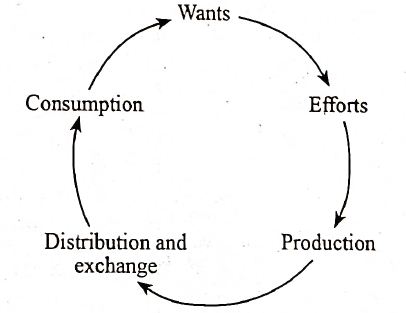
4.
5.
| Wealth | Welfare | Scarcity | Growth |
| Adam Smith classical era. |
Alfred Marshall- neo classical era. |
Lionel Robbins new age. |
Paul Samuelson modern age. |
| An Inquiry into nature and causes of Wealth of Nations (1776). |
Principles of |
An Essay on the nature and Significance of Economic Science (1932). |
Economics studies how men and society choose with or without the use of money, to employ scarce productive resources which could have alternative uses, to produce various commodities over time and distribute them for consumption now and in the future among various people and groups of society. |
| Economics is the science of wealth. | Economics is a study of mankind in the ordinary business of life, it examines that part of individual and social action which is most closely connected with the attainment and with the use of material requisites of well being. It studies wealth and man. |
Economics is a science which studies human behaviour as a relationship between ends and scarce means which have alternative uses. |
Economics deals with how the society uses the limited resources for alternative uses. |
| Deals with only the goods which are scarce and have money value |
wealth and welfare of man is important. | Human behaviour regarding choice is important. |
It covers production, distribution and consumption. |
| Deals with consumption, production, exchange, distribution of wealth. |
Only material welfare is considered, differentiates between material and immaterial things. |
Economic problem arises because of scarcity of resources. |
Economics is a social science. |
| By introducing welfare, economics becomes inexact. |
Ethical aspects are not considered so Economics is exact |
||
| Welfare definition makes Economics classificatory. | Economics is a positive science. |
||
| Economics is a science of individual behaviour. |
|||
| Both material and immaterial activities are considered. |

11th Standard Syllabus & Materials
11th Standard
TN 11th Tamil பீடு பெற நில் - செய்யுள் - காவடிச்சிந்து Important Questions And Answers Study Material - QB365 Set A
NEW11th Standard
TN 11th Tamil பீடு பெற நில் - உரைநடை - மலை இடப்பெயர்கள் : ஓர் ஆய்வு Important Questions And Answers Study Material - QB365 Set A
NEW11th Standard
TN 11th Tamil மாமழை போற்றுதும் - துணைப்பாடம் - யானை டாக்டர் Important Questions And Answers Study Material - QB365 Set A
NEW11th Standard
TN 11th Tamil மாமழை போற்றுதும் - செய்யுள் - ஐங்குறுநூறு Important Questions And Answers Study Material - QB365 Set A



Tamilnadu Stateboard 11th Standard Subjects

Maths

Commerce
Economics

Biology

Business Maths and Statistics

Accountancy

Computer Science

Physics

Chemistry
Maths
Biology
Economics
Physics
Chemistry

History
Business Maths and Statistics

Computer Science
Accountancy

Computer Applications
History
Computer Technology
Commerce
Computer Applications
Computer Technology

Tamil

English

French
Tamilnadu Stateboard Standards



