 100% FREE ACCESS
11th Standard Syllabus & Materials
11th Standard
TN 11th Tamil இயற்கை வேளாண்மை,சுற்றுச்சூழல் -செய்யுள் - மனோன்மணீயம் Important Questions And Answers Study Material - QB365 Set A
NEW11th Standard
TN 11th Tamil என்னுயிர் என்பேன் -துணைப்பாடம் - இசைத்தமிழர் இருவர் Important Questions And Answers Study Material - QB365 Set A
NEW11th Standard
TN 11th Tamil மொழி கலை -செய்யுள் - ஒவ்வொரு புல்லையும் Important Questions And Answers Study Material - QB365 Set A
NEW11th Standard
TN 11th Tamil பீடு பெற நில் - இலக்கணம் - பகுபத உறுப்புகள் Important Questions And Answers Study Material - QB365 Set A
NEW11th Standard
TN 11th Tamil பீடு பெற நில் - துணைப்பாடம் - வாடிவாசல் Important Questions And Answers Study Material - QB365 Set A
NEW11th Standard
TN 11th Tamil பீடு பெற நில் - செய்யுள் - குறுந்தொகை Important Questions And Answers Study Material - QB365 Set A

Published on: 13/05/2022
QB365 provides detailed and simple solution for every Creative Questions in class 11 Economics Subject. It will helps to get more idea about question pattern in every Creative questions with solution.
latest Creative QuestionsDownload Tamil Nadu 11th Standard Economics question papers, model tests, one-mark questions, important questions, and public exam papers in PDF format. Free study materials and answer keys for TN State Board students.
Questions + Answers key
Take MCQ Economics Test1.
Examine whether Economics is an Art or a Science.
2.
State the welfare definition given by Alfred Marshall and assess it.
3.
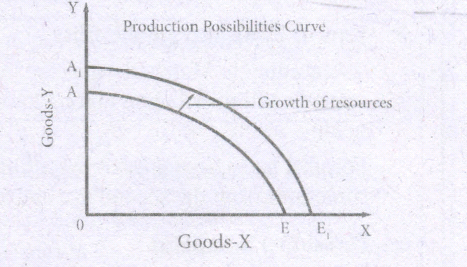
Explain briefly shift of production possibility curve with the help of a diagram?
4.
Explain the different types of utility.
5.
Examine Adam Smith's Definition of Economics.
1.
Economics is an Art and a Science:
(i) Economics as an Art:
Art is the practical application of knowledge for achieving particular goals. Economics provides guidance to the solutions to all the economic problems. A. C. Pigou, Alfred Marshall and others regard Economics as an art.
(ii) Economics as a Science:
(a) Science is a systematic study of knowledge. All its relevant facts are collected, classified and analyzed with its scale of measurement. Using these facts, science develops the co-relationship between cause and effect.
(b) Scientific laws derived are tested through experiments, and future predictions are made. These laws are universally applicable and accepted.
(c) Economists like Robbins, Jordon and Robertson argue that Economics is a science like Physics, Chemistry, etc., since, it has several similar characteristics.
(d) Economics examines the relationships between the causes and the effects of the problems. Hence, it is rightly considered as both an art and a science. In fact, art and science are complementary to each other.
2.
Welfare Definition :
Alfred Marshall Alfred Marshall (1842-1924) in his book "Principles of Economics" (1890) defines Economics thus: "Political Economy" or Economics is a study of mankind in the ordinary business of life; it examines that part of individual and social action which is most closely connected with the attainment and with the use of the material requisites of well-being. Thus, it is on one side a study of wealth; and on the other, and more important side, a part of the study of man.
The important features of Marshall's definition are:
(a) Economics does not treat wealth as the be-all and end-all of economic activities. Man promotes primarily welfare and not wealth.
(b) The science of Economics contains the concerns of ordinary people who are moved by love and not merely guided or directed by the desire to get maximum monetary benefit,
(c) Economics is a social science. It studies people in the society who influence one another.
Criticism
(a) Marshall regards only material things. He does not consider immaterial things, such as the services of a doctor, a teacher and so on. They also promote people's welfare.
(b) In the theory of wages, Marshall ignores the amount of money that goes as reward for the services of 'immaterial' services.
(c) Marshall's definition is based on the concept of welfare. But it is not clearly defined. Welfare varies from person to person, country to country and one period to another. Marshall clearly distinguishes between those things that are capable of promoting welfare of people and those things that are not. Things like liquor that are not capable of promoting welfare but command a price, come under the purview of Economics.
(d) However, welfare means happiness or comfortable living conditions of an individual or group of people. The welfare of an individual or nation is dependent not only on the stock of wealth possessed but also on political, social and cultural activities of the nation.
3.
Shift of Peoduction Posibility curve
i) The change in the supply of productive resource and
ii) The change in the state of Technology
The Production capacity of an economy grows over time through increase in resource supplies and improvement of technology. This enables PPC to shift upward from AE to AIEl as shown in the following diagram.
Explanation:
i) OX-denots Good X and OY - denotes Good Y.
ii) AE is the production possibility curve shown the choice along which a society can choose to substitute one good X for another good Y assuming given State of Technology and given resources.
iii) PPC to shift upward from AE to AtEI.
iv) This outward shift of the PPC is the basic feature of economic growth.
4.
Utility means "usefulness". In Economics utility is the want satisfying, power of a commodity or a service utility is a subjective or Psychological concept.
Types of Utility:
The following are the types of utility.
1. Form Utility: An individual consumer obtains utility from a good or service only where and when it is available in a particular form. (Ex) Cotton as a raw material may not possess utility for a consumer, but as it gets a new form as a cloth it yields the consumer utility.
2. Time Utility: A sick man derives time utility from blood not at the time of its donation, but only at the operation time, when it is used.
3. Place Utility: A student derives place utility from a book not at the place of its publication (Production centre) but only at the place of his education (consumption centre).
4. Service Utility: A consumer derives service utility from a service made available at the time when he most needs it. (Ex) Clients obtain service utility from their lawyers.
5. Possession Utility: When a student buy a book or dictionary from a book seller, then only it gives utility.
6. Knowledge Utility: It is the utility derived by having knowledge of a particular thing. Advertisement serves as a source of information on an object.
5.
(i) Adam Smith (1723 - 1790) in his book "An Inquiry into Nature and Causes of Wealth of Nations" (1776) defines "Economics as the science of Wealth"
(ii) He explains how a nation's wealth is created and increased.
(iii) He considers that the individual in the society wants to promote his own gain and led by an "invisible hand".
(iv) He states that every man is motivated by his self-interest
(v) Severe competition in factories and the society help in bettering the product
Criticism:
(i) Economics consists of wealth-getting activities and wealth-spending activities.
(ii) He ignores human welfare as an essential part of economics.
(iii) Smith gives his definition when religious and spiritual values are held high.
(iv) Ruskin and Carlyle criticized economics as a 'dismal science'. 'pig science' etc
11th Standard Syllabus & Materials
11th Standard
TN 11th Tamil பீடு பெற நில் - செய்யுள் - காவடிச்சிந்து Important Questions And Answers Study Material - QB365 Set A
NEW11th Standard
TN 11th Tamil பீடு பெற நில் - உரைநடை - மலை இடப்பெயர்கள் : ஓர் ஆய்வு Important Questions And Answers Study Material - QB365 Set A
NEW11th Standard
TN 11th Tamil மாமழை போற்றுதும் - துணைப்பாடம் - யானை டாக்டர் Important Questions And Answers Study Material - QB365 Set A
NEW11th Standard
TN 11th Tamil மாமழை போற்றுதும் - செய்யுள் - ஐங்குறுநூறு Important Questions And Answers Study Material - QB365 Set A

Tamilnadu Stateboard 11th Standard Subjects

Maths

Commerce
Economics

Biology

Business Maths and Statistics

Accountancy

Computer Science

Physics

Chemistry
Maths
Biology
Economics
Physics
Chemistry

History
Business Maths and Statistics

Computer Science
Accountancy

Computer Applications
History
Computer Technology
Commerce
Computer Applications
Computer Technology

Tamil

English

French
Tamilnadu Stateboard Standards