
 100% FREE ACCESS
12th Standard CBSE Syllabus & Materials
12th Standard CBSE
CBSE 12th Economics Government Budget and the Economy Previous year Question Papers Study Material - QB365 Set A
NEW12th Standard CBSE
CBSE 12th Computer Science Interface Python with MySQL - New Previous year Question Papers Study Material - QB365 Set A
NEW12th Standard CBSE
CBSE 12th Computer Science Database Concept - New Previous year Question Papers Study Material - QB365 Set A
NEW12th Standard CBSE
CBSE 12th Computer Science Data Communication - New Previous year Question Papers Study Material - QB365 Set A
NEW12th Standard CBSE
CBSE 12th Computer Science Data Structures - New Previous year Question Papers Study Material - QB365 Set A
NEW12th Standard CBSE
CBSE 12th Computer Science Functions - New Previous year Question Papers Study Material - QB365 Set A

Published on: 25/10/2025
Download CBSE Class 12th Standard CBSE Biology question papers, sample papers, important questions, and previous year solved papers in PDF format. Get free study materials, NCERT solutions, and exam preparation resources for Class 12th Standard CBSE Biology
Questions + Answers key
Take MCQ Biology Test
1.
(a) Differentiate between primary and secondary ecological succession.
(b) Explain the different steps of xerarch succession occurring in nature.
2.
Write the importance of species diversity to the Ecosystem. Support your answer with the findings of Tilman.
3.
Taking a small pond as an example of an ecosystem list the four components of this ecosystem. How do these components function as a unit in a small pond ?
4.
Give two examples of artificial or man-made ecosystems. List the salient features by which they differ from natural ecosystems.
5.
"The energy flow in the ecosystem follows the second law of thermodynamics". Explain.
6.
Give an account of energy flow in an ecosystem.
7.
Describe the components of an ecosystem.
8.
List the different steps and state their role in the process of decomposition in an ecosystem.
9.
Explain the different steps involved in the process of decomposition of detritus.
1.
| S.No | Primary Succession | Secondary Succession |
| 1. | Starts where no living organism existed previously. | Starts where life existed earlier and got lost. |
| 2. | New biotic communities are formed on bare rock/lava and so it is slow. | Some soil sediments with propagules present and so it is faster. |
(b) Xerarch Succession:
1. Takesplace in dry area hence progress from xeric to mesic condition
2. Pioneer species such as lichens secrete acids to break rocks, initiate soil formation.
3. lichens pave way to bryophytes
4. which are succeeded by bigger plants. Ultimately, stable mesic community is formed.
2.
David Tilman's experiments with more species in a plot showed less year to year variation in total biomass, he also showed that increased diversity contributed to higher productivity, so stable community should not show much variation in productivity, it should be resistant to occasional disturbances (natural or man made), it must also be resistant to invasion by alien species.
3.
Four Components of small pond ecosystem: aboitic components-air, water, soil, light, temperature, other climatic conditions. Biotic components-producers-phytoplanktons, some algae, floating and submerged plants. Consumers of various order - Zooplanktons Decomposers-fungi, bacteria and other flagellates. (any four-l mark; any two-l/2 mark; atleast one biotic and abiotic components should be mentioned).
Components work as a unit for the following functions:
Productivity: conversion of inorganic into organic material through photosynthesis with the help of solar energy and consumption of autotrophs by heterotrophs i.e. secondary productivity.
Decomposition:
Decomposition and mineralisation of the dead matter and Nutrient Cycling-to release the nutrients/elements back for use by autotrophs.
Energy Flow: Unidirectional flow of energy and its subequent dissipation as one moves towards higher tropic levels.
4.
(a) Two examples of man-made ecosystems are: Gardens and parks, crop fields and fishery tanks.
(b) Salient features of man-made ecosystems:
(i) These are simple and highly efficient.
(ii) These are generally monoculture (e.g. field crops) with low biodiversity.
(iii) These are generally unstable
(iv) These are more vulnerable to sudden changes because of low biodiversity, stability and self-regulation.
5.
According to second law of thermodynamics every activity involving energy transformation is accomplished by dissipation of energy as heat and only a part of it is used in building up tissues in an organisms. If left to itself it will undergo randomness.
This trapped energy as biomass is transferred to next trophic level. According to Lindman law only 10% of the stored energy is passed from one trophic level to successive trophic level.
6.
1. Sun is the ultimate source of energy for all ecosystems on the earth.
2. Only about 50% of the incident solar radiation is photosynthetically active radiation (PAR).
3. Plants capture only 2-10% of the PAR and all organisms are dependent for their food on producers, either directly or indirectly.
4. The flow of energy from the sun to producers and then to consumers is unidirectional and is keeping with the first law of thermodynamics.
5. Ecosystems need a continuous supply of energy for the synthesis of molecules needed and to counteract the tendency towards increasing disorderliness, i.e. energy flow follows the second law of thermodynamics too.
7.
Components of an Ecosystem:
The components are broadly classified into two categories:
(i) Biotic components
(ii) Abiotic components
Biotic components include the following:
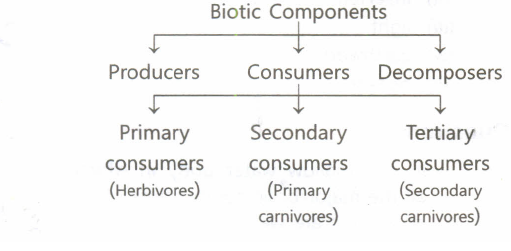
Producers:
These are the green plants or other autotrophs, which prepare their own organic food and feed energy into the ecosystem.
Decomposers:
Decomposers are the organisms which degrade the dead and decaying organic matter and satisfy their energy requirement, e.g. bacteria and fungi.
Abiotic Components:
They include the factors like:
(i) Air
(ii) Water
(iii) Solar radiation
(iv) Temperature
(v) Soil with organic and inorganic compounds as nutrients to plants.
8.
Process of decomposition
(i) Fragmentation:
It is the process of breaking of the detritus into smaller particles by detritivores like earthworm.
(ii)Leaching:
It is the process in which water-soluble inorganic substances run down into soil horizon and get precipitated as unavailable salts.
(iii) Catabolism:
The enzymatic conversion of the detritus into simple organic compounds and then into inorganic compounds, is called catabolism.
The enzymes are secreted by the decomposers like bacteria and fungi.
(iv) Humification:
Humification during decomposition leads to the accumulation of a dark coloured, amorphous substance, called humus.
(v) Mineralisation:
It is the process in which the humus is degraded by certain microbes and the inorganic nutrients are released.
9.
Process of decomposition
(i) Fragmentation:
It is the process of breaking of the detritus into smaller particles by detritivores like earthworm.
(ii)Leaching:
It is the process in which water-soluble inorganic substances run down into soil horizon and get precipitated as unavailable salts.
(iii) Catabolism:
The enzymatic conversion of the detritus into simple organic compounds and then into inorganic compounds, is called catabolism.
The enzymes are secreted by the decomposers like bacteria and fungi.
(iv) Humification:
Humification during decomposition leads to the accumulation of a dark coloured, amorphous substance, called humus.
(v) Mineralisation:
It is the process in which the humus is degraded by certain microbes and the inorganic nutrients are released.

12th Standard CBSE Syllabus & Materials
12th Standard CBSE
CBSE 12th Computer Science Python Revision Tour I - New Previous year Question Papers Study Material - QB365 Set A
NEW12th Standard CBSE
CBSE 12th Business Studies Planning Important Questions And Answers Study Material - QB365 Set A
NEW12th Standard CBSE
CBSE 12th Business Studies Business Environment Important Questions And Answers Study Material - QB365 Set A
NEW12th Standard CBSE
CBSE 12th Business Studies Principles of Management Important Questions And Answers Study Material - QB365 Set A



NCERT Books

Syllabus

Exam Pattern

Sample Question Papers

Previous year Question Papers

Important Notes

MCQ Practice test

NCERT Exemplers

Case study Questions

Image Based Questions

Passage based Questions

HOT Questions

Value Based Questions

Model Questions Papers
NCERT ( Book Back ) Questions

Assertion and Reason
Important Questions And Answers

CBSE 12th Standard CBSE Subjects
CBSE Standards