
 100% FREE ACCESS
12th Standard CBSE Syllabus & Materials
12th Standard CBSE
CBSE 12th Economics Government Budget and the Economy Previous year Question Papers Study Material - QB365 Set A
NEW12th Standard CBSE
CBSE 12th Computer Science Interface Python with MySQL - New Previous year Question Papers Study Material - QB365 Set A
NEW12th Standard CBSE
CBSE 12th Computer Science Database Concept - New Previous year Question Papers Study Material - QB365 Set A
NEW12th Standard CBSE
CBSE 12th Computer Science Data Communication - New Previous year Question Papers Study Material - QB365 Set A
NEW12th Standard CBSE
CBSE 12th Computer Science Data Structures - New Previous year Question Papers Study Material - QB365 Set A
NEW12th Standard CBSE
CBSE 12th Computer Science Functions - New Previous year Question Papers Study Material - QB365 Set A

Published on: 25/10/2025
Download CBSE Class 12th Standard CBSE Biology question papers, sample papers, important questions, and previous year solved papers in PDF format. Get free study materials, NCERT solutions, and exam preparation resources for Class 12th Standard CBSE Biology
Questions + Answers key
Take MCQ Biology Test
1.
State the type of interaction that exists between ticks and dogs.
2.
Name the technique that is used to alter the chemistry of genetic material (DNA, RNA) to obtain desired result.
3.
State the significanceof the process of RNA interference (RNAi) in eukaryotic organisms.
4.
Indiscriminate diagnostic practices using X - rays, etc., should be avoided. Give one reason.
5.
Name the major surface water pollutant from farm run-off and bathroom water.
6.
Name the two types of biogeochemical cycles.
7.
What is mesovarium?
8.
What is harvesting?
9.
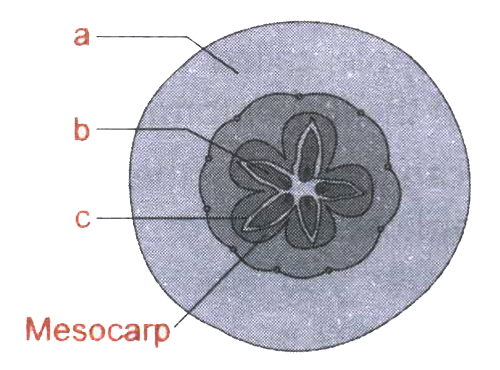
(i) Given below is a T.S. of an apple. Identify a, b and c.
(ii) Why is an apple categorised as a false fruit?
10.
Mention one commercial use of lipases.
11.
Which type or natural selection is the industrial melanism observed in moth, Biston betularia?
12.
Name the cellular factory responsible for synthesis of proteins.
13.
How does Penicillium reproduce asexually?
14.
Match the items given in column I with appropriate items (one or more) of column II.
| Column I | Column II |
| (i) Rich biodiversity | (a) Within community diversity |
| (ii) Alpha diversity | (b) Diversity of whole geographical region. |
| (iii) Gamma diversity | (c) Tropical areas |
| (iv) Endangered species | (d) Dodo |
| (v) Extinct species | (e) Great Indian bustard |
| (f) Coral reefs |
15.
Name the water fern that is an excellent bio fertiliser for rice cultivation.What helps the fern to do so?
16.
How does population size increase or decrease?
17.
Define harvesing. List various methods of harvesting of fishes.
18.
What is pollen allergy? Illustrate with an example.
19.
Describe the cell-mediated immunity.
20.
(a) mention the cause and the body system affected by ADA deficiency in humans.
(b) Name the vector used for transferring ADA-DNA into the recipent cells in humans. Name the recipient cells.
21.
In a cross between two tall pea plants, some of the offspring produced were dwarf. Show with the help of a Punnet square, how this is possible.
22.
Why is Cu-T considered a good contraceptive device to space children?
23.
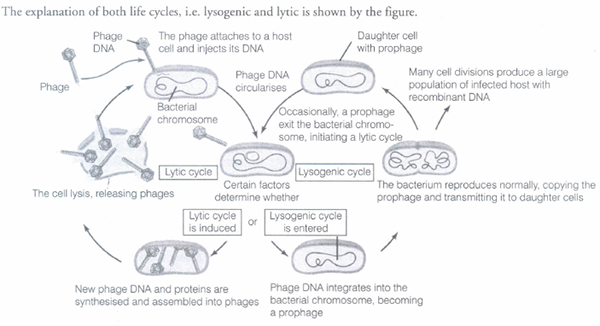
Bacteriophages are virus infecting bacteria, that are used as vectors because of their high copy number.
Lambda phage is a non-contractile bacteriophage used as vector that follows two life cycle, lysogenic and lytic. Explain, both the life cycles with the help of a diagram
24.
Briefly, discuss the enzymes and steps involved in repair replication
25.
List a few modern day animals and from internet like to corresponding ancient fossil. Name both.
26.
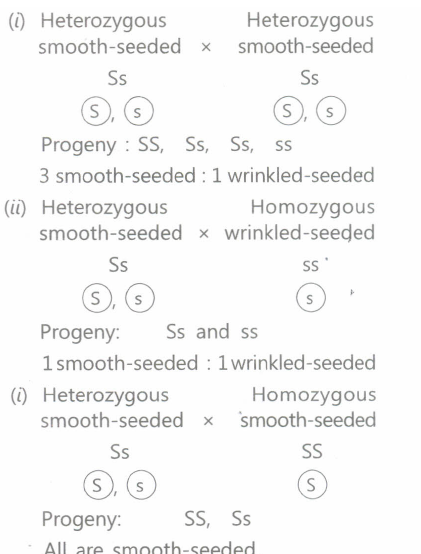
In garden pea, smooth seed coat is dominant over wrinkled seed coat. What will be the expected ratio of phenotypes of the offspring in a cross between:
(i) Heterozygous smooth \(\times\) Heterozygous smooth
(ii) Heterozygous smooth \(\times\) Homozygous wrinkled
(iii) Heterozygous smooth \(\times\) Homozygous smooth.
27.
(a) Describe Hardy - Weinberg Principle.
(b) List any four factors which affect genetic equilibrium.
(c) Describe founder effect.
28.
Mukta visits a dairy farm near her locality to buy milk for her household. While, waiting there for her turn, she noticed that one of the member of the farm was injecting something into the cow before milking. She was very curious and discussed her queries with her friend (a biology expert)
(i) What did the injection contain?
(ii) Why is this injection administered to the cow?
(iii) State any two methods of herd improvements.
(iv) What values are shown by Mukta?
29.
Protein is an important constituent of our food and its deficiency leads to many health problems.A large population of developing countries can not afford pulses.Ramesh learnt that many so he thought of culturing these microorganisms to provide a cheap source of proteins.
Read the above passage and answer the following questions:
(i) What are single cell protein (SCP)?
(ii) Name two microorganisms which provide SCP.
(iii) Why did Ramesh want to culture microorganisms?
1.
()
Ecto (Parasitism)
2.
()
Genetic Engineering.
3.
()
RNA interface (RNAi) acts as cellular defense in all eukaryotic organisms.
4.
()
Indiscriminate diagnostic practices using X - rays should be avoided because there are several potential risks from exposure to ionising radiations, such as cancer can be developed in later stages of life, tissues can also get affected such as in cataract, hair loss, etc.
5.
()
Phosphorus.
6.
()
Gaseous and sedimentary.
7.
()
Mesovarium comprises of peritoneum that holds the ovary close to the lateral walls of the pelvic cavity.
8.
()
Capturing of fully grown fishes is called harvesting or fishing.
9.
()
(i)
(a) Thalmaus
(b) Seed
(c) Endoscope
(ii) Apple is considered a false fruit because thalamus also contributes to the formation of fruit other than its ovary.
10.
()
Lipases are used in detergent formulations and are used in removing oily stains from the clothes.
11.
()
It is directional type.
12.
()
Ribosome
13.
()
Penicillium reproduces asexually by forming conidia.
14.
(i) c, f
(ii) a
(iii) b
(iv) e
(v) d
15.
An attractive cyanobacterial biofertilizer is Anabaena symbiosis which is an excellent bio fertiliser for rice cultivation.The atmospheric nitrogen is fixed by cyanobacteria--Anabaena azollae
16.
Population (size/density) increases by birth/hatching/germination and immigration that add individuals. Population (size/density) decreases by death and emigration. Population is regulated by food, space, disease, natural calamities and environmental factors.
17.
Harvesting involves the capturing of fully grown fishes and is also called fishing. It is done with the help of Angling (hooked fishing rods) or traps (e.g. Dip net, Cast net, Drag net, etc).
18.
Pollen allergy. Pollen grains of many species cause severe allergies and bronchial afflictions in some people often leading to chronic respiratory disorders, asthma, bronchitis etc. It may be mentioned that Parthenium or carrot grass that came into India as a contaminant with imported wheat, is present everywhere and cause pollen allergy.
19.
Cell Mediated Immunity:
(i) It is mediated by T-lymphocytes.
There are two group of T-lymphocytes.
(i) Cytotoxic or killer T cells,which kill the specific target cells by a variety of mechanisms.
(ii) Helper T cells,which activate the specific B-cells to produce antibodies.
T-lymphocytes are responsible for graft rejections.
20.
a) ADA - deficiency It is caused by the deletion of the gene for adenosine deaminase. The enzyme is crucial for the functioning of the immune system; hence the immune system gets affected.
(b) Vector - A retroviral vector Recipient - Lymphocytes.
21.
Since dwarfness (recessive trait) has appeared in the progeny, the tall pea plant must be heterozygous for tallness, i.e. its genotype is Tt
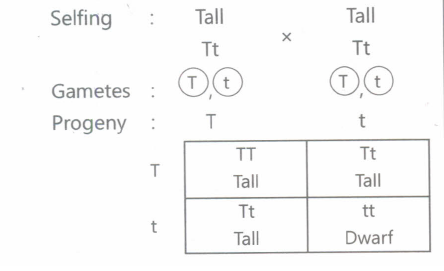
The phenotypic ratio is 3 Tall : 1 dwarf.
Since tallness is dominant over dwarfness, the homozygotes (TT) as well as the heterozygotes (Tt) are tall.
The recessive trait is expressed only under homozygous condition (tt) and hence appears only in one-fourth of the progeny.
22.
Cut is an intra-uterine device (IUD) and functions as follows:
1. It suppresses sperm motility and the fertilising capacity of sperms.
2. It increases phagocytosis of sperms within the uterus.
23.
24.
A variety of nuclease are involved in the repair replication such as exonuclease and endonuclease repair replication involves following steps
1) Incision: Damaged part of DNA is recognised by an enzyme, endonuclease (incision enzyme). This breakdown one of strand at damaged part
2) Excision: Damaged part of DNA strand is removed by an exonuclease (Excision enzyme). DNA polymerase I of E.coli has 3'->5' has exonucleolytic activity
3) Re-insertion: New nucleotide complementary to those on intact strand opposite are inserted by DNA polymerase
4) Joining of newly formed strand segment: The newly synthesised segment of DNA is attached to the main strand by polynucleotide enzyme
25.
| Modern day animal | Ancient fossil |
| 1. Modern man (Homo sapiens sapiens) | (i) Cro-magnon man (H.spines fossilis) |
| 2. Modern horse (Equus) |
(ii) Dawn horse (Eohippus) |
| 3. Modern birds | (iii) Ornithomimus dinosaur with a wish-bone. |
| 4.Modern Amphibians | (iv) Labyrinthodonts (earliest fossilised amphibians). |
| 5. Modern camel (Camelus) | (v) Poebrotherium and Procamelus. |
| 6. Modern elephant (Elephas indica) | (vi) Moeritherium of late Eocene (unaltered fossil discovered) |
| 7. Ammonites (Cephalopod mollusc) | (vii) Bactrites of ordovician period |
| 8. Arthropods like crustaceans, insects, arachnids ect. | (viii) Trilobites of Palaeozoic era. |
| 9. Land-dwelling forms |
(ix) Crossopterygian fishes. |
| 10. Monkey and Apes | (x) Tassers |
26.
27.
(a) Allele frequencies in a population are stable and constant / gene pool total genes and their allels in a population remain constant from generation to generation and maintain genetic equilibrium.
(b) Factors affecting genetic equilibrium are -
(i) Gene migration / gene flow
(ii) Genetic drift
(iii) Mutation.
(iv) Genetic recombination
(v) Natural selection
(c) Change in allele frequency New genes develop, old genes are lost Migration Drift New species When section of population gets separated due to migration or genetic drift, gene frequencies changed; sometimes this change in allele frequency is different in the new population so that they becomes new species, this is called founder effect.
28.
(i) The injection contained stilbestrol.
(ii) Stilbestrol is administered to sterile cows for inducing lactation.
(iii) Two methods of held improvement are:
(a) Artificial insemination
(b) Multiple Ovulation Embryo Transfer Technique
(iv) Mukta is highly vigilant, inquisitive, a good observer and has love towards animals.
29.
(i) SCP refers to the large-scale production of protein obtained from unicellular or filamentous microorganisms.
(ii) Spirulina, Chlorella.
(iii) He was concerned about the welfare of the society.

12th Standard CBSE Syllabus & Materials
12th Standard CBSE
CBSE 12th Computer Science Python Revision Tour I - New Previous year Question Papers Study Material - QB365 Set A
NEW12th Standard CBSE
CBSE 12th Business Studies Planning Important Questions And Answers Study Material - QB365 Set A
NEW12th Standard CBSE
CBSE 12th Business Studies Business Environment Important Questions And Answers Study Material - QB365 Set A
NEW12th Standard CBSE
CBSE 12th Business Studies Principles of Management Important Questions And Answers Study Material - QB365 Set A



NCERT Books

Syllabus

Exam Pattern

Sample Question Papers

Previous year Question Papers

Important Notes

MCQ Practice test

NCERT Exemplers

Case study Questions

Image Based Questions

Passage based Questions

HOT Questions

Value Based Questions

Model Questions Papers
NCERT ( Book Back ) Questions

Assertion and Reason
Important Questions And Answers

CBSE 12th Standard CBSE Subjects
CBSE Standards