
 100% FREE ACCESS
12th Standard CBSE Syllabus & Materials
12th Standard CBSE
CBSE 12th Economics Government Budget and the Economy Previous year Question Papers Study Material - QB365 Set A
NEW12th Standard CBSE
CBSE 12th Computer Science Interface Python with MySQL - New Previous year Question Papers Study Material - QB365 Set A
NEW12th Standard CBSE
CBSE 12th Computer Science Database Concept - New Previous year Question Papers Study Material - QB365 Set A
NEW12th Standard CBSE
CBSE 12th Computer Science Data Communication - New Previous year Question Papers Study Material - QB365 Set A
NEW12th Standard CBSE
CBSE 12th Computer Science Data Structures - New Previous year Question Papers Study Material - QB365 Set A
NEW12th Standard CBSE
CBSE 12th Computer Science Functions - New Previous year Question Papers Study Material - QB365 Set A

Published on: 25/10/2025
Download CBSE Class 12th Standard CBSE Biology question papers, sample papers, important questions, and previous year solved papers in PDF format. Get free study materials, NCERT solutions, and exam preparation resources for Class 12th Standard CBSE Biology
Questions + Answers key
Take MCQ Biology Test
1.
Neha's mother brought a big cactus plant from a nursery. She told Neha not to water the plant daily. Neha was confused. Explain the reason for not watering the plant daily and what will happen if she will water the plant daily? Do you know some animals who are also of the same nature?
2.
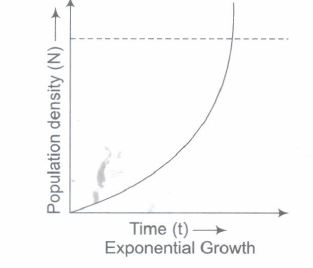
(a) Name the two growth models that represent population growth and draw the respective growth curves they represent
(b) State the basis for the difference in the shape of these curves.
(c)Which one of the curves represents the human population growth at present? Do you think such a curve is sustainable? Give reason in support of your answer
3.
Ramesh visited a National Park on a school trip where he saw tiger eating a deer. He got disturbed and asked his teacher why is he doing so. His teacher replied that it is natural population controlling phenomenon.
(i) Which type of interspecific interaction is found between tiger and deer?
(ii) State the role of predators
(iii) What other type of population interaction are seen in nature?
(iv) State the values of Ramesh towards animals
4.
What is adaptation? Describe the adaptation of plant and animal in desert.
5.
What is mutualism? Describe any four examples.
6.
Define commensalism. Describe any four examples.
7.
List any three important characteristics of a population and explain.
8.
List the different ways by which organisms cope or manage with abiotic stresses in nature. Explain any three ways listed.
9.
(a) Explain with the help of a graph, the population growth curve when resources are
(i) limiting and
(ii) not limiting.
(b) 'Nature has a carrying capacity for a species'. Explain.
1.
The cactus plants grow in desert regions where they adapt to store water in the roots, stems or fruits. So, they need very less water to survive.If she waters it daily, it will gradually decay due to excess of water.
Kangaroo rats, camels and desert lizards are animals that survive without water. This is because, the kangaroo rat in North American deserts is capable of meeting all its water requirements through its internal fat oxidation (in which water is a by product). It also has the ability to concentrate its urine so that minimal volume of water is used to remove excretory products.
2.
(a)The two types of growth models are as follows:
(i): Exponential growth:When the resources are unlimited, population tends to grow in an exponential pattern
If the population size is N and the birth and death rates (not per capita) are band d respectively, then increase or decrease of N at t (time period) is given by
dN/dt = (b-d) * N
If (b - d) = r, then
dN/dt = rN
where r = Intrinsic rate of natural increase
or N1=N0eN
where
N, = Population density at time t
No = Population density at time 0
r = Intrinsic rate of natural increase
e = Base of natural algorithm (2.71828)
(ii) Logistic Growth : When the resources are limited leading to competition between individuals and survival of fittest, the population tends to grow in a logistic manner
A population with limited resources shows initially a lag phase, followed by phases of acceleration and deceleration and finally an asymptote, when the population density reaches the carrying capacity. This type of population growth is called Verhulst-Pearl Logistic Growth
\(\frac { dN }{ dt } =rN\left( \frac { K-N }{ K } \right) \)
where,
N = Population density at time t
r = Intrinsic rate of natural increase
K = Carrying capacity
.JPG)
(b) The difference in the shape of these curves is the amount of resources available for the given population. For exponential growth, the amount of resources is considered infinite, while, logistic growth happens when there are
limited resources.
(c) The human population represents the logistic growth curve as the numbers of human beings are increasing rapidly but available resources are not increasing at the same pace. Such a growth pattern is not sustainable because at one point the human population would reach a place where there would not be enough resources for everyone. For sustainable growth, we must find out ways to develop and use already present resources more intelligently.
3.
(i) Predation (Tiger-predator and deer-prey)
(ii) The role of predators is
(a) To keep prey population under control
(b) To help in maintaining species diversity in a community by reducing the intensity of competition among prey species.
(iii) Population interaction seen in nature are:
(a) Predation
(b) Parasitism
(c) Commensalism
(d) Mutualism
(iv) Animals lover and sympathy towards animals
4.
Adaptation is the quality of the organism (morphological, physiological, behavioural) that enables the organism to survive and reproduce in its habitat. It adopts organism to live in different types of habitats.
Adaptation of desert plant are as follows:
(i) Desert plants have cuticle to minimise transpiration.
(ii) In some desert plant, leaves modify into spines to minimise loss of water.
(iii) They have long roots and adaptations to reduce transpiration, e.g., Acacia.
Adaptation of desert animal are as follows:
(i) Desert animals concentrate their urine for minimum loss of water, e.g., Kangaroo rat.
(ii) Desert animals absorb heat from the sun when the body temperature drop below the comfort zone.
(iii) They live in burrows during hot season and have little water requirement.
5.
Mutualism:
Mutualism is defined as the interspecific interaction in which both the interacting species are benefitted, e.g.
(i) Lichens show an intimate mutualistic relationship between a fungus and an alga, where the fungus provides protection and helps the alga to absorb nutrients.
The alga prepares the food for the fungus too.
(ii) Mycorrhizae are mutualistic association between certain fungi and the roots of higher plants.
The fungus helps the plant by making the nutrients available in the vicinity of roots, and stores certain minerals like phosphorus in the mantle of hyphae
The fungus gets food and shelter from the plant.
(iii) Plants depend on insects for pollination; the insects are rewarded in the form of nectar or edible pollen or sometimes place for oviposition.
(iv) Rhizobium in the root nodules of legumes helps in nitrogen fixation and nitrogen nutrition to the plants and in turn gets shelter and food from the plant.
6.
Commensalism:
Commensalism is defined as an interspecific interaction where one species is benefitted, while the other species is neither benefitted nor harmed, e.g.
(i) Orchids grow as epiphytes on mango or other fruit trees.
Orchids are benefitted by getting a shelter, while the tree is neither benefitted nor damaged.
(ii) Barnacles growing on the whale are benefitted to move where food is available.
(iii) The cattle egrets always forage near to where the cattle animals graze; the cattle animals stir up the ground and the insects are flushed' out from the vegetation and make it easy for the egrets to catch them.
(iv) The clown fish living among sea anemones get protection from their predators, which stay away from the stinging tentacles of the sea anemone
7.
Three important characteristics of a population are:
(i) Population size and population density
(ii) Birth or natality rate
(iii) Death or mortality rate.
(i) Population size. The size of population keeps changing with time depending on the factors like:
(a) Food availability
(b) Weather
(c) Predation pressure and
(d) Competition.
The population density in a given habitat during a given period, changes due to four basic processes namely
(a) Natality,
(b) Mortality,
(c) Immigration and
(d) Emigration.
While natality and immigration contribute to an increase in the size and density of a population, mortality and emigration contribute to a decrease in them.
So the equation for population growth is:
\(N_{ t+1 }=N_{ t }+[(B+I)-(D+E)],\)
where, N = population density at time t.
B = Birth rate.
I = Immigration.
D = Death rate.
E = Emigration.
If B + I is more than D + E, the population density increases.
If B + I is less than D + E, the population density decreases.
(ii) Birth or Natality rate. It is generally expressed as number or births per 1,000 individuals of a population per year. It increases the population size (total number of individuals of a population) and population density.
Natal or Birth Rate
If B + I is more than D + E, the population density increases.
\(=\frac { Total\quad Number\quad of\quad Live\quad Births\quad in\quad a\quad year }{ Total\quad Population\quad in\quad the\quad Middle\quad of\quad the\quad year } X1000\)
(iii) Death or Mortality rate. It is opposite of Mortality (Death) Rate natality rate. It is commonly expressed as the number of deaths per 1,000 individuals of a population per year.
\(=\frac { No.of\quad Deaths\quad in\quad a\quad year\qquad }{ Total\quad Population\quad in\quad the\quad Middle\quad of\quad the\quad year } X1000\\ \)
8.
The different ways to cope with abiotic stresses are:
(i) Regulation
(ii) Conformation
(iii) Migration and
(iv) Suspending.
(i) Regulation: Some animals maintain homeostasis by physiological means that ensure a constant body temperature, constant osmolarity of body fluids, etc; mammals maintain a constant body temperature.
(ii) Conformation: Those animals called conformers, which cannot maintain homeostasis, change their body temperature or osmolarity of body fluids according to the ambient environment.
(iii) Migration: If the stressful condition is localised, animals move away temporarily from the stressful environment to more hospitable area and return when the stressful conditions is over.
(iv) Suspending: Some animals avoid the stress by escaping in time; bears go into hibernation during winter and snails go into aestivation in summer. (any three)
9.
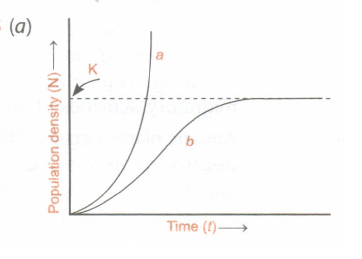
(I) When resources are limiting, the population growth curve is sigmoid and it is represented by the equation:
\(dN/dt=rN\left( \frac { K-N }{ K } \right) \), where
N = population density at time t
r = intrinsic rate of natural increase
K = carrying capacity
When resources are not limiting, the growth curve is J shaped and is represented by the equation: dN/dt = rN
\(N_{ t }={ N }_{ 0 }^{ e^{ rt } },where\)
\(N_{ t }\) =population density after time t
\(N_{ 0 }\)= population density at time zero
r = intrinsic rate of natural increase
e = the base .of natural logarithm (2.71828)

12th Standard CBSE Syllabus & Materials
12th Standard CBSE
CBSE 12th Computer Science Python Revision Tour I - New Previous year Question Papers Study Material - QB365 Set A
NEW12th Standard CBSE
CBSE 12th Business Studies Planning Important Questions And Answers Study Material - QB365 Set A
NEW12th Standard CBSE
CBSE 12th Business Studies Business Environment Important Questions And Answers Study Material - QB365 Set A
NEW12th Standard CBSE
CBSE 12th Business Studies Principles of Management Important Questions And Answers Study Material - QB365 Set A



NCERT Books

Syllabus

Exam Pattern

Sample Question Papers

Previous year Question Papers

Important Notes

MCQ Practice test

NCERT Exemplers

Case study Questions

Image Based Questions

Passage based Questions

HOT Questions

Value Based Questions

Model Questions Papers
NCERT ( Book Back ) Questions

Assertion and Reason
Important Questions And Answers

CBSE 12th Standard CBSE Subjects
CBSE Standards